 Hifz
Hifz
Relying on raw willpower instead of a structured system is precisely why most Quran memorization plans fail. When life gets busy, consistency collapses and pages fade away. A six-month timeline is completely realistic for your lifestyle, provided you replace emotional bursts with a daily operational system. You do not need absolute free time; you simply need a calculated approach that maximizes every single window of focus in your day. This guide provides a prayer-mapped routine, a strict review system, and proven retention techniques to ensure a successful six-month completion.
1. Calculate Your Daily Target and Fix It Before Day One
The six-month Hifz plan requires memorizing one Juz every six days on average, which breaks down to 3 to 4 pages of new material daily, split across multiple sessions.
The Quran contains 604 pages across 30 Juz. Over 180 days, completing the full text requires an average of approximately 3.3 new pages per day, not counting review. Before you open the Mushaf on Day One, these three numbers must be settled in writing.
Your daily page target depends on your current reading fluency. Someone who reads Arabic slowly and deliberately cannot absorb four pages of new memorization per day. Someone who reads fluently with basic Tajweed knowledge can sustain that pace. Being honest about your level at the start saves weeks of frustration later.
| Experience Level | Recommended Daily New Pages | Estimated Completion |
| Beginner (slow Arabic reader) | 2 pages | 10 months (needs extended plan) |
| Intermediate (reads fluently, basic Tajweed) | 3 to 3.5 pages | 6 months |
| Advanced (strong Tajweed, prior Hifz sections completed) | 4 to 5 pages | 4 to 5 months |
If your honest assessment places you in the beginner category, the six-month timeline requires first investing two to four weeks in reading fluency before starting the memorization clock. Students who skip this preparation consistently hit a wall at Juz 3 or 4, where the Surahs grow longer and more lexically complex.
Choose One Mushaf and Commit to It Completely
Your brain stores memorized text using visual memory. You remember the approximate position of a word on a page, the shape of the line it sits in, and the portion of white space above it. When you switch Mushafs midway, this spatial memory becomes unreliable, causing gaps that feel inexplicable. Choose one Mushaf on Day One, keep it for the entire six months, and do not open another layout for review or reference.
The Madinah Mushaf (15 lines per page) is the most widely used format globally and the one most teachers reference when guiding page-by-page progress.
Set a Non-Negotiable Daily Minimum
Thirty minutes of consistent, focused memorization every single day produces better retention than two hours four times a week. The brain forms stronger memory traces through consistent spacing than through irregular intensity. Before you begin, write down your absolute minimum: the amount of Hifz time you will protect even on your most difficult days.
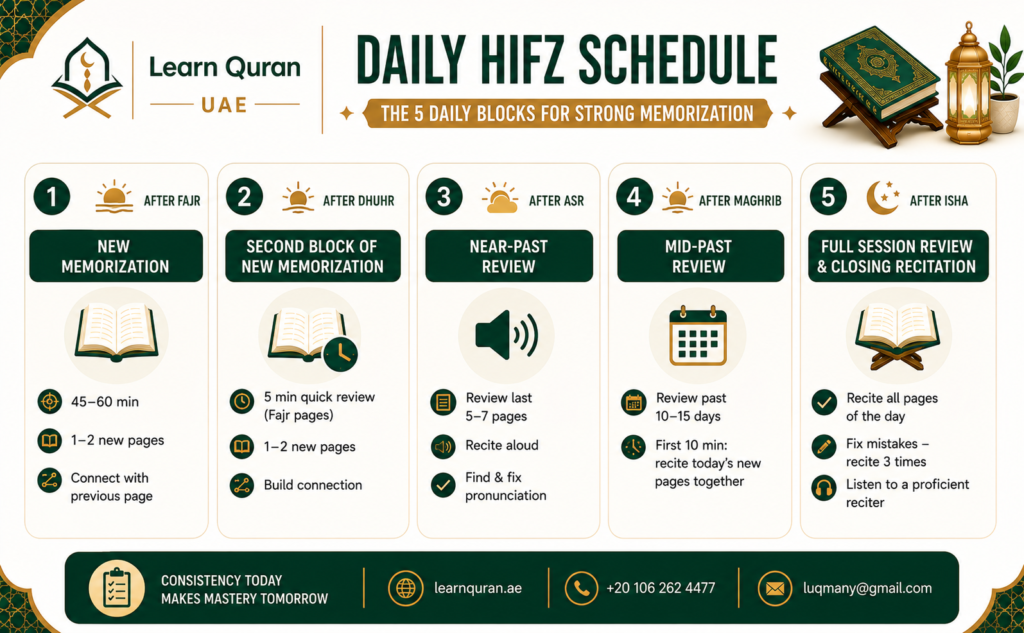
2. Structure Every Day Around the Five Prayer Times
Dividing your daily memorization across the five prayers turns worship into a built-in spaced repetition system, giving the brain five separate encoding windows instead of one overwhelming block.
This is the structural engine behind every serious six-month Hifz plan. Prayer times are not just spiritual anchors. They are natural intervals spaced throughout the day that allow the brain to rest between sessions, process what was encoded, and return fresh to new material. When you use them deliberately for Hifz, five prayers become five reinforcement sessions.
After Fajr: New Memorization
This is your primary Hifz window. The mind is rested from sleep, the environment is quiet, and the neural pathways are maximally receptive. Dedicate forty-five to sixty minutes here to your first one to two new pages. Read the target pages slowly three times with full attention before attempting memorization. Then work line by line: read a line, close the Mushaf, repeat it from memory, open and check. Once a full page is memorized, connect it to the previous page and recite both continuously.
After Dhuhr: Second Block of New Memorization
Start this session with a five-minute quick review of what you memorized at Fajr. Then move into your next one to two new pages using the same method. The brief review before new material reinforces the Fajr session and builds the connection between both sets of verses.
After Asr: Near-Past Review
This is your dedicated review session, not new memorization. Review the last five to seven pages you have memorized, reciting them aloud without looking at the Mushaf. Vocal recitation at this stage serves a specific purpose: it surfaces pronunciation errors you would never detect reading silently, and it activates a different type of memory encoding that strengthens long-term retention.
After Maghrib: Mid-Past Review
Recite everything memorized in the past ten to fifteen days. By now you are in a consistent cycle where near-past and mid-past review both receive daily attention. Spend the first ten minutes of this session reciting all new material since Fajr connected together as one continuous block.
After Isha: Full Session Review and Closing Recitation
Close the day with a complete recitation of everything memorized that day, all pages together from start to finish. If you stumble on any section, return to the Mushaf, fix the exact word, and recite that section three times before continuing. Then listen to a proficient reciter reading the same pages as your final exposure before sleep.
3. Apply the Sequential Layered Repetition Method for Every Page
Repeating individual verses before combining them cumulatively is the method that prevents the most common Hifz failure: students who memorize verses as isolated units rather than a connected passage.
Most students who want to know how to hifz Quran in 6 months make the same error. They read a full page repeatedly from start to finish until it feels familiar, then move on. This produces surface memorization that collapses within seventy-two hours. The Sequential Layered Repetition method builds memorization differently.
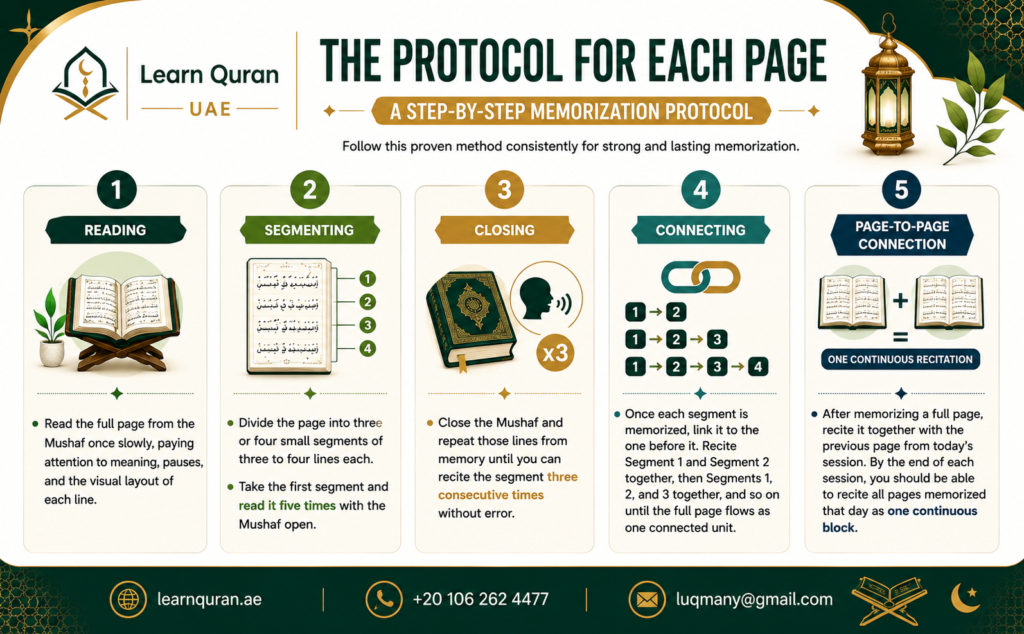
Phase 1: Reading
Read the full page from the Mushaf once slowly, paying attention to meaning, pauses, and the visual layout of each line. Do not attempt memorization during this phase. The goal is to pre-load the brain with the sound, shape, and meaning of the text before the encoding work begins.
Phase 2: Segmenting
Divide the page into three or four small segments of three to four lines each. Take the first segment and read it five times with the Mushaf open, paying close attention to the precise wording of each line.
Phase 3: Closing
Close the Mushaf and repeat those lines from memory until you can recite the segment three times consecutively without error or hesitation.
Phase 4: Connecting
Once each segment is memorized, link it to the one before it. Recite Segment 1 plus Segment 2 together, then 1 plus 2 plus 3, and so on until the full page flows as one connected unit.
Phase 5: Page-to-Page Connection
After memorizing a full page, recite it together with the previous page from that day’s session. By the end of each session, you should be able to recite all pages memorized that day as one continuous block without stopping at page boundaries.
The Prophet ﷺ emphasized the reward that comes with sustained effort in this process:
“مَثَلُ الَّذِي يَقْرَأُ الْقُرْآنَ وَهُوَ حَافِظٌ لَهُ مَعَ السَّفَرَةِ الْكِرَامِ الْبَرَرَةِ، وَمَثَلُ الَّذِي يَقْرَأُ الْقُرْآنَ وَهُوَ يَتَعَاهَدُهُ وَهُوَ عَلَيْهِ شَدِيدٌ، فَلَهُ أَجْرَانِ”
“Such a person as recites the Quran and masters it by heart will be with the noble righteous scribes. And such a person who exerts himself to learn the Quran by heart and recites it with great difficulty will have a double reward.”
The struggle itself is rewarded. The difficulty you feel in early sessions is not a signal to stop. It is the signal that real encoding is happening.
4. Build a Three-Layer Daily Review System
New memorization disappears within forty-eight hours without near-term review. A three-layer review system running simultaneously alongside new memorization is what separates completed Hifz from permanent restarts.
This is where most six-month plans fail. Students treat review as something they will do later, after they have memorized more. Memory does not work that way. Recall strength decays sharply in the first twenty-four to forty-eight hours after initial encoding, then stabilizes only if the memory is revisited. Skipping review for three consecutive days can undo an entire week of memorization work.
The three-layer system runs every day, not on separate days.
| Review Category | Definition | Daily Commitment |
| Near-Past Review | Last 5 to 7 pages memorized | Daily, non-negotiable, every single session |
| Mid-Past Review | Pages 8 to 25 behind current position | Daily, increasing gradually as Hifz accumulates |
| Far-Past Review | Everything memorized beyond 25 pages ago | Weekly rotation covering all prior material |
Weekly Revision Day
Every seventh day is a full revision day with no new memorization. On this day, recite every page memorized across the previous six days continuously from memory, ideally to a teacher or recitation partner who can identify errors in real time. This weekly reset prevents the most dangerous Hifz failure: memorizing forward while losing the pages already completed.
The monthly schedule built around this system looks like this:
| Month | Juz to Complete | Weekly Target | Key Focus |
| Month 1 | Juz 1 to 5 | Just under 1 Juz per week | Establishing the routine and review habit |
| Month 2 | Juz 6 to 10 | 1 Juz per week | Strengthening near-past review |
| Month 3 | Juz 11 to 15 | 1 Juz per week | Adding mid-past review as material accumulates |
| Month 4 | Juz 16 to 20 | 1 Juz per week | Far-past review rotations begin |
| Month 5 | Juz 21 to 25 | 1 Juz per week | Consolidation weeks when retention weakens |
| Month 6 | Juz 26 to 30 | 1 to 1.5 Juz per week | Final push with full prior material maintained |
Read also: How Long Does It Take to Memorize the Quran?
5. Use Salah as a Built-In Review System Every Day
Reciting memorized verses in the five daily prayers turns worship into five active retrieval sessions, strengthening memory traces more effectively than passive review and fulfilling the actual purpose of Hifz.
This technique appears in nearly every serious Hifz framework because it works on multiple levels simultaneously. Reciting memorized material in prayer forces recall under mild performance pressure, which is precisely the condition that strengthens long-term memory. It also builds the functional habit of using Hifz for its real purpose: worshipping Allah, not just passing a test.
How to Rotate Material Across the Five Prayers
- Fajr: Recite the newest material memorized, when your focus is sharpest and errors are easiest to detect.
- Dhuhr and Asr: Rotate pages memorized earlier in the current week.
- Maghrib and Isha: Use material memorized in the previous week, ensuring it gets retrieval practice before it fades.
This distribution gives each segment of recently memorized Quran multiple retrieval opportunities per day without requiring additional dedicated time. By the end of a week, every page from that week has been recited in prayer at least twice beyond your formal review sessions.
If you notice during prayer that your pronunciation feels uncertain or that you are filling in words from habit rather than clear memory, this is a signal that your Tajweed foundation needs attention. The Quran Reading with Tajweed Course at UAE Quran Academy builds the recitation accuracy that makes prayer recitation feel settled and confident.

Students who correct their Tajweed foundation early in the six-month plan memorize faster, because accurate pronunciation creates stronger and more distinct memory traces than imprecise recitation does.
Strengthen your Tajweed and recite every verse with confidence.
Experience a Live Quran Class
Watch a short sample from one of our online Quran classes and discover our engaging teaching style, interactive lessons, and personalized learning approach.
Start Learning Quran with Expert Tutors in the UAE
Accredited online Quran and Arabic classes tailored for adults and children. Schedule your session today.
Book Your Free Trial6. Understand the Meaning of What You Are Memorizing
Comprehension creates multiple independent memory pathways for every verse, making recall more robust and less vulnerable to pressure-induced forgetting.
When you understand what an ayah means, your brain encodes it three ways simultaneously: through its sound, through the visual image of the Arabic text, and through its conceptual meaning. Each of these is an independent retrieval route. If one weakens under pressure, the others compensate.
Students who memorize with zero understanding of meaning are using only acoustic and visual memory, which is why they often find that verses they knew perfectly yesterday become inaccessible during prayer.
This does not require becoming a Tafseer scholar. Reading a brief, trustworthy translation before each memorization session and noting the theme of the passage is sufficient to activate meaning-based memory pathways.
Allah reminds us of the purpose behind engaging with His words:
“أَفَلَا يَتَدَبَّرُونَ الْقُرْآنَ أَمْ عَلَىٰ قُلُوبٍ أَقْفَالُهَا”
Afalā yatadabbarūna al-Qurʾāna am ʿalā qulūbin aqfāluhā.
“Then do they not reflect upon the Quran, or are there locks upon their hearts?”
For students who want structured access to Quranic meanings alongside their Hifz, the Quran Tafseer Course at UAE Quran Academy provides guided understanding under qualified teacher supervision. When Hifz and comprehension are developed in parallel, they reinforce each other rather than competing for time.

Explore Quran Tafseer and deepen your understanding today.
7. Listen to Proficient Reciters Throughout Every Day
Deliberate listening to accurate recitation trains auditory memory to compensate when active recall weakens, and builds a stable internal audio template that guides pronunciation during independent recitation.
Listening is not passive activity when used deliberately for Hifz. When you play the verses you are currently memorizing during a commute, household tasks, or while preparing for sleep, your brain reinforces the same neural patterns being built during your active memorization sessions. Auditory memory and active recall memory operate differently and they reinforce each other when both are consistently engaged.
Scholars recommend reciters known for precise Tajweed, such as al-Husary and al-Minshawi, specifically because precision matters at this stage. If you internalize a slightly incorrect pronunciation or rhythm through repeated listening, it becomes embedded in your memory and extremely difficult to correct later. The audio you choose for background listening directly shapes the accuracy of what you are building.
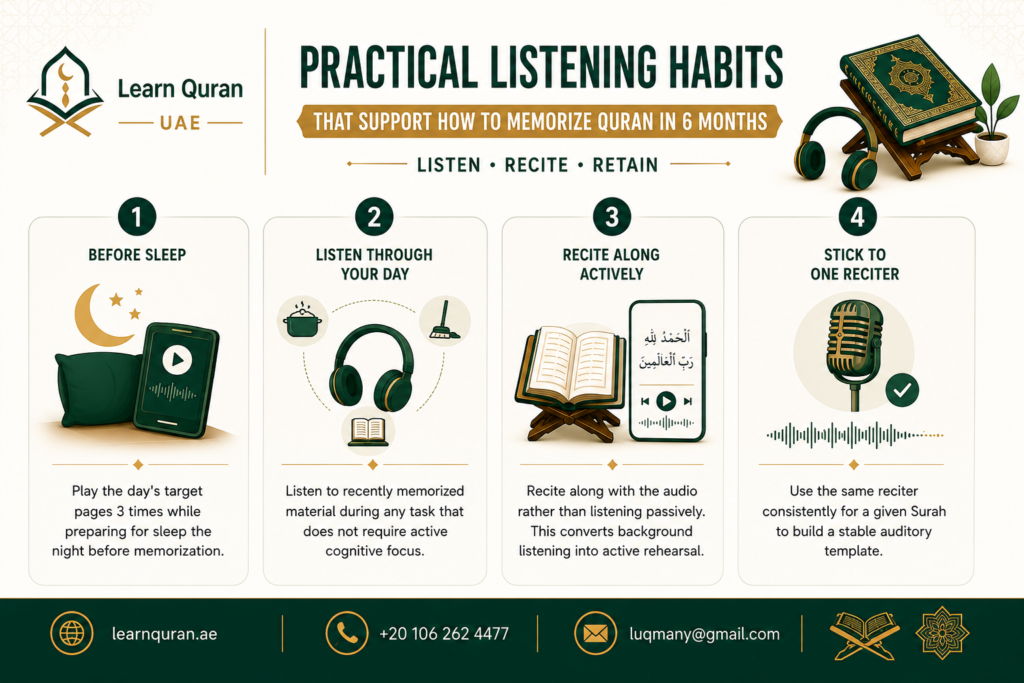
Practical listening habits that support how to memorize Quran in 6 months:
- Play the day’s target pages three times while preparing for sleep the night before memorization.
- Listen to recently memorized material during any task that does not require active cognitive focus.
- Recite along with the audio rather than listening passively. This converts background listening into active rehearsal.
- Use the same reciter consistently for a given Surah to build a stable auditory template.
8. Identify and Avoid the Six Mistakes That Break Six-Month Plans
Most six-month Hifz attempts do not fail because the goal is impossible. They fail because of identifiable, preventable structural errors made in the first two weeks.
Understanding what breaks the plan is as important as understanding what builds it. These six mistakes are consistent across nearly every unsuccessful Hifz attempt.
| Mistake | Why It Destroys the Plan |
| Skipping revision days | New memorization overwrites old material before it is consolidated |
| Changing the Mushaf mid-plan | Visual spatial memory tied to page layout is disrupted |
| Memorizing at variable times with no fixed schedule | No habitual cue means no automatic recall |
| Reciting silently without vocalization | Pronunciation errors go undetected and become permanent |
| Exceeding daily target in early weeks to “save time” | Mental fatigue causes sharp retention drops and motivation collapse by Month 2 |
| Continuing without a qualified teacher | Tajweed mistakes compound silently until they are embedded and very difficult to remove |
Beyond these structural errors, scholars across generations have consistently noted that the state of the heart affects the capacity for Hifz. Consistent sins, neglect of obligatory worship, and poor company all weaken the faculty of memorization. Sincere repentance, maintained prayer, and guarding one’s time and environment are not tangential to the six-month plan. They are part of the method.
9. Recite Daily to a Qualified Teacher for Real-Time Correction
Memorizing without a teacher means embedding Makhraj errors, Tajweed violations, and incorrect verse boundaries that become exponentially harder to correct the longer they remain in the memorized text.
The oral transmission of the Quran is not incidental. It is the defining feature of how the Quran has been preserved across fourteen centuries. Every word in the Mushaf today exists exactly as it does because of an unbroken chain of teachers and students transmitting it orally, with each student being corrected in real time.
Memorizing from recordings or text alone breaks this chain and removes the error-correction mechanism that is central to authentic Hifz.
A qualified teacher catches:
- Makhraj errors: incorrect articulation points for Arabic letters that change how words sound.
- Tajweed rule violations that may seem minor but alter the meaning of verses when made consistently.
- Incorrect verse boundaries that cause students to pause in the wrong position during recitation.
- Memorization gaps where a forgotten word is replaced unconsciously with a similar-sounding one.

None of these can be reliably self-detected, and no recording can respond to what a specific student is reciting in a specific session.
The Prophet ﷺ himself established this principle. Jibreel would review the Quran with him once each year, and in the year of his passing, they reviewed it twice. Reciting to a qualified listener is the original Sunnah method of Quranic transmission, not a modern pedagogical convenience.
“يُقَالُ لِصَاحِبِ الْقُرْآنِ يَوْمَ الْقِيَامَةِ: اقْرَأْ وَارْتَقِ وَرَتِّلْ كَمَا كُنْتَ تُرَتِّلُ فِي الدُّنْيَا، فَإِنَّ مَنْزِلَتَكَ عِنْدَ آخِرِ آيَةٍ تَقْرَأُهَا”
“One who was devoted to the Quran will be told on the Day of Resurrection: Recite and ascend. Recite carefully as you recited carefully in the world, for your rank will be at the last verse you recite.”
Your rank in Jannah is determined by the last verse you reach. That verse needs to be correct.
The six-month plan works when the right system and the right teacher are in place together.
Enroll in UAE Quran Academy’s Hifz Programs Today
Read also: How to Memorize Quran in 1 Year? – A Complete Step-by-Step Plan
10. Build a Maintenance System for After You Complete the 30 Juz
Completing memorization on Day 180 is not the finish line. Students who do not transition immediately into a structured monthly revision cycle lose significant portions within three months.
Many people who learn how to hifz Quran in 6 months focus so intensely on reaching the final pages that they have no plan for the day after. The maintenance phase requires its own structure, and building it before you need it prevents the painful experience of completing the Quran and then watching it fade.
Weekly Revision Load After Completion
- Days 1 to 6: Recite 5 Juz per day from memory, completing one full review of the entire Quran per week.
- Day 7: Full listening session, following along with a proficient reciter without looking at the Mushaf, identifying any section where your memory hesitates.
Monthly Deep Revision Cycle
- Week 1: Juz 1 to 10 with concentrated attention on historically weak sections.
- Week 2: Juz 11 to 20 with Tajweed self-audit during recitation.
- Week 3: Juz 21 to 30 with faster recitation to build fluency.
- Week 4: Full Quran from memory in a single extended session, ideally in Tahajjud or a long voluntary prayer.
This monthly cycle ensures every portion of the Quran is actively recited at least four times per month, keeping the memorization fresh across all 30 Juz without disproportionate attention to the sections memorized most recently.
See How Our Online Classes Work
Get a glimpse of a real online session and explore how students learn Quran with experienced teachers in a supportive and interactive environment.
Start Your Six-Month Hifz Journey with UAE Quran Academy
Most students who struggle with how to memorize Quran in 6 months are not lacking commitment. They are lacking structure, personalized pacing, and qualified teacher guidance. UAE Quran Academy provides every component of the six-month system described in this article through live, one-to-one online sessions with certified teachers.
For the complete Hifz journey from first verse to final page, the Quran Memorization (Hifz) Course provides a fully structured pathway with personalized daily and weekly review plans built into the curriculum from Day One.
Brothers who want a dedicated program tailored to their schedule will find the Hifz for Men Course built around their specific pace and learning style. Sisters can progress in a comfortable, fully private environment through the Hifz for Ladies Classes, with qualified female teachers managing both memorization and review simultaneously.
For children, the Hifz for Kids Classes uses an age-appropriate system that matches their natural learning capacity and keeps them engaged throughout.
Every program at UAE Quran Academy includes:
- One-to-one live sessions with a qualified, certified teacher.
- Structured daily and weekly review plans built into the curriculum from the start.
- Real-time Tajweed correction so every page memorized is accurate from Day One.
- Flexible scheduling that fits around work, school, and family commitments.
- Personalized pacing that adjusts when life interrupts without abandoning the six-month goal.
The six-month plan works when the right system and the right teacher are in place together.
Enroll in UAE Quran Academy’s Hifz Programs Today
Our Quran Memorization Courses
- Quran Memorization (Hifz) Course
- Hifz for Kids Course
- Hifz for Adults Course
- Hifz for Ladies / Sisters Course
- Hifz for Men Course
- Quran Memorization Center (UAE)
- Juz Amma Memorization Program
- Hifz Completion & Hafiz Certification
Enroll today and begin your journey toward becoming a Hafiz with expert guidance, personalized learning plans, and flexible online classes.
Start Learning Quran with Expert Tutors in the UAE
Accredited online Quran and Arabic classes tailored for adults and children. Schedule your session today.
Book Your Free TrialConclusion
Knowing how to memorize Quran in 6 months is ultimately about replacing scattered effort with a complete, layered system. The ten steps above cover every stage:
Setting a realistic daily target, structuring memorization around the five prayers, applying the Sequential Layered Repetition method, building a three-layer review system, using Salah for daily retrieval practice, understanding meaning, listening constantly to accurate recitation, avoiding the structural mistakes that collapse plans, reciting daily to a qualified teacher, and transitioning into a post-completion maintenance cycle.
The six-month timeline is demanding. It requires protecting a daily minimum, maintaining review even when adding new pages, and staying in an accountable relationship with a qualified teacher from the first session to the last. What it does not require is exceptional memory, special talent, or full-time availability.
At UAE Quran Academy, every element of this system is built into the curriculum and delivered through live, personalized online instruction available to learners anywhere.
Frequently Asked Questions
Is it realistic to complete Hifz in exactly 6 months?
Yes, for fluent readers memorizing 3-4 pages daily. Beginners need 4-8 weeks of reading prep first. Success requires protecting your daily schedule and treating cumulative review as strictly mandatory.
How many pages should I memorize per day for a 6-month plan?
The target is approximately 3.3 pages of new material per day to complete 604 pages in 180 days. Beginners should start with 2 pages and raise gradually. Advanced students can target 4 to 5 pages with full review maintained. Consistency at a lower page count always outperforms inconsistency at a higher one.
What is the best time of day to memorize Quran for a 6-month plan?
After Fajr is the strongest window for new memorization because the mind is rested, distractions are absent, and the spiritual context of having just completed Salah strengthens focus. After Asr is the best time for near-past review. The prayer-structured daily schedule spreads memorization and review across the entire day for maximum retention.
Do I need a teacher to memorize Quran in 6 months?
Yes, without exception. Self-guided memorization over a six-month period almost always produces embedded Tajweed errors that become extremely difficult to correct later. A qualified teacher provides real-time correction at every session, which is the only mechanism that catches Makhraj errors, incorrect boundaries, and substituted words before they are permanently sealed into the memorized text.
What should I do if I fall behind the schedule?
Never double the daily target to compensate for missed days. Instead, spend two days on near-past review only, then return to new memorization at your original pace for three to five days before considering any increase. The goal is to return to the system, not to make up lost time at the cost of retention quality.




Leave a Reply