 Hifz
You’ve probably heard someone called a hafiz at the mosque, at a family gathering, or during Ramadan when they led taraweeh. Maybe you’ve wondered what it really takes to earn that title. A hafiz is a Muslim who has learned the whole Quran by heart and keeps it strong. A true hafiz reviews it often, recites it correctly, and lives by what it teaches.
There’s more to the word than that, though. Arabic has a separate word for women and another for groups. Scholars also have a clear rule about who really counts as a hafiz. Someone who memorized the Quran as a child but has since forgotten much of it may not fit that rule anymore.
That’s why the title means so much. It isn’t a one-time award you earn and keep forever. It’s something a person holds on to through daily effort, often for the rest of their life.
This guide explains it all in plain words. You’ll see what the hadiths say, how a hafiz is different from a qari, and how long it takes to memorize the Quran. Whether you’re dreaming of becoming a hafiz yourself or helping your child start, you’ll know exactly what the journey involves.
What you’ll learn in this article
- What the word hafiz means and who truly counts as one.
- The words hafiz, hafiza, and huffaz.
- A simple test to check how strong your memory of the Quran is.
- What the hadiths say about the hafiz, with a link to each one.
- The difference between a hafiz and a qari.
- How long it takes to become a hafiz.
Hafiz Meaning In Islam: How Scholars Define It
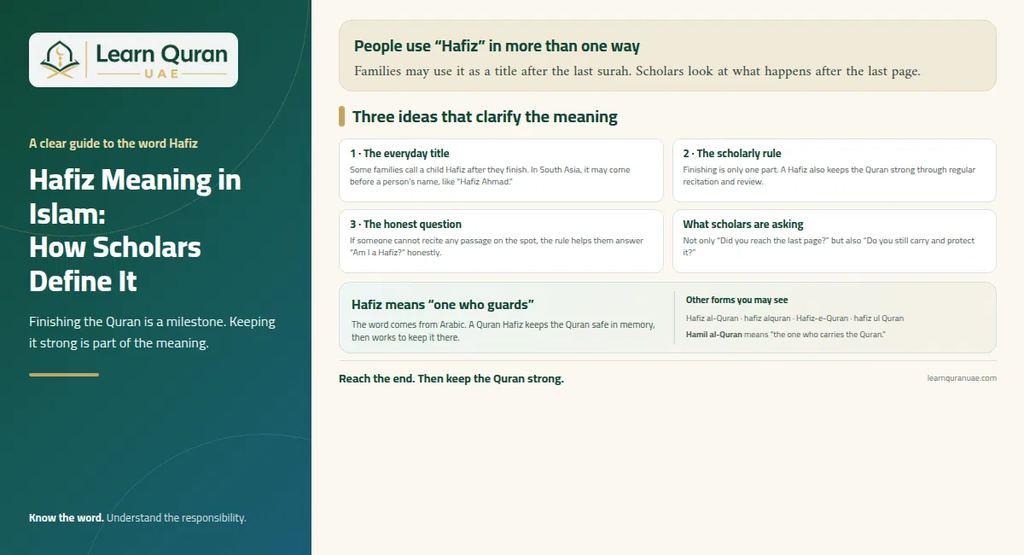
People use the word hafiz in different ways. In some families, a child is called a hafiz the day they finish their last surah.
In parts of South Asia, “Hafiz” is even placed before a person’s name as a title, like “Hafiz Ahmad.” Others use the word for anyone who has memorized a large part of the Quran.
Scholars use the word more carefully. For them, finishing is only one part of it. What matters just as much is what happens after the last page.
This difference shows up in real life. Some Quran teachers who memorized the whole Quran years ago feel unsure when someone asks, “Are you a hafiz?” They worry they could not recite any passage on the spot. Knowing the scholars’ rule helps you answer that question honestly, for yourself or for your child.
The three parts below explain what the word means, clear up a common mix-up with one of Allah’s Names, and show the rule scholars use to decide who truly counts as a hafiz.
What Does The Word Hafiz Mean In English?
The word hafiz comes from Arabic. It means “one who guards” or “one who keeps safe.” So the Quran hafiz meaning is a person who keeps the Quran safe in their memory.
You will see the word written in a few ways. Hafiz al-Quran is the Arabic form. Some people write it as one word, hafiz alquran. Hafiz-e-Quran and hafiz ul Quran are the Urdu and Persian forms.
So what is hafiz e Quran? It is the same person. The hafiz e Quran meaning in English is “a guardian of the Quran.” Every one of these names points to a Muslim hafiz who knows the whole Quran by heart.
A hafiz is also called hamil al-Quran. This means “the one who carries the Quran.” Scholars said this name fits well. Learning the Quran takes years of effort. Keeping it takes effort every day after that. It is like a load the hafiz carries for life, and carries with honor.
Is Al-Hafiz In The Quran The Same As A Person Who Memorizes It?
No. Al-Hafiz, with “Al” at the start, is one of the Names of Allah. It means the One who protects all things. A person who memorizes the Quran shares the same root word. But a person does not share the meaning of Allah’s Name.
There is still a link between them. Allah says He sent down the Quran, and He will guard it (Surah Al-Hijr 15:9). Allah keeps His Book safe in many ways.
One of those ways is human memory. For more than 1,400 years, students have learned the Quran from teachers. Each teacher learned from a teacher before them. This chain helps keep every word as it was revealed.
So when someone searches for “al hafiz Quran,” they may mean one of two things. They may mean Allah’s Name, or they may mean a person who memorized the Quran. Knowing this difference helps you read Islamic books and talks without getting confused.
When Does Someone Truly Count As A Hafiz?
Someone truly counts as a hafiz when they can recite the Quran from memory and keep it strong by reviewing it. Finishing the last page one time is only the start.
A scholar on Islamweb answered a question about this. Some students learn a new part each day and never go back to it. They finish fast, but they forget most of what they learned. The answer was clear: these students are not truly huffaz. Real memorizing needs repeating and reviewing over time.
Scholars have a phrase for someone who memorized and then forgot. They say this person “was a hafiz.” The Prophet ﷺ warned that the Quran slips away faster than a camel breaks free from its rope.
So every hafiz memorized the Quran at some point. What keeps the title is the daily work that comes after.
Hafiz, Hafiza, And Huffaz: Words For Men, Women, And Groups
Arabic words change for men, women, and groups. English articles often mix them up. Here is how to use each one correctly.
Hafiz And Hafiza: The Words For A Man And A Woman
Hafiz (حافظ) is the word for a man or boy who knows the Quran by heart. Hafiza (حافظة) is the word for a woman or girl. So a female hafiz is called a hafiza.
A hafiza has the same honor as a hafiz. The hadiths talk about “the companion of the Quran.” They do not say this is only for men. Women have memorized and taught the Quran since the time of the Companions.
Some people think women have fewer chances to memorize. Today that is not true. Many women memorize at home in short daily lessons. They fit study time around family and work.
Many women and girls also prefer a female teacher. They feel more at ease when they recite and get corrected. This small choice often helps a student stay with hifz for years instead of stopping early.
Huffaz, Hafizat, And Hafazah: The Words For Groups
Huffaz (حفاظ) is the plural most people use. It means a group of men, or a group of men and women together. If the group is only women, the word is hafizat (حافظات).
There is also a third plural: hafazah (حفظة). You will often hear it in the phrase hafazat al-Quran. It means “the people who carry the Quran in their memory.”
In English, you may see the word “hafizes.” It is not wrong in English, but it is not Arabic. When you write for Muslim readers, huffaz sounds more natural.
Here is an easy way to remember all of this. One man is a hafiz. One woman is a hafiza. A mixed group or a group of men is huffaz. A group of only women is hafizat. If you hear hafazah, it means the same as huffaz.
A quick look at learning with us
See how a live class works, from the teacher’s explanation to the student’s recitation. It’s a simple way to know what to expect before your first lesson.
Read also: What Is Hifz? Meaning of Hifdh in Islam
Hadith About Hafiz E Quran: Four Virtues And Their Limits
The Prophet ﷺ spoke about the hafiz in several hadiths. In Urdu, these virtues are often called hafiz Quran ki fazilat. They describe rewards a person can hope for from Allah. They depend on a good intention and good actions. They are not prizes that come with a title.
The Hafiz Rises In Paradise By What They Memorized
The Prophet ﷺ said the companion of the Quran will be told: “Read and rise in status, and recite as you used to recite in the world. Your place will be at the last verse you recite.” This hadith is in Sunan al-Tirmidhi 2914 and Sunan Abi Dawud 1464.
Scholars said this hadith is about memory. Anyone can read from a page. But people hold different amounts of the Quran in their hearts. So a person’s place in Paradise may rise with what they memorized and recited, by Allah’s mercy.
This gives hope to more people than you might think. It is for the full hafiz. It is also for someone who knows only a few surahs. Each verse you learn and keep is one more step. You do not need to finish the whole Quran before this hadith speaks to you.
The Hafiz Is With The Angels, And Slow Learners Get Two Rewards
The Prophet ﷺ said that the one who reads the Quran and memorizes it is with the noble, righteous scribes. These scribes are angels. He also said that the one who reads it with difficulty gets two rewards (Sahih al-Bukhari 4937).
The second part matters for every learner. Maybe you are an adult who stumbles over words. Maybe one verse takes you a whole week. That is not failure. The Prophet ﷺ said hard effort earns a double reward, as the IslamHouse fatwa on memorizing the Quran also explains.
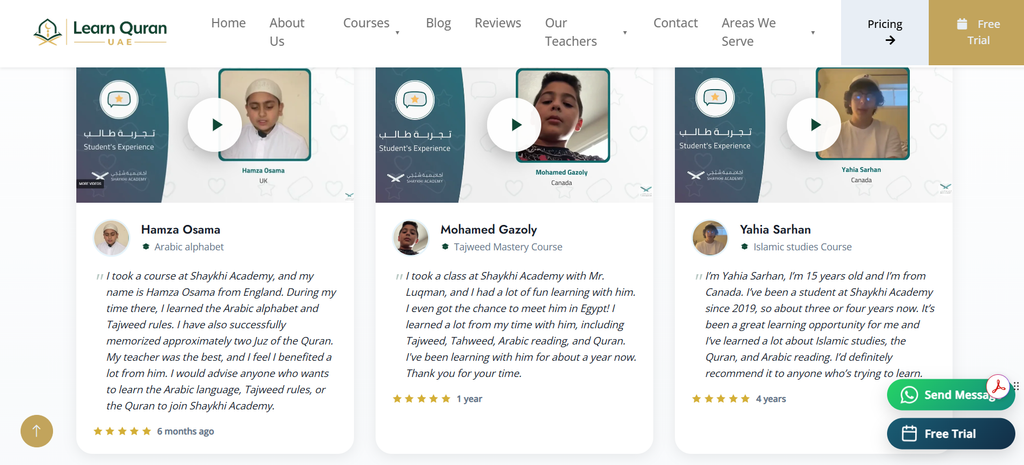
Having a perfect online session is what we provide for UAE Quran Academy’s students. Have a look at what the students saying about their learning journey.
Start Learning Quran with Expert Tutors in the UAE
Accredited online Quran and Arabic classes tailored for adults and children. Schedule your session today.
Book Your Free TrialThe Quran Speaks Up For Its Companions And Asks Allah To Honor Them
The Prophet ﷺ said:
“Read the Quran, for it will come on the Day of Judgment to speak up for its companions” (Sahih Muslim 804). The Arabic word for this is shafi’, which means one who asks Allah to help someone.
Who are the “companions” of the Quran? Scholars say they are people who stayed close to it. They recited it, and they followed what it says. IslamQA also notes that the Quran will speak against people who ignored its rules. So this hadith is a hope for those who lived by it, not just those who memorized words.
Another hadith shows more honor. The Quran asks Allah to reward its companion. He is given a crown of honor, then a robe of honor. Then Allah is pleased with him, and he gains a reward for every verse. This hadith is in Sunan al-Tirmidhi 2915, as IslamQA explains.
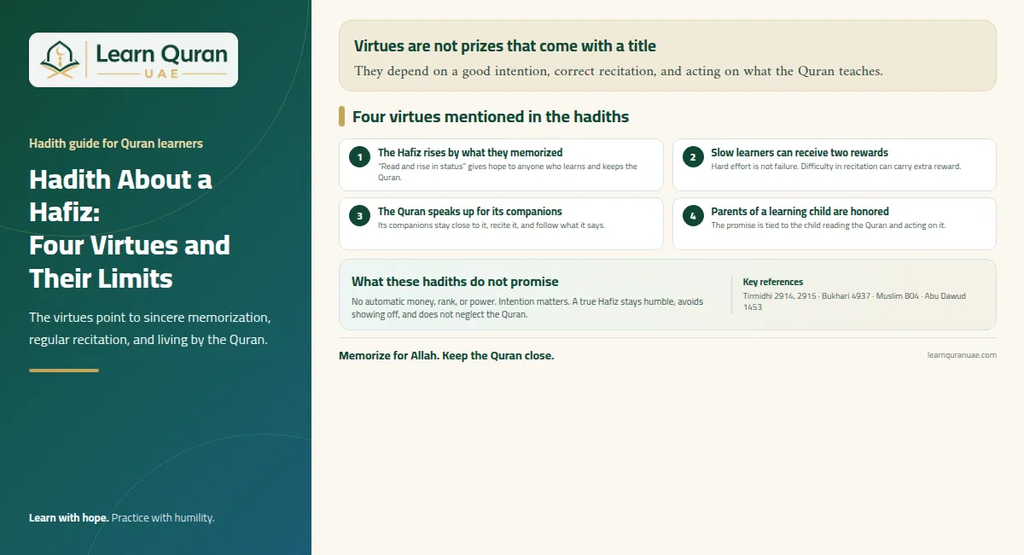
Parents Of A Child Who Learns The Quran Will Be Honored
The Prophet ﷺ said that whoever reads the Quran and acts on it, his parents will be given a crown on the Day of Judgment. Its light will be brighter than sunlight (Sunan Abi Dawud 1453).
Other reports add more detail. They say the parents will wear two robes worth more than the whole world. When the parents ask why, they are told it is because their child learned the Quran. These reports are in the books of at-Tabarani and al-Hakim.
Hadith scholars study how strong each report’s chain of narrators is. Shaykh al-Albani said these reports support each other when you take them together.
Look at the condition in the hadith, though. The child reads the Quran and acts on it. This gives parents a strong reason to help their children learn. It holds even if the parents never memorized the Quran themselves.
No Hadith Promises A Hafiz Money, Rank, Or Power
None of these hadiths promise that a hafiz gets money, rank, or power in this world. The Prophet ﷺ did say that the person who knows the most Quran should lead the prayer, a hadith in Sahih Muslim 673 that IslamQA explains.
But this is a rule about who leads salah. It does not make a hafiz better than others in every part of life.
The Prophet ﷺ also described the kind of hafiz who should be honored. It is one who does not go too far with the Quran and does not neglect it, as reported in Sunan Abi Dawud 4843. Going too far can mean showing off while reciting. Neglect can mean leaving the Quran and forgetting it.
Intention matters too. Shaykh al-Albani said the reward of “read and rise” is for someone who memorized for Allah. It is not for someone who did it for money or fame. A good hafiz stays humble and keeps their eyes on the next life.
Benefits Of Being A Hafiz In Daily Life
The hafiz Quran benefits are not only for the next life. Teachers see real changes in their students’ everyday lives.
A hafiz can recite long passages in their own prayers. Salah feels fuller and less rushed. Daily review also builds a steady habit, so the Quran is part of every day, not only Ramadan.
Reciting to a teacher again and again also improves how you say each letter. Over time, your recitation gets clearer and more correct.
There is also a benefit for the whole Ummah. Scholars say memorizing the Quran is a shared duty. Enough Muslims must do it so the duty is met for everyone. Scholars call this fard kifayah, and each new hafiz helps carry it.
Hafiz Vs Qari: What Is The Difference?
The difference between a qari and a hafiz is simple. A hafiz recites the Quran from memory. A qari recites it correctly with tajweed, the rules for saying each letter, either from memory or from the Mushaf.
| Hafiz | Qari | |
| Main skill | Knows the whole Quran by heart | Recites with correct tajweed |
| Reads from | Memory | Memory or the Mushaf |
| Must keep doing | Review often so nothing is lost | Keep tajweed exact and clear |
| Can be both? | Yes | Yes |
A hafiz may have average tajweed. A qari may not know the whole Quran by heart. The best students work on both, which is why correct recitation is part of how this article defines a hafiz.
How Long Does It Take To Become A Hafiz?
The standard Madinah Mushaf has 604 pages. Each page has 15 lines, and each juz is about 20 pages. The table below divides those 604 pages by common daily amounts.
| Learner type | New amount each day | Days per week | About how long |
| Young child (about 5 to 9) | 5 lines (1/3 page) | 6 | 5.5 to 6 years |
| Busy working adult | 4 lines (1/4 page) | 5 | About 9 years |
| Working adult with a steady routine | Half a page | 5 | About 4.5 years |
| Older child or teen | Half a page | 6 | About 4 years |
| Committed adult or student | 1 page | 6 | About 2 years |
| Full-time student | 2 pages | 6 | About 1 year |
A clear plan helps you keep your pace. The Quran Memorization (Hifz) Course at UAE Quran Academy builds each plan around the daily amount that fits your life. Every one-on-one class mixes new pages, daily review, and live correction, so you keep what you learn as you move forward.
How To Keep Your Memorization Strong After You Finish
Finishing the last page is a big moment. But as you read earlier, scholars say a true hafiz keeps the Quran, not just reaches the end once. Follow these six steps to check your memory and stop it from fading.
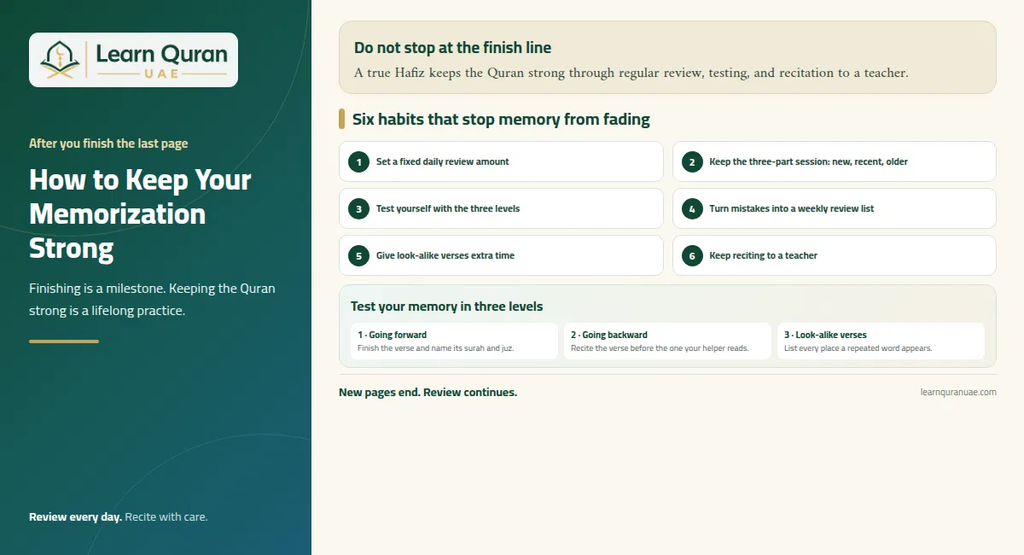
Set a fixed daily review amount. Pick an amount you can read from memory every day, and keep it even on busy days. Many huffaz keep a daily amount for life, so every part of the Quran comes back on a regular cycle.
Split each session into three parts while you are still memorizing. Learn today’s new page first. Next, go over the pages from the last few days. Then review an older part from weeks ago. Once you finish the whole Quran, the new-page part drops away, and all your time goes to review.
Test yourself with the three levels. Ask a friend or family member to hold a Mushaf and quiz you. Quran teachers described these levels in a discussion among Quran scholars. Start at level one and move up.
| Level | What your helper does | What you do | What it shows |
| 1. Going forward | Reads the start of a verse | Finish the verse and name its surah and juz | You know the Quran well enough to move through it |
| 2. Going backward | Reads a verse or says one word | Recite the verse before it, or the start of the word’s verse | Your memory is exact (a mutqin) |
| 3. Look-alike verses | Says a word that repeats in the Quran | List every verse where it appears | You can tell similar verses apart |
Turn your mistakes into a weekly review list. Have your helper open the Mushaf to random pages. Write down every verse you miss or mix up. Review those verses every day that week, then test them again.
Give look-alike verses extra time. Verses that differ by one word are the easiest to mix up. For example, after the word “bihi,” some verses end with “alima,” some with “khabira,” and some with “basira.” Group these verses side by side and review them together.
Keep reciting to a teacher. A teacher hears small mistakes you don’t notice, and a mistake that isn’t fixed early gets stuck in your memory. That is why even experienced huffaz keep reading to a teacher.
The most common reason memory fades is skipping steps 1 and 2. Students keep adding new pages but stop reviewing old ones. It feels fine at first, but after a few months, even level one gets hard.
What happens in a UAE Quran Academy class?
This short sample shows you a real lesson in action, with clear explanations, live practice, and gentle correction from the teacher.
Start Learning Quran with Expert Tutors in the UAE
Accredited online Quran and Arabic classes tailored for adults and children. Schedule your session today.
Book Your Free TrialStart Memorizing The Quran With UAE Quran Academy Today
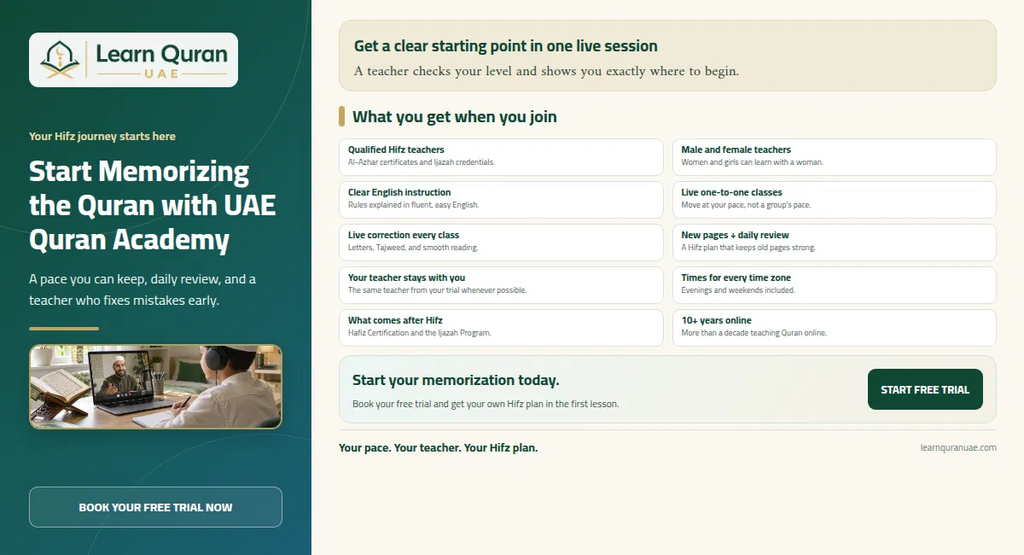
A strong hifz needs three things: a pace you can keep, daily review, and a teacher who fixes mistakes early. UAE Quran Academy gives you all three. Here is what you get when you join:
- Teachers with Al-Azhar certificates and an Ijazah, a license to teach the Quran passed down through a chain of teachers
- Male and female teachers, so women and girls can learn with a woman
- Teachers who explain every rule in clear, fluent English
- Live one-on-one classes that move at your pace, not a group’s pace
- Live correction in every class for letters, tajweed, and smooth reading
- A hifz plan that mixes new pages with daily review
- The same teacher from your free trial for your whole program whenever possible
- Class times that fit any time zone, including evenings and weekends
- A clear next step after hifz, with Hafiz Certification and the Ijazah Program
- More than 10 years of experience teaching the Quran online
Book your free trial now. In one live session, a teacher will check your level and show you exactly where to start.
Our Quran Memorization Courses
Browse our Quran memorization courses, and choose the best course that suits you.
- Quran Memorization (Hifz) Course
- Hifz for Kids Course
- Hifz for Adults Course
- Hifz for Ladies / Sisters Course
- Hifz for Men Course
- Quran Memorization Center (UAE)
- Juz Amma Memorization Program
- Hifz Completion & Hafiz Certification
Conclusion
Being a hafiz is about more than finishing the last page. It means holding the Quran in your heart for life. You review it, you say it correctly, and you let it shape how you live.
The words around it are easy to learn. A man is a hafiz, a woman is a hafiza, and a group is huffaz. Names like hafiz-e-Quran and hafiz ul Quran all describe the same person. Al-Hafiz, the Name of Allah, is different and belongs to Him alone.
The hadiths give real hope to every learner. They speak of a higher place in Paradise for what you memorized. They speak of being with the noble angels.
They promise a double reward for the student who struggles. They tell of the Quran speaking up for those who followed it, and of parents honored for their child’s effort.
Those same hadiths also set limits. They do not promise worldly power or status. They ask for a clean intention, humility, and a life that follows the Quran’s guidance. A hafiz who memorized for fame misses the point the hadiths make.
If you want to start, keep three things in mind. Pick a daily amount you can keep for years, even if it is small. Give review a place in every single lesson. And test yourself often with the three levels, so you know where your memory is weak.
FAQs
People often ask the same few questions when they first learn about the hafiz and hifz. Here are short, clear answers to the ones we hear most.
What Is The Meaning Of Hafiz?
To define hafiz simply, it means “one who guards” in Arabic. In Islam, it is a person who knows the whole Quran by heart and keeps it through review.
What Is A Female Hafiz Called?
A female hafiz is called a hafiza. She has the same honor as a male hafiz, and a group of women hafizas are called hafizat.
Is Hafiz E Quran The Same As Hafiz Al Quran?
Yes. Hafiz-e-Quran is the Urdu and Persian way to say it, and hafiz al-Quran is the Arabic way. Both mean someone who knows the Quran by heart.
What Is The Best-Known Hadith About Hafiz E Quran?
The best-known hadith about hafiz e Quran is the “read and rise” hadith. It says a person’s place in Paradise is at the last verse they recite (Sunan al-Tirmidhi 2914).
Can An Adult Become A Hafiz?
Yes. Adults can memorize at any age, often at half a page a day or less. The Prophet ﷺ promised two rewards to those who find it hard (Sahih al-Bukhari 4937).
What Should A Hafiz Do If They Start Forgetting?
A hafiz who starts forgetting should add daily review right away, before learning anything new. Going back over weak surahs with a teacher is the fastest way to make them strong again.




Leave a Reply