 Hifz
Hifz
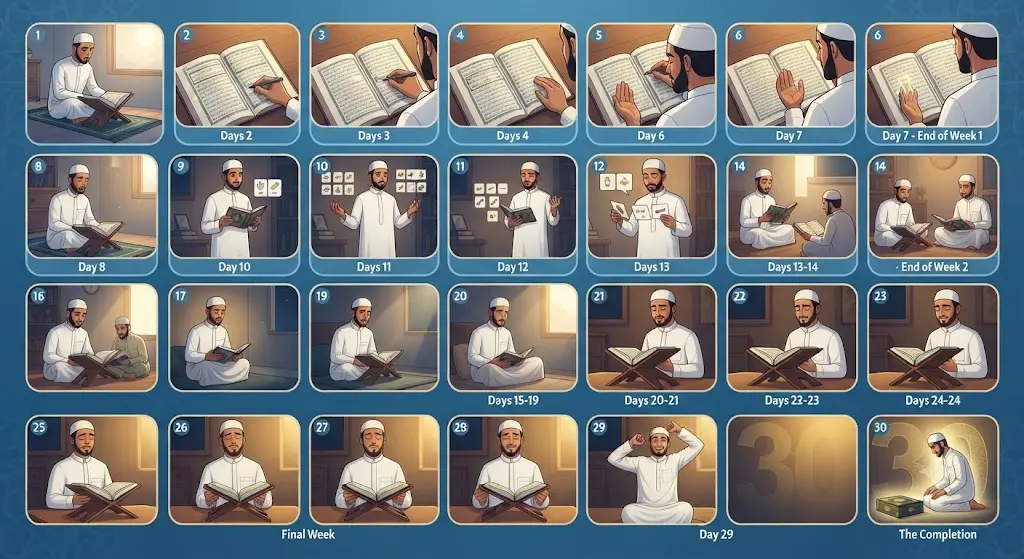
Ever started memorizing the Quran, only to quit because of a packed schedule or the frustration of forgetting yesterday’s pages? It is easy to feel guilty watching months slip away, thinking you need years of isolation just to finish, or fearing your memory isn’t sharp enough to hold Allah’s words long-term.
But learning how to memorize Quran in 1 month is not a myth. Since the Quran has 30 Juz, mastering one Juz a day is all it takes. This guide explains exactly how to memorize Quran in 30 days with a practical schedule, mistakes to avoid, and proven strategies to lock in your Hifz forever.
1- Set Your Daily Memorization Target Before Day One
Every serious memorization plan begins before you open the Mushaf. The Quran contains 30 Juz, and each Juz contains 20 pages. To memorize Quran in 30 days, your daily target is one complete Juz — 20 pages — divided across the five daily prayers.
That breaks down to 4 pages after every Salah: Fajr, Dhuhr, Asr, Maghrib, and Isha. This structure keeps the workload manageable and ties your memorization rhythm to worship, which is exactly the right context for this kind of commitment.
Before Day One, settle three things:
- Choose one Mushaf and commit to it for the entire 30 days. Your brain stores the visual position of every verse on every page. Switching Mushafs mid-journey disrupts this and weakens recall.
- Set a fixed time for each session. Memorization performed at random hours does not build a habit. It builds inconsistency.
- Identify a qualified teacher or recitation partner to whom you will recite daily. Memorizing without correction means you may be locking in mistakes permanently.
If you are currently struggling to read fluently before beginning Hifz, the Quran Reading Course at UAE Quran Academy gives you the accurate reading foundation that memorization absolutely depends on.

Enroll today and build the skills that will carry your Hifz from the first page to the last.
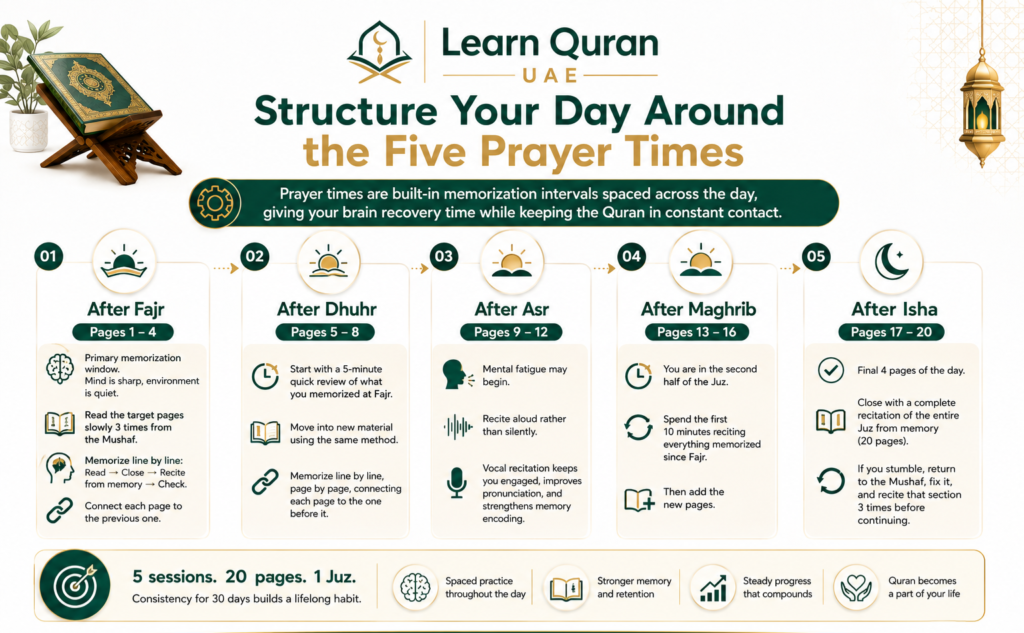
2- Structure Your Day Around the Five Prayer Times
This is the operational engine of your 30-day plan. Prayer times are not just spiritual anchors; they are built-in memorization intervals spaced across the entire day, giving your brain recovery time between sessions while keeping the Quran in constant contact with your memory.
After Fajr
This is your primary memorization window. The mind is at its sharpest after Fajr, the environment is quiet, and there are no demands from the day yet. Dedicate 45 to 60 minutes here to your first 4 pages.
Read the target pages slowly from the Mushaf 3 times with full attention. Then begin memorizing line by line: read a line, close the Mushaf, repeat it from memory, open and check. Once a full page is memorized, connect it to the previous page and recite both together.
After Dhuhr
This session covers your second 4 pages. Begin with a 5-minute quick review of what you memorized at Fajr, then move into new material using the same method: line by line, page by page, connecting each page to the one before it.
After Asr
Third session, pages 9 through 12. At this point in the day, mental fatigue may begin. Counter it by reciting aloud rather than silently. Vocal recitation keeps you engaged, surfaces pronunciation errors, and activates a different type of memory encoding than silent reading.
After Maghrib
Pages 13 through 16. By now you are in the second half of the Juz. Spend the first 10 minutes of this session reciting everything memorized since Fajr, then add the new pages.
After Isha
Final 4 pages of the day. This session closes with a complete recitation of the entire Juz from memory — all 20 pages, start to finish. If you stumble on any section, return to the Mushaf, fix it, and recite that section again three times before continuing.
3- Apply the Line-by-Line Repetition Method for Each Page
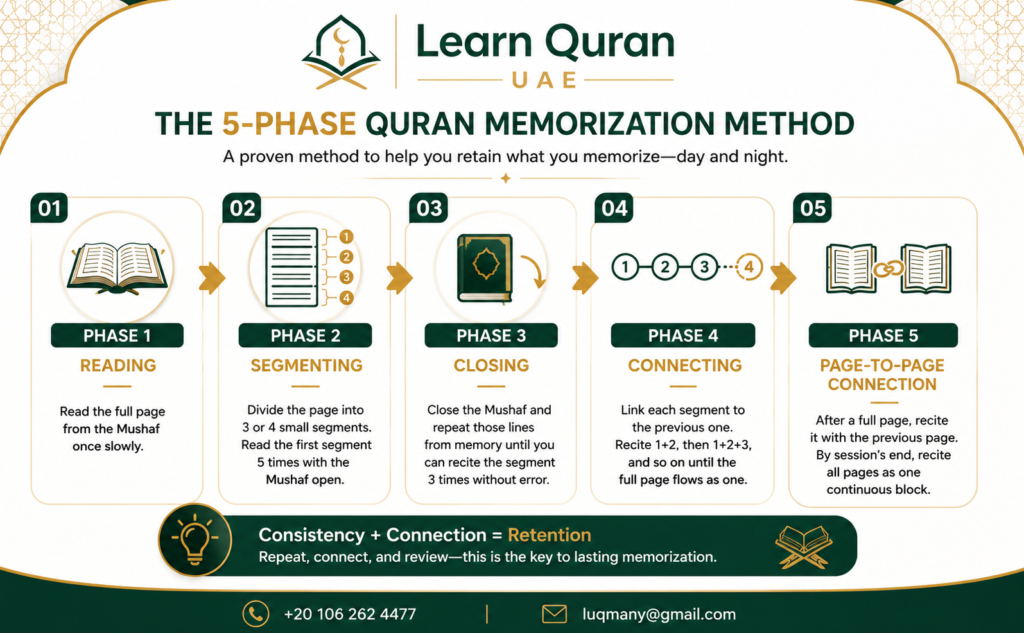
The memorization method you use inside each session determines whether what you learn stays or disappears overnight. The most reliable method, supported consistently by memorization scholars, works as follows:
Phase 1: Reading: Read the full page from the Mushaf once slowly, paying attention to meaning, pauses, and the visual layout of each line.
Phase 2: Segmenting: Divide the page into 3 or 4 small segments. Take the first segment (typically 3 to 4 lines) and read it 5 times with the Mushaf open.
Phase 3: Closing: Close the Mushaf and repeat those lines from memory. Do this until you can recite the segment 3 times consecutively without error.
Phase 4: Connecting: Once each segment is memorized, link it to the one before it. Recite Segment 1 + Segment 2 together, then 1 + 2 + 3, and so on until the full page flows as one connected unit.
Phase 5: Page-to-Page connection: After memorizing a full page, recite it together with the previous page from today’s session. By the end of each session, you should be able to recite all pages memorized that day as one continuous block.
The Prophet ﷺ emphasized the discipline this demands:
“مَثَلُ الَّذِي يَقْرَأُ الْقُرْآنَ وَهْوَ حَافِظٌ لَهُ مَعَ السَّفَرَةِ الْكِرَامِ الْبَرَرَةِ، وَمَثَلُ الَّذِي يَقْرَأُ الْقُرْآنَ وَهْوَ يَتَعَاهَدُهُ وَهْوَ عَلَيْهِ شَدِيدٌ، فَلَهُ أَجْرَانِ”
“Such a person as recites the Qur’an and masters it by heart, will be with the noble righteous scribes (in Heaven). And such a person exerts himself to learn the Qur’an by heart, and recites it with great difficulty, will have a double reward.”
The struggle itself carries reward. Do not be discouraged by difficulty in early sessions.
4- Dedicate Day 7 Entirely to Revision, Not New Memorization
This is the weekly reset that prevents the most common Hifz failure: memorizing forward while losing what was already learned. Every seventh day in your 30-day plan is a full revision day with zero new material.
On revision day, recite every page memorized across the previous 6 days — all 120 pages of the six Juz covered that week — ideally to a teacher or recitation partner who can correct errors in real time.
The revision structure for each week looks like this:
| Week | Days of New Memorization | Revision Day | Total Juz Covered |
| Week 1 | Days 1-6 | Day 7 | Juz 1-6 |
| Week 2 | Days 8-13 | Day 14 | Juz 7-12 |
| Week 3 | Days 15-20 | Day 21 | Juz 13-18 |
| Week 4 | Days 22-27 | Day 28 | Juz 19-24 |
| Final Days | Days 29-30 | — | Juz 25-30 |
The final two days cover the remaining 6 Juz with heavier daily targets. If your reading is very fluent and your retention is strong, you can extend the revision window by finishing the 30 Juz a day or two early and using the remaining time for full-Quran recitation from memory.
Consistent revision is itself an act of worship. Allah says:
“إِنَّا نَحْنُ نَزَّلْنَا الذِّكْرَ وَإِنَّا لَهُ لَحَافِظُونَ”
“Inna nahnu nazzalnadh-dhikra wa inna lahu lahafizoon.”
“Indeed, it is We who sent down the Quran and indeed, We will be its guardian.”
You memorize it; Allah preserves it through the community of those who carry it in their hearts.
For women who want structured guidance through every Juz, the Hifz for Ladies Classes at UAE Quran Academy provide one-on-one online sessions with qualified female teachers who track your memorization and revision simultaneously.

Content us now and begin your journey with daily accountability built in from Day One.
Read also: Easy Surahs to Memorize
Experience a Live Quran Class
Watch a short sample from one of our online Quran classes and discover our engaging teaching style, interactive lessons, and personalized learning approach.
Start Learning Quran with Expert Tutors in the UAE
Accredited online Quran and Arabic classes tailored for adults and children. Schedule your session today.
Book Your Free Trial5- Recite Daily to a Qualified Teacher for Error Correction
Memorizing silently and alone is the fastest way to cement mistakes. The Arabic language contains sounds, tajweed rules, and letter distinctions that the untrained ear cannot self-audit reliably. A student who has been reciting an incorrect pronunciation for two weeks has memorized that mistake, and unlearning it is harder than learning correctly from the start.
The daily recitation session with a teacher serves three purposes:
- Pronunciation correction in real time before errors become habit
- Pacing accountability so you do not fall behind the daily target
- Motivation continuity through external commitment that is harder to abandon than private resolve
The Prophet ﷺ himself set this standard. Jibreel would review the Quran with the Prophet ﷺ once every year, and in the year of his passing, they reviewed it twice. The principle of reciting to a qualified listener is not a modern pedagogical invention; it is the original Sunnah method of Quranic transmission.
“يُقَالُ لِصَاحِبِ القُرْآنِ يَوْمَ القِيَامَةِ: اقْرَأْ وَارْتَقِ وَرَتِّلْ كَمَا كُنْتَ تُرَتِّلُ فِي الدُّنْيَا، فَإِنَّ مَنْزِلَتَكَ عِنْدَ آخِرِ آيَةٍ تَقْرَأُهَا”
“One who was devoted to the Qur’an will be told to recite, ascend and recite carefully as he recited carefully when he was in the world, for he will reach his abode when he comes to the last verse he recites.”
Your rank in Jannah is determined by the last verse you reach. That verse needs to be correct.
6- Eliminate the Six Mistakes That Break 30-Day Plans
Most people who attempt to memorize Quran in 1 month do not fail because the goal is impossible. They fail because of identifiable, preventable errors. Knowing them before you start saves the entire journey.
| Mistake | Why It Destroys Hifz |
| Skipping revision days | New memorization overwrites old material without periodic consolidation |
| Changing the Mushaf mid-plan | Visual memory tied to page layout is disrupted |
| Memorizing at variable times | No habitual cue means no automatic recall |
| Reciting silently without vocalization | Errors go undetected; pronunciation habits are not built |
| Overloading pages in early days to “save time” | Mental exhaustion causes sharp retention drops by Week 2 |
| Continuing without a teacher | Mistakes compound silently until they are embedded |
Beyond these structural mistakes, the sources are consistent on one deeper point: the state of the heart affects the capacity for memorization. Scholars across generations have noted that consistent sins harden the heart and weaken the faculty of memorization. Sincere repentance, maintained prayer, and keeping good company are not tangential to Hifz — they are part of the method.
For adults who want to take on this challenge regardless of age or previous Hifz experience, the Hifz for Adults Classes at UAE Quran Academy offer a realistic, flexible path to complete memorization without disrupting work or family responsibilities.

7- Build a Monthly Revision System After Completing the 30 Days
Completing memorization on Day 30 is not the finish line. It is the beginning of the maintenance phase, which requires its own structure. Many people who complete Hifz in a short period lose significant portions within months because they do not transition immediately into a systematic revision routine.
A practical monthly revision framework after completing the 30-day plan:
Weekly revision load:
- Days 1-6: Recite 5 Juz per day from memory (one full review of the complete Quran per week)
- Day 7: Full listening session — follow along with a proficient reciter without looking at the Mushaf
Monthly deep revision:
- Week 1: Juz 1-10 with focused attention on historically weak sections
- Week 2: Juz 11-20 with Tajweed self-audit
- Week 3: Juz 21-30 with fast recitation to build fluency
- Week 4: Full Quran from memory, timed, ideally in Salah (night prayer)
The monthly revision cycle ensures that every part of the Quran is actively recited at least four times per month, which keeps the memorization fresh across all 30 Juz without disproportionate attention to the Juz memorized most recently.
For men who want to continue their memorization journey with structured guidance, the Quran Classes For Men at UAE Quran Academy provides a personalized memorization and revision plan built around your schedule.

Enroll now and start covering Juz under qualified supervision today.
Read also: How to Memorize Quran Fast? 10 Proven Steps
See How Our Online Classes Work
Get a glimpse of a real online session and explore how students learn Quran with experienced teachers in a supportive and interactive environment.
Start Your Hifz Journey with UAE Quran Academy
Every person reading this article has already taken the first step: the intention. What separates those who memorize from those who plan to memorize is a structured environment with qualified teachers and daily accountability.
UAE Quran Academy offers online Hifz programs designed for every learner:
- Quran Memorization (Hifz) Course: structured Juz-by-Juz memorization with qualified teachers
- Hifz for Men Course: personalized for brothers with focused one-on-one sessions
- Hifz for Ladies Classes: female teachers, private environment, flexible timing
- Hifz for Adults Classes: built for real-life schedules, no prior memorization experience required
- Quran Classes for Kids: step-by-step foundational learning tailored for young minds with child-friendly scheduling
All programs are delivered online, available from anywhere in the UAE and beyond, with certified teachers who correct your Tajweed, track your progress, and keep you on target every single day.
Book your free trial session today at UAE Quran Academy and begin Day One of your 30-day plan with a qualified teacher beside you.
Our Quran Memorization Courses
- Quran Memorization (Hifz) Course
- Hifz for Kids Course
- Hifz for Adults Course
- Hifz for Ladies / Sisters Course
- Hifz for Men Course
- Quran Memorization Center (UAE)
- Juz Amma Memorization Program
- Hifz Completion & Hafiz Certification
Enroll today and begin your journey toward becoming a Hafiz with expert guidance, personalized learning plans, and flexible online classes.
Start Learning Quran with Expert Tutors in the UAE
Accredited online Quran and Arabic classes tailored for adults and children. Schedule your session today.
Book Your Free TrialConclusion
Learning how to memorize Quran in 30 days is a commitment that demands structure, sincerity, and consistent effort — but it is well within reach for anyone willing to organize their day around the five prayer times and protect their memorization with daily revision.
The plan is simple: one Juz per day, four pages after each prayer, weekly revision on Day 7, daily recitation to a teacher, and a single fixed Mushaf throughout. What makes the difference is not talent or even time — it is consistency and accountability.
Surround yourself with the right guidance, correct your Tajweed from the start, and let the Quran become the organizing principle of your month.
FAQ
Can you really memorize the entire Quran in 30 days?
Yes, it is achievable for learners with strong reading fluency who commit to memorizing one complete Juz daily and maintain consistent revision. The 30-day timeframe requires roughly 4 to 6 hours of active memorization and review each day, split across the five prayer times.
What is the best time of day to memorize Quran?
The period after Fajr prayer is widely considered the most effective memorization window. The mind is rested, the environment is quiet, and the spiritual context of having just completed Salah strengthens focus and retention. Night sessions after Isha are the second most productive window.
How many pages of Quran should I memorize per day for a 30-day plan?
You need to memorize 20 pages per day, which equals one complete Juz. This is most effectively divided into four 4-page sessions, each following one of the five daily prayers, with the fifth prayer used for daily full-Juz review.
Do I need a teacher to memorize Quran in 30 days?
Yes. Self-guided memorization almost always results in Tajweed errors that become embedded over time. A qualified teacher corrects pronunciation mistakes in real time, tracks your progress, and provides the accountability that makes the daily schedule sustainable.
What should I do after completing 30-day Quran memorization?
Immediately transition into a structured monthly revision cycle. A practical approach is to review 5 Juz per day across six days each week, ensuring the full Quran is covered once weekly. Without a consistent post-completion revision plan, significant portions of memorized material are typically lost within the first three months.



Leave a Reply