 Hifz
Hifz
Most people who start memorizing the Quran don’t quit because they lack discipline. They quit because they never had a real plan — just a vague goal to “memorize more” with no daily target, no revision system, and no way to see progress.
A Quran memorization planner and tracker solves that problem. It turns an overwhelming goal — 604 pages, 6,236 verses, 30 Juz — into a daily number you can actually hit, and a weekly record that shows whether what you memorized is actually staying with you.
This guide covers everything someone searching for a Quran memorization planner and tracker actually needs: what it is, how to build one, which timetable fits your pace, how many verses to memorize daily, a ready-to-use tracker template, the tools worth using, and how to fix a schedule that’s fallen apart.
What Is a Quran Memorization Planner and Tracker?
A Quran memorization planner is a written schedule that breaks the Quran into daily or weekly memorization targets. A Quran memorization tracker is the record you keep alongside it — a log of what you memorized, what you reviewed, and how well you retained it.
The two work together. The planner tells you what to do today. The tracker tells you whether yesterday’s work actually stuck. Without the tracker, a planner is just a wish list — you can follow the schedule on paper while quietly losing pages you memorized weeks ago.
The Quran contains 114 surahs, 6,236 verses, and 604 pages. Left undivided, that number feels impossible. A planner makes it concrete — five verses today, revision of yesterday’s portion tomorrow, one Juz reviewed every two weeks — and enforces spaced repetition automatically, without relying on you to remember when review is due.
A common rule among Hifz instructors is that at least 30% of your schedule should be allocated to revision, not new memorization. Students who ignore this ratio tend to reach the final third of the Quran having already forgotten the first third.
If you’re building your first schedule, it often helps to have someone experienced set that revision ratio for you rather than guessing. Structured Hifz classes build this balance into the course itself, so you’re not designing the system and following it at the same time.
How Do You Create a Quran Memorization Plan?
Creating a Quran memorization plan starts with choosing a realistic memorization pace, dividing your study time between new Hifz and regular revision, setting achievable daily and weekly goals, and following a consistent routine that fits your lifestyle. The right plan should also include progress tracking and the use of effective memorization tools to help you retain what you learn over the long term.
1. Building a Quran Memorization Schedule That Lasts
Hifz needs to happen daily, not in occasional long sessions, and every schedule needs to separate three distinct activities. Skipping any one of them is the single biggest reason students lose previously memorized pages.
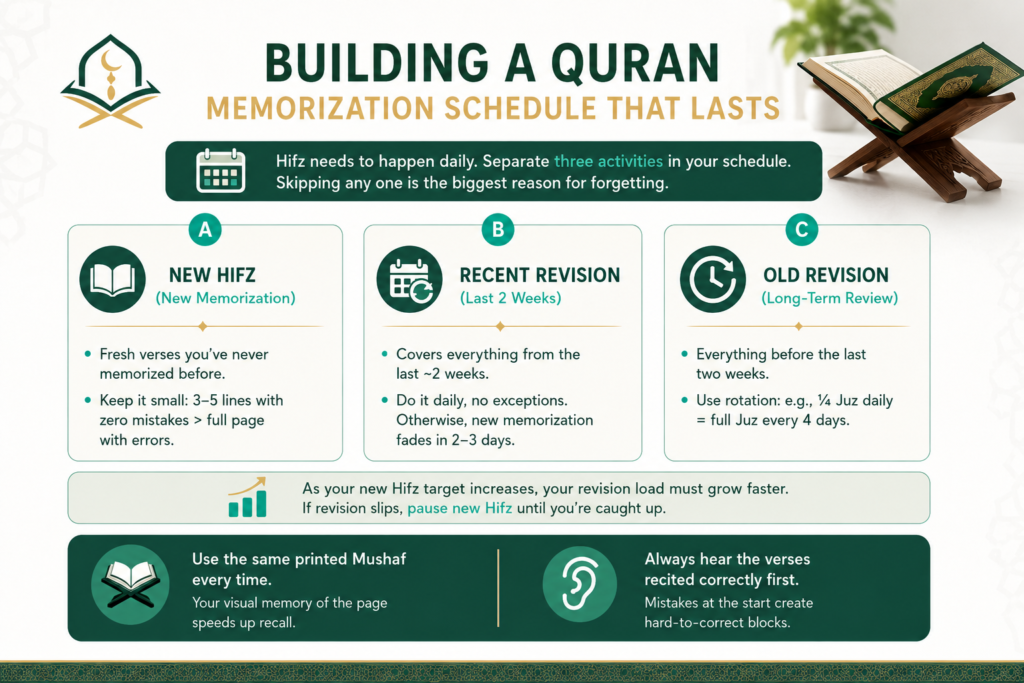
A. New Hifz (New Memorization)
This is the fresh material for the day — verses you have never memorized before. Keep this portion small and fixed. Three to five lines memorized with zero mistakes is worth more than a full page memorized with several.
B. Recent Revision
This covers everything memorized in roughly the last two weeks. Newly memorized material is unstable — without daily review, it begins fading within two to three days. Recent Revision has to happen every day, with no exceptions, or the New Hifz portion is wasted effort.
C. Old Revision (Long-Term Review)
This is everything memorized before the last two weeks. As your memorized portion grows, you can’t review it all daily, so it needs a rotation — for example, reading a quarter of a Juz each day so the whole Juz cycles through every four days.
As your daily New Hifz target goes up, your revision load has to grow faster, not at the same rate. A student memorizing a full page a day will eventually need an hour or more of daily revision just to keep older material intact. If revision starts slipping, the correct response is to pause New Hifz completely until it’s caught up — not to push forward anyway.
Two habits protect this structure day to day: always memorize from the exact same printed Mushaf, since your visual memory of page layout speeds up recall, and never memorize a page before hearing it recited correctly first. Mispronouncing a word during the first stage of memorization creates a mental block that’s very difficult to correct once it settles in.
2. Choosing the Right Quran Memorization Timetable
The timetable you choose depends on two things: how many verses you can realistically memorize with zero mistakes each day, and how much daily time you have for revision as your memorized portion grows. A faster plan isn’t automatically better — it’s only better if your revision capacity can keep up with it.
The table below compares the four most common timetables side by side:
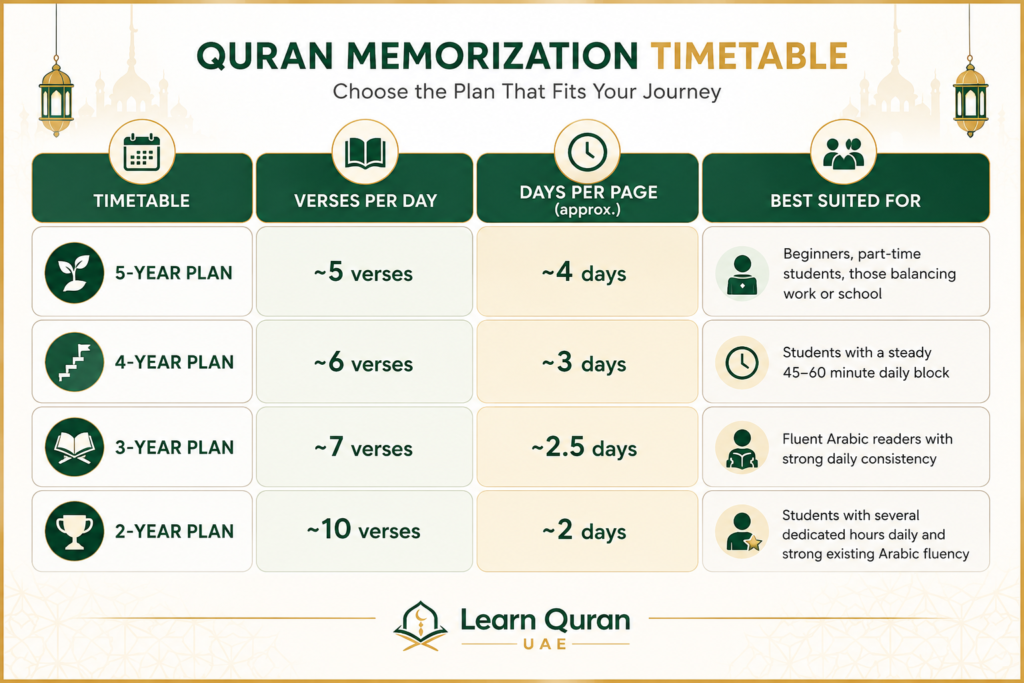
A practical decision rule: if you’re not yet fluent reading Arabic without hesitation, the 2-year and 3-year plans will produce more forgotten pages than finished ones. Speed only helps once accuracy is no longer the bottleneck — memorizing fast with mistakes is far harder to fix later than memorizing slowly and correctly the first time.
If you’re not sure which pace fits your actual reading level, a beginner-focused Quran course is the more realistic starting point — it builds the reading fluency your memorization pace will eventually depend on.
3. Setting Realistic Daily and Weekly Memorization Goals
The most reliable way to set a target is backward planning: start from how much time you actually have each day, then calculate what’s achievable within it, rather than picking an ambitious number first and hoping the time appears. As a general benchmark, memorizing the Quran within one year requires roughly 2 pages a day, or about 14 pages a week.
Even if your daily count varies, tracking the weekly total keeps you honest about whether you’re on pace. A day that falls short can be made up within the same week without derailing the schedule — but only if you’re tracking the weekly number, not just today’s.
Below is a simple weekly tracker format covering all three pillars, with a quality grade so you can see where mistakes are happening, not just how much ground you covered.
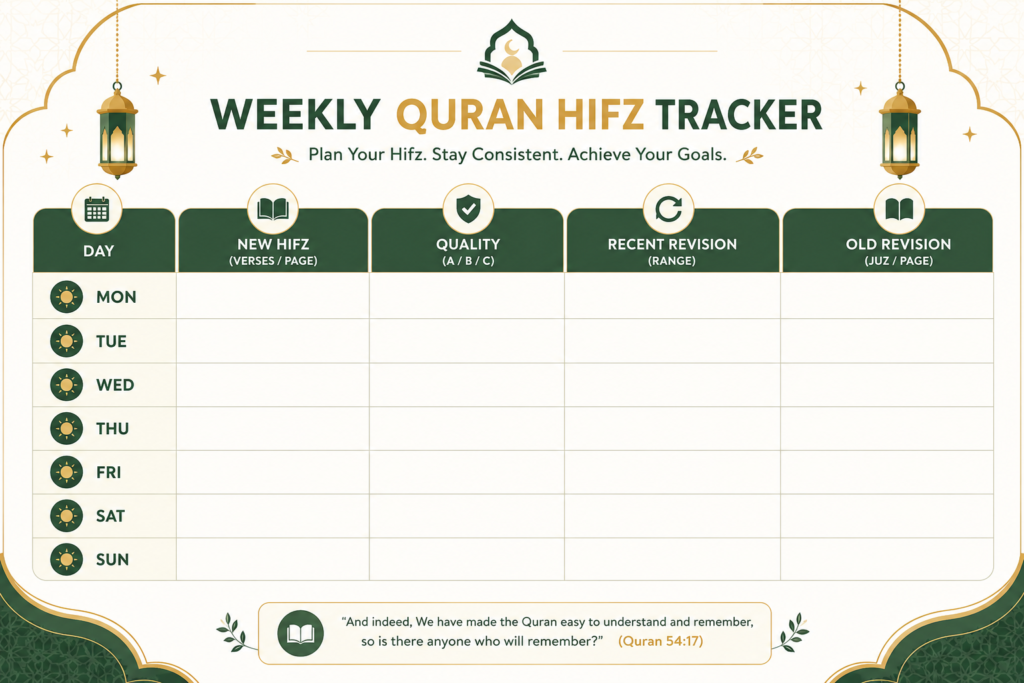
Grading system:
- A — Fluent, no hesitation, no mistakes.
- B — Mostly solid, but needed to pause or think once or twice.
- C — Weak recitation, needed the Mushaf, or made errors. Repeat this portion the next day before adding anything new.
For students starting with Juz 30, working backward from the shorter surahs at the end tends to build momentum faster than starting at the longer opening surahs, since early wins keep motivation intact while the habit forms.
Experience a Live Quran Class
Watch a short sample from one of our online Quran classes and discover our engaging teaching style, interactive lessons, and personalized learning approach.
Start Learning Quran with Expert Tutors in the UAE
Accredited online Quran and Arabic classes tailored for adults and children. Schedule your session today.
Book Your Free Trial4. Organizing Your Memorization Schedule Around Daily Life
This section answers: how do you follow a memorization schedule around a full-time job?
You don’t need more free time — you need to anchor memorization to time you already have. Working students who succeed generally use the same three-window structure, built around existing habits rather than blocks of free time that rarely appear.
Use the period around Fajr for New Hifz, since the mind is least cluttered at this point in the day — even 15 minutes reciting the new portion here builds familiarity before the day starts. Use commute time for Recent Revision, either reciting from memory or listening to a slow, clear reciter on repeat. Between Maghrib and Isha, run through your Old Revision rotation, when energy is lower but the material is already familiar enough that the goal is polishing, not fresh encoding.
This structure works for beginners too, though daily targets should be smaller. Adults balancing a job, family, and memorization often need a schedule built around their actual week rather than a generic template — which is where adult-focused Hifz classes tend to work better than a self-designed plan, since pacing and accountability are adjusted to your calendar from the start.
Read also: How to Memorize the Quran in 6 Months? – 10 Trusted Steps
5. Essential Tools for Quran Memorization
A planner sets the structure, but a few supporting tools make daily execution easier. None of these replace a teacher — they support the schedule around your sessions.
- Mobile memorization apps — scanned Mushaf copies, multiple recitations, and verse-repetition features for daily practice on the go.
- Interactive Quran software — useful on a laptop or desktop for structured, distraction-free practice sessions at home.
- Traditional Tajweed books — remain one of the most reliable resources for the theoretical rules behind correct pronunciation.
- Hifz Al-Mutoun — classical memorized poems, such as Tuhfat Al-Atfal and Al-Manzuma Al-Jazariya, that teach Tajweed rules in a structured, memorable form, most commonly used alongside — not instead of — a teacher.
- Quran reader pens and devices — particularly useful for students who aren’t yet confident reading directly from the Mushaf.
- Recitation podcasts — a low-effort way to build passive familiarity with rhythm and pronunciation during otherwise unused time, such as a commute.
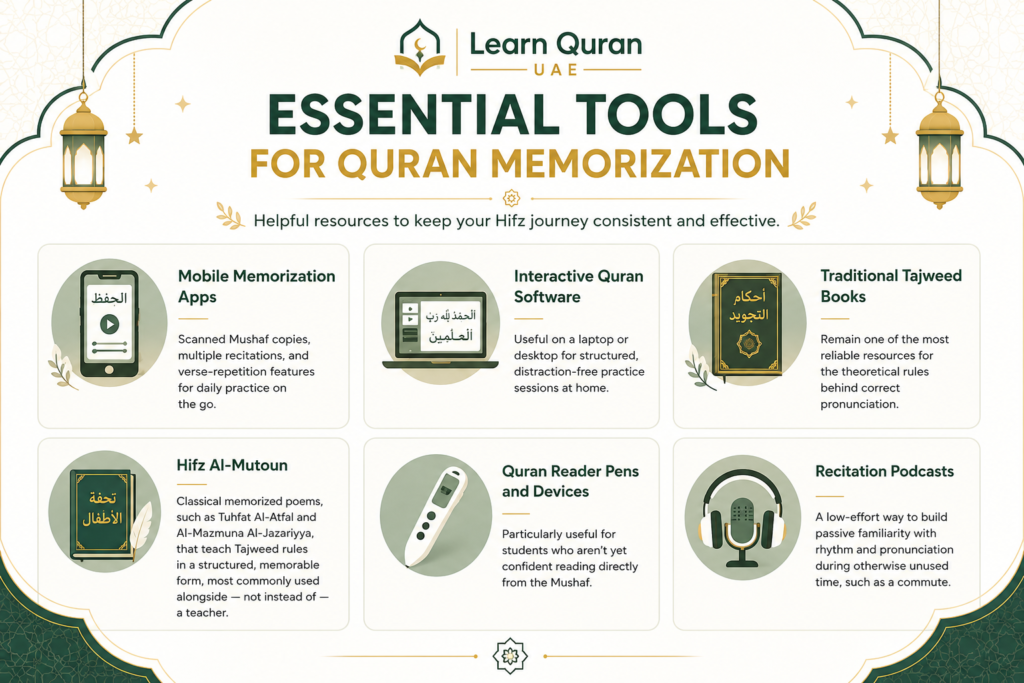
Tools like these fill the gaps between sessions. The core progress still comes from consistent daily memorization and revision, guided by a teacher who can catch pronunciation errors before they settle in.
Common Mistakes That Break a Quran Memorization Schedule
This section answers: what causes a schedule to fall apart, and how do you fix it once it does?
- Skipping Recent Revision to add more New Hifz. This is the fastest way to lose progress — new material decays quickly without same-week review.
- Setting a pace based on ambition instead of available time. A one-page-a-day target with a 9-to-5 job usually collapses within a month.
- Correcting mistakes by memorizing around them. If you realize you’ve been mispronouncing a word, stop new memorization immediately and revise that portion with a qualified teacher until it’s fixed.
- Using a different Mushaf copy each session. Switching editions removes the visual page-layout cue that speeds up recall.
- Pushing through a stall instead of pausing. Stalls tend to appear at predictable points — often mid-surah or when moving into sections with similarly worded verses. The more effective response is a temporary “maintenance mode”: stop new memorization for one to two weeks and revise only what you already know.
Watch for early warning signs before a stall becomes a full break in the schedule: consistently grading sessions “C” for more than two or three days, skipping Recent Revision to keep adding new material, or feeling unable to recite yesterday’s portion without the Mushaf.
See How Our Online Classes Work
Get a glimpse of a real online session and explore how students learn Quran with experienced teachers in a supportive and interactive environment.
Build a Schedule That Actually Works, With Guidance
A printable tracker gives you structure. What it can’t do is catch a pronunciation error before it becomes permanent, or rebalance your revision load when life gets busier. That’s where a qualified tutor changes the outcome.
At UAE Quran Academy, your schedule isn’t a generic template — it’s built around your current reading level, your available hours, and how much you’re memorizing already. If your revision is falling behind, your tutor adjusts the plan with you instead of leaving you to figure it out alone.
Our Quran Memorization Courses
- Quran Memorization (Hifz) Course
- Hifz for Kids Course
- Hifz for Adults Course
- Hifz for Ladies / Sisters Course
- Hifz for Men Course
- Quran Memorization Center (UAE)
- Juz Amma Memorization Program
- Hifz Completion & Hafiz Certification
Enroll today and begin your journey toward becoming a Hafiz with expert guidance, personalized learning plans, and flexible online classes.
Start Learning Quran with Expert Tutors in the UAE
Accredited online Quran and Arabic classes tailored for adults and children. Schedule your session today.
Book Your Free TrialStart your Hifz journey with UAE Quran Academy today →

Conclusion
A working Quran memorization planner and tracker rests on more than a daily verse count. It needs a defined structure — New Hifz, Recent Revision, and Old Revision — a timetable matched honestly to your reading level and available hours, and a tracker that shows whether yesterday’s work actually stuck, not just whether you sat down to study.
The habits that keep a schedule intact are simple but easy to skip: memorizing from one fixed Mushaf, hearing a page recited correctly before attempting it, correcting mistakes immediately instead of memorizing around them, and shifting into maintenance mode the moment a stall appears rather than pushing through it. Whether you’re following a 5-year plan or an intensive 2-year pace, the students who finish are the ones tracking consistency, not just volume.
Read also: How to Memorize Quran in 1 Year? – A Complete Step-by-Step Plan
Frequently Asked Questions
How do I create a Quran memorization schedule?
Start by setting a small, fixed daily New Hifz target — three to five verses is a realistic starting point — then build two revision blocks around it: one for the last two weeks of material and one rotating review for everything memorized before that. Track all three daily using a simple weekly tracker.
How many verses should I memorize per day?
It depends on your timetable goal: roughly 5 verses a day supports a 5-year completion pace, while 10 verses a day supports a 2-year pace. The right number is whichever amount you can memorize with zero mistakes and still fully revise the next day.
What should a Quran memorization tracker include?
A useful tracker logs three things daily: what new material you memorized, what recent material you revised, and a quality grade (fluent, hesitant, or weak) so you can see where mistakes are forming before they become permanent.
Can I memorize the Quran in one year?
It’s possible only with several dedicated hours daily and strong existing Arabic reading fluency, since the daily verse count required is significantly higher than the 2-year pace. For most students, a 3 to 5-year timetable produces stronger long-term retention.
Why do I keep forgetting verses I already memorized?
This almost always comes down to insufficient Recent Revision, not a memory problem. New material can start fading within two to three days without active daily review, which is why the Recent Revision pillar has to run every day without exception.
What is the best time of day to memorize Quran?
The window around Fajr is widely recommended for New Hifz, since the mind is least cluttered at that point in the day. Later windows — commute time and the evening between Maghrib and Isha — work well for revision rather than fresh memorization.




Leave a Reply