 Quran

Yes, it takes real effort. But no, it’s not too hard for you. It’s the kind of hard that ordinary people get through every single year.
If you’re asking, there’s a good chance you’ve already tried. Maybe you got through Juz ‘Amma, felt amazing for a while, and then life got busy. One missed day turned into a week. Now the Mushaf sits on the shelf, and you’re not sure you have what it takes.
You do. Kids finish the Quran. Grandparents finish it. People with full-time jobs and three children finish it. Most of them didn’t have a special memory. They had a simple plan and kept at it.
Below, we’ll look at what makes Hifz feel heavy, how to stop forgetting what you’ve learned, and how long it really takes when you live in the UAE.
What you’ll learn in this article
- The honest answer to how hard Hifz really is.
- The eight factors that make it harder or easier for you.
- How to keep old pages from fading.
- Real Hifz timelines for UAE students, workers, and full-time learners.
- What to expect if you don’t speak Arabic.
How Hard Is It To Memorize The Quran? 8 Factors That Decide It
How hard it is to memorize the Quran depends on eight personal factors. These are your daily time, your reading skill, your Arabic, your Tajweed, your consistency, the quality of your review, your teacher support, and your age and memory. Check each one below to see where you stand before you make your plan.
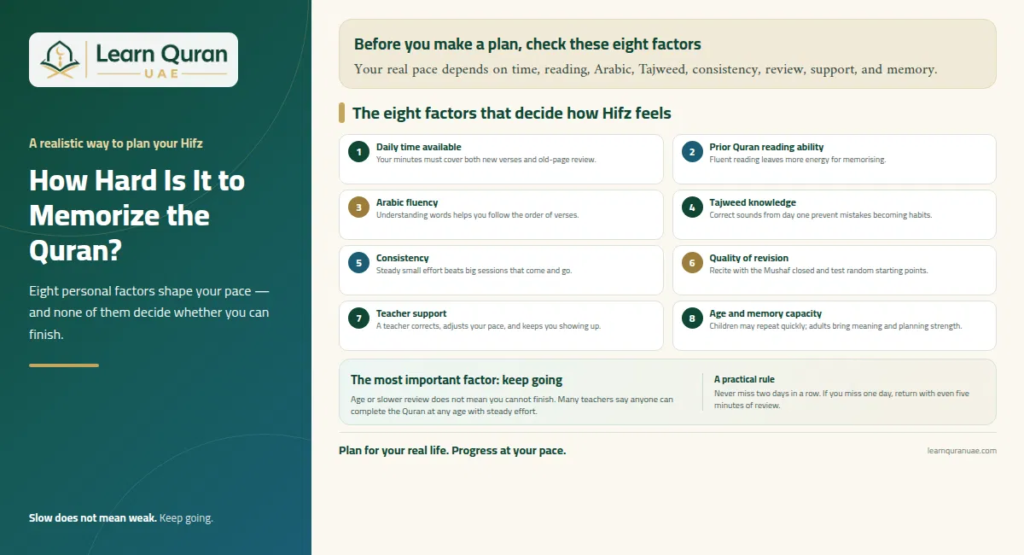
1-Daily Time Available
Time is the first thing that shapes your pace. A student with three free hours a day will move much faster than a parent with thirty minutes. Both can finish. They just finish at different speeds.
Your time has to cover two jobs. One is learning new verses. The other is reviewing old ones. Many people only count the first job, so their plan looks faster on paper than it is in real life.
Most learners don’t expect this next part. As your Hifz grows, review takes more of the same time. In your first month, almost all your time goes to new verses. After ten juz, a big share goes to review. So your pace will slow a little later on. That’s normal, not a sign of failure.
To plan well, count the minutes you really have on a normal day, not the minutes you hope to have.
2- Prior Quran Reading Ability
How well you read the Quran today has a big effect on how hard Hifz feels. If you still stop to sound out words, each page will need many more repeats. Slow reading also tires you out faster. You spend your energy on reading the letters, so you have less left for memorising them.
Try this quick test. Open any page and read it out loud. Do you lose your place? Do you stop often? Do you guess at words? If so, your reading needs work first.
This is not a setback. A few months of reading practice can save you a year of slow Hifz later. Fluent readers can look at a line, say it smoothly, and put all their focus on remembering it. That makes every new page lighter.
3- Arabic Fluency
Your Arabic level changes how familiar the words feel. If you understand what you recite, your mind can follow the meaning from one verse to the next. That makes the order easier to recall.
Learners usually fall into one of four groups. Some don’t know Arabic at all. Some can read it but don’t understand it. Some understand common words. Others speak it well.
Each step up makes Hifz a bit easier. But even native speakers don’t always find it easy. The Arabic of the Quran is different from the Arabic people speak at home in the UAE or anywhere else. Many words and forms are not used in daily talk.
So Arabic speakers also gain a lot from reading a short tafsir. And if you’re at the start of this list, know that this gap closes with time.
4- Tajweed Knowledge
Tajweed is about saying each letter and word the right way. It matters a lot in Hifz because memorising locks in how you say things.
If you memorise a word with a mistake, you’ll repeat that mistake every time you recite. You’ll say it in your review. You’ll say it in your prayers. After hundreds of repeats, the wrong sound feels right to you.
Common mistakes include making a short sound long, or a long sound short. Others are saying a heavy letter lightly, or skipping the nasal sound called ghunnah.
Fixing these later is hard. You have to unlearn the old sound and learn the new one at the same time. That’s why basic Tajweed before you start makes Hifz easier, not harder. You learn each verse once, the right way, and move on.
5- Consistency
Consistency is the biggest factor of all. Most people who stop Hifz don’t stop because they lack intelligence. They stop because they study on some days and skip others.
- A missed day costs more than the lines you didn’t learn: When you come back, your recent pages feel weaker. You have to review them before you can add anything new. One missed day becomes two days of catching up.
- A missed week is even worse: Many learners never come back after one, because starting again feels too heavy.
- A simple rule helps here: never miss two days in a row. If you miss one day, the next day becomes a must, even if you only do five minutes of review.
Steady effort, even when small, beats big effort that comes and goes. Over a year, the steady learner is almost always far ahead.
6- Quality of revision
Many people review, but they review the wrong way. Reading old pages with your eyes is not real review. It only feels like it. Your eyes see the words, so your brain thinks it knows them. Real review means reciting from memory, out loud, with the Mushaf closed. Only then do you find out what you truly know.
Good review also tests the weak spots. Two places cause the most trouble. The first is the jump from the end of one page to the start of the next. The second is verses that sound almost the same in different surahs. Scholars call these mutashabihat.
To test yourself, try starting from a random verse instead of always starting at the top. If you can pick up from anywhere, your Hifz is strong. If you can only recite from the start, it needs more work.
7- Teacher Support
Learning alone makes Hifz much harder. You can’t hear your own mistakes well. Your ear gets used to how you say things, even when it’s wrong.
A teacher fixes this. But a good teacher does more than correct sounds. They also decide when you’re ready to move on to a new page, and when you need to stay and review. That choice is hard to make on your own. Most learners either move too fast and forget, or stay too long and get bored.
A teacher also changes your plan when life gets busy. During exams, work deadlines, or travel, they can lower your new portion and keep your review going. That keeps you from stopping completely. And when you know someone is waiting to hear you, it’s much easier to show up.
8- Age and Memory Capacity
Age changes how you memorise, but it doesn’t decide if you can. Young children often memorise fast by sound. They repeat what they hear without much effort.
Adults may need more repeats. But adults have other strengths. They understand meaning better. They can plan their week and keep a schedule. They also know why they’re doing it, which keeps them going.
Memory also differs from person to person at any age. In one question sent to Islamweb, a young man knew ten juz well. Still, he needed 50 minutes to review one juz, while others needed 25.
He felt slow and wanted to quit. But he was already a hafiz of ten juz. Slower does not mean weaker. Many teachers say anyone can finish the Quran at any age, as long as they keep going.
The Hardest Part Of Hifz: Keeping What You Memorised
Learning a new page is not the hardest part. Holding on to it for years is. The Prophet ﷺ told us the Quran slips away faster than a camel from its rope. The two plans below, one daily and one weekly, are how huffaz keep their pages safe.
The Daily Review Plan For New Pages
New pages are the weakest pages you have. They need daily attention for a while before they settle. Many teachers keep each new page on the daily list for about two weeks.
Order matters a lot. Start each session with review, and only then learn your new portion. When new work comes first, review gets the time left over. On a busy day, that’s nothing.
A simple daily session has three steps. First, recite the pages you learned over the last few days. Next, learn today’s new lines. Last, recite today’s lines one more time before you sleep.
That last step is small, but it helps. Going over a new portion at night gives it one more push before the day ends.
Keep the daily list moving. When a page has been on it long enough, it leaves the list and joins your weekly cycle. That handoff is what stops pages from slipping through the cracks.
The Weekly Review Cycle For Older Juz
Older pages need a different plan. You can’t recite all of them every day, so you spread them across the week. Say you know five juz. You could review one juz a day for five days and use the other two days to catch up. This way, every page gets recited at least once a week.
As your Hifz grows, the cycle grows with it. At ten juz, you might review two juz a day. Sheikh Ibn Baz advised learners to keep up their review so they don’t forget what they worked hard to learn.
Here’s a rule many teachers use. If you forget more each week than you add, stop new pages for a few days. Only review. Then start again on a strong base.
If you’d like a ready-made system for this, our guide to the Quran memorization planner and tracker shows you how to set it up step by step.
Planning new pages and review on your own is where many learners get lost. In the Quran memorization (Hifz) courses at Learn Quran UAE, your teacher builds both plans for you and listens to both, so old pages stay firm while you keep moving forward.

A quick look at learning with us
See how a live class works, from the teacher’s explanation to the student’s recitation. It’s a simple way to know what to expect before your first lesson.
How To Make Memorising The Quran Easier: 5 Daily Habits
The right habits can make the same amount of Quran feel much lighter. None of them are hard to start. Here are five you can begin this week.
Start With A Small Daily Target
Begin with 3 to 5 lines a day, or about a quarter of a page. It may feel like too little. It isn’t. A small target is easy to finish, even on a long day. Finishing gives you a quiet win, and that win brings you back tomorrow.
If a verse is long, break it into short phrases. Learn the first phrase, then the next, then join them together. When your target has felt easy for about three weeks, add one or two lines. Grow slowly, the way you’d add weight at the gym.
Watch for one warning sign. If you start skipping review to finish your new lines, your target is too big. Cut it back until both fit.
Memorise At The Same Time Every Day
Pick one time and give it to Hifz. Many people choose the time after Fajr. The house is quiet, and the mind is fresh. If mornings don’t work for you, choose a time when you still have energy. Late at night, when you’re tired, is usually the hardest time to learn something new.
Tie your Hifz to something you already do. “Right after Fajr” or “right after Asr” works better than “sometime in the evening.” The prayer becomes your reminder.
Keep the place the same too. Use the same chair or corner each day, and leave your phone in another room. Soon, sitting in that spot at that time will feel normal. You won’t have to push yourself to start. You’ll just start.
Stick To One Mushaf
Choose one Mushaf and never switch. A good choice is the 15-line Madinah Mushaf. It has 604 pages, with about 20 pages in each juz. Most pages also end at the end of a verse.
This layout helps your eyes. They quietly remember where each verse sits. Is it at the top? Near the bottom? On the left page? Over time, you’ll “see” the page in your mind as you recite. That picture becomes a strong memory tool.
A different print moves every verse to a new spot, and the picture is lost. So buy a sturdy copy you can keep for years. If you travel, use a phone app with the same 15-line layout. That way, your pages look the same wherever you are.
Listen To One Reciter Before You Memorise
Pick one clear reciter and stay with him. Sheikh Al-Husary is a great choice for learners. His slow, steady style makes every letter easy to hear. Sheikh Al-Minshawi is another good option.
Before you memorise a new part, listen to it many times. Keep going until you can follow along without reading. This teaches your ear the right sounds before your tongue tries them. When you start memorising, the words already feel familiar.
You can listen at times you’d waste anyway. Play your next portion in the car, on the metro, or while you cook. Changing reciters often can confuse you. Each one has his own rhythm, and your memory gets mixed up. One voice keeps things clear.
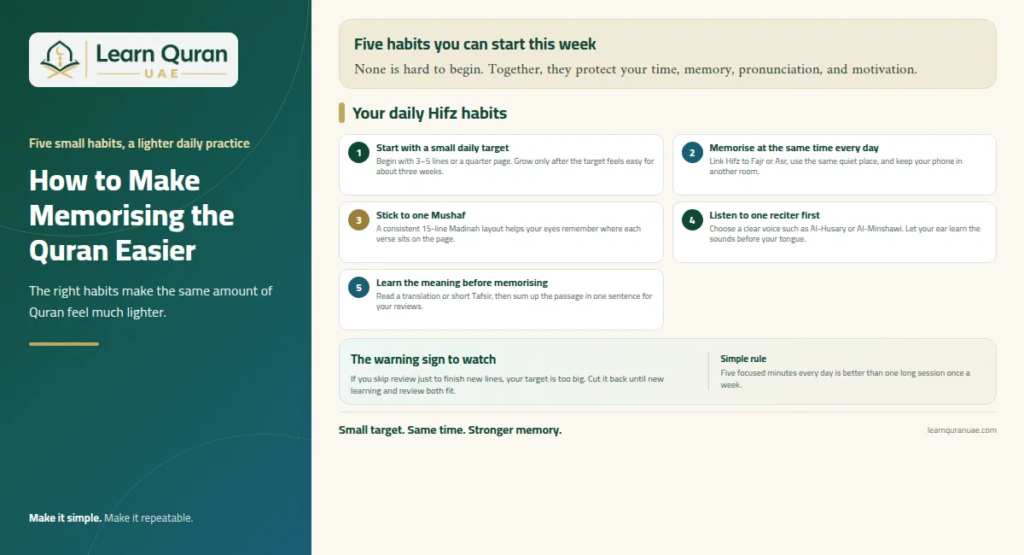
Learn The Meaning Before You Memorise
Before you start a new part, read its meaning in a good translation. A short tafsir note is even better. It only takes a few minutes. Knowing the meaning gives your memory a story to follow. You know what the passage is about, so the next verse feels like the natural next step, not a random line.
Try this simple trick. After reading the meaning, sum up the passage in one sentence. For example: “These verses tell the story of Musa and Pharaoh.” Say that sentence before each review.
Meaning also makes Hifz feel personal. When a verse talks about patience on a hard day, it stays with you. Verses that touch your heart are the ones you rarely forget.
Start Learning Quran with Expert Tutors in the UAE
Accredited online Quran and Arabic classes tailored for adults and children. Schedule your session today.
Book Your Free TrialRead also: Izhar in Tajweed: The 6 Throat Letters
Mistakes That Make Hifz Harder Than It Should Be
Some habits quietly drain your effort. They don’t feel like mistakes at first. Spotting them early can save you months of struggle.
Comparing Yourself With Other Students
It’s easy to look at the student next to you. They finished two juz while you’re still on your first. That one thought can make you want to give up.
Comparing happens online too. Short videos show children finishing the Quran at eight years old. They’re inspiring, but they can also make you feel slow.
The problem is that you only see their result. You don’t see their free time, their teacher, or how many years they’ve been studying.
Your only real race is with yesterday’s you. Did you recite today? Do you know more than last month? Those are the questions that matter.
If you need a number to watch, track your own pages on a simple chart. Seeing your own line go up is far more helpful than watching someone else’s.
Losing Your Intention Along The Way of Your Memorisation Journey
Hifz is worship, so your intention matters. When it slips, the work often gets heavier.
Pride is one way it slips. In another Islamweb question, a sister said she once felt very proud while telling someone about her Hifz. After that, she found it very hard to go on.
Sins can also weigh on you. Scholars say they weaken memory and harden the heart.
The fix is simple, though not always easy. Memorise for Allah, not for praise. Keep your progress private if it helps. Ask Allah for help before each session, and make tawbah when you slip. A clean heart makes room for the Quran.
Is It Hard To Memorise The Quran In The UAE?
Hifz in the UAE has its own challenges. Many people balance school or university, work, long drives, and family duties. Free time is short. Heat and summer travel can also break routines.
But UAE learners have real help too. There are Hifz centres, mosque circles, online academies, and flexible one-to-one classes. Ramadan nights and events like the Dubai International Holy Quran Award also give many families a strong push.
Hifz timelines for UAE learners
How long will it take you? It depends on how much time you give each day. Here are realistic ranges.
| Learner type | Daily time | Time to finish |
| Full-time Hifz student | Several hours a day | 1 to 2 years |
| School student | 30 to 60 minutes a day | 2 to 4 years |
| Adult with a job and family | 45 to 90 minutes a day | 3 to 5 years |
| Busy part-time learner | A few lines or a quarter page a day | 4 to 7+ years |
Full-time students finish fast because they have hours for both new pages and review. School students do well when they keep a short daily session all year.
Working adults often finish in three to five years. That may sound long. But those years pass anyway, and you can reach the end of them as a hafiz.
Busy part-time learners move the slowest. Still, a few lines a day add up. For a closer look at these numbers, read our guide on how long it takes to memorize the Quran.
Fitting Hifz Into School, Work, And Family Life
School students can match Hifz to the school calendar. Keep short daily lessons during term. Add extra pages during summer and winter breaks. Then, in exam weeks, switch to review only so nothing slips.
Working adults can split the day. Use a short morning slot, before the commute, for new pages. Use a short evening slot for review. Weekends can carry the bigger weekly review.
Parents can learn with their children. A family Hifz time after Maghrib keeps everyone on track, and kids love testing their parents.
Online classes also remove the drive across the city. You can study from home in Dubai, Abu Dhabi, Sharjah, or any emirate. To see what this costs for you or your family, check the Learn Quran UAE pricing plans. You’ll find options for different schedules and budgets.

Is It Possible To Memorise The Quran In 1 Year?
Yes, but it’s rare and very demanding. For most UAE learners who also have school or work, 2 to 5 years is much more realistic than one year.
What A One-Year Hifz Plan Needs
A one-year plan asks a lot from you.
- You’ll need to memorise 1.5 to 2 pages every day, which is a big daily goal on its own. Here’s why it has to be that high. The Mushaf has 604 pages, so even at 2 pages a day, you need about 10 months. That’s before any sick days, travel, or review breaks.
- You’ll also need 2 to 3 hours of study each day. That time includes review, not just new pages. Without review, two pages a day would fade fast.
- You’ll need a strict review system. Every new page, recent page, and old juz must have its place in your week.
- You’ll need a qualified teacher who hears you often, ideally every day.
Last, you should already read the Quran well and know Tajweed before you begin. There’s no time to learn the basics inside a one-year plan. If you’re ready for this path, our guide on how to memorize the Quran in 1 year gives you a full step-by-step plan.
How To Memorize The Quran If You Don’t Speak Arabic
You can memorize the Quran without speaking Arabic. Your first months may feel slower than an Arabic speaker’s. That’s normal, and the following steps help close the gap quickly.
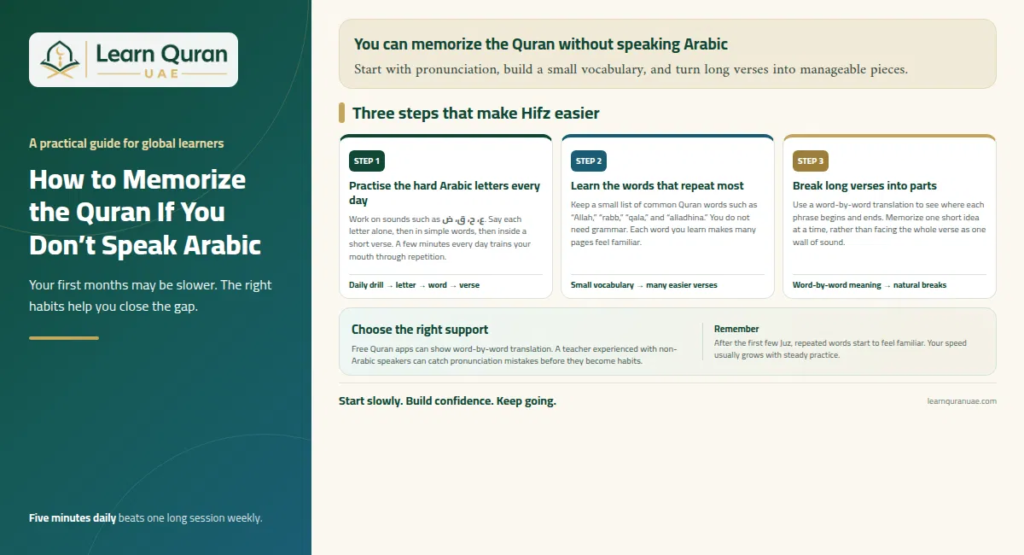
Step 1: Practise The Hard Arabic Letters Every Day
Some Arabic letters don’t exist in many languages. Sounds like ع, ح, ق, and ض can feel strange in your mouth at first. When a sound feels strange, you slow down to say it. That makes every verse take longer to memorise.
So start with a short daily drill. Spend a few minutes on the letters you find hardest. Say each one slowly on its own. Then say it inside simple words. Then try it in a short verse.
Five minutes a day works better than one long session a week. Your mouth learns through repetition, just like your memory does. fter a few weeks, these sounds stop feeling foreign. Once they feel natural, you can put your full focus on remembering the words instead of saying them.
Step 2: Learn The Words That Repeat Most
When you don’t speak Arabic, every word feels like a new sound pattern. You can’t use meaning to guess what comes next, so you need more repeats at first. The good news is that many Quran words come up again and again. Words like “Allah,” “rabb,” “qala,” and “alladhina” appear on almost every page.
Keep a small list of these common words. Learn a few each week. You don’t need to study grammar. Just know what each word means when you see it.
Every word you learn makes many verses easier at once. Pages that once felt like strange sounds start to feel familiar. This is why many learners say their speed picks up after the first few juz. The same words keep showing up, and the Quran starts to feel less new.
Step 3: Break Long Verses Into Parts With A Word-By-Word Translation
Long verses can feel like a wall of sound. If you don’t know where one phrase ends and the next begins, it’s hard to split them into small parts. A word-by-word translation solves this. It shows the meaning right under each Arabic word.
With it, you can see where each idea starts and stops. A long verse turns into three or four short pieces you can memorise one at a time.
This is different from reading a normal translation. A normal translation tells you what the whole passage means. A word-by-word translation shows you how the Arabic is built, piece by piece.
Many free Quran apps offer this feature. Open it before you start a new portion, and mark the natural breaks in each long verse. If you join classes, look for teachers who often work with non-Arabic speakers. They know the common mistakes before you make them, so they can guide you past them early.
Finding Hifz Hard? Your Effort Still Counts
If memorising feels hard for you, that’s not a reason to stop. In Islam, the struggle itself is rewarded. The Prophet ﷺ said that a person who recites the Quran while finding it difficult, and keeps going anyway, gets two rewards (Muslim). The skilled reciter is honoured too. But the one who stumbles is not left behind.
Imam al-Nawawi explained that one reward is for the reciting and the other is for the effort. So every time you repeat a verse ten times because it won’t stick, that effort is written for you. Your hard days are not wasted days. They may be the most rewarded part of your Hifz.
Watch a real lesson before you book
Not sure what online Quran classes look like? This short clip gives you a feel for our teaching style and how each class is built around the student.
Start Learning Quran with Expert Tutors in the UAE
Accredited online Quran and Arabic classes tailored for adults and children. Schedule your session today.
Book Your Free TrialStart Your Hifz With Learn Quran UAE Today
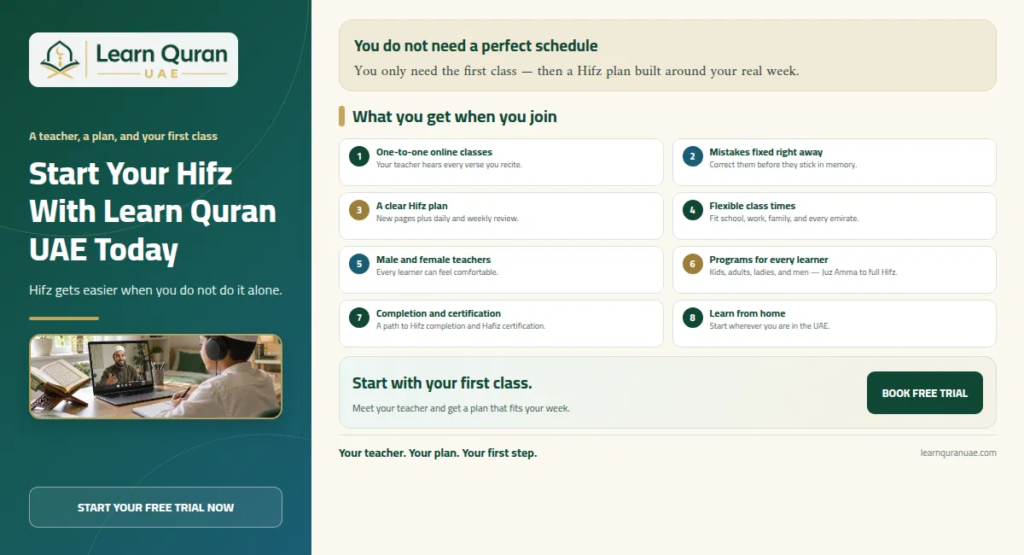
Hifz gets easier when you don’t do it alone. At Learn Quran UAE, you get a teacher and a plan built around your real life.
Here’s what you get when you join:
- One-to-one online classes, so your teacher hears every verse you recite
- Mistakes fixed right away, before they stick in your memory
- A Hifz plan with new pages and a clear daily and weekly review schedule
- Flexible class times that fit school, work, and family in every emirate
- Male and female teachers, so every learner feels comfortable
- Programs for kids, adults, ladies, and men, from Juz ‘Amma to full Hifz
- A path to Hifz completion and Hafiz certification
You don’t need a perfect schedule to begin. You only need the first class. Book your free trial today and get a Hifz plan that fits your week.
Our Online Quran Courses Include:
Have a look at our available courses and choose the one you like to start.
- Online Quran Classes in UAE
- Quran Classes for Kids
- Quran Classes for Adults
- Quran Classes for Ladies / Sisters
- Quran Classes for Men
- Quran Course for Beginners
- Quran Classes for Toddlers
- Weekend Quran Classes
- Intensive Quran Course
- Al-Azhar Quran Course
- Arabic & Quran Classes
- Zoom Quran Classes
- Skype Quran Classes
Conclusion
So, is it hard to memorise the Quran? The honest answer sits in the middle. It asks for patience and a lot of small days that add up. But nothing in it is out of reach for an ordinary person who keeps coming back to the Mushaf.
How it feels for you comes down to your own starting point. Your free minutes, your reading, your Arabic, your Tajweed, and your memory all play a part.
The good news is that most of these can grow. Reading gets smoother. Tajweed gets cleaner. Arabic words start to look like old friends. Even your memory gets sharper the more you use it.
The part that surprises most learners is where the real work hides. Learning a new page is quick. Holding on to fifty pages, then a hundred, then three hundred, is the true test.
People who finish are rarely the fastest in the class. They’re the ones who recite their old pages out loud, week after week, even when it feels boring.
Time is the other thing to be honest about. A one-year plan exists, but only a small group can carry it. For a school student in Sharjah or a working mother in Abu Dhabi, a few years is a fair and healthy goal. Slow progress still counts as progress.
If you’ve tried before and stopped, you haven’t failed. You’ve learned what didn’t work. Pick a small daily goal, find a teacher who will listen to you, and give yourself time. Page by page, the Quran you once found hard can become the Quran you carry in your heart for life.
FAQs
Still have a few questions about memorising the Quran? Here are short, clear answers to the ones learners in the UAE ask us most often.
How Hard Is It To Memorize The Quran?
Memorizing the Quran takes real effort, but it is not impossible. You learn about 604 pages while reviewing old ones. Your time, reading, Tajweed, habits, and support decide how hard it feels.
Is It Easy To Memorize The Quran?
Memorizing the Quran is not effortless, but small daily steps make it feel light. A few lines a day, one Mushaf, one reciter, and a teacher help the most.
How Long Does It Take To Memorise The Quran In The UAE?
Most UAE learners take 2 to 5 years to memorise the Quran. Full-time students may finish in 1 to 2 years. Busy part-time learners may need 4 to 7 years or more.
Is It Possible To Memorise The Quran In 1 Year?
Memorising the Quran in one year is possible but rare. It needs 1.5 to 2 pages a day, 2 to 3 hours of study, strong Tajweed, and a teacher who hears you often.
Can I Memorise The Quran If I Don’t Speak Arabic?
Yes, you can memorise the Quran without speaking Arabic. Your first months may be slower. Letter practice, extra listening, and a word-by-word translation help you catch up.
What Should I Do If I Keep Forgetting What I Memorised?
If you keep forgetting, review before you add anything new. If you forget more than you learn each week, pause new pages for a few days and only review.
What Is The Best Age To Start Memorising The Quran?
There is no wrong age to start memorising the Quran. Children often learn quickly by sound, while adults plan and understand better. A steady daily habit matters more than age.
How Many Minutes A Day Should I Spend On Hifz?
Most learners do well with 30 to 90 minutes a day. That time should cover both new lines and review. Even 20 steady minutes daily beats long sessions now and then.




Leave a Reply