 Quran
Quran
If you’ve ever heard two Muslims recite the same verse and noticed the words sound slightly different, you weren’t imagining it. Both readers can be completely correct — because the Quran was preserved through several authenticated recitation systems, not just one.
The 7 Qirat of the Quran are seven distinct, verified ways of reciting the same divine text, each traced through an unbroken chain of transmission back to the Prophet Muhammad ﷺ. They are not different versions of the Quran — the meaning never changes. What changes is pronunciation, vowel length, and a handful of recitation rules.
This guide walks you through what the 7 Qirat are, how many Qirat of the Quran actually exist, how they differ from Tajweed, and how you can start learning one with proper guidance.
What Is a Qirat in Islam?
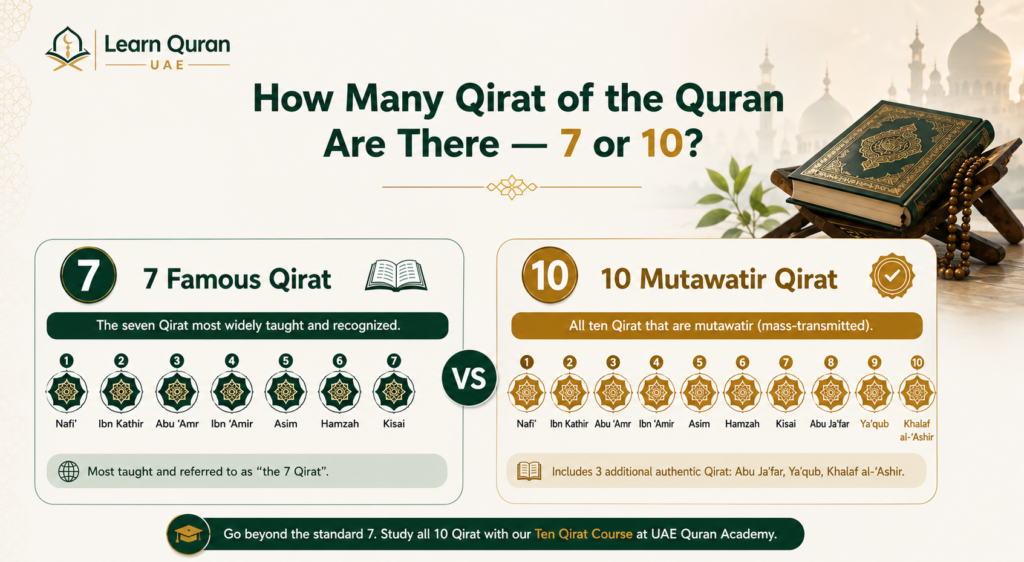
A Qirat (plural: Qirat, or Qira’at) is an authenticated method of reciting the Quran, verified through an unbroken chain of transmission back to the Prophet ﷺ. The word comes from the Arabic root qara’a (to read), and a scholar who transmits one is called a Qari.
Each Qirat carries its own rules for pronunciation, vowel length, and certain letter sounds — but the wording of the Mushaf and the meaning of the verses stay identical across all of them. Think of it less as “different Qurans” and more as different, equally authentic oral traditions of the same text.
This system of recitation exists because of how the Quran itself describes its revelation. Allah says in the Quran:
وَلَقَدْ يَسَّرْنَا الْقُرْآنَ لِلذِّكْرِ فَهَلْ مِن مُّدَّكِرٍ
“And We have certainly made the Quran easy for remembrance, so is there any who will remember?” — Surah Al-Qamar, 54:17
How Many Qirat of the Quran Are There — 7 or 10?
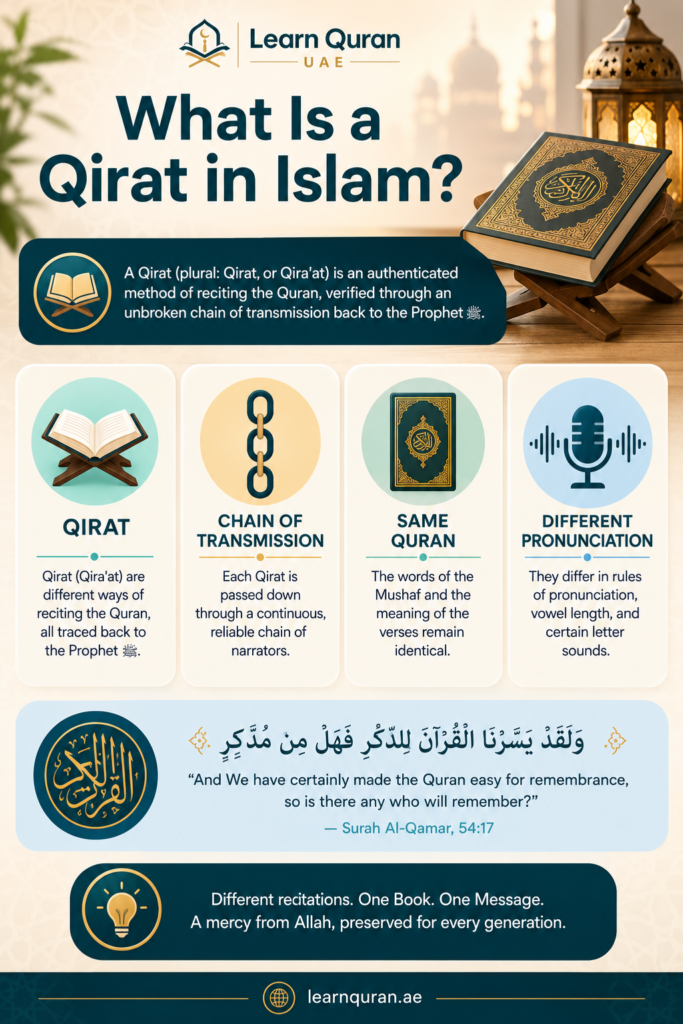
This is one of the most common questions learners ask, and the honest answer is: both numbers are correct, depending on what’s being counted.
There are 10 mutawatir (mass-transmitted) Qirat of the Quran in total. Of these, 7 are the most widely taught and referenced, which is why most people only ever hear about “the 7 Qirat.” The remaining 3 — Abu Ja’far, Ya’qub, and Khalaf al-‘Ashir — are just as authentic; they simply became less geographically widespread over time.
If you want to go beyond the standard 7 and study the full scope of authenticated recitation, our Ten Qirat Course at UAE Quran Academy is built specifically for that advanced path.
Why Were the 7 Qirat of the Quran Formalized?
The number “seven” isn’t arbitrary. It traces back to a hadith in which the Prophet ﷺ described the Quran as having been revealed in seven modes, or ahruf.
نزل القرآن على سبعة أحرف فاقرءوا ما تيسر منه
“This Quran has been revealed in seven ahruf, so recite from it whichever is easy for you.” — Sahih al-Bukhari 5041
A related report, narrated by Umar ibn al-Khattab, describes him hearing a companion recite Surah Al-Furqan differently from how he himself had learned it — and being concerned enough to bring the matter directly to the Prophet ﷺ. The Prophet ﷺ listened to both men recite and confirmed that each version had indeed been revealed to him. This narration is recorded in Sahih al-Bukhari 2419.
By the 4th century AH, dozens of recitation chains were circulating across the Muslim world — some strong, some weak. The scholar Abu Bakr Ibn Mujahid al-Baghdadi (died 324 AH) selected seven of the strongest, most widely transmitted chains and documented them in his work Kitab al-Sab’ah, giving the Ummah a clear, standardized reference point. This didn’t invalidate the other three authentic recitations — it simply gave scholars and students a manageable starting framework.
The Names of the 7 Qirat and Their Narrators
Each of the 7 Qirat is named after the Imam who mastered and transmitted it, and each Imam’s recitation reaches us today through two primary students, called Rawis.
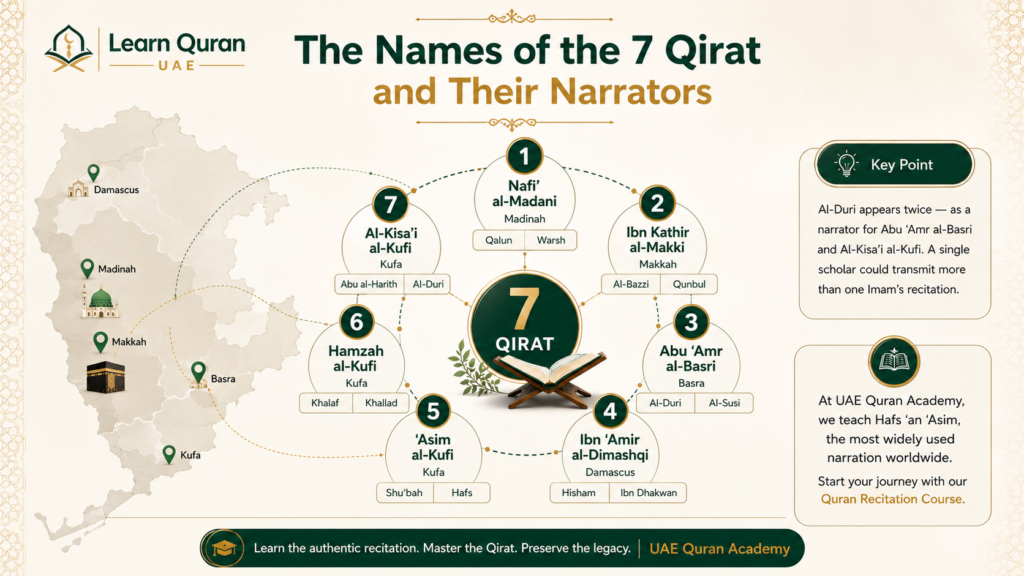
Here is the complete list.
| Imam (Qirat) | City | Narrator 1 | Narrator 2 | |
| 1 | Nafi’ al-Madani | Madinah | Qalun | Warsh |
| 2 | Ibn Kathir al-Makki | Makkah | Al-Bazzi | Qunbul |
| 3 | Abu ‘Amr al-Basri | Basra | Al-Duri | Al-Susi |
| 4 | Ibn ‘Amir al-Dimashqi | Damascus | Hisham | Ibn Dhakwan |
| 5 | ‘Asim al-Kufi | Kufa | Shu’bah | Hafs |
| 6 | Hamzah al-Kufi | Kufa | Khalaf | Khallad |
| 7 | Al-Kisa’i al-Kufi | Kufa | Abu al-Harith | Al-Duri |
Notice that Al-Duri appears twice — once as a narrator for Abu ‘Amr al-Basri, and again for Al-Kisa’i. This isn’t an error; a single scholar could transmit more than one Imam’s recitation, which is part of what makes the chain of transmission so tightly cross-verified.
At UAE Quran Academy, our foundational classes teach within Hafs ‘an ‘Asim, the most widely used narration globally — and students who want structured, one-on-one guidance in this narration can start with our Quran Recitation Course.
Read also: What We Learn From the Quran? 10 Life-Changing Lessons
Experience a Live Quran Class
Watch a short sample from one of our online Quran classes and discover our engaging teaching style, interactive lessons, and personalized learning approach.
Start Learning Quran with Expert Tutors in the UAE
Accredited online Quran and Arabic classes tailored for adults and children. Schedule your session today.
Book Your Free TrialA Brief Profile of Each of the 7 Qirat Imams
Knowing the names on a list is one thing — understanding who these scholars were makes the chain of transmission feel real rather than abstract.
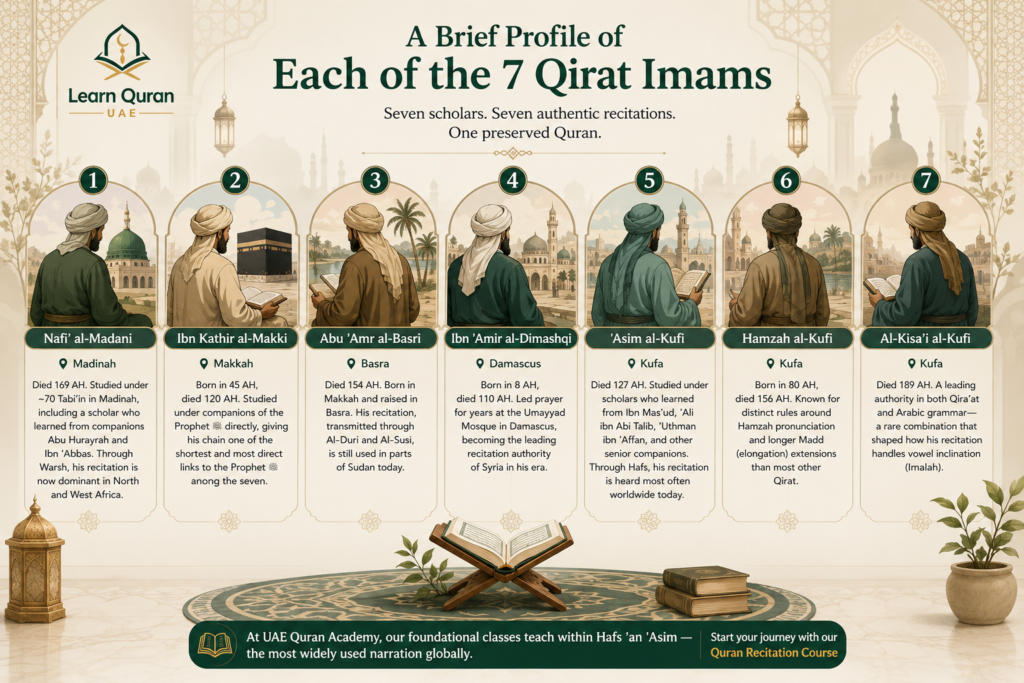
1. Nafi’ al-Madani
Nafi’ (died 169 AH) studied under roughly 70 Tabi’in in Madinah, including a scholar who had learned directly from companions Abu Hurayrah and Ibn ‘Abbas. Through his narrator Warsh, his recitation is now the dominant Qirat across North and West Africa.
2. Ibn Kathir al-Makki
Born in Makkah in 45 AH, Ibn Kathir (died 120 AH) studied under companions of the Prophet ﷺ directly, giving his chain one of the shortest and most direct links to the Prophet ﷺ among the seven.
3. Abu ‘Amr al-Basri
Abu ‘Amr (died 154 AH) was born in Makkah and raised in Basra. His recitation, transmitted through Al-Duri and Al-Susi, is still used in parts of Sudan today.
4. Ibn ‘Amir al-Dimashqi
Born in 8 AH, Ibn ‘Amir (died 110 AH) led prayer for years at the Umayyad Mosque in Damascus, becoming the leading recitation authority of Syria in his era.
5. ‘Asim al-Kufi
‘Asim (died 127 AH) studied under scholars who had learned directly from Ibn Mas’ud, ‘Ali ibn Abi Talib, ‘Uthman ibn ‘Affan, and other senior companions. His recitation, through the narrator Hafs, is the one you’ll hear most often anywhere in the world today.
6. Hamzah al-Kufi
Born in 80 AH, Hamzah (died 156 AH) is known for distinct rules around Hamzah pronunciation and longer Madd (elongation) extensions than most other Qirat.
7. Al-Kisa’i al-Kufi
Al-Kisa’i (died 189 AH) was a leading authority in both Qira’at and Arabic grammar — a rare combination that shaped how his recitation handles vowel inclination (Imalah).
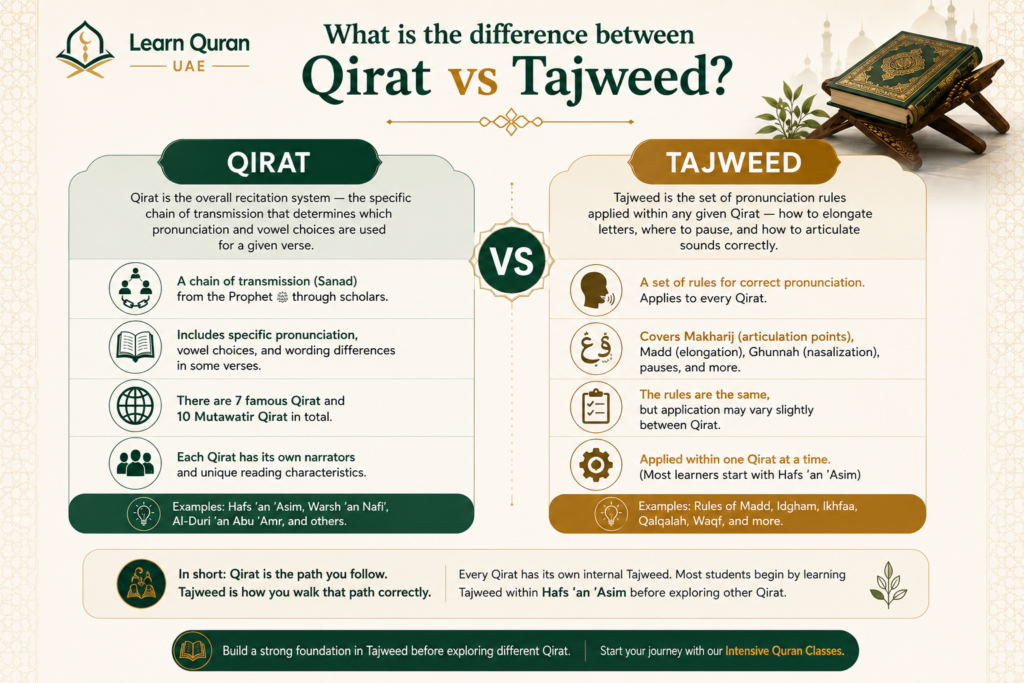
What is the difference between Qirat and Tajweed?
Beginners frequently mix these two terms up, so it’s worth stating plainly: Qirat and Tajweed are not the same discipline.
Qirat is the overall recitation system — the specific chain of transmission that determines which pronunciation and vowel choices are used for a given verse. Tajweed, by contrast, is the set of pronunciation rules applied within any given Qirat — how to elongate letters, where to pause, how to articulate specific sounds correctly.
In other words, every Qirat has its own internal Tajweed. When most students begin, they learn Tajweed within one Qirat — almost always Hafs ‘an ‘Asim — before ever exploring how the rules shift in another narration. If you’re building this foundation from scratch, our Intensive Quran Classes are designed to get that core Tajweed base solid before moving into comparative Qirat study.
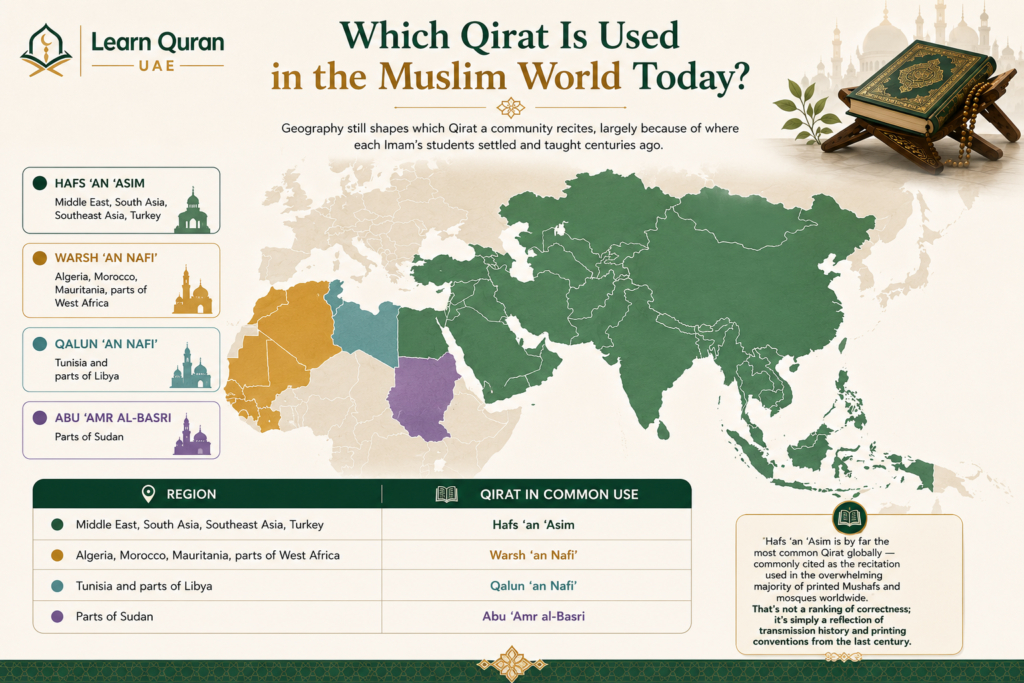
Which Qirat Is Used in the Muslim World Today?
Geography still shapes which Qirat a community recites, largely because of where each Imam’s students settled and taught centuries ago.
| Region | Qirat in Common Use |
| Middle East, South Asia, Southeast Asia, Turkey | Hafs ‘an ‘Asim |
| Algeria, Morocco, Mauritania, parts of West Africa | Warsh ‘an Nafi’ |
| Tunisia and parts of Libya | Qalun ‘an Nafi’ |
| Parts of Sudan | Abu ‘Amr al-Basri |
Hafs ‘an ‘Asim is by far the most common Qirat globally — commonly cited as the recitation used in the overwhelming majority of printed Mushafs and mosques worldwide. That’s not a ranking of correctness; it’s simply a reflection of transmission history and printing conventions from the last century.
Common Mistakes Learners Make When Approaching Qirat Study
A few patterns show up repeatedly among students who try to tackle Qirat too early or without structure — worth knowing before you start.
Jumping into a second Qirat before Tajweed in the first is solid
Mixing elements from two narrations mid-verse is a real error, not a stylistic choice — each Qirat must be applied as a complete, internally consistent system.
Assuming Qirat differences are about “which Quran is right
“ They’re not. All 10 mutawatir Qirat are equally authentic; the differences sit entirely in pronunciation and vowel mechanics, never in meaning.
Skipping a qualified teacher and relying only on recordings
Listening helps train the ear, but the fine distinctions in Madd length and Hamzah handling are difficult to self-correct without live feedback.
A reasonable starting timeline: most students spend 6–12 months solidifying Tajweed within Hafs ‘an ‘Asim before a teacher would recommend branching into a second narration like Warsh.
Read also: What Is Ijazah & Its Types, Importance And How to Get?
See How Our Online Classes Work
Get a glimpse of a real online session and explore how students learn Quran with experienced teachers in a supportive and interactive environment.
Start Learning the 7 Qirat with a Certified Teacher
Reading about the Qirat is one thing. Reciting them correctly, with a teacher who can hear and correct you in real time, is what actually builds the skill.
UAE Quran Academy connects you with certified instructors for structured, one-on-one sessions — whether you’re starting Tajweed for the first time or ready to move into comparative Qirat study. Every class is tailored to your current level, so you’re never rushed past fundamentals or held back if you’re ready to progress.
Our teachers are trained specifically in Hafs ‘an ‘Asim as a foundation, with several also qualified to guide advanced students through Warsh and other narrations once the basics are solid. Sessions run on a flexible schedule that works around your time zone, with real-time correction on pronunciation, Madd length, and Hamzah handling — the exact details that are nearly impossible to fix from a recording alone.
[Book Your Free Trial Class Today]
Our Quran Courses
- Noorani Qaida Course
- Noorani Qaida for Kids Course
- Noorani Qaida with Tajweed Course
- Noor Al-Bayan Course
- Quran Reading Course
- Quran Reading for Kids Course
- Quran Reading for Beginners Course
- Quran Reading with Tajweed Course
- Quran Recitation Course
- Quran Recitation for Kids Course
- Quran Tafseer Course
- Tafseer for Kids Course
- Quran Ijazah Program
- Tajweed Ijazah Course
- Ten Qirat Course
Enroll today and start learning the Quran from the comfort of your home with expert instructors at UAE Quran Academy.
Start Learning Quran with Expert Tutors in the UAE
Accredited online Quran and Arabic classes tailored for adults and children. Schedule your session today.
Book Your Free Trial
Conclusion
The 7 Qirat of the Quran — and the 10 mutawatir Qirat as a whole — are one of the most carefully documented oral traditions in existence. Each recitation, from Nafi’ in Madinah to Al-Kisa’i in Kufa, reaches us through a verified chain of scholars stretching back to the Prophet ﷺ himself.
Whether you recite Hafs, Warsh, or eventually branch out to study more, the core point stands: these are not competing versions of the Quran, but different authenticated ways of preserving the same divine text. Understanding the 7 Qirat of the Quran deepens your appreciation of exactly how meticulously that preservation happened.
Frequently Asked Questions About the 7 Qirat of the Quran
How many Qirat of the Quran are there?
There are 10 mutawatir Qirat in total, though only 7 are commonly taught and referenced as “the 7 Qirat.” The remaining 3 — Abu Ja’far, Ya’qub, and Khalaf al-‘Ashir — are equally authentic but less geographically widespread today.
What is the difference between Qirat and Tajweed?
Qirat is the overall recitation system tied to a specific chain of transmission, while Tajweed is the set of pronunciation rules applied within that system. Every Qirat has its own internal Tajweed rules for elongation, pausing, and articulation.
Which of the 7 Qirat is most widely used today?
Hafs ‘an ‘Asim is the most widely used Qirat globally, dominant across the Middle East, South Asia, Southeast Asia, and Turkey. Warsh ‘an Nafi’ is the primary recitation across North and West Africa.
Do the 7 Qirat change the meaning of the Quran?
No. The 7 Qirat never alter the meaning of the text — only pronunciation, vowel length, and specific recitation rules differ. Every Qirat conforms to the same ‘Uthmanic Mushaf and carries the identical message.
Can I recite the Quran using any of the 7 Qirat?
Yes, any of the 10 mutawatir Qirat is valid for prayer and daily recitation, provided it’s learned properly through a qualified teacher. Mixing elements between two different narrations mid-recitation is not permitted — each system must be applied as a whole.


Leave a Reply