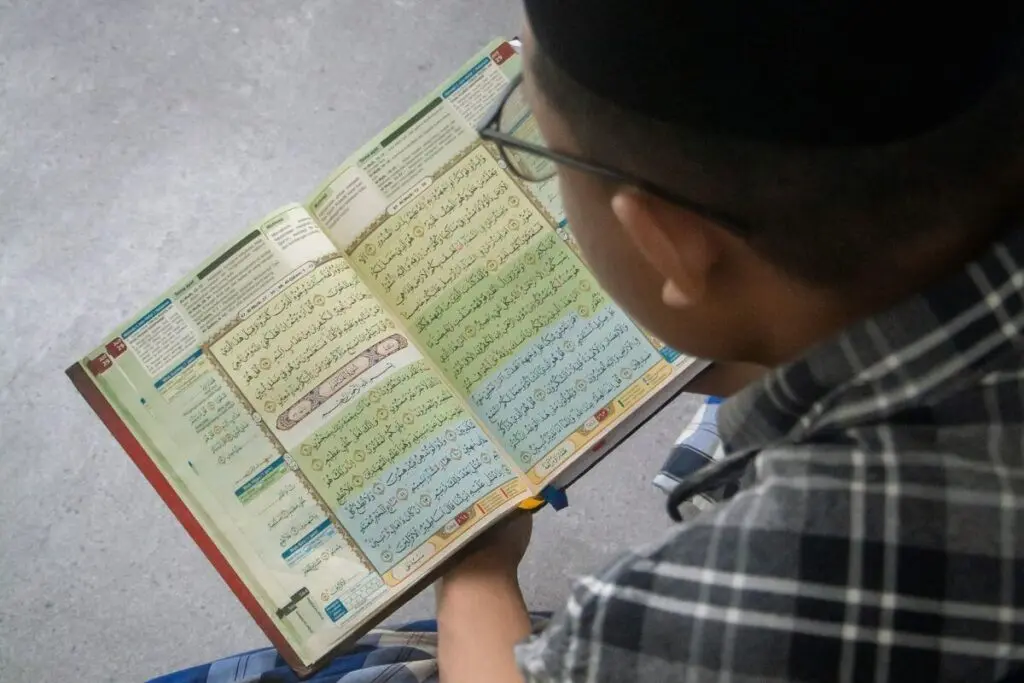
 Hifz

My grandmother could not read a single word of Arabic. But every night before bed, she recited Surah Al-Mulk from memory, word for word, the way her mother taught her.
So why do Muslims memorise the Quran when it sits on every shelf and every phone? For most, it isn’t about knowing it on paper. They want it in their hearts, where it goes with them into every prayer and every hard day.
Below, we look at the real reasons behind Hifz and the proof for each one. You’ll also see how much a Muslim actually has to memorise, how the Quran was protected long before printing, and how to begin without feeling overwhelmed.
1. To Keep Allah’s Words Safe
Allah promised to protect the Quran. One way He does this is through the hearts of people who know it by heart. He calls the Quran “clear verses in the hearts of those given knowledge” (Al-Ankabut 29:49).
The scholar Ibn al-Jazari said this is a special gift to Muslims. Other nations kept their holy books mainly on paper. Muslims keep theirs in their hearts as well.
Allah also made the Quran easy to learn. He says, “And We have made the Quran easy to remember” (Al-Qamar 54:17). Imam al-Qurtubi said this means Allah helps anyone who sets out to memorise it.
This promise is for everyone. Children have memorised the whole Quran. So have older people and people who do not speak Arabic at all.
Every new hafiz joins a long chain. That chain goes back, person by person, to the Prophet ﷺ himself. When you memorise, you help keep that chain alive in your own home.
2. To Recite More Of The Quran In Daily Prayers
Every prayer has Quran in it. The more you know by heart, the more you can choose from when you pray. Your prayers stop feeling like the same few lines each time.
This matters most in night prayer. Long night prayers need long passages. A hafiz can stand and recite for a long time without holding a book.
A hafiz can also recite outside prayer, at any time. You can recite while walking, driving, cooking, or lying in bed. No book or screen is needed, and no light either.
The reward adds up fast. The Prophet ﷺ said each letter you recite brings a good deed, and each good deed is worth ten (Tirmidhi 2910). Someone who recites often earns this again and again.
Memorising also helps you pray with more focus. When you know what you are reciting, your mind wanders less. You can think about the words instead of trying to remember the next line.
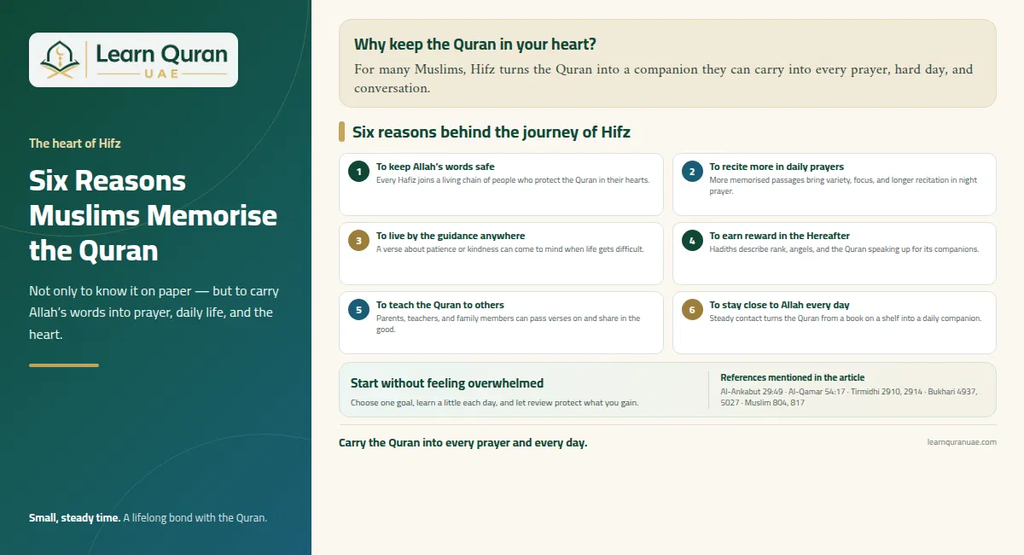
3. To live by the Quran’s guidance wherever you are
The Quran is a guide for daily life. When you know it by heart, that guide goes wherever you go.
Think of a hard moment at work or an argument at home. A verse about patience or kind words can come to mind right away. You do not need to look for a book first.
The Quran also guards the heart in times of trial. The Prophet ﷺ said whoever memorises the first ten verses of Surah Al-Kahf will be protected from the Dajjal (Muslim 809). Even a small part brings real protection.
Ideas and trends change quickly. A Muslim who holds the Quran in their heart has a steady scale to judge right from wrong, as Saaid.net explains.
This guidance also helps when you talk with others. You can share a verse with a friend who is sad or confused. The right words are already with you.
4. To Earn Great Reward In The Hereafter
The Prophet ﷺ described special rewards for the person who memorises the Quran and lives by it. He said the companion of the Quran will be told to recite and rise, and their rank will be at the last verse they recite (Tirmidhi 2914). Scholars said this is for the one who knows it by heart, as IslamQA explains.
He also said the hafiz will be with the noble angels. And the one who finds reciting hard but keeps going gets two rewards (Bukhari 4937). So a slow learner is not left behind.
The Quran will also come on the Day of Judgement to speak up for its people (Muslim 804). This is a great comfort on a very hard day. The Prophet ﷺ said Allah raises some people high through this Book (Muslim 817). Their honour starts in this world and lasts into the next.
5. To Teach The Quran To Others
The Prophet ﷺ said: “The best of you are those who learn the Quran and teach it” (Bukhari 5027). A person who memorises is ready to teach.
A hafiz can lead the prayer. The Prophet ﷺ said the one who knows the most Quran should lead (Muslim 673). In the time of Umar, the Quran reciters sat on his council, young or old (Bukhari 7286).
Teaching does not need a classroom. A mother who helps her child learn Surah Al-Ikhlas is teaching. A father who fixes a word in his son’s recitation is teaching too.
A hafiz also finds it easy to share proof from the Quran. In a talk, a lesson, or a simple chat, the right verse is ready. Others may spend a long time just finding it.
The reward of teaching lasts. Each time your student recites what you taught, you share in the good. This is why many huffaz keep teaching all their lives.
6. To Stay Close To Allah Every Day
The Prophet ﷺ said the people of the Quran are the people of Allah and His special ones (Ibn Majah 215). Being linked to Allah in this way is a huge honour.
Hifz keeps you with Allah’s words for hours each week. You repeat them, think about them, and come back to them. This steady contact turns the heart toward Allah. Many learners say the Quran stops feeling like a book on a shelf. It becomes part of their day, like a friend they speak with often.
This bond grows slowly. It comes from small, steady time with the Quran, not one big push. Even ten minutes a day can keep it alive.
It also changes how you hear the Quran. When an imam recites a passage you know, you follow every word. You feel part of the prayer, not just a listener.
Read also: Is It Hard to Memorise the Quran?
How Much Of The Quran Must Every Muslim Memorise?
Memorising the whole Quran is not required of every Muslim. Every Muslim must learn enough to pray, and at the very least, that means Surah Al-Fatihah.
Scholars call full Hifz fard kifayah. This is a duty on the whole community. As long as enough Muslims know the full Quran by heart, everyone else is free of this duty.
Learning enough Quran for prayer is fard ‘ayn. This is a personal duty that each Muslim must do for themselves. Egypt’s Dar al-Ifta explains both rulings clearly.
So, if you have not memorised the whole Quran, you are not sinning. But if you cannot recite Al-Fatihah correctly yet, make it your first goal.
How Memory And Writing Kept The Quran Safe
The Quran was kept safe in two ways at the same time. People memorised it, and scribes wrote it down. Each way checked the other.
When verses came down, the Prophet ﷺ recited them to his Companions, and many learned them by heart. Scribes wrote them down. Every Ramadan, he reviewed the Quran with the angel Jibril, and twice in his last year.
The Quran was also heard out loud in prayer every day. If someone made a mistake, others who knew the verse would correct it on the spot.
After the Prophet ﷺ died, Abu Bakr asked Zayd ibn Thabit to gather the Quran into one copy. Zayd collected it from palm stalks, flat stones, and people’s memories (Bukhari 4986). Later, Uthman had copies made and sent to the main Muslim cities (Bukhari 4987).
See How Our Online Classes Work
Get a glimpse of a real online session and explore how students learn Quran with experienced teachers in a supportive and interactive environment.
Start Learning Quran with Expert Tutors in the UAE
Accredited online Quran and Arabic classes tailored for adults and children. Schedule your session today.
Book Your Free TrialHifz Is More Than Memorising Words
Hifz is not just storing words in your head. Its goal is to bring the Quran into your prayer, your manners, and your daily choices. When Aisha was asked about the Prophet’s manners, she said, “His character was the Quran” (Muslim 746). He lived what he recited.
You can learn this way today. With each new page, read its meaning in a simple tafseer. Recite it in prayer that week. Then ask yourself: what does this page ask me to do?
Take Surah Al-Hujurat. It tells us not to mock people or spy on them. A student who memorises it should start to notice how they talk about others.
This is how the Quran Memorization (Hifz) Course at UAE Quran Academy works. Your teacher helps you memorise, checks your tajweed, and explains the meaning of each part you learn.
Personal Benefits Of Memorising The Quran
People who memorise the Quran often say it changed them in small but real ways. These changes aren’t promised, and they look different for everyone. Think of them as a bonus that may come along with your effort, not the reason you start.
- Better focus: Hifz makes you listen closely. You learn to hear the difference between a short sound and a long one, or between two letters that sound alike. After weeks of this, many students notice they pay closer attention in class and at work too.
- Stronger self-discipline: You can’t memorise the Quran only when you feel like it. You sit down at the same time each day, even on busy or tired days. Keeping that promise to yourself, month after month, slowly builds self-control you can use in other parts of life.
- A calmer heart: Allah says, “Surely in the remembrance of Allah do hearts find rest” (Ar-Ra’d 13:28). Many learners say reciting from memory, in the car or before sleep, helps them feel settled when life gets noisy. Some days you’ll feel this more than others, and that’s normal.
The Right Intention For Memorising The Quran
Ask yourself one honest question before you start: why do I want to memorise the Quran? Your answer matters more than how fast you learn or how much you finish. The best reasons are simple ones. You want to be closer to Allah. You want your prayers to feel fuller. And you want to understand His words well enough to live by them.
Understanding also protects you. When you know what a verse means, you’re less likely to get your faith wrong. And when a friend or your child asks you something, you’ll have a real answer to give.
There’s a hard truth here too. The Prophet ﷺ said one of the first people judged on the Last Day will be a man who learned the Quran just so people would call him a reciter. He got the praise he wanted in this world, and nothing more (Muslim 1905).
That’s why memorising alone doesn’t make someone a good person. As this fatwa on Islamweb puts it, Hifz is a great gift, but the real test is whether you live by what you carry.
One small habit keeps you on track. Before each lesson, pause for a moment and remind yourself who you’re doing this for. It takes ten seconds, and it changes the whole session.
How To Start Memorising The Quran, Step By Step
Thinking about the whole Quran at once can make anyone want to quit before they even begin. So don’t start there. Take these steps one at a time, and only move on when the last one feels steady.
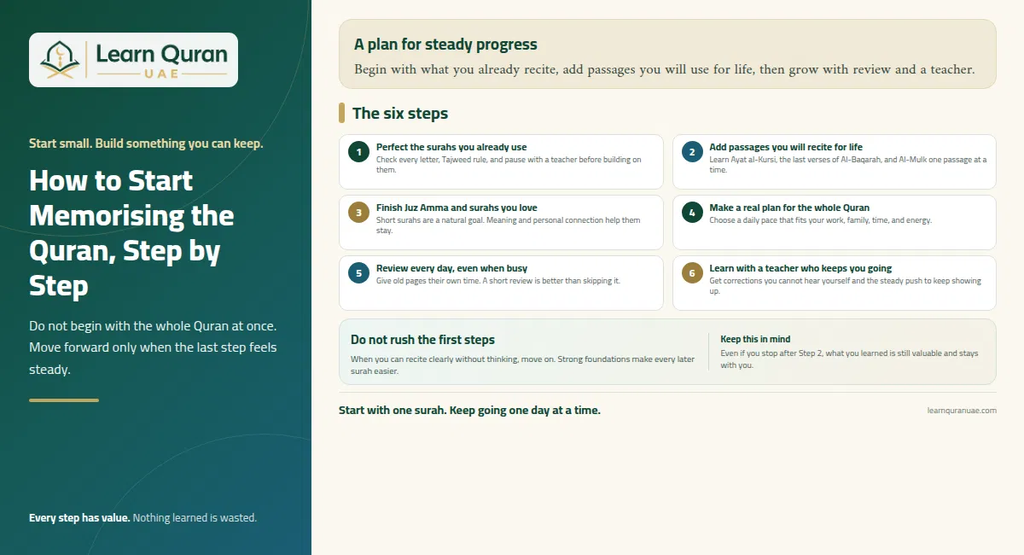
Step 1: Perfect The Surahs You Already Use In Prayer
Start with what you know. Most of us recite the same few short surahs in every prayer, and that’s the best place to begin. Sit with a teacher or a trusted recording and check each word. Are your letters coming from the right place? Are you stretching the long sounds and keeping the short ones short?
This step may feel slow, but it saves you a lot of trouble later. A small mistake you learn now will follow you into every surah after it. Fix it early, and everything you build on top will be stronger. Don’t rush to finish this step. When you can recite these surahs clearly without thinking, you’re ready for the next one.
Step 2: Add The Passages You’ll Recite For Life
Now add a few passages you’ll use again and again: Ayat al-Kursi, the last verses of Surah Al-Baqarah, and Surah Al-Mulk. These aren’t random picks. Many Muslims recite them before sleep or after prayer, so once you learn them, you’ll use them almost every day. That daily use keeps them fresh without extra effort.
Take one passage at a time. Learn a few lines, say them out loud until they flow, then add a few more. Ayat al-Kursi can take a week for one person and a few days for another, and both are fine.
By the end of this step, you’ll notice something change. You’ll catch yourself reciting while you wait in traffic or before you fall asleep. That’s when the Quran starts to feel like part of your day.
Step 3: Finish Juz Amma And A Few Surahs You Love
Juz Amma is the last part of the Quran. Its surahs are short, which makes it a natural next goal and a big win when you finish it. After Juz Amma, choose a few longer surahs that mean something to you. Maybe it’s Surah Maryam, Surah Yusuf, or a surah your parents used to recite at home.
Picking surahs you love matters more than it sounds. There will be days when you’re tired and don’t feel like opening the Mushaf. On those days, a surah you care about is much easier to come back to.
Keep reading the meaning as you go. When you know what a story is about, the verses are easier to remember and much harder to forget.
STEP 4: MAKE A REAL PLAN FOR THE WHOLE QURAN
If you decide to memorise the whole Quran, you’ll need more than good intentions. You’ll need a plan you can actually keep. How long does it take? A sermon on Alukah says a learner with a steady plan can often finish in about two years. Some take longer, some finish sooner, and that depends on your time and your pace.
Be honest about your week. If you work long hours or have small children, a smaller daily goal you keep is better than a big one you drop after a month.
Our guide on how long it takes to memorize the Quran shows what different timelines look like in daily pages. It can help you pick a pace that fits your real life.
Step 5: Review Every Day, Even When You’re Busy
This is the step most people skip, and it’s the reason many give up. They keep adding new pages, and a few weeks later the early surahs start slipping away.
The fix is simple, but it takes discipline. Give review its own time every day, separate from learning new pages. Even on a busy day, a short review is better than none.
A good rule is to treat old pages like a garden. If you stop watering them, they dry out, no matter how well you planted them.
To keep track, use a Quran memorization planner and tracker. It shows you what’s due each day, so you’re not guessing or forgetting a whole section without noticing.
Step 6: Learn With A Teacher Who Keeps You Going
You can do a lot on your own, but a teacher catches what you can’t hear yourself. A small slip in a letter or a missed pause is easy to miss when you’re reciting alone.
A teacher also keeps you honest. When you know someone is expecting you next lesson, you’re far more likely to show up prepared. That steady push matters most in the middle months, when the excitement fades.
If you’d like to try on your own first, our guide on how to learn the Quran by heart gives you a simple daily routine.
If you’d rather have a teacher with you from the start, UAE Quran Academy offers plans for different schedules and budgets. You can see the options on our pricing page and choose what fits your family.

Experience a Live Quran Class
Watch a short sample from one of our online Quran classes and discover our engaging teaching style, interactive lessons, and personalized learning approach.
Start Learning Quran with Expert Tutors in the UAE
Accredited online Quran and Arabic classes tailored for adults and children. Schedule your session today.
Book Your Free TrialBook Your Free Trial Class At UAE Quran Academy Today
Knowing why you memorise is the first step. The next step is a teacher who keeps you going and fixes mistakes before they stick.
With UAE Quran Academy, you get:
- Live one-to-one classes, so mistakes are corrected right away
- Qualified Quran teachers, with female teachers for sisters and girls
- A written Hifz plan with regular progress checks
- Flexible class times that fit school, work, and weekends
- Courses for kids, adults, ladies, and men
- A path from Juz Amma all the way to Hafiz certification
You learn from home, anywhere in the UAE. Try a free class first, meet your teacher, and get a plan that fits your level.

Our Quran Memorization Courses
Don’t wait any longer; browse our courses and start today, not tomorrow.
- Quran Memorization (Hifz) Course
- Hifz for Kids Course
- Hifz for Adults Course
- Hifz for Ladies / Sisters Course
- Hifz for Men Course
- Quran Memorization Center (UAE)
- Juz Amma Memorization Program
- Hifz Completion & Hafiz Certification
Conclusion
So, why do Muslims memorise the Quran? When you strip everything else away, it comes down to love. Love for Allah’s words, and a quiet wish to carry them close enough that they shape how you pray, speak, and live.
For some, that means memorising the whole Quran and teaching it to others. For many more, it means a handful of surahs recited every night, or a few verses that come back to mind on a hard day. Both count.
Allah doesn’t measure your Hifz only by how many pages you finish, but by how sincerely you hold on to what you learn.
If you’ve been putting this off because the goal feels too big, let it be smaller. Pick one short surah this week. Learn it slowly, recite it in your prayers, and read what it means. Next week, add a little more. A year from now, you might be surprised by how much you carry in your heart. And every verse you keep, you keep for life.
FAQs
Still have questions about memorising the Quran? Here are clear, simple answers to the ones people ask us most.
Do Muslims Memorize The Quran In Arabic Only?
Yes, Muslims memorize the Quran in Arabic, the language it was revealed in. Translations help with meaning, but only the Arabic words are recited in prayer.
Do People Memorize The Quran Without Speaking Arabic?
Yes, millions of non-Arab Muslims have memorized the whole Quran. They learn correct pronunciation with a teacher, and many study the meaning alongside.
Can Adults Memorise The Quran?
Yes, adults can memorise the Quran at any age. Shorter lessons and a steady routine work well for busy adults.
What Age Should A Child Start Memorising The Quran?
Many children start with short surahs as soon as they can repeat words clearly. A patient teacher and short, fun lessons help young learners most.
Do You Have To Memorise The Quran To Enter Paradise?
No, entering Paradise depends on faith and good deeds, not on full Hifz. Memorising the Quran with sincerity raises a person’s rank, but it is not a condition.
How Many Lines Should A Beginner Memorise Each Day?
A beginner should start with a small amount, such as a few lines a day. It is better to learn a little well than a lot poorly.
Is It Better To Memorise The Quran Or Understand It?
It is best to do both together. Memorising keeps the words with you, and understanding helps you live by them.
What Is The Difference Between A Hafiz And A Qari?
A hafiz knows the whole Quran by heart. A qari is someone skilled in reciting it beautifully with tajweed, and a person can be both.




Leave a Reply