 Hifz
Hifz

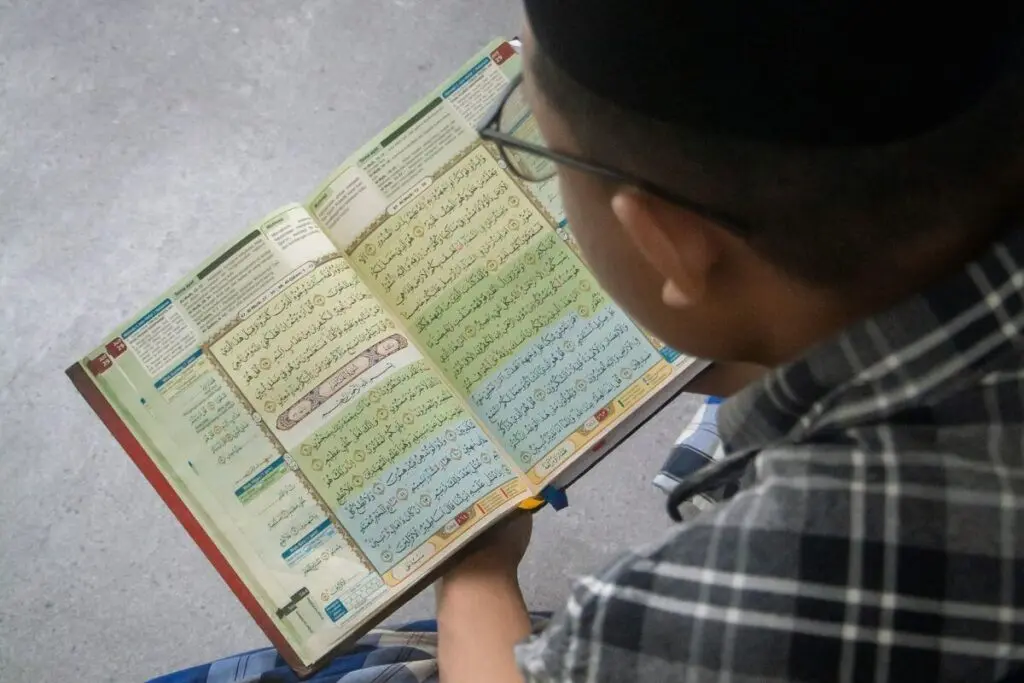
Starting Quran memorization can feel overwhelming when the Mushaf holds 114 surahs and more than 6,000 verses. The good news is that the easiest surahs to memorize are short, rhythmic, and recited daily in prayer — which means your child (or you) can start today and see real progress within a week.
This guide walks through the 10 easiest surahs to memorize, in order of length, with the Arabic text, transliteration, English meaning, and a practical tip for each. These are the same short surahs to memorize that early Muslim scholars and Huffaz recommend beginning with, all found in Juz Amma — the 30th and final part of the Quran.
Why Short Surahs Are the Best Surahs to Memorize First?
Juz Amma is the final section of the Quran, containing the shortest surahs — most between 3 and 9 verses. It’s the traditional starting point for Hifz (Quran memorization) because these surahs are recited in daily prayer, which means new memorization gets reinforced automatically, five times a day.
Short surahs also produce quick wins. A child or adult beginner can memorize a complete surah in a single sitting, which builds the confidence needed to keep going. This matters more than it sounds — momentum from early success is one of the strongest predictors of whether a student continues their Hifz journey or gives up in the first month.
If your child is just starting out, structured kids’ Hifz classes can make this first stage far smoother, since a tutor corrects pronunciation before mistakes become habits.
1. Surah Al-Kawthar
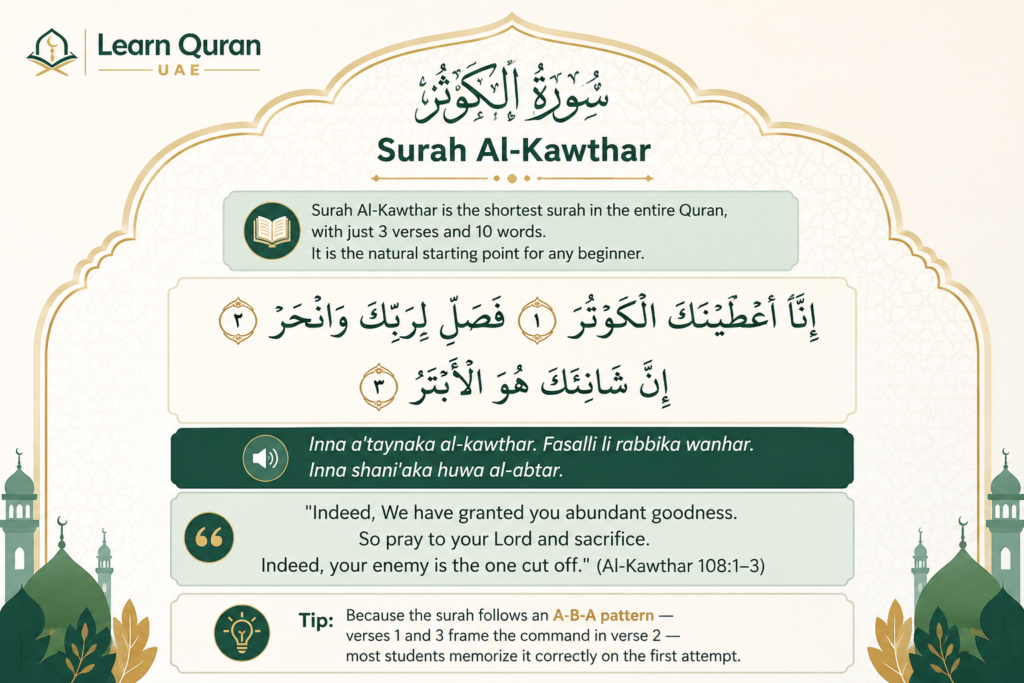
Surah Al-Kawthar is the shortest surah in the entire Quran, with just 3 verses and 10 words. It is the natural starting point for any beginner.
إِنَّا أَعْطَيْنَاكَ الْكَوْثَرَ ﴿١﴾ فَصَلِّ لِرَبِّكَ وَانْحَرْ ﴿٢﴾ إِنَّ شَانِئَكَ هُوَ الْأَبْتَرُ ﴿٣﴾
Inna a’taynaka al-kawthar. Fasalli li rabbika wanhar. Inna shani’aka huwa al-abtar.
“Indeed, We have granted you abundant goodness. So pray to your Lord and sacrifice. Indeed, your enemy is the one cut off.” (Al-Kawthar 108:1–3)
Tip: Because the surah follows an A-B-A pattern — verses 1 and 3 frame the command in verse 2 — most students memorize it correctly on the first attempt.
2. Surah Al-Asr
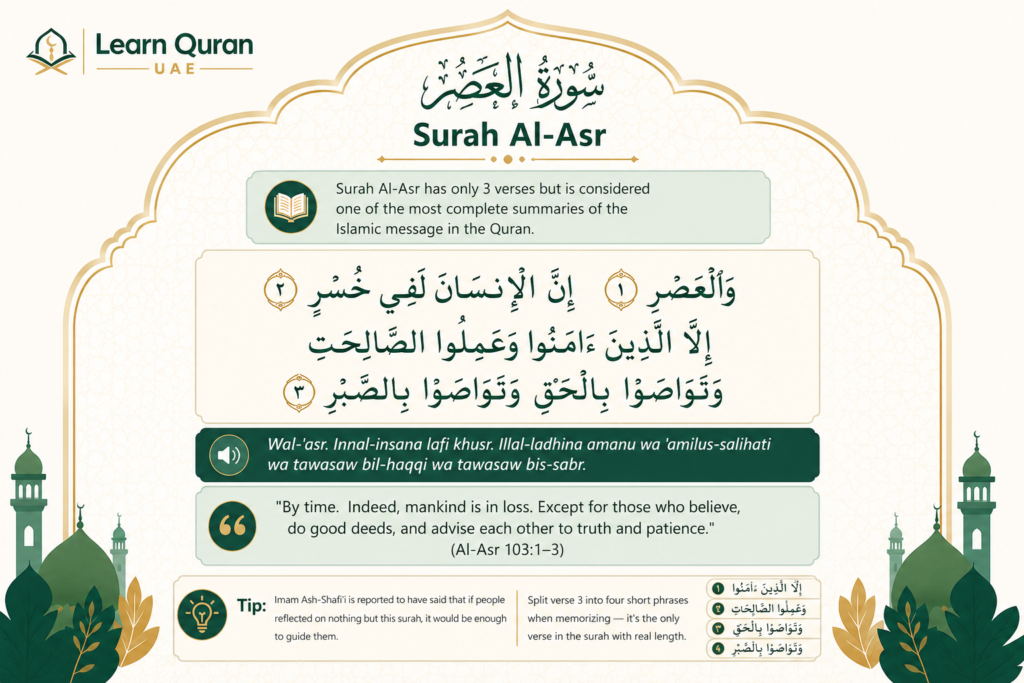
Surah Al-Asr has only 3 verses but is considered one of the most complete summaries of the Islamic message in the Quran.
وَالْعَصْرِ ﴿١﴾ إِنَّ الْإِنسَانَ لَفِي خُسْرٍ ﴿٢﴾ إِلَّا الَّذِينَ آمَنُوا وَعَمِلُوا الصَّالِحَاتِ وَتَوَاصَوْا بِالْحَقِّ وَتَوَاصَوْا بِالصَّبْرِ ﴿٣﴾
Wal-‘asr. Innal-insana lafi khusr. Illal-ladhina amanu wa ‘amilus-salihati wa tawasaw bil-haqqi wa tawasaw bis-sabr.
“By time. Indeed, mankind is in loss. Except for those who believe, do good deeds, and advise each other to truth and patience.” (Al-Asr 103:1–3)
Imam Ash-Shafi’i is reported to have said that if people reflected on nothing but this surah, it would be enough to guide them. Split verse 3 into four short phrases when memorizing — it’s the only verse in the surah with real length.
3. Surah An-Nasr
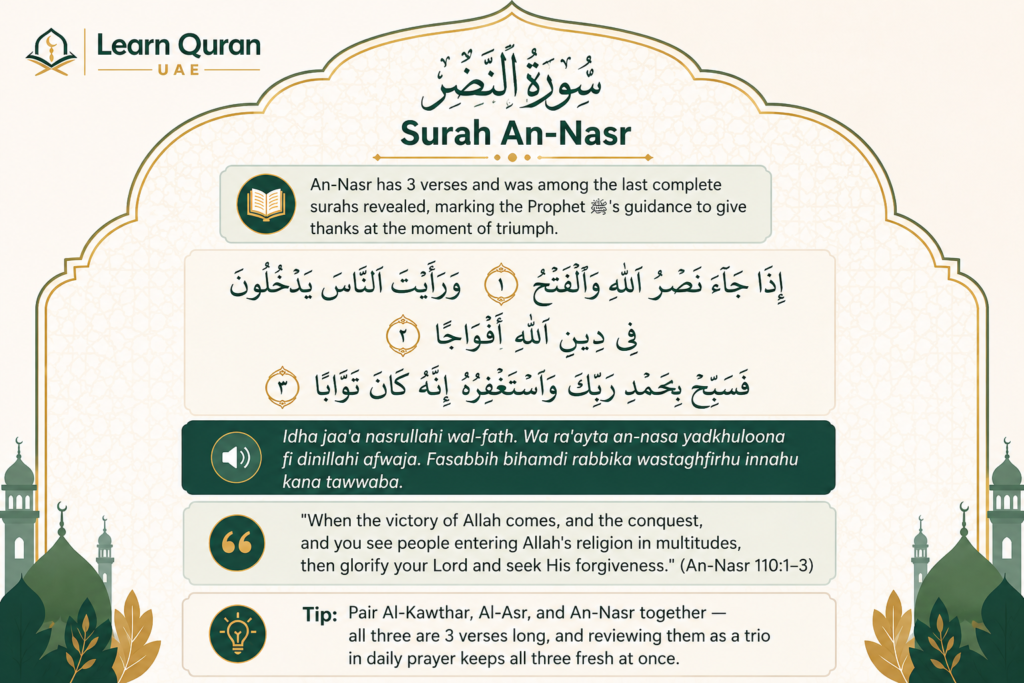
An-Nasr has 3 verses and was among the last complete surahs revealed, marking the Prophet ﷺ’s guidance to give thanks at the moment of triumph.
إِذَا جَاءَ نَصْرُ اللَّهِ وَالْفَتْحُ ﴿١﴾ وَرَأَيْتَ النَّاسَ يَدْخُلُونَ فِي دِينِ اللَّهِ أَفْوَاجًا ﴿٢﴾ فَسَبِّحْ بِحَمْدِ رَبِّكَ وَاسْتَغْفِرْهُ إِنَّهُ كَانَ تَوَّابًا ﴿٣﴾
Idha jaa’a nasrullahi wal-fath. Wa ra’ayta an-nasa yadkhuloona fi dinillahi afwaja. Fasabbih bihamdi rabbika wastaghfirhu innahu kana tawwaba.
“When the victory of Allah comes, and the conquest, and you see people entering Allah’s religion in multitudes, then glorify your Lord and seek His forgiveness.” (An-Nasr 110:1–3)
Tip: Pair Al-Kawthar, Al-Asr, and An-Nasr together — all three are 3 verses long, and reviewing them as a trio in daily prayer keeps all three fresh at once.
4. Surah Al-Ikhlas
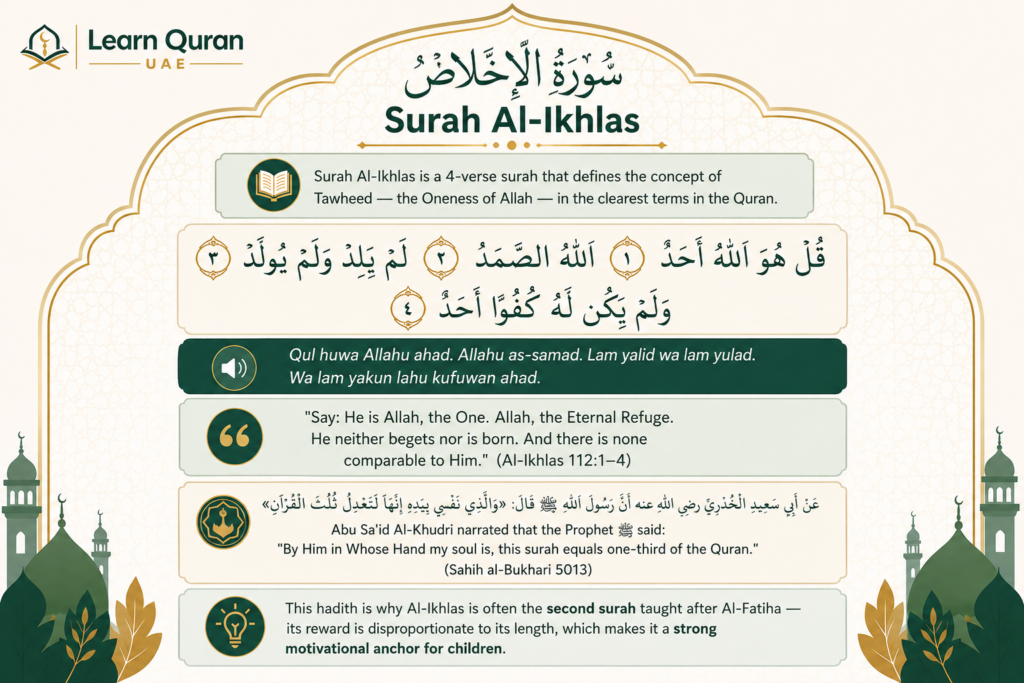
Surah Al-Ikhlas is a 4-verse surah that defines the concept of Tawheed — the Oneness of Allah — in the clearest terms in the Quran.
قُلْ هُوَ اللَّهُ أَحَدٌ ﴿١﴾ اللَّهُ الصَّمَدُ ﴿٢﴾ لَمْ يَلِدْ وَلَمْ يُولَدْ ﴿٣﴾ وَلَمْ يَكُن لَّهُ كُفُوًا أَحَدٌ ﴿٤﴾
Qul huwa Allahu ahad. Allahu as-samad. Lam yalid wa lam yulad. Wa lam yakun lahu kufuwan ahad.
“Say: He is Allah, the One. Allah, the Eternal Refuge. He neither begets nor is born. And there is none comparable to Him.” (Al-Ikhlas 112:1–4)
عَنْ أَبِي سَعِيدٍ الْخُدْرِيِّ رضى الله عنه أَنَّ رَسُولَ اللَّهِ ﷺ قَالَ: «وَالَّذِي نَفْسِي بِيَدِهِ إِنَّهَا لَتَعْدِلُ ثُلُثَ الْقُرْآنِ»
Abu Sa’id Al-Khudri narrated that the Prophet ﷺ said: “By Him in Whose Hand my soul is, this surah equals one-third of the Quran.” (Sahih al-Bukhari 5013)
This hadith is why Al-Ikhlas is often the second surah taught after Al-Fatiha — its reward is disproportionate to its length, which makes it a strong motivational anchor for children.
5. Surah Al-Falaq
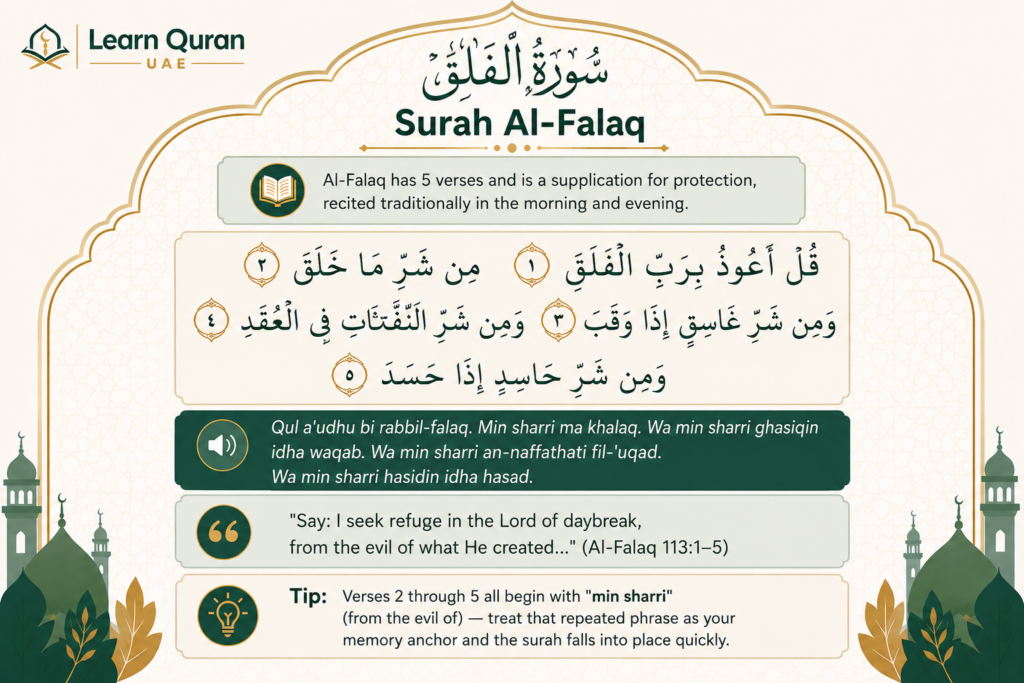
Al-Falaq has 5 verses and is a supplication for protection, recited traditionally in the morning and evening.
قُلْ أَعُوذُ بِرَبِّ الْفَلَقِ ﴿١﴾ مِن شَرِّ مَا خَلَقَ ﴿٢﴾ وَمِن شَرِّ غَاسِقٍ إِذَا وَقَبَ ﴿٣﴾ وَمِن شَرِّ النَّفَّاثَاتِ فِي الْعُقَدِ ﴿٤﴾ وَمِن شَرِّ حَاسِدٍ إِذَا حَسَدَ ﴿٥
Qul a’udhu bi rabbil-falaq. Min sharri ma khalaq. Wa min sharri ghasiqin idha waqab. Wa min sharri an-naffathati fil-‘uqad. Wa min sharri hasidin idha hasad.
“Say: I seek refuge in the Lord of daybreak, from the evil of what He created…” (Al-Falaq 113:1–5)
Tip: Verses 2 through 5 all begin with “min sharri” (from the evil of) — treat that repeated phrase as your memory anchor and the surah falls into place quickly.
Read also: How To Memorize Quran In 30 Days / 1 Month?
Experience a Live Quran Class
Watch a short sample from one of our online Quran classes and discover our engaging teaching style, interactive lessons, and personalized learning approach.
Start Learning Quran with Expert Tutors in the UAE
Accredited online Quran and Arabic classes tailored for adults and children. Schedule your session today.
Book Your Free Trial6. Surah An-Nas
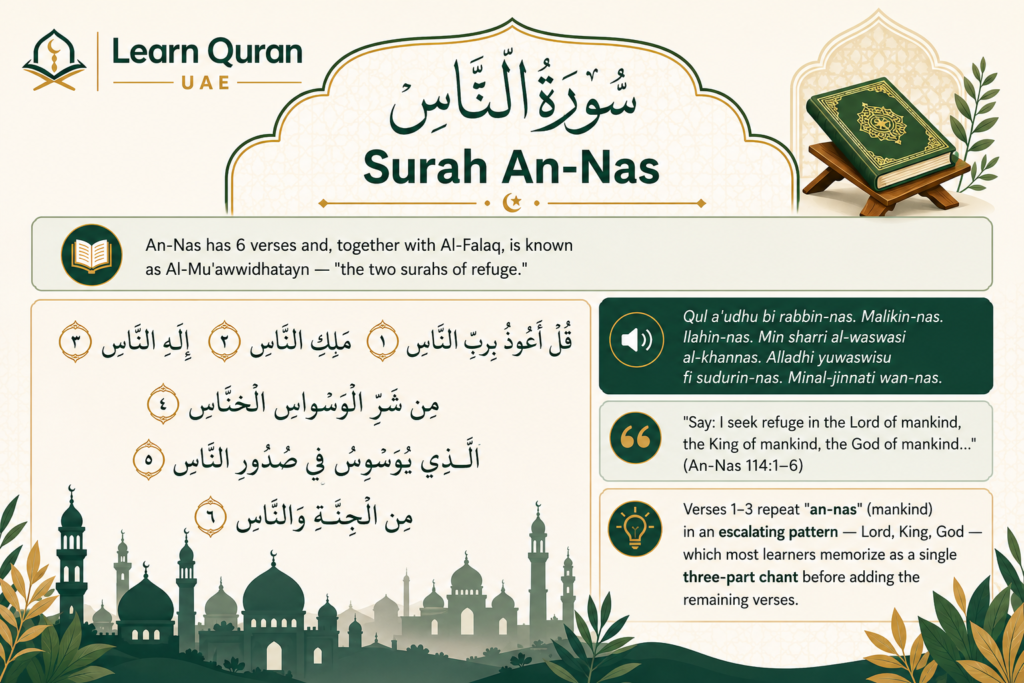
An-Nas has 6 verses and, together with Al-Falaq, is known as Al-Mu’awwidhatayn — “the two surahs of refuge.”
قُلْ أَعُوذُ بِرَبِّ النَّاسِ ﴿١﴾ مَلِكِ النَّاسِ ﴿٢﴾ إِلَٰهِ النَّاسِ ﴿٣﴾ مِن شَرِّ الْوَسْوَاسِ الْخَنَّاسِ ﴿٤﴾ الَّذِي يُوَسْوِسُ فِي صُدُورِ النَّاسِ ﴿٥﴾ مِنَ الْجِنَّةِ وَالنَّاسِ ﴿٦
Qul a’udhu bi rabbin-nas. Malikin-nas. Ilahin-nas. Min sharri al-waswasi al-khannas. Alladhi yuwaswisu fi sudurin-nas. Minal-jinnati wan-nas.
“Say: I seek refuge in the Lord of mankind, the King of mankind, the God of mankind…” (An-Nas 114:1–6)
Verses 1–3 repeat “an-nas” (mankind) in an escalating pattern — Lord, King, God — which most learners memorize as a single three-part chant before adding the remaining verses.
7. Surah Quraysh
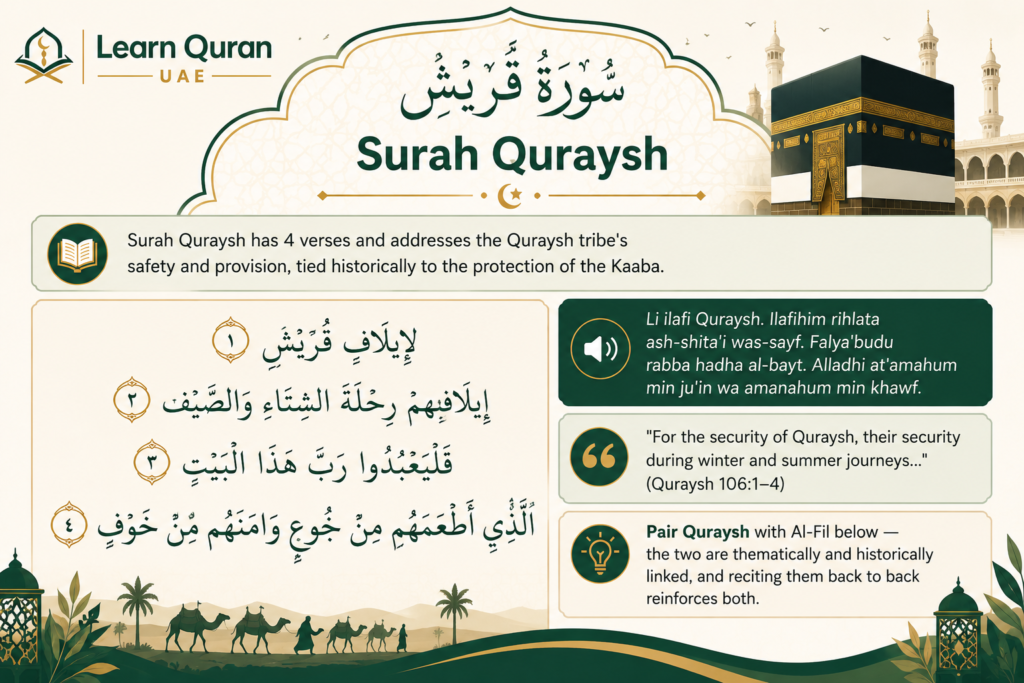
Surah Quraysh has 4 verses and addresses the Quraysh tribe’s safety and provision, tied historically to the protection of the Kaaba.
لِإِيلَافِ قُرَيْشٍ ﴿١﴾ إِيلَافِهِمْ رِحْلَةَ الشِّتَاءِ وَالصَّيْفِ ﴿٢﴾ فَلْيَعْبُدُوا رَبَّ هَٰذَا الْبَيْتِ ﴿٣﴾ الَّذِي أَطْعَمَهُم مِّن جُوعٍ وَآمَنَهُم مِّنْ خَوْفٍ ﴿٤﴾
Li ilafi Quraysh. Ilafihim rihlata ash-shita’i was-sayf. Falya’budu rabba hadha al-bayt. Alladhi at’amahum min ju’in wa amanahum min khawf.
“For the security of Quraysh, their security during winter and summer journeys…” (Quraysh 106:1–4)
Pair Quraysh with Al-Fil below — the two are thematically and historically linked, and reciting them back to back reinforces both.
8. Surah Al-Fil
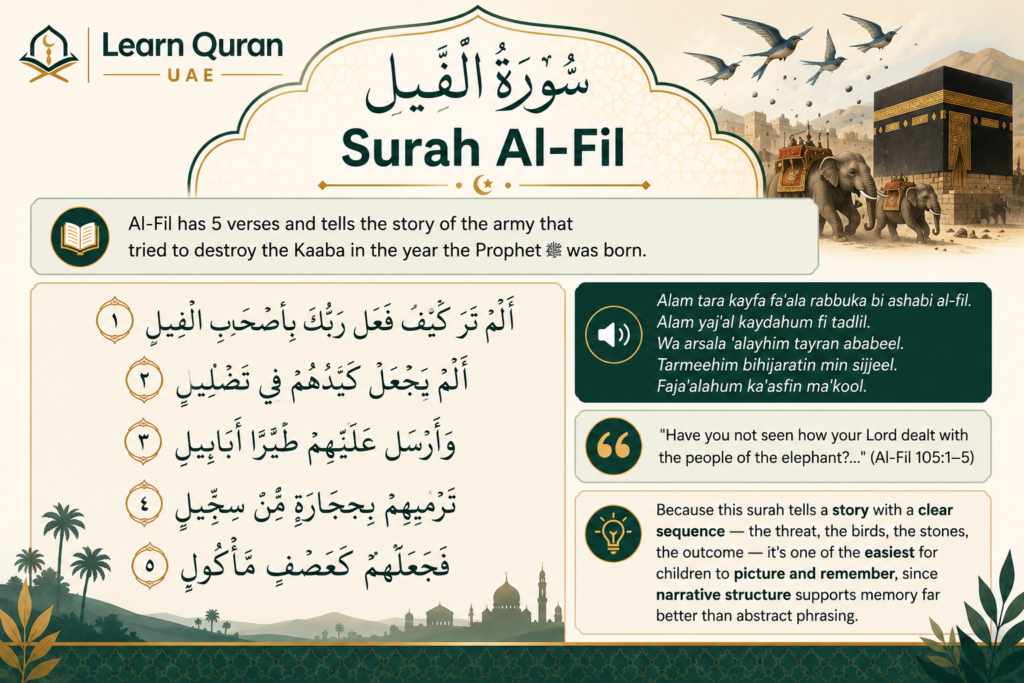
Al-Fil has 5 verses and tells the story of the army that tried to destroy the Kaaba in the year the Prophet ﷺ was born.
أَلَمْ تَرَ كَيْفَ فَعَلَ رَبُّكَ بِأَصْحَابِ الْفِيلِ ﴿١﴾ أَلَمْ يَجْعَلْ كَيْدَهُمْ فِي تَضْلِيلٍ ﴿٢﴾ وَأَرْسَلَ عَلَيْهِمْ طَيْرًا أَبَابِيلَ ﴿٣﴾ تَرْمِيهِم بِحِجَارَةٍ مِّن سِجِّيلٍ ﴿٤﴾ فَجَعَلَهُمْ كَعَصْفٍ مَّأْكُولٍ ﴿٥﴾
Alam tara kayfa fa’ala rabbuka bi ashabi al-fil. Alam yaj’al kaydahum fi tadlil. Wa arsala ‘alayhim tayran ababeel. Tarmeehim bihijaratin min sijjeel. Faja’alahum ka’asfin ma’kool.
“Have you not seen how your Lord dealt with the people of the elephant?…” (Al-Fil 105:1–5)
Because this surah tells a story with a clear sequence — the threat, the birds, the stones, the outcome — it’s one of the easiest for children to picture and remember, since narrative structure supports memory far better than abstract phrasing.
9. Surah Al-Ma’un
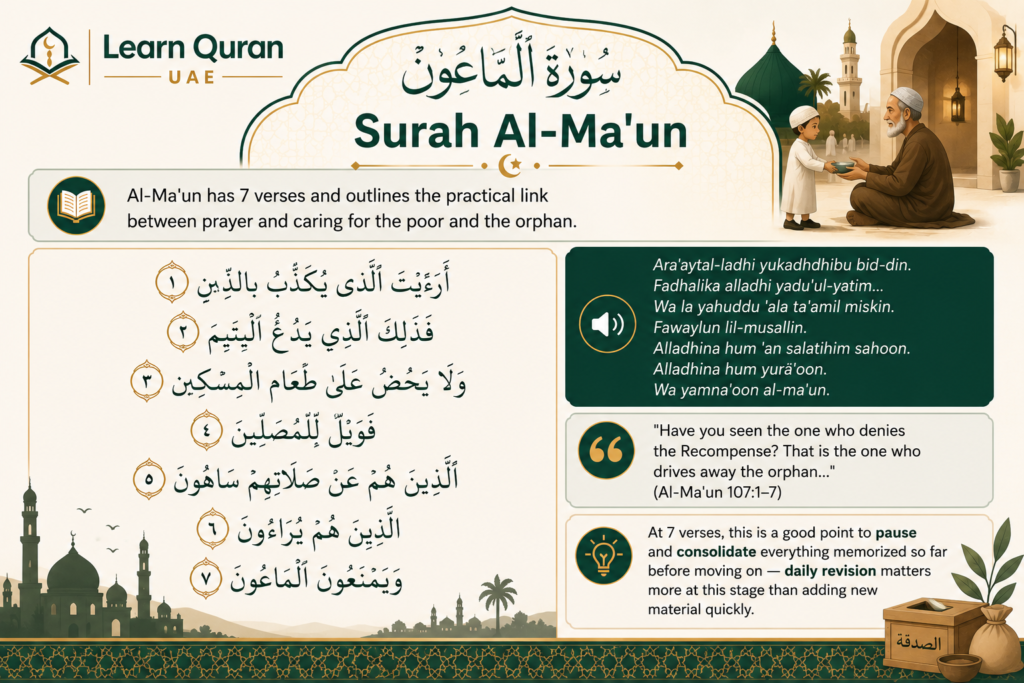
Al-Ma’un has 7 verses and outlines the practical link between prayer and caring for the poor and the orphan.
أَرَأَيْتَ الَّذِي يُكَذِّبُ بِالدِّينِ ﴿١﴾ فَذَٰلِكَ الَّذِي يَدُعُّ الْيَتِيمَ ﴿٢﴾ وَلَا يَحُضُّ عَلَىٰ طَعَامِ الْمِسْكِينِ ﴿٣﴾ فَوَيْلٌ لِّلْمُصَلِّينَ ﴿٤﴾ الَّذِينَ هُمْ عَن صَلَاتِهِمْ سَاهُونَ ﴿٥﴾ الَّذِينَ هُمْ يُرَاءُونَ ﴿٦﴾ وَيَمْنَعُونَ الْمَاعُونَ ﴿٧﴾
Ara’aytal-ladhi yukadhdhibu bid-din. Fadhalika alladhi yadu’ul-yatim…
“Have you seen the one who denies the Recompense? That is the one who drives away the orphan…” (Al-Ma’un 107:1–7)
At 7 verses, this is a good point to pause and consolidate everything memorized so far before moving on — daily revision matters more at this stage than adding new material quickly.
10. Surah Al-Fatiha
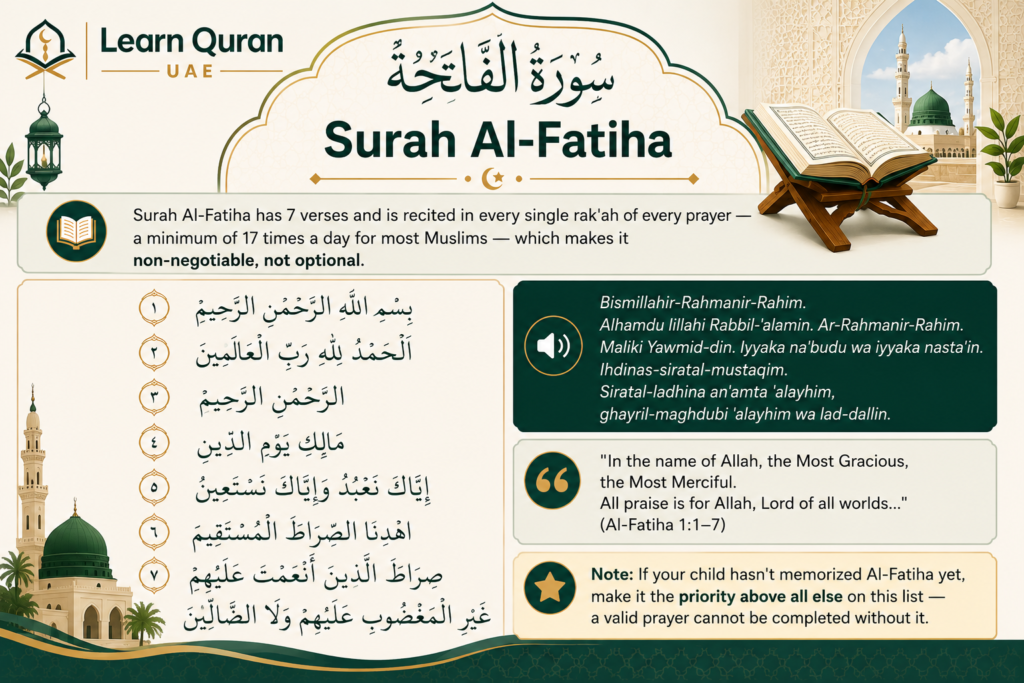
Surah Al-Fatiha has 7 verses and is recited in every single rak’ah of every prayer — a minimum of 17 times a day for most Muslims — which makes it non-negotiable, not optional.
بِسْمِ اللَّهِ الرَّحْمَٰنِ الرَّحِيمِ ﴿١﴾ الْحَمْدُ لِلَّهِ رَبِّ الْعَالَمِينَ ﴿٢﴾ الرَّحْمَٰنِ الرَّحِيمِ ﴿٣﴾ مَالِكِ يَوْمِ الدِّينِ ﴿٤﴾ إِيَّاكَ نَعْبُدُ وَإِيَّاكَ نَسْتَعِينُ ﴿٥﴾ اهْدِنَا الصِّرَاطَ الْمُسْتَقِيمَ ﴿٦﴾ صِرَاطَ الَّذِينَ أَنْعَمْتَ عَلَيْهِمْ غَيْرِ الْمَغْضُوبِ عَلَيْهِمْ وَلَا الضَّالِّينَ ﴿٧﴾
Bismillahir-Rahmanir-Rahim. Alhamdu lillahi Rabbil-‘alamin. Ar-Rahmanir-Rahim. Maliki Yawmid-din. Iyyaka na’budu wa iyyaka nasta’in. Ihdinas-siratal-mustaqim. Siratal-ladhina an’amta ‘alayhim, ghayril-maghdubi ‘alayhim wa lad-dallin.
“In the name of Allah, the Most Gracious, the Most Merciful. All praise is for Allah, Lord of all worlds…” (Al-Fatiha 1:1–7)
Note: If your child hasn’t memorized Al-Fatiha yet, make it the priority above all else on this list — a valid prayer cannot be completed without it.
How to Memorize Each Surah, Step by Step
This method works whether you’re memorizing alongside your child or on your own, and it’s the same sequence used across each surah above.
Step 1 — Listen before reciting
Play a qualified reciter 8–10 times without attempting to repeat. This builds correct pronunciation in the ear before the tongue tries to reproduce it, which prevents locked-in mistakes later.
Step 2 — Repeat with the text, then without it
Read and repeat each verse roughly 20 times while looking at the Arabic, then another 20 times from memory alone.
Step 3 — Connect verses in pairs
Memorize verses 1–2, then 3–4, then link them together, rather than trying to absorb the whole surah in one block. The brain retains chunked information far better than long unbroken passages.
Step 4 — Use the surah in prayer immediately
Reciting a newly memorized surah in salah within 24 hours cements it faster than passive review alone.
A common mistake we see in beginners: rushing past correct Tajweed to “get through” the surah faster. Fixing a mispronounced letter after it’s become a habit takes far longer than learning it correctly the first time — which is exactly where guided Hifz classes make the biggest difference, since a tutor corrects errors in real time instead of letting them repeat for weeks.
If you’re an adult learner rather than a parent teaching a child, the same sequence applies — many working adults fit these steps into a lunch break or the time right after Fajr, and structured Hifz classes for adults are built around exactly that kind of flexible schedule.
Read also: How to Memorize Quran Fast? 10 Proven Steps
See How Our Online Classes Work
Get a glimpse of a real online session and explore how students learn Quran with experienced teachers in a supportive and interactive environment.
Help Your Child Memorize Easy Surahs with Learn Quran UAE
Learning easy surahs to memorize is the perfect first step toward a lifelong Hifz journey. The 10 surahs featured in this guide are short, meaningful, and ideal for helping children build confidence while developing a consistent memorization habit. Starting with manageable surahs allows young learners to focus on correct pronunciation, understand the rhythm of Quranic recitation, and experience the joy of steady progress.
At Learn Quran UAE, we transform these first memorization milestones into a strong foundation for long-term success. Our experienced Quran teachers provide personalized one-on-one Hifz lessons, teach every surah with proper Tajweed, and use structured revision techniques that help children retain what they memorize instead of forgetting it after a few days.
[Book Your Free Trial Class Today]
Our Quran Memorization Courses
- Quran Memorization (Hifz) Course
- Hifz for Kids Course
- Hifz for Adults Course
- Hifz for Ladies / Sisters Course
- Hifz for Men Course
- Quran Memorization Center (UAE)
- Juz Amma Memorization Program
- Hifz Completion & Hafiz Certification
Enroll today and begin your journey toward becoming a Hafiz with expert guidance, personalized learning plans, and flexible online classes.
Start Learning Quran with Expert Tutors in the UAE
Accredited online Quran and Arabic classes tailored for adults and children. Schedule your session today.
Book Your Free Trial
Conclusion
The easiest surahs to memorize aren’t a lesser starting point — they’re the foundation every hafiz builds on. Starting with Al-Kawthar, Al-Asr, and An-Nasr, then working through Al-Ikhlas, Al-Falaq, An-Nas, Quraysh, Al-Fil, Al-Ma’un, and Al-Fatiha gives a beginner ten usable surahs within a few weeks of consistent daily practice.
What matters most isn’t speed — it’s correct pronunciation from the very first repetition, and daily revision once a surah is learned. Short, steady sessions beat long, irregular ones every time.
FAQs
How long does it take to memorize these 10 easy surahs?
Most beginners memorize all 10 surahs listed above within 3–6 weeks with 15–20 minutes of daily practice. Children often move faster due to stronger short-term retention, while consistency matters more than session length for adult learners.
Should I learn Tajweed before memorizing these surahs?
It’s best to learn basic Tajweed rules alongside memorization rather than waiting to finish one before starting the other. Correcting a mispronunciation after it’s become a habit takes far longer than learning it correctly from the start.
What is the reward for memorizing Surah Al-Ikhlas?
The Prophet ﷺ said that Surah Al-Ikhlas equals one-third of the Quran in reward, as recorded in Sahih al-Bukhari 5013. Its short length combined with this narration is why many teachers assign it as the second surah after Al-Fatiha.
Can young children memorize these surahs on their own?
Children can memorize short surahs quickly, but pronunciation still needs correction from a qualified teacher. Left uncorrected, small mistakes in letters like غ (ghayn) or ص (saad) can become permanent habits that are harder to fix later.
What is the best surah to memorize first for daily prayer?
Surah Al-Fatiha should be memorized first, since it’s recited in every rak’ah of every prayer. After that, Al-Ikhlas, Al-Falaq, and An-Nas are the most commonly prioritized, as they’re recited daily in morning and evening supplications.




Leave a Reply