 Hifz
Hifz

Most parents who set out to memorize Juz Amma with their child start the same way: they open Surah An-Naba, the first surah in the juz, and try to memorize it in order. Within a few weeks, momentum stalls. The surah is long, the child feels discouraged, and the whole effort gets shelved.
A working Juz Amma memorization plan does the opposite. It starts at the end of the juz, builds a daily rhythm before it builds ambition, and treats revision as part of memorization rather than something that happens “later.” Juz Amma — also called Juz 30, the final and shortest juz of the Quran — is the standard entry point into Hifz for exactly this reason: its 37 surahs are short, rhythmic, and already familiar from daily Salah.
This guide lays out a realistic, step-by-step plan you can follow at home, whether you’re building it for your child or for yourself. It covers sequencing, daily session structure, revision, Tajweed, and realistic timelines — including an honest answer to whether Juz Amma can really be memorized in 30 days.
What a Juz Amma Memorization Plan Should Actually Include?
Juz Amma is the 30th and final part of the Quran, made up of 37 surahs, most of them under ten ayat. A memorization plan for Juz Amma is a structured sequence of what to memorize, in what order, for how long each day, with revision built in from the first session — not just an intention to “start memorizing.”
A plan built on intention alone tends to fail for a predictable reason: without a sequence and a daily time slot, memorization competes with every other demand on a child’s (or an adult’s) day and loses. The four elements below are what separate a plan that finishes Juz Amma from one that stalls at surah six.
1. Start Your Plan at the End of Juz Amma, Not the Beginning
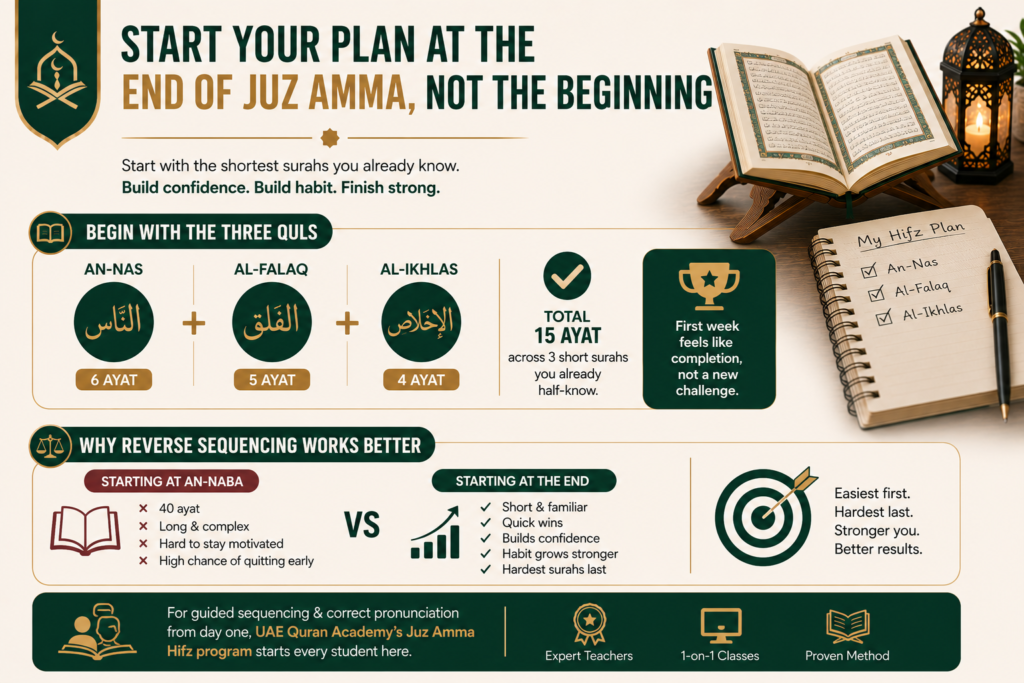
The most effective starting point for Juz Amma memorization is the last three surahs: An-Nas, Al-Falaq, and Al-Ikhlas. These are the shortest surahs in the Quran, and most children and new memorizers already recognize them from daily prayer, which means the first week of the plan feels like completion rather than a new, unfamiliar task.
Begin With the Three Quls An-Nas has 6 ayat, Al-Falaq has 5, and Al-Ikhlas has 4 — a combined 15 ayat across three surahs a beginner already half-knows. Starting here removes the single biggest obstacle to sticking with a memorization plan: the discouragement of week one.
Why Reverse Sequencing Works Better Than Starting at An-Naba?
Surah An-Naba, the first surah in Juz Amma, has 40 ayat with dense, multi-clause verses — a difficult entry point for someone who hasn’t yet built a memorization habit. Reverse sequencing puts the easiest material first and the hardest material last, by which point the learner has months of habit and stamina behind them. This is a basic principle of skill-building — sequencing tasks from low to high difficulty — applied specifically to how Juz Amma’s surahs are structured, since they generally get longer moving from Surah 114 toward Surah 78.
If you’re building this plan for a child and want a teacher to guide the sequencing and correct pronunciation from the first session, UAE Quran Academy’s Juz Amma Hifz program starts every student at exactly this point.
2. Set a Fixed Daily Session and a Weekly Rhythm
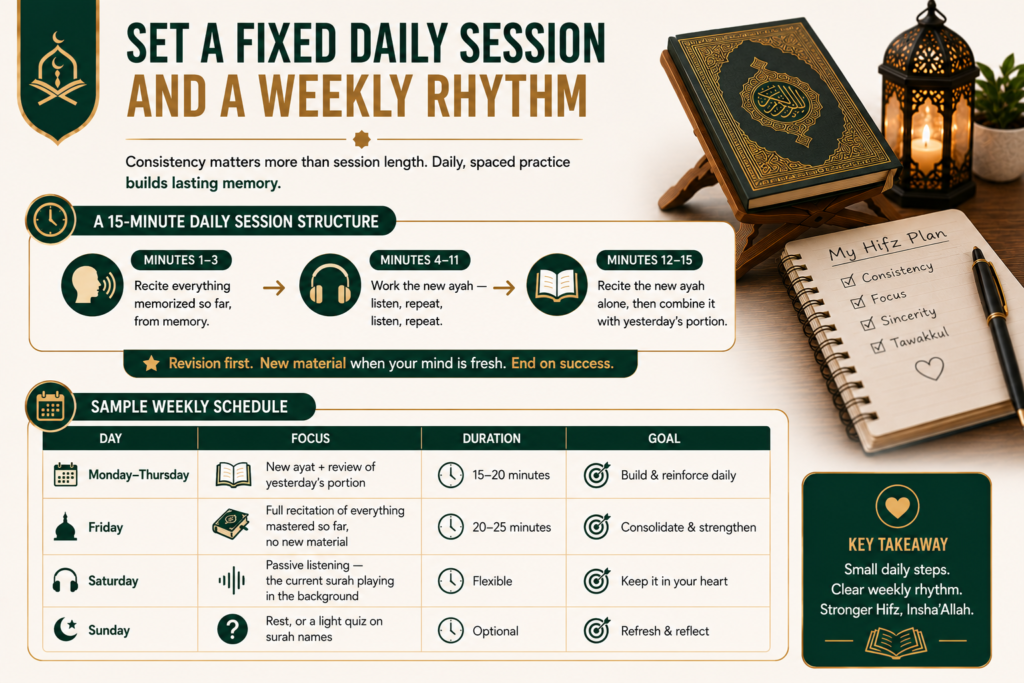
Consistency matters more than session length. A focused 15-minute daily session builds stronger retention than an occasional 90-minute session, because memory needs repeated, spaced exposure — not a single long push — to move from short-term to long-term recall.
A 15-Minute Daily Session Structure
Before listing the structure, note that the order matters: revision comes first, new material comes when attention is freshest, and the session ends on something already mastered.
- Minutes 1–3: Recite everything memorized so far, from memory
- Minutes 4–11: Work the new ayah — listen, repeat, listen, repeat
- Minutes 12–15: Recite the new ayah alone, then combine it with yesterday’s portion
Sample Weekly Schedule
A weekly rhythm keeps the plan sustainable instead of turning every day into new-material pressure. The table below spreads new memorization across weekdays and reserves two days for consolidation.
| Day | Focus | Duration |
| Monday–Thursday | New ayat + review of yesterday’s portion | 15–20 minutes |
| Friday | Full recitation of everything mastered so far, no new material | 20–25 minutes |
| Saturday | Passive listening — the current surah playing in the background | Flexible |
| Sunday | Rest, or a light quiz on surah names | Optional |
3. Sequence the Remaining Surahs by Length and Difficulty
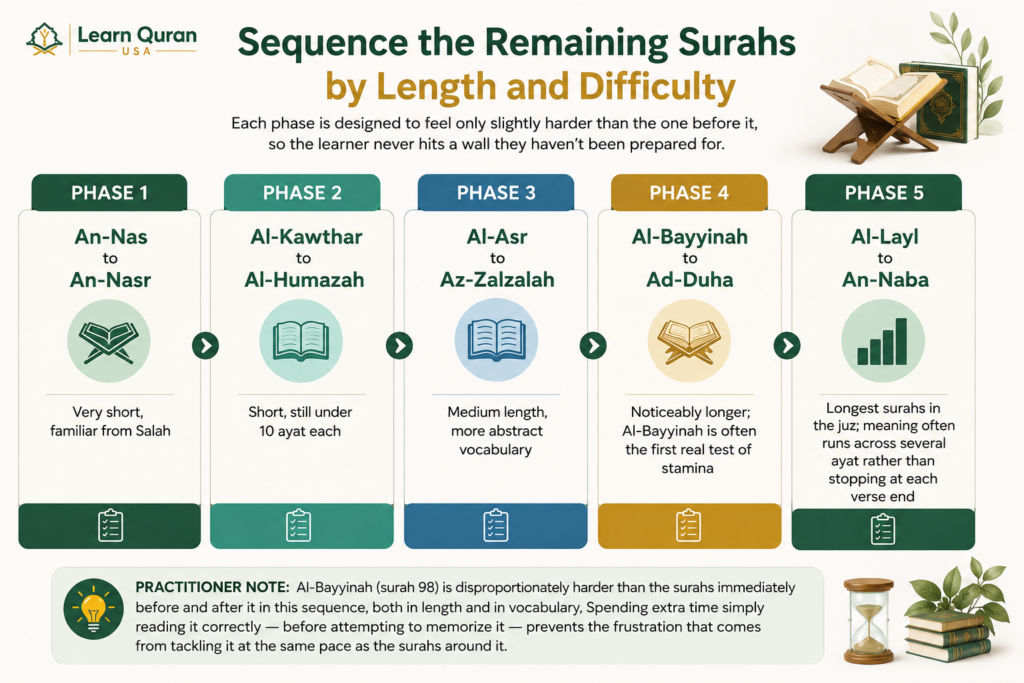
Before listing the phases, note the underlying logic: each phase should feel only slightly harder than the one before it, so the learner never hits a wall they haven’t been prepared for.
| Phase | Surah range (roughly) | What defines it |
| Phase 1 | An-Nas to An-Nasr | Very short, familiar from Salah |
| Phase 2 | Al-Kawthar to Al-Humazah | Short, still under 10 ayat each |
| Phase 3 | Al-Asr to Az-Zalzalah | Medium length, more abstract vocabulary |
| Phase 4 | Al-Bayyinah to Ad-Duha | Noticeably longer; Al-Bayyinah is often the first real test of stamina |
| Phase 5 | Al-Layl to An-Naba | Longest surahs in the juz; meaning often runs across several ayat rather than stopping at each verse end |
A practitioner note worth planning around: Al-Bayyinah (surah 98) is disproportionately harder than the surahs immediately before and after it in this sequence, both in length and in vocabulary. Spending extra time simply reading it correctly — before attempting to memorize it — prevents the frustration that comes from tackling it at the same pace as the surahs around it.
4. Build Daily Revision Into the Plan From Day One
New memorization without built-in revision is temporary. A learner can memorize ten surahs over several months and discover, on reaching the eleventh, that the first three have already faded — not from lack of ability, but because nothing kept them active in memory.

This isn’t a minor risk. The Prophet ﷺ warned directly about how easily memorized Quran is lost without deliberate upkeep:
تَعَاهَدُوا الْقُرْآنَ فَوَالَّذِي نَفْسِي بِيَدِهِ لَهُوَ أَشَدُّ تَفَصِّيًا مِنْ الْإِبِلِ فِي عُقُلِهَا
“Keep on reciting the Quran, for by Him in Whose Hand my soul is, it escapes faster than a hobbled camel escapes its tying ropes.” (Sahih al-Bukhari 5033)
The image the hadith uses — a camel straining against its rope — describes exactly what unrevised memorization feels like: it doesn’t disappear all at once, it works itself loose gradually until it’s gone. A revision system is the rope.
Progress you can actually verify matters more than progress you assume is there. A qualified teacher checking recitation weekly catches the gap between “memorized once” and “retained” before it becomes a pattern — something UAE Quran Academy’s Hifz instructors build into every session through live correction rather than leaving revision to chance.
Experience a Live Quran Class
Watch a short sample from one of our online Quran classes and discover our engaging teaching style, interactive lessons, and personalized learning approach.
Start Learning Quran with Expert Tutors in the UAE
Accredited online Quran and Arabic classes tailored for adults and children. Schedule your session today.
Book Your Free TrialRead also: Best Country to Learn Quran
5. Correct Tajweed as You Go, Not After
Treating memorization and Tajweed as two separate phases — memorize first, fix pronunciation later — tends to embed errors that take much longer to unlearn than they would have taken to prevent. If a surah is memorized with an incorrect letter articulation, that error is stored in long-term memory alongside the correct words.
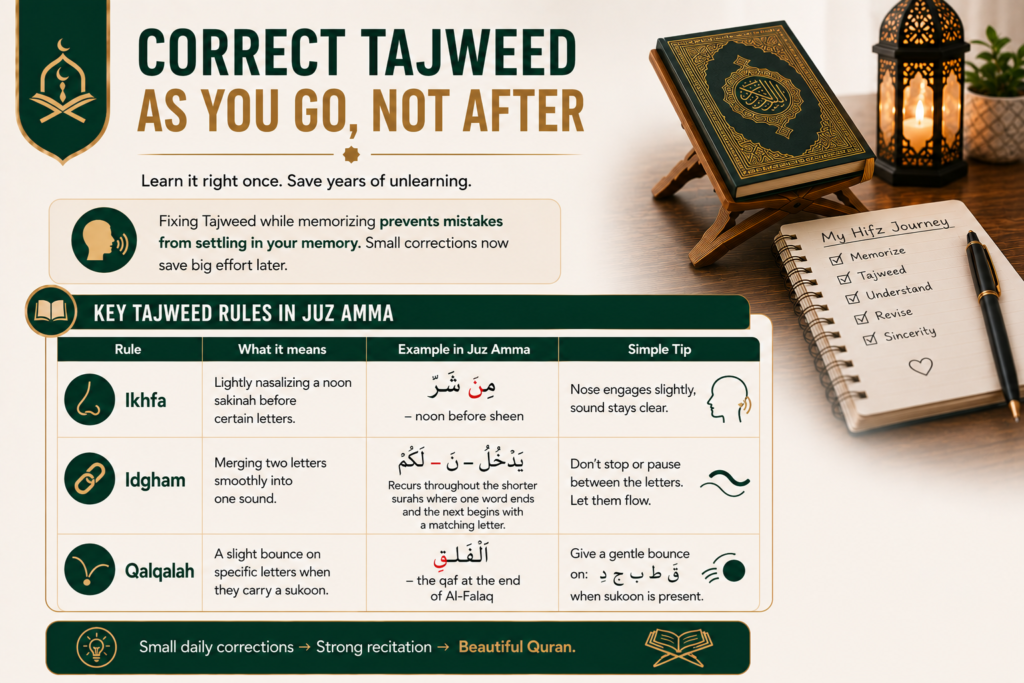
The rules that appear most often in Juz Amma aren’t advanced Tajweed — they show up constantly and can be introduced in plain language while memorization is happening, not as a separate later unit.
| Rule | What it means | Example in Juz Amma |
| Ikhfa | Lightly nasalizing a noon sakinah before certain letters | مِن شَرِّ — noon before sheen |
| Idgham | Merging two letters smoothly into one sound | Recurs throughout the shorter surahs where one word ends and the next begins with a matching letter |
| Qalqalah | A slight bounce on specific letters when they carry a sukoon | الْفَلَقِ — the qaf at the end of Al-Falaq |
6. Anchor Memorization to Meaning
A memorizer who understands what they’re reciting retains it longer than one memorizing sound alone, because the words carry meaning that anchors the memory instead of floating free as pure repetition. This doesn’t require formal Tafsir study — one plain sentence of meaning per surah is enough to shift memorization from rote to connected.
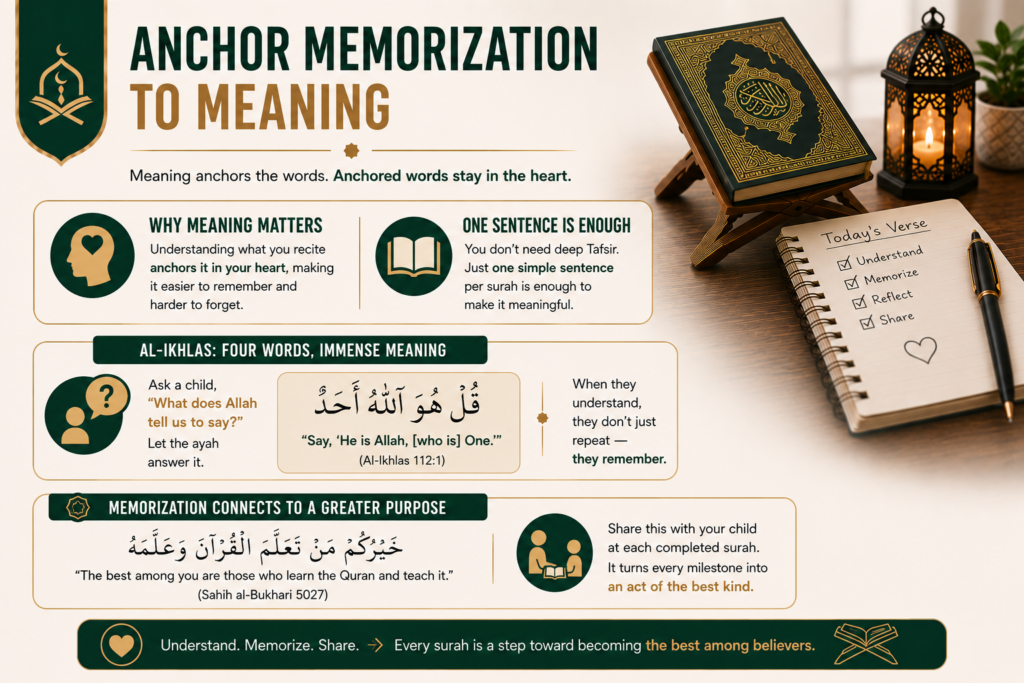
Al-Ikhlas is the clearest example. Four words, immense meaning:
قُلْ هُوَ ٱللَّهُ أَحَدٌ
“Say, ‘He is Allah, [who is] One.'” (Al-Ikhlas 112:1)
Asking a child “what does Allah tell us to say?” and letting the ayah itself be the answer turns four words into something they’ve actually understood, not just repeated.
This kind of anchoring also connects memorization to a deeper motivation. The Prophet ﷺ described learning and teaching the Quran as the mark of the best among believers:
خَيْرُكُمْ مَنْ تَعَلَّمَ الْقُرْآنَ وَعَلَّمَهُ
“The best among you are those who learn the Quran and teach it.” (Sahih al-Bukhari 5027)
Sharing that with a child at each completed surah connects the plan to something bigger than a checklist — it reframes each milestone as a form of the good the hadith describes, not just an academic target.
How Long Does It Take to Memorize Juz Amma?
The honest answer depends on age, daily consistency, and whether a teacher is correcting pronunciation along the way — but most learners with a real daily habit finish in several months, not days.
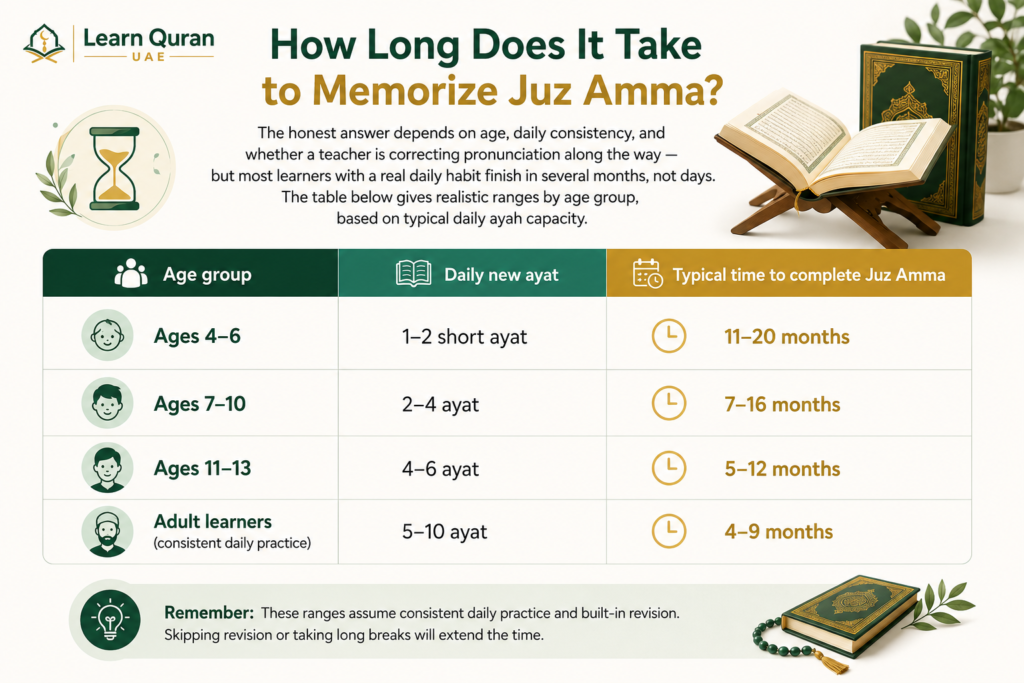
The table below gives realistic ranges by age group, based on typical daily ayah capacity.
| Age group | Daily new ayat | Typical time to complete Juz Amma |
| Ages 4–6 | 1–2 short ayat | 11–20 months |
| Ages 7–10 | 2–4 ayat | 7–16 months |
| Ages 11–13 | 4–6 ayat | 5–12 months |
| Adult learners (consistent daily practice) | 5–10 ayat | 4–9 months |
Can Juz Amma be memorized in 30 days?
For most learners, no — not with retention that lasts. Juz Amma has roughly 564 ayat across 37 surahs; committing that volume to reliable long-term memory in 30 days would require memorizing close to 19 ayat a day with no revision time, which leaves nothing for the review that prevents forgetting.
A 30-day plan can realistically cover the first 8–10 surahs (the short surahs from An-Nas through roughly Al-Fil) with solid retention — a strong first milestone, not the whole juz. Anyone marketing a full 30-day Juz Amma memorization plan is describing initial exposure, not durable Hifz.
See How Our Online Classes Work
Get a glimpse of a real online session and explore how students learn Quran with experienced teachers in a supportive and interactive environment.
Read also: How to Memorize the Quran Faster?
Give Your Child or Yourself Structured, Supervised Progress
A written plan gives you the sequence. What it can’t give you is real-time correction — catching a mispronounced letter, an inconsistent revision habit, or a surah that was “memorized” but never actually secured. Home practice builds frequency; a qualified instructor builds accuracy, and Hifz needs both.
UAE Quran Academy pairs each student with a dedicated instructor who follows exactly this sequencing — reverse-order surahs, daily revision, Tajweed correction from the first session — in personalized one-on-one classes built around your schedule.
[Book Your Free Trial Class Today]
Our Quran Memorization Courses
- Quran Memorization (Hifz) Course
- Hifz for Kids Course
- Hifz for Adults Course
- Hifz for Ladies / Sisters Course
- Hifz for Men Course
- Quran Memorization Center (UAE)
- Juz Amma Memorization Program
- Hifz Completion & Hafiz Certification
Enroll today and begin your journey toward becoming a Hafiz with expert guidance, personalized learning plans, and flexible online classes.
Start Learning Quran with Expert Tutors in the UAE
Accredited online Quran and Arabic classes tailored for adults and children. Schedule your session today.
Book Your Free Trial
Conclusion
A Juz Amma memorization plan works when it’s built on sequence, not ambition. Start with An-Nas, Al-Falaq, and Al-Ikhlas. Fix a daily 15-minute slot before setting any target. Treat revision as part of the session, not something added on afterward. Introduce Tajweed rules alongside new ayat instead of correcting them later, and let meaning — even one sentence per surah — do the work of making memorization stick.
Juz Amma memorization for a child or an adult beginner realistically takes several months of consistent daily practice, not 30 days — but a 30-day plan focused on the first surahs is a legitimate, achievable first milestone inside that longer plan. Followed with consistency and, ideally, a teacher checking the recitation along the way, completing Juz Amma stops being a distant hope and becomes a scheduled outcome.
Frequently Asked Questions About a Juz Amma Memorization Plan
How long does it take to memorize Juz Amma (Juz 30)?
Most learners with a consistent 15–20 minute daily practice complete Juz Amma in 4–16 months, depending on age and daily ayah capacity. Children aged 4–6 typically need 11–20 months at a gentler pace, while adults with strong daily consistency can finish in 4–9 months.
Can you memorize Juz Amma in 30 days?
Not with lasting retention for the whole juz — Juz Amma has roughly 564 ayat, and covering that volume in 30 days leaves no time for the daily revision that prevents forgetting. A realistic 30-day plan covers the first 8–10 short surahs, which is a strong milestone rather than the full juz.
What is the best age to start a Juz Amma memorization plan for a child?
Children can begin with very short surahs like Al-Ikhlas and An-Nas as early as age 4. Most children develop enough attention span for a structured daily session by age 6–7. Starting earlier, even informally, builds phonetic familiarity that speeds up formal memorization later.
Should Tajweed be learned before starting Juz Amma memorization?
No — Tajweed doesn’t need to be studied formally before memorization begins. It should be introduced alongside memorization, guided by a teacher who models correct pronunciation from the first ayah, so pronunciation habits are built correctly rather than corrected afterward.
Can Juz Amma be memorized without a teacher?
The words can be memorized without a teacher, but pronunciation accuracy generally can’t be self-verified. Tajweed mistakes and weak revision habits tend to go uncorrected without outside feedback, and those errors become harder to unlearn the longer they go unnoticed.


Leave a Reply