 Quran
Quran

Choosing the best country to learn Quran can shape how deeply you understand Tajweed, memorization, and Quranic Arabic for years to come. Some countries offer centuries-old institutions with master teachers; others combine modern technology with authentic transmission of the Quranic sciences. The right choice depends on your budget, learning style, and whether you prefer in-person immersion or flexible online study.
This guide breaks down the ten countries most recognized for Quran and Arabic education, what makes each one distinct, and how to decide which path fits your goals.
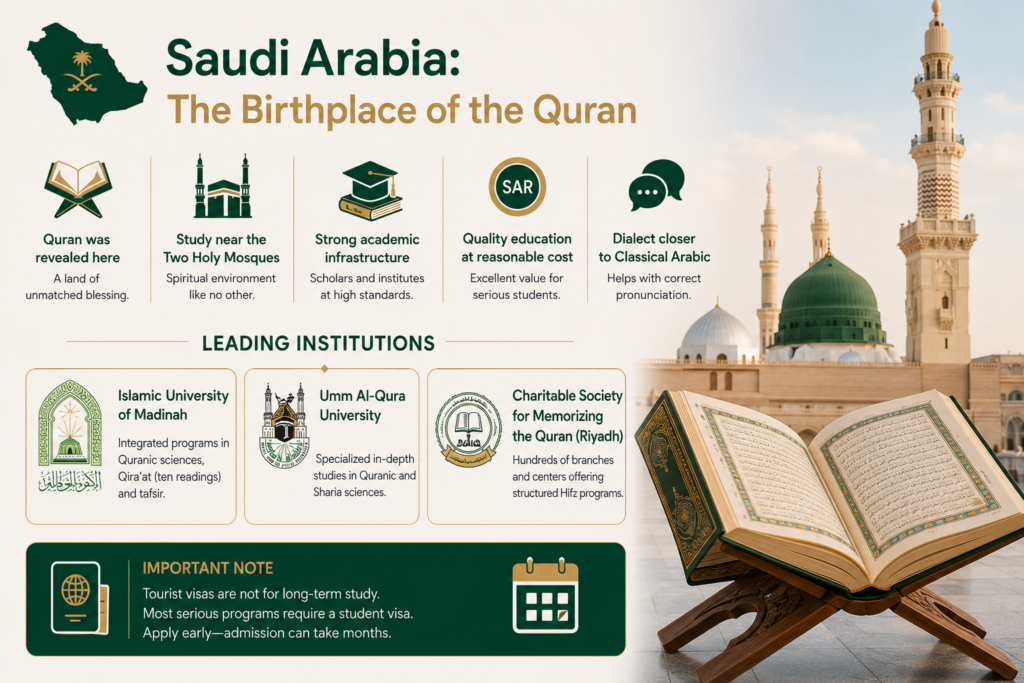
1. Saudi Arabia: The Birthplace of the Quran
Saudi Arabia is the country where the Quran was revealed, which gives its institutions a unique authority in Quranic education. Students come for the spiritual weight of studying near the Two Holy Mosques, but the academic infrastructure is equally strong.
The country is home to scholars and institutes operating at a high professional standard in religious sciences and Arabic language instruction. Tuition costs are often reasonable relative to the quality offered, and the local dialect sits closer to Classical Arabic than in most other Arabic-speaking nations, which helps students absorb correct pronunciation naturally.
Leading Institutions in Saudi Arabia
The Islamic University in Medina offers integrated academic programs in Quranic sciences, including instruction in the ten canonical readings (Qira’at) and tafsir. Umm Al-Qura University in Makkah focuses on in-depth studies in Quranic and Sharia sciences. The Charitable Society for Memorizing the Quran in Riyadh operates hundreds of branches and centers across the country, making structured Hifz programs accessible to residents and visitors alike.
A common mistake students make here is assuming tourist visas allow long-term study; most serious programs require a student visa, and admission timelines can run several months, so applying early matters more than most people expect.
2. Egypt: Home of Al-Azhar and the World’s Leading Reciters
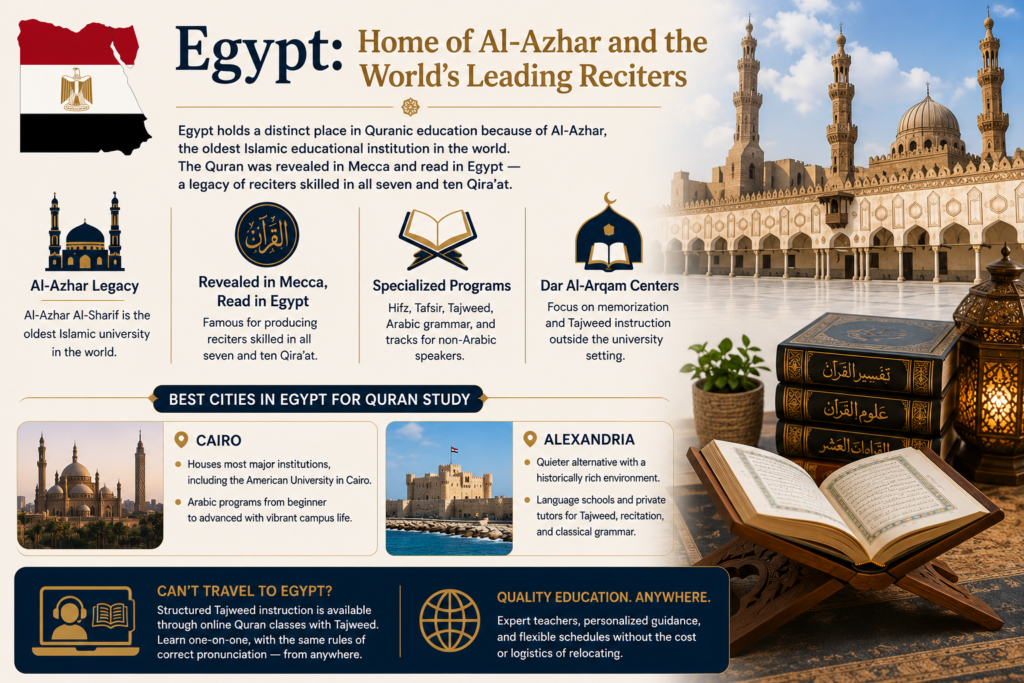
Egypt holds a distinct place in Quranic education because of Al-Azhar, the oldest Islamic educational institution in the world. There’s a well-known saying among scholars: the Quran was revealed in Mecca and read in Egypt — a reference to the country’s reputation for producing reciters skilled across all seven and ten Qira’at.
Al-Azhar Al-Sharif offers specialized programs for memorization, interpretation, Tajweed, and Arabic grammar, with dedicated tracks for non-Arabic speakers. Dar Al-Arqam centers focus specifically on memorization and Tajweed instruction outside the university setting.
Best Cities in Egypt for Quran Study
Cairo houses most of the country’s major institutions, including the American University in Cairo, which runs Arabic programs from beginner to advanced level alongside a notable campus life. Alexandria offers a quieter alternative, with language schools and private tutors covering Tajweed, recitation, and classical grammar in a historically rich setting.
If travel to Egypt isn’t realistic for your schedule, structured Tajweed instruction is also available through online Quran classes with Tajweed, where the same rules of correct pronunciation are taught one-on-one without the cost or logistics of relocating.
3. Morocco: Traditional Quranic Schools at a Lower Cost
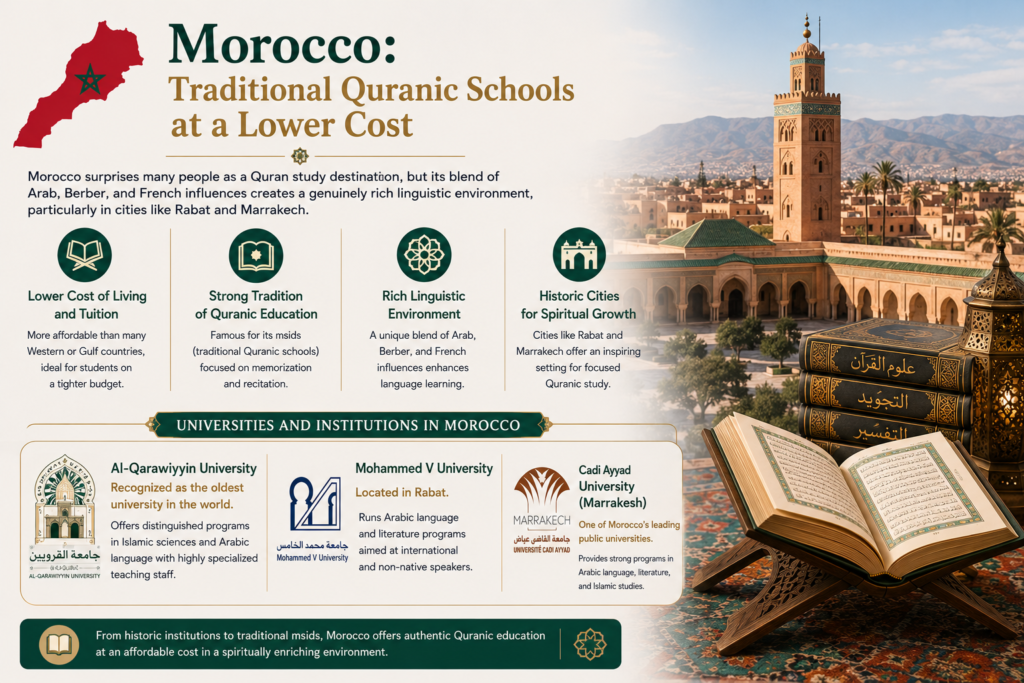
Morocco surprises many people as a Quran study destination, but its blend of Arab, Berber, and French influences creates a genuinely rich linguistic environment, particularly in cities like Rabat and Marrakech.
Tuition and living costs in Morocco tend to run lower than in many Western or Gulf countries, which makes it accessible for students on a tighter budget. The country is especially known for its msids — traditional Quranic schools built around memorization and the rules of recitation, an approach largely unchanged for generations.
Universities and Institutions in Morocco
Al-Qarawiyyin University, recognized as the oldest university in the world, offers distinguished programs in Islamic sciences and Arabic language with highly specialized teaching staff. Mohammed V University in Rabat runs Arabic language and literature programs aimed partly at international and non-native speakers. Cadi Ayyad University in Marrakesh, one of Morocco’s largest universities, offers humanities programs that include Arabic and Islamic studies.
4. United Arab Emirates: Modern Infrastructure Meets Quranic Tradition
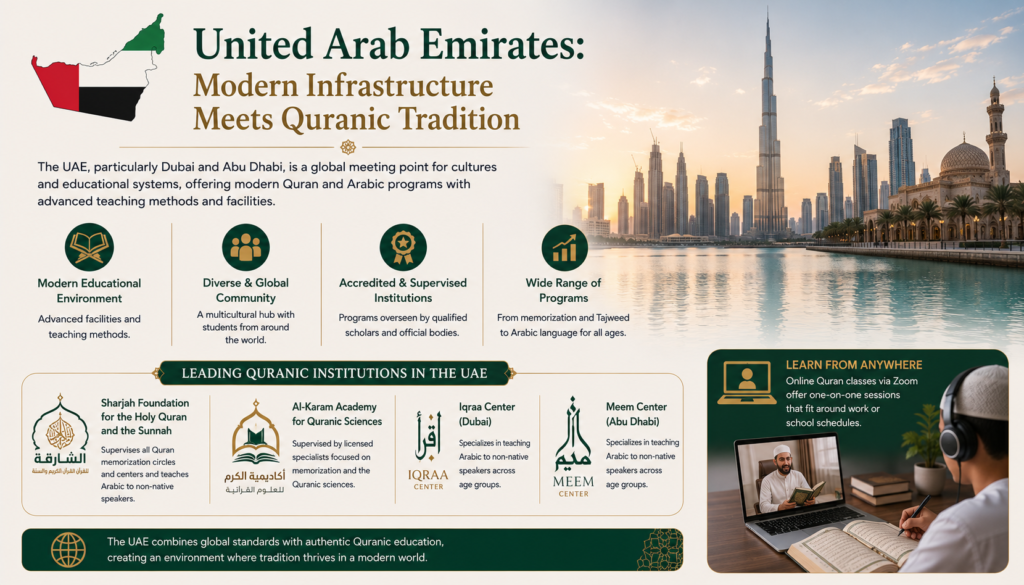
The UAE, particularly Dubai and Abu Dhabi, functions as a global meeting point for cultures and educational systems, which gives its Quran and Arabic programs a notably modern delivery style — even though costs here tend to run higher than in Egypt or Morocco.
The Sharjah Foundation for the Holy Quran and the Sunnah supervises all Quran memorization circles and centers across the emirate, both permanent and temporary, and also teaches Arabic to non-native speakers. Al-Karam Academy for Quranic Sciences is supervised by licensed specialists focused specifically on memorization and the Quranic sciences. The Iqraa Center in Dubai and the Meem Center in Abu Dhabi both specialize in teaching Arabic to non-native speakers across age groups.
For UAE residents who want the same quality of instruction without committing to a physical center’s schedule, online Quran classes via Zoom offer one-on-one sessions that fit around work or school timetables.
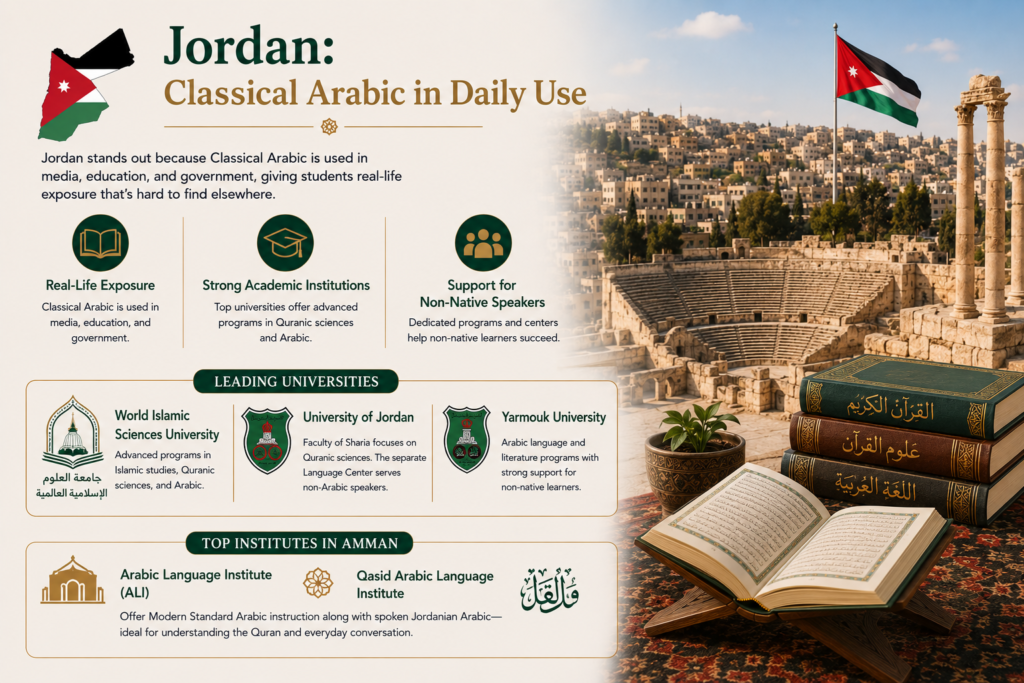
5. Jordan: Classical Arabic in Daily Use
Jordan stands out because Classical Arabic isn’t confined to the classroom — it’s used in media, education, and government, which gives students real-life exposure that’s harder to find elsewhere.
The World Islamic Sciences University offers advanced programs in Islamic studies, Quranic sciences, and Arabic. The University of Jordan’s Faculty of Sharia focuses on Quranic sciences, while its separate Language Center serves non-Arabic speakers. Yarmouk University runs Arabic language and literature programs with particular attention to non-native learners.
In Amman, institutions such as the Arabic Language Institute and Qasid Arabic Language Institute are well known for combining Modern Standard Arabic instruction with exposure to spoken Jordanian Arabic — useful if your goal extends beyond reading the Quran into everyday conversation.
Read also: Juz Amma Memorization Plan – A Complete Step-by-Step Guide
Experience a Live Quran Class
Watch a short sample from one of our online Quran classes and discover our engaging teaching style, interactive lessons, and personalized learning approach.
Start Learning Quran with Expert Tutors in the UAE
Accredited online Quran and Arabic classes tailored for adults and children. Schedule your session today.
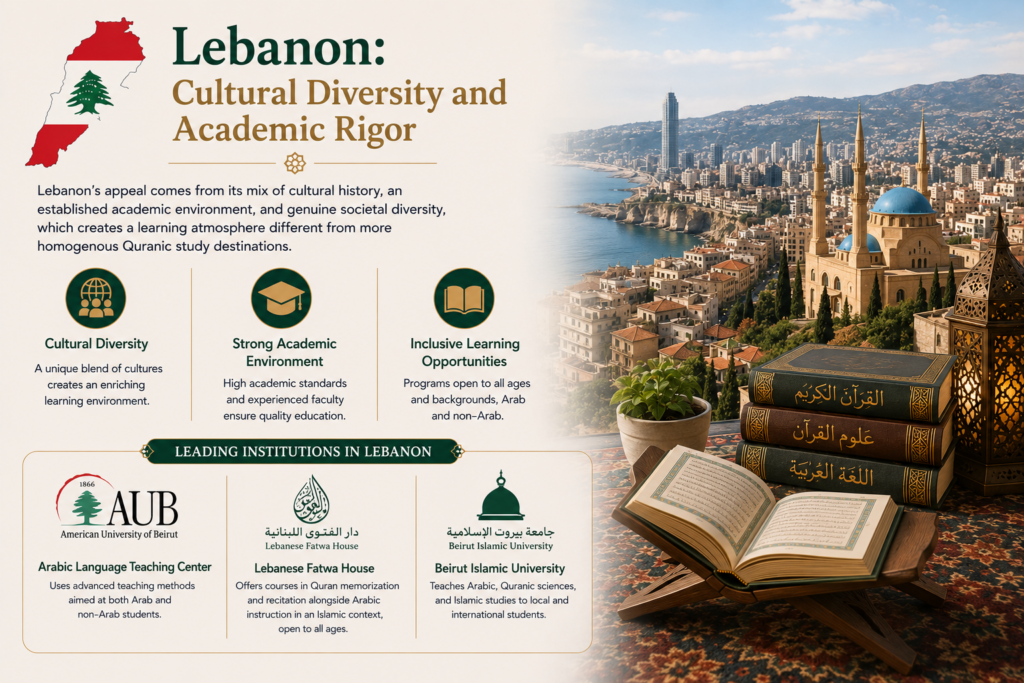
Book Your Free Trial6. Lebanon: Cultural Diversity and Academic Rigor
Lebanon’s appeal comes from its mix of cultural history, an established academic environment, and genuine societal diversity, which creates a learning atmosphere different from more homogenous Quranic study destinations.
The Arabic Language Teaching Center at the American University of Beirut uses advanced teaching methods aimed at both Arab and non-Arab students. The Lebanese Fatwa House offers courses in Quran memorization and recitation alongside Arabic instruction in an Islamic context, open to all ages. Beirut Islamic University, affiliated with the Lebanese Fatwa House, teaches Arabic, Quranic sciences, and Islamic studies to local and international students.
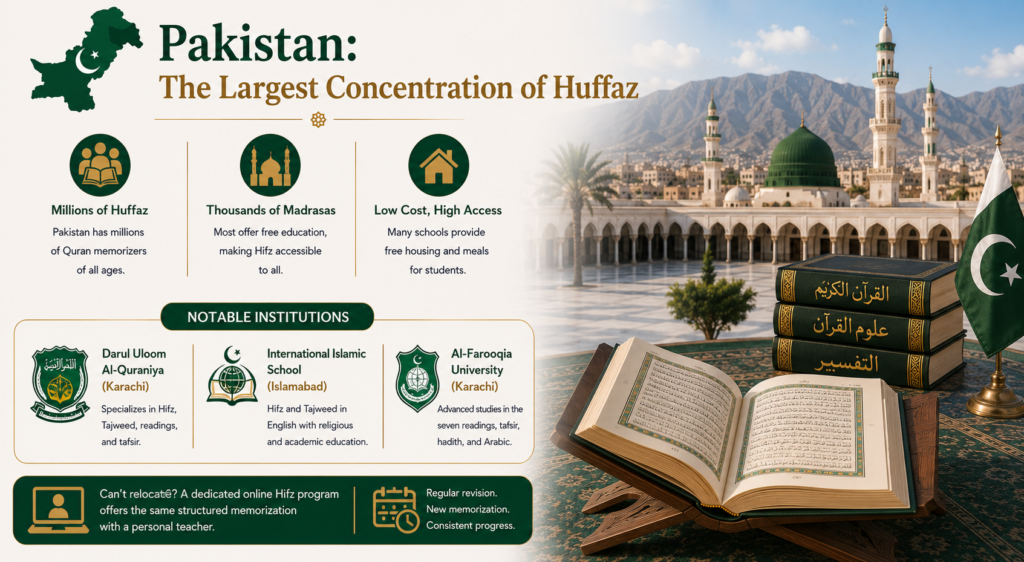
7. Pakistan: The Largest Concentration of Huffaz
Pakistan produces more Quran memorizers (huffaz) than almost any other country — by 2024, the number of memorizers there was estimated in the millions, reflecting a culture where Hifz is pursued at every age, from young children to adults.
Thousands of Quranic schools (madrasas) operate across Pakistan, most offering free education, which makes memorization programs accessible regardless of family income. This is one of the few places where the cost barrier to serious, sustained Hifz study is genuinely low, since many schools also provide free housing and meals.
Notable Institutions in Pakistan
Darul Uloom Al-Quraniya in Karachi is one of the oldest and most prominent religious institutions specializing in memorization, Tajweed, readings, and tafsir, drawing students internationally. The International Islamic School in Islamabad teaches its Hifz and Tajweed programs in English, making it more accessible to international students, and combines religious with academic instruction. Al-Farooqia University in Karachi offers advanced courses in the seven readings, tafsir, hadith, and Arabic.
If full relocation for a Hifz program isn’t possible, the same structured approach to memorization is available through a dedicated online Hifz program, which pairs students with a consistent teacher for revision and new memorization on a fixed schedule — the same consistency that makes in-person madrasa programs effective.
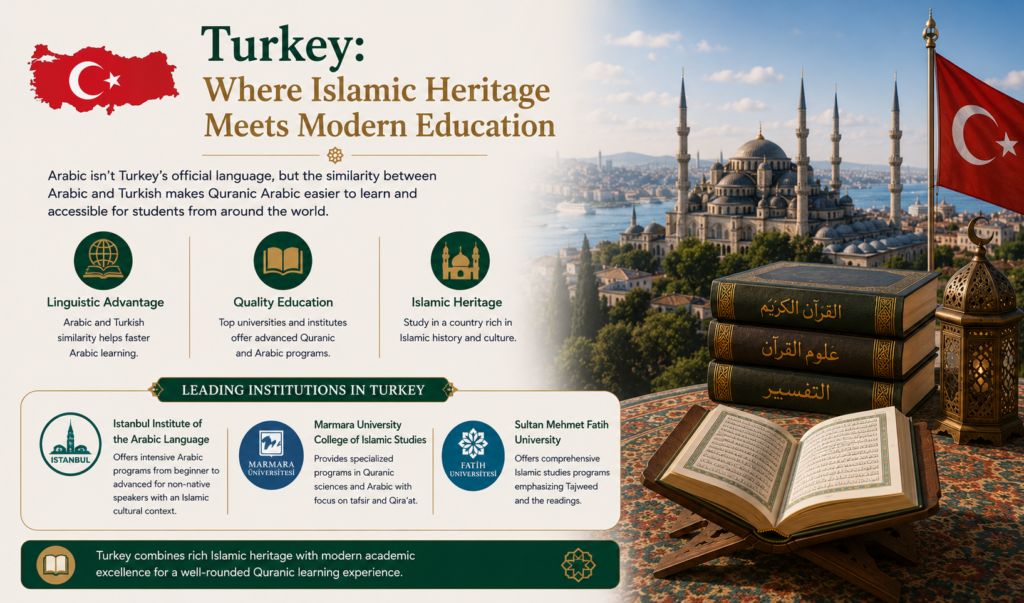
8. Turkey: Where Islamic Heritage Meets Modern Education
Arabic isn’t Turkey’s official language, but the linguistic similarity between Arabic and Turkish makes it noticeably easier for Turkish speakers — and reasonably approachable for others — to pick up Quranic Arabic here.
The Istanbul Institute of the Arabic Language runs intensive programs from beginner to advanced for non-native speakers, combining language instruction with Islamic cultural context. Marmara University’s College of Islamic Studies offers specialized Quranic sciences and Arabic programs with a focus on tafsir and Qira’at. Sultan Mehmet Fatih University, one of Turkey’s endowment universities, offers comprehensive Islamic studies programs with emphasis on Tajweed and the readings.
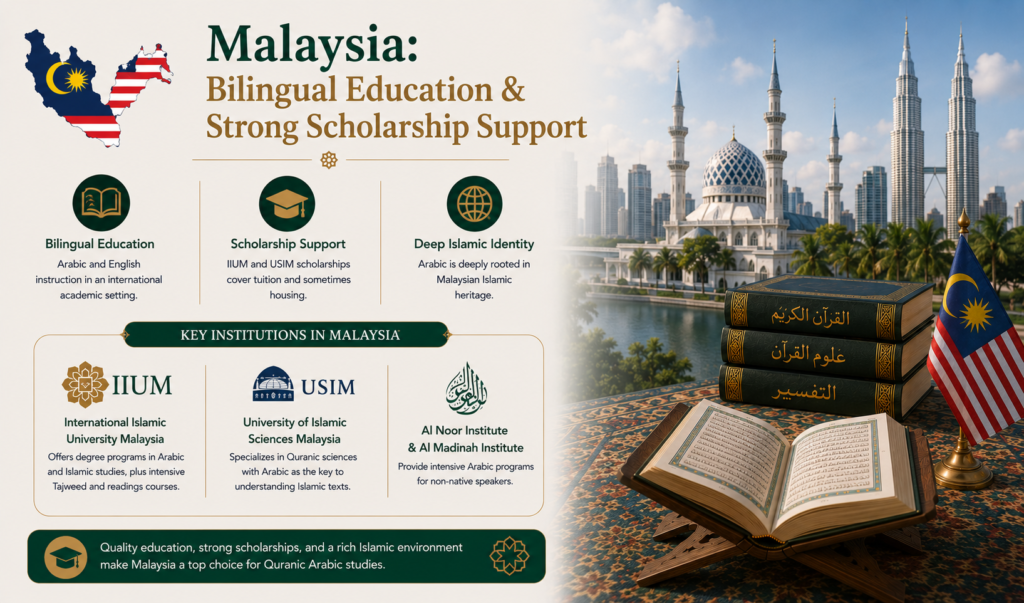
9. Malaysia: Bilingual Education and Strong Scholarship Support
Arabic holds a particular significance in Malaysia because of its direct link to the Quran and Hadith; historically, Malaysians even adapted Arabic script for their own Javanese writing system before Romanization, a sign of how deeply the language is woven into Malaysian Islamic identity.
Malaysia’s bilingual approach — teaching in both Arabic and English — helps students access Quranic Arabic within an internationally recognizable academic framework. Scholarships such as IIUM and USIM cover tuition and sometimes housing, which makes Malaysia a practical option for students who couldn’t otherwise afford long-term study abroad.
Key Institutions in Malaysia
The International Islamic University Malaysia (IIUM) offers bachelor’s, master’s, and doctoral programs in Arabic and Islamic studies, plus intensive Tajweed and readings courses. The University of Islamic Sciences Malaysia (USIM) specializes in Quranic sciences with Arabic taught as the gateway to understanding Islamic texts. Institutes such as Al Noor Institute and Al Madinah Institute run intensive non-native Arabic programs outside the university system.
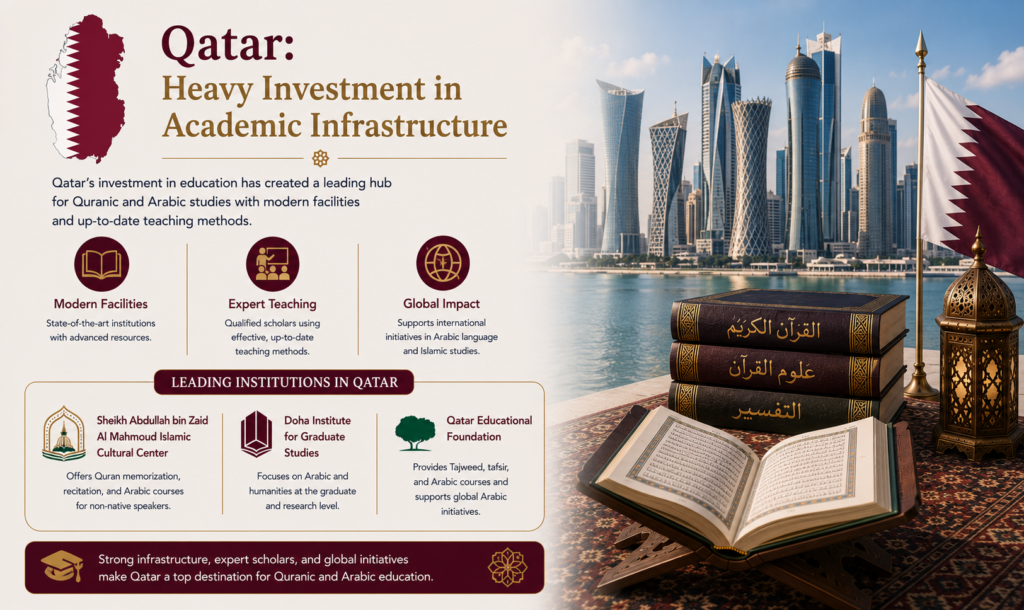
10. Qatar: Heavy Investment in Academic Infrastructure
Qatar’s significant investment in education has turned it into a recognized center for Quranic and Arabic studies, with facilities and teaching methods that are consistently up to date.
The Sheikh Abdullah bin Zaid Al Mahmoud Islamic Cultural Center offers Quran memorization and recitation lessons alongside Arabic instruction for non-native speakers. The Doha Institute for Graduate Studies focuses on Arabic and humanities at an academic level, suited to students with research or postgraduate goals. The Qatar Educational Foundation runs Tajweed, tafsir, and Arabic courses and supports broader Arabic-language initiatives, including international conferences and translation studies.
How to Choose Between These Countries?
Match the country to your specific goal rather than its general reputation. If your priority is fast, structured memorization with minimal cost, Pakistan’s madrasa system is hard to beat. If you want academic depth and a recognized degree, Jordan, Malaysia, or Egypt’s university programs fit better. If spiritual proximity to the Two Holy Mosques matters most to you, Saudi Arabia is the clear choice despite a longer visa process.
Budget is the most common deciding factor, and it varies sharply by country: Pakistan and Morocco tend to be the most affordable, the UAE and Qatar the most expensive, with Saudi Arabia, Egypt, Jordan, and Turkey sitting in between depending on the specific institution.
A mistake worth avoiding: picking a country purely on reputation without checking whether the specific institution teaches in a language you understand. Several Pakistani and Moroccan institutions teach primarily in Urdu or French alongside Arabic, which can slow down a non-native Arabic speaker more than the Tajweed or memorization curriculum itself.
If relocating isn’t feasible at all — whether for work, family, or visa reasons — online study with a qualified teacher remains a legitimate path to the same Tajweed accuracy and Ijazah-track memorization these countries are known for, just delivered remotely through platforms like Zoom rather than in a physical classroom.
Read also: How to Memorize the Quran Faster?
See How Our Online Classes Work
Get a glimpse of a real online session and explore how students learn Quran with experienced teachers in a supportive and interactive environment.
Start Your Quran Journey from Home Today
You don’t need a plane ticket to learn the Quran the right way. Whether you’re working toward solid Tajweed, structured Hifz, or simply consistent weekly recitation practice, UAE Quran Academy connects you with a qualified one-on-one teacher who delivers the same rigor these top countries are known for — without the visa process or relocation cost.
At UAE Quran Academy, every student is matched with a certified teacher for personalized sessions scheduled around your own routine, whether you’re a working adult, a parent, or a student balancing other commitments. Lessons run over Zoom with the same structured curriculum used in traditional Tajweed and Hifz programs, just delivered to wherever you are.
Our Online Quran Courses Include:
- Online Quran Classes in UAE
- Quran Classes for Kids
- Quran Classes for Adults
- Quran Classes for Ladies / Sisters
- Quran Classes for Men
- Quran Course for Beginners
- Quran Classes for Toddlers
- Weekend Quran Classes
- Intensive Quran Course
- Al-Azhar Quran Course
- Arabic & Quran Classes
- Zoom Quran Classes
- Skype Quran Classes
Start Learning Quran with Expert Tutors in the UAE
Accredited online Quran and Arabic classes tailored for adults and children. Schedule your session today.
Book Your Free Trial
Conclusion
There’s no single best country to learn Quran — the right choice depends on what you’re optimizing for. Saudi Arabia offers unmatched spiritual significance and proximity to the source of revelation. Egypt provides world-class reciters and Al-Azhar’s centuries of scholarship. Pakistan delivers the most accessible path to full memorization, while Jordan, Malaysia, and Turkey balance academic rigor with reasonable cost.
What matters most is matching the country, institution, and teaching language to your actual goals and budget, rather than choosing based on name recognition alone. And if travel genuinely isn’t an option right now, structured online Quran, Tajweed, and Hifz programs can deliver comparable results with far more flexibility — proof that the best country to learn Quran isn’t always a physical destination.
Frequently Asked Questions
What is the best country to learn Quran for beginners?
Egypt and Saudi Arabia are generally considered the best starting points for beginners because of their structured, widely available programs and large pool of qualified teachers. Both countries also offer dedicated tracks for non-Arabic speakers, which makes early-stage learning more accessible.
Which country is cheapest to study Quran in?
Pakistan and Morocco are typically the most affordable options. Pakistan’s madrasa system often provides free tuition, housing, and meals, while Morocco offers lower living costs alongside traditional Quranic school education.
Can I learn Quran with Tajweed online instead of traveling abroad?
Yes, online Tajweed instruction with a one-on-one teacher can teach the same makharij (articulation points) and recitation rules taught in physical institutions, without the cost or logistics of relocating. Many students use online classes as either a full alternative or as preparation before traveling.
How long does it take to become a Hafiz in these countries?
This depends on the program and the student’s pace, but full Quran memorization commonly takes between two and five years in structured Hifz programs, whether in-person in Pakistan or Saudi Arabia, or through a consistent online Hifz schedule.
Do I need to speak Arabic before studying in these countries?
No, most of the institutions listed — including Al-Azhar in Egypt, IIUM in Malaysia, and several centers in the UAE and Jordan — run dedicated programs for non-Arabic speakers, often starting from the alphabet and basic grammar before progressing to Quranic Arabic.
Is it better to study Quran in person or online?
In-person study offers immersion and direct community access, while online study offers flexibility, lower cost, and access to specific qualified teachers regardless of your location. For working adults or parents, online programs often allow more consistent weekly progress than travel-based study.


Leave a Reply