 Hifz
Hifz
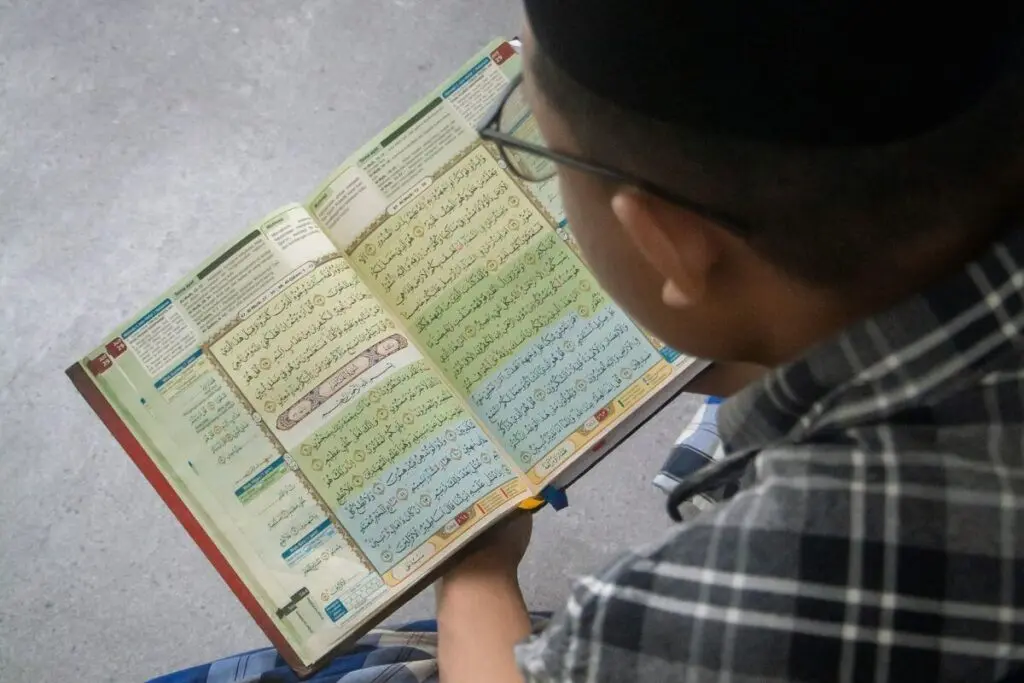
Intending to memorize the Quran but struggling with consistency? The obstacle isn’t the scope of the goal; it is the absence of a structured system. Completing the Quran in a single year is highly achievable. With 604 pages in the Mushaf, committing to just two pages a day—taking less than an hour of focused effort—will lead you to completion within twelve months.
This guide provides the exact strategic framework you need: optimized daily targets, robust revision schedules, and proven retention techniques designed to build a sustainable habit and ensure you finish successfully without starting over.
1. Set Your Daily Target Before You Open the Mushaf
Before a single verse is memorized, the structure of your year needs to be clear. The Quran has 604 pages divided into 30 Juz, with each Juz spanning approximately 20 pages. To complete the full memorization in 12 months, your daily target is two pages — one page after Fajr and one page after Asr or Maghrib.
This is not an arbitrary number. Two pages per day over 302 days covers the entire Mushaf, leaving the remaining 63 days of the year entirely for revision and consolidation. Students who do not plan this split in advance tend to race forward on strong days and then abandon the program when a difficult week hits.
Three decisions must be settled before Day One:
- Choose one Mushaf and commit to it. Your brain stores the visual layout of each verse on each page. Switching between different print editions mid-journey disrupts this visual memory and creates confusion during recall.
- Set fixed memorization times. Memorization performed at random hours does not build a habit. It builds inconsistency. Protecting the same time slot every day — even if only 30 to 45 minutes — is what converts effort into long-term retention.
- Identify a qualified teacher or recitation partner. Memorizing without real-time correction means errors in pronunciation and Tajweed become permanently embedded. A teacher catches makhraj mistakes and Tajweed violations that the student cannot hear in their own recitation.
If your reading fluency is not yet strong enough to support two pages per day of new memorization, the Quran Reading Course at UAE Quran Academy builds the accurate reading foundation that every Hifz journey depends on. Attempting to memorize while still struggling to read smoothly doubles the difficulty unnecessarily — enroll today and arrive at your memorization program fully prepared
.

Master Quran reading before beginning your Hifz journey.
2. Divide the Quran Across 12 Months
A year-long Hifz plan works best when broken into monthly milestones rather than left as one distant finish line. When you can see exactly where you should be at the end of each month, it becomes far easier to maintain momentum and correct drift before it becomes collapse.
The standard division for how to memorize Quran in 1 year looks like this:
| Month | Target | Juz Covered |
| 1 | 50 pages | Juz 30 + Part of Juz 29 |
| 2 | 50 pages | Juz 28–29 completion |
| 3 | 50 pages | Juz 26–27 |
| 4 | 50 pages | Juz 24–25 |
| 5 | 50 pages | Juz 22–23 |
| 6 | 50 pages | Juz 20–21 |
| 7 | 50 pages | Juz 18–19 |
| 8 | 50 pages | Juz 16–17 |
| 9 | 50 pages | Juz 14–15 |
| 10 | 50 pages | Juz 12–13 |
| 11 | 50 pages | Juz 10–11 |
| 12 | 50 pages | Juz 1–9 completion |
Many scholars recommend beginning from Juz Amma and working backward toward Surah Al-Baqarah, because the shorter Surahs of the final Juz build momentum and confidence early in the journey before the longer Surahs of the middle and early Juz are reached.
At the end of every month, dedicate three to four days to comprehensive revision of everything memorized that month before moving forward. This monthly reset prevents the most common failure pattern in long-term Hifz: memorizing forward while silently losing what came before.
3. Use the Twenty-Repetition Method for Every Page
The single most reliable memorization technique used by scholars across the Arab world is the sequential layered repetition method. Every verse is repeated a minimum of twenty times before moving to the next, and verses are combined cumulatively rather than memorized in isolation.
The protocol for each page works as follows:
Phase 1 — Reading: Read the full page from the Mushaf once slowly, paying attention to meaning, pauses, and the visual layout of each line.
Phase 2 — Segmenting: Divide the page into three or four small segments of three to four lines each. Take the first segment and read it five times with the Mushaf open.
Phase 3 — Closing: Close the Mushaf and repeat those lines from memory until you can recite the segment three consecutive times without error.
Phase 4 — Connecting: Once each segment is memorized, link it to the one before it. Recite Segment 1 and Segment 2 together, then Segments 1, 2, and 3 together, and so on until the full page flows as one connected unit.
Phase 5 — Page-to-Page Connection: After memorizing a full page, recite it together with the previous page from today’s session. By the end of each session, you should be able to recite all pages memorized that day as one continuous block.
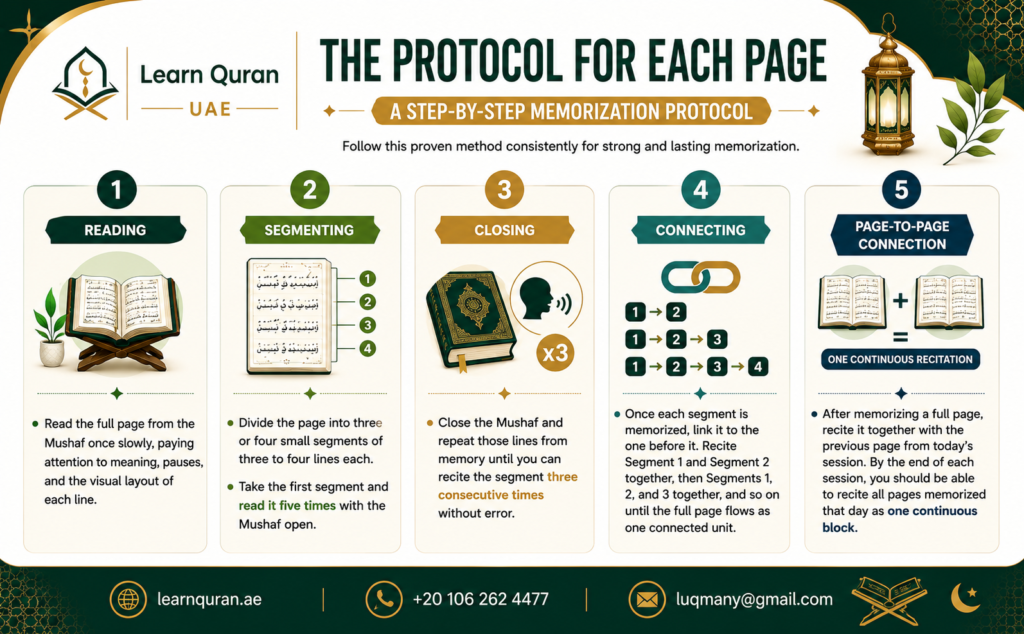
The combination step is the most overlooked part of this method. Most memorization failures occur not because individual verses are forgotten but because the connection between them was never built. A student who memorizes verses as separate units will stall at the beginning of a verse when their mind cannot locate the one that came before it.
“مَثَلُ الَّذِي يَقْرَأُ الْقُرْآنَ وَهُوَ حَافِظٌ لَهُ مَعَ السَّفَرَةِ الْكِرَامِ الْبَرَرَةِ، وَمَثَلُ الَّذِي يَقْرَأُ الْقُرْآنَ وَهُوَ يَتَعَاهَدُهُ وَهُوَ عَلَيْهِ شَدِيدٌ، فَلَهُ أَجْرَانِ”
“Such a person as recites the Qur’an and masters it by heart, will be with the noble righteous scribes (in Heaven). And such a person exerts himself to learn the Qur’an by heart, and recites it with great difficulty, will have a double reward.”
The struggle is not a sign that you are failing. It is a sign that you are earning double reward.
4. Structure Your Day Around the Five Prayer Times
Prayer times are not just spiritual anchors — they are built-in memorization intervals distributed across the entire day, giving the brain recovery time between sessions while keeping the Quran in constant contact with memory. Tying your memorization schedule to Salah times is the most sustainable daily structure available.
| Prayer | Session Type | Target |
| After Fajr | Primary memorization — new material | 1 page (new) |
| After Dhuhr | Continuation + quick review of Fajr material | Review of morning pages |
| After Asr | Second new page or deep review | 1 page (new or revision) |
| After Maghrib | Mid-week cumulative review | Pages from current week |
| After Isha | Full review of day’s memorization | All pages memorized today |
After Fajr is the highest-quality memorization window in the entire day. The mind is rested, the environment is quiet, and the spiritual context of having just completed Salah strengthens focus. Dedicate 45 to 60 minutes here to new material.
The Isha session closes with a complete recitation of everything memorized that day from memory. If you stumble on any section, return to the Mushaf, fix it, and recite that section again three times before continuing. This closing recitation converts short-term retention into overnight consolidation.
5. Apply the Seven-Day Revision Cycle Every Week
New memorization disappears without near-term review. Recall strength decays rapidly in the first 24 to 48 hours after initial memorization, then stabilizes when the memory is revisited. Skipping revision even for two or three consecutive days can undo an entire week of memorization work.
The weekly structure that prevents this looks like this:
- Days 1 through 6: Memorize new material daily (two pages per day), while reviewing the four pages memorized on the two days immediately before each session.
- Day 7: Zero new material. Full revision day only — recite every page memorized across the previous six days, ideally to a teacher or recitation partner who can catch errors in real time.
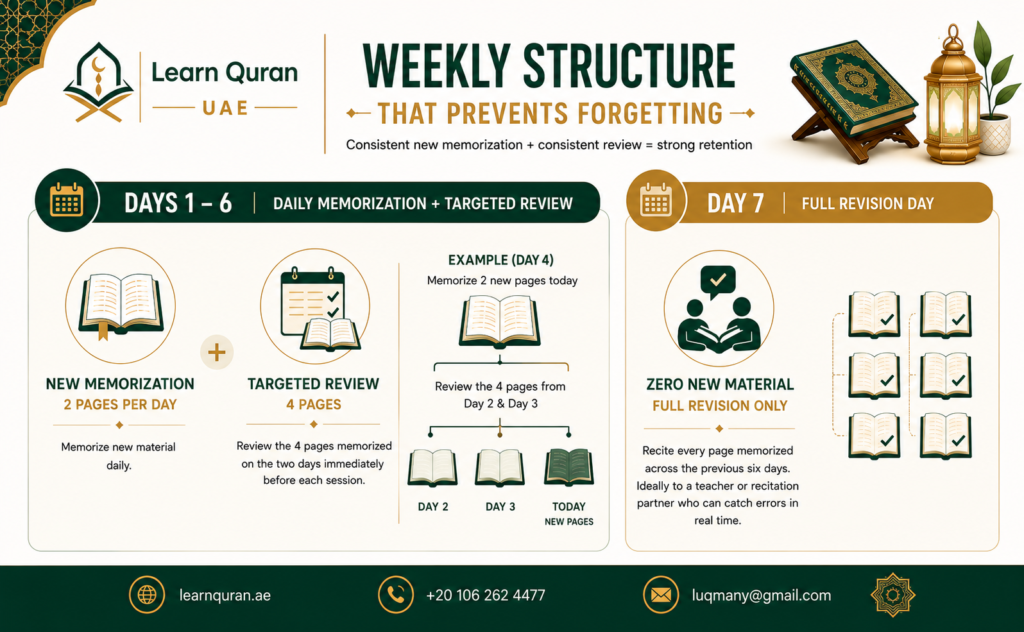
This 6:1 ratio of memorization to revision is the structural feature shared by every Hifz program that produces consistent results. On the revision day, the student recites the week’s material as one continuous block, identifying any weak points before they become permanent gaps.
“إِنَّا نَحْنُ نَزَّلْنَا الذِّكْرَ وَإِنَّا لَهُ لَحَافِظُونَ”
Inna nahnu nazzalnadh-dhikra wa inna lahu lahafizoon.
“Indeed, it is We who sent down the Quran and indeed, We will be its guardian.”
You memorize it; Allah preserves it through those who carry it in their hearts. Your weekly revision is your participation in that preservation.
Read also: How Long Does It Take to Memorize the Quran?
Experience a Live Quran Class
Watch a short sample from one of our online Quran classes and discover our engaging teaching style, interactive lessons, and personalized learning approach.
Start Learning Quran with Expert Tutors in the UAE
Accredited online Quran and Arabic classes tailored for adults and children. Schedule your session today.
Book Your Free Trial6. Understand the Meaning of What You Are Memorizing
Comprehension is a memorization tool, not a separate activity. When you understand what an ayah means, the brain creates multiple retrieval pathways for it — the sound of the words, the visual image of the Arabic text, and the conceptual meaning all become independent routes back to the same verse. If one route weakens under pressure, the others compensate.
Students who memorize without any understanding of meaning rely entirely on acoustic and visual memory. This makes them vulnerable to forgetting during Salah, when the mind is focused on worship rather than mechanical recall. A single reading of a trustworthy translation before each session is sufficient to activate meaning-based memory without requiring scholarly study.
“أَفَلَا يَتَدَبَّرُونَ الْقُرْآنَ أَمْ عَلَى قُلُوبٍ أَقْفَالُهَا”
Afalā yatadabbarūna al-Qur’āna am ʿalā qulūbin aqfāluhā
“Then do they not reflect upon the Qur’an, or are there locks upon [their] hearts?”
For students who want structured access to Quranic meanings alongside their Hifz, the Quran Tafseer Course at UAE Quran Academy provides guided comprehension under qualified teacher supervision. When Hifz and Tafseer work together, the memorization is faster, more durable, and spiritually richer — enroll today and experience the difference.

Deepen your Hifz through guided Quran Tafseer today.
7. Recite to a Qualified Teacher Every Single Day
Memorizing silently and alone is the fastest way to cement mistakes. Arabic contains sounds, Tajweed rules, and letter distinctions that the untrained ear cannot self-audit reliably. A student who has been reciting an incorrect pronunciation for two weeks has memorized that mistake, and unlearning it later is harder than learning correctly from the start.
The daily recitation session with a teacher serves three purposes:
- Pronunciation correction in real time before errors become habit
- Pacing accountability so the daily target stays on track
- Motivation continuity through external commitment that is harder to abandon than private resolve
The Prophet ﷺ himself established this standard. Jibreel reviewed the Quran with the Prophet ﷺ once every year, and in the year of his passing, they reviewed it twice. Reciting to a qualified listener is not a modern pedagogical invention — it is the original Sunnah method of Quranic transmission.
“يُقَالُ لِصَاحِبِ الْقُرْآنِ يَوْمَ الْقِيَامَةِ: اقْرَأْ وَارْتَقِ وَرَتِّلْ كَمَا كُنْتَ تُرَتِّلُ فِي الدُّنْيَا، فَإِنَّ مَنْزِلَتَكَ عِنْدَ آخِرِ آيَةٍ تَقْرَأُهَا”
“One who was devoted to the Qur’an will be told to recite, ascend and recite carefully as he recited carefully when he was in the world, for he will reach his abode when he comes to the last verse he recites.”
Your rank in Jannah is determined by the last verse you accurately reach. That verse needs to be correct — which means every verse before it needs to be correct too. Brothers pursuing their Hifz journey with structured one-on-one guidance can enroll in the Hifz for Men Course at UAE Quran Academy, built around focused sessions and flexible scheduling that fits around work and family.

Begin your Hifz journey with personalized guidance for brothers.
8. Manage the Three-Phase Revision System After Every Ten Juz
Continuous forward memorization without structured mid-journey revision produces a well-known failure pattern: the student reaches Juz 20 and discovers that Juz 1 through 10 have faded to the point of near-total loss. Preventing this requires a deliberate pause after every ten Juz.
The three-phase system works as follows:
After completing Juz 1 through 10
Stop all new memorization for one full month. Dedicate the month entirely to reviewing those ten Juz, reciting eight pages every day. Only after a full month of solid revision do you return to new memorization.
After completing Juz 11 through 20
Stop again for two months. Review the full twenty Juz daily, eight pages per day, for sixty days. Return to new memorization only after completing this period.
After completing Juz 21 through 30
The full Quran is now in memory. Begin a final three-stage review — first ten Juz alone for one month, then twenty Juz for one month, then all thirty Juz for one month — before entering the permanent maintenance phase.
This system feels slow in the middle of the year, but students who follow it arrive at Khatm with a Quran that is actually memorized — not one that exists on paper but disappears under recitation pressure.
9. Build a Permanent Maintenance Plan After Khatm
Completing the memorization is not the finish line. It is the beginning of the maintenance phase, which requires its own structure. Many students who complete Hifz in a year lose significant portions within months because they do not transition immediately into a systematic revision routine.
A practical post-Khatm maintenance plan:
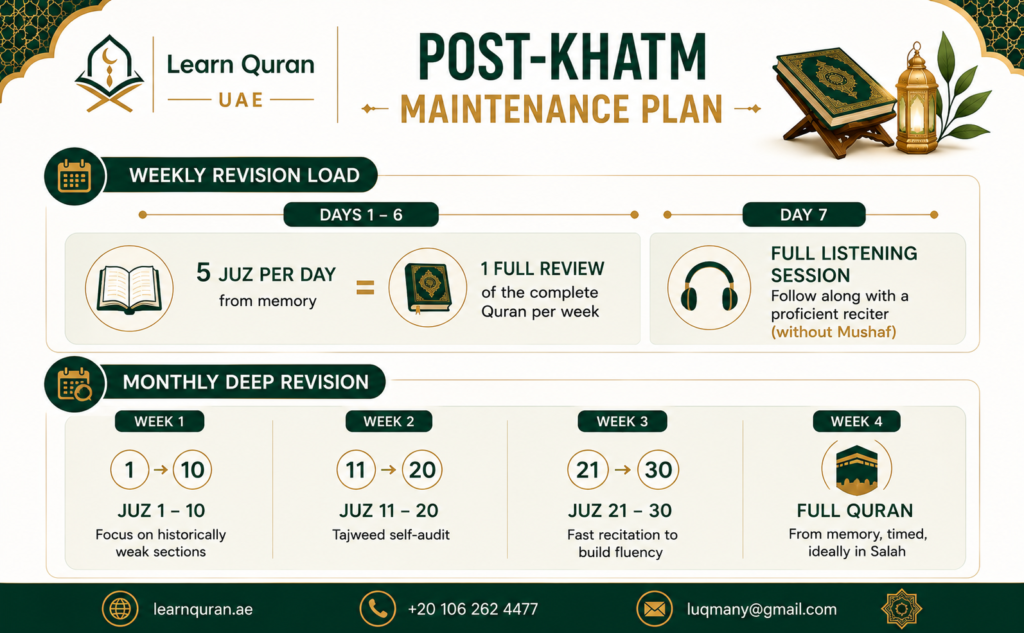
Weekly revision load:
- Days 1 through 6: Recite five Juz per day from memory — one full review of the complete Quran per week.
- Day 7: Full listening session, following along with a proficient reciter without looking at the Mushaf.
Monthly deep revision:
- Week 1: Juz 1 through 10 with focused attention on historically weak sections.
- Week 2: Juz 11 through 20 with Tajweed self-audit.
- Week 3: Juz 21 through 30 with fast recitation to build fluency.
- Week 4: Full Quran from memory, timed, ideally in Salah.
The scholars set an even higher standard for long-term maintenance: the Prophet ﷺ completed a full Quran recitation every seven days, dividing it into the famous seven-day schedule known through the mnemonic “Fami bi Shawq” — beginning at Al-Fatiha, Al-Maidah, Yunus, Bani Israil, Al-Shu’ara, Al-Saffat, and Qaf respectively across the seven days of the week.
Children who begin their Hifz journey early have a profound advantage in building this lifelong relationship with the Quran. The Hifz for Kids Classes at UAE Quran Academy give children a purpose-built system that matches their learning capacity and keeps them engaged throughout their memorization year — enroll your child today and give them a gift that lasts a lifetime.

Enroll your child and inspire a lifelong love for the Quran.
Read also: How to Memorize the Quran in 6 Months? – 10 Trusted Steps
10. Protect the Memorization Through Spiritual Discipline
Scholars across generations have consistently noted that the capacity for Quran memorization is not purely cognitive — it is also spiritual. Sin weakens the faculty of memory in ways that no technique can fully compensate for. Sincere repentance, maintained prayer, good company, and avoiding idle entertainment are not tangential to Hifz — they are part of the method.
The state of the heart during memorization determines how deeply the Quran settles. A heart occupied with distraction, sin, or heedlessness resists retention in ways that extra repetition cannot fix. A heart in a state of clarity, tawbah, and genuine orientation toward Allah finds that memorization comes with unusual ease.
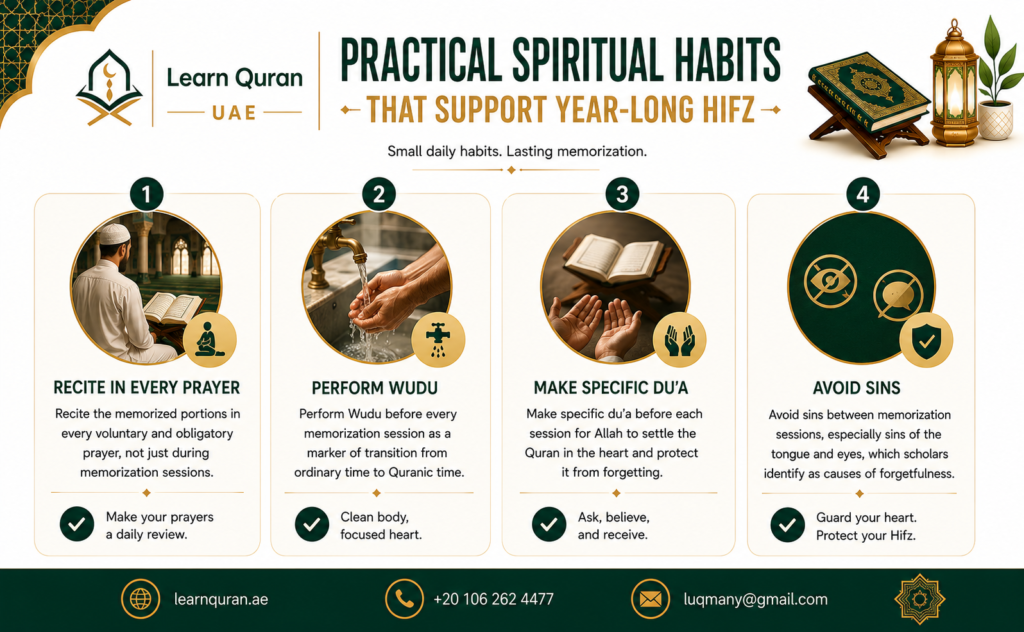
Practical spiritual habits that support year-long Hifz:
- Reciting the memorized portions in every voluntary and obligatory prayer, not just during memorization sessions.
- Performing Wudu before every memorization session as a marker of transition from ordinary time to Quranic time.
- Making specific du’a before each session for Allah to settle the Quran in the heart and protect it from forgetting.
- Avoiding sins between memorization sessions, particularly sins of the tongue and eyes, which scholars specifically identify as causes of forgetfulness.
Allah SWT says:
“كِتَابٌ أَنزَلْنَاهُ إِلَيْكَ مُبَارَكٌ لِّيَدَّبَّرُوا آيَاتِهِ وَلِيَتَذَكَّرَ أُولُو الْأَلْبَابِ”
Kitābun anzalnāhu ilayka mubārakun liyaddabbarū āyātihī wa liyatadhakkara ūlū l-albāb
“[This is] a blessed Book which We have revealed to you, [O Muhammad], that they might reflect upon its verses and that those of understanding would be reminded.”
See How Our Online Classes Work
Get a glimpse of a real online session and explore how students learn Quran with experienced teachers in a supportive and interactive environment.
Start Your Year-Long Hifz Journey at UAE Quran Academy
Most students who struggle with how to memorize Quran in 1 year are not lacking memory ability or time — they are lacking structure, accountability, and qualified guidance. A year of scattered effort produces scattered results. A year inside a structured program with a certified teacher produces a Hafiz.
UAE Quran Academy offers a complete range of Hifz programs designed for every type of learner, delivered one-to-one with certified teachers online. Every program at UAE Quran Academy includes one-to-one sessions with a qualified teacher, structured daily and weekly review plans built into the curriculum, real-time Tajweed correction from the very first verse, and flexible scheduling that fits around work, school, and family.
The fastest way to memorize Quran in one year is not a shortcut — it is a system. And the right system starts with the right teacher.
Book your free trial session today at UAE Quran Academy and begin Day One of your year-long plan with qualified guidance beside you.
Our Quran Memorization Courses
- Quran Memorization (Hifz) Course
- Hifz for Kids Course
- Hifz for Adults Course
- Hifz for Ladies / Sisters Course
- Hifz for Men Course
- Quran Memorization Center (UAE)
- Juz Amma Memorization Program
- Hifz Completion & Hafiz Certification
Enroll today and begin your journey toward becoming a Hafiz with expert guidance, personalized learning plans, and flexible online classes.
Start Learning Quran with Expert Tutors in the UAE
Accredited online Quran and Arabic classes tailored for adults and children. Schedule your session today.
Book Your Free TrialConclusion
Learning how to memorize Quran in 1 year is not a matter of extraordinary memory or unlimited free time. It is a matter of two pages per day, a consistent schedule built around the five prayers, weekly revision without exception, monthly consolidation pauses, and daily recitation to a teacher who corrects in real time.
The plan works when the components work together: sincere intention, a fixed Mushaf, the twenty-repetition layering method, the 6:1 weekly revision cycle, the three-phase mid-journey pause after every ten Juz, and a permanent maintenance routine the moment the thirtieth Juz is complete. Remove any one of these components and the system develops a gap that compounds over months.
At UAE Quran Academy, every one of those components is built into the curriculum and delivered through live, personalized online instruction. You do not have to design the system yourself — you only have to show up every day and follow it. Make this the year the Quran settles permanently in your heart.
Frequently Asked Questions
Is it realistic to memorize the entire Quran in exactly one year?
Yes. The Quran has 604 pages, requiring roughly two pages daily to finish in 12 months. With 45-60 minutes after Fajr and a later review session, it is highly realistic. Success relies entirely on daily consistency.
How many pages of Quran should I memorize per day to finish in one year?
Two pages per day is the standard target for a 12-month Hifz plan. Beginners with limited Arabic reading fluency may need to start at half a page or one page daily for the first two months before building to the full two-page target. The critical factor is not the daily number but maintaining it without prolonged breaks.
Should I memorize from the beginning of the Quran or the end?
Most scholars recommend beginning from Juz Amma and working backward toward Surah Al-Baqarah. The shorter Surahs of the final Juz are easier to memorize, build early confidence and momentum, and are the Surahs most commonly used in Salah — meaning the student immediately benefits from what they have memorized.
What should I do if I miss a day of memorization?
Do not attempt to double the next day’s target to compensate. Doubling overloads the consolidation capacity for a single session and produces weak retention in both portions. Instead, simply resume the standard two-page daily target and accept that the year-end completion date shifts by one day. Consistency of method matters more than meeting an exact calendar deadline.
Can adults with busy schedules really memorize Quran in one year?
Yes. Adults leverage high discipline and strong comprehension to compensate for time constraints. Success requires protecting a fixed, non-negotiable daily time slot, using prayer times to distribute review, and hiring a teacher for strict external accountability.



Leave a Reply