 Tajweed

Ever noticed how a good reciter reads مِن رَّبِّهِمْ (min rabbihim) as “mir-rabbihim,” with no “n” at all? That missing noon isn’t a slip. It’s idgham in tajweed, the rule that lets a noon sakinah or tanween slide into the letter after it.
You’ll run into idgham on almost every page of the Quran, so it’s worth getting right early. The good news is that it’s one of the easier rules to learn. There are six letters, gathered in the word يَرْمَلُونَ (yarmaloon), two ways to read them, and one simple condition.
We’ll go through each part with real verses, and every example comes with its surah and ayah number. Keep your mushaf open and read along as you go.
What you’ll learn in this article
- What idgham means and why we read this way.
- The six idgham letters and a simple trick to remember them.
- The two types of idgham, with Quran examples to practise.
- When idgham happens, and the few places it does not.
- The most common idgham mistakes and how to fix them.
What Is Idgham In Language And In Tajweed?
Idgham has two meanings: a general one in the Arabic language, and a specific one in tajweed. They’re closely linked, and knowing the first makes the second much easier to understand.
Idgham In Arabic
In everyday Arabic, idgham comes from the verb (adghama), and it simply means “to put one thing inside another.” The old Arabs used it for ordinary things. Someone might say meaning “I pushed the clothes into the bag.” The clothes don’t disappear. They just go inside and become part of what holds them.
Arabic grammar borrowed this idea for letters. Look at the verb (madda), “he stretched.” Its original form is مَدْدَ, with two dal letters side by side. Saying “mad-da” with a break in the middle feels clumsy, so the first dal slips into the second. You’re left with one dal carrying a shaddah ( ّ ).
The same thing happened to (shadda, “he pulled”), which started out as شَدْدَ. Arabic speakers didn’t enjoy saying the same letter twice in a row, so they joined them. Linguists like Ibn Jinni described idgham as bringing one sound close to another. You can see more examples on Wikipedia’s idgham page.
So the shaddah you see in so many Arabic words is really a small trace of idgham. Long before anyone wrote tajweed rules, Arabic was already blending letters this way.
Idgham In Tajweed
Tajweed scholars took that same idea and gave it an exact definition.. Put simply, a letter with no vowel meets a letter that has one, and you read the pair as a single doubled letter.
In practice, you don’t pronounce the first letter at all. You go straight to the second and give it a little extra weight.
Most of the time, when teachers say “idgham,” they mean a rule about noon. It covers the noon sakinah, a noon with no vowel, like the end of مَنْ. It also covers tanween, the doubled vowel marks at the end of a word ( ً ٍ ٌ ). Tanween has no letter of its own, but your ear hears it as a noon, so هُدًى comes out as hudan.
Idgham is one of four rules for noon sakinah and tanween. The other three are izhar (الإظهار), iqlab, and ikhfa. Each rule depends on which letter comes after the noon. Idgham has its own group of six letters, which we’ll get to shortly.
Why We Use Idgham In Tajweed
The short answer is flow. Say مِن رَّبِّهِمْ (min rabbihim) slowly with a full, clear “n,” and pay attention to your tongue. It touches down for the noon, lifts off, then has to set up again for the ra. That tiny stop-and-start makes a bump in the sound.
With idgham, the bump is gone. Your tongue rises once and falls once for both letters, and the two words melt into each other. The verse sounds the way it was taught and passed down, connected and easy on the ear.
Scholars also explain why only certain letters blend with the noon. When the next letter is also a noon, the two are identical (التماثل). Saying the same sound twice in a row is heavy, so they merge. The other letters aren’t identical, but they’re close to the noon in where they’re made in the mouth, or in how they sound (التقارب). Sounds that live near each other blend without effort.
The aim is to make the reading lighter without changing a single word. You can find the full reasoning in the Alukah article on noon sakinah rules.
What Are The Idgham Letters?
There are six idgham letters: ya (ي), ra (ر), meem (م), lam (ل), waw (و), and noon (ن). Scholars packed them into one word to make them easy to remember: يَرْمَلُونَ (yarmaloon). The word comes from Tuhfat al-Atfal, a famous tajweed poem.
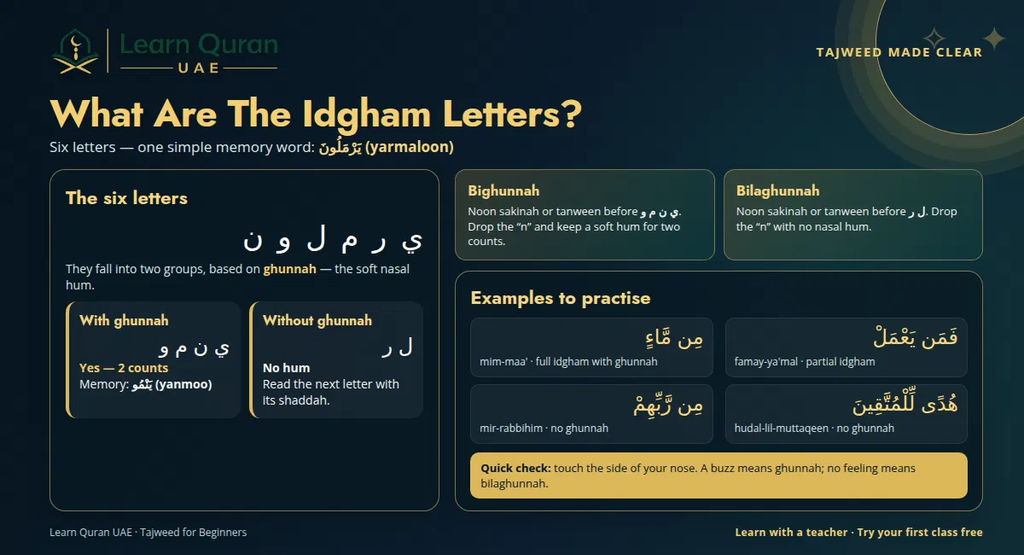
The six letters fall into two groups. What splits them is a soft humming sound from the nose called ghunnah.
| Group | Letters | Memory word | Ghunnah |
| Idgham with ghunnah | ي ن م و | يَنْمُو (yanmoo) | Yes, for two counts |
| Idgham without ghunnah | ل ر | none needed | No |
Surah Quran’s idgham page lists the same letters with more verses.
Types Of Idgham In Tajweed
Idgham has two main types: with ghunnah and without it. Scholars also sort it by how much of the noon is left after the blend. Each part below gives real examples and shows you how to say them.
Idgham With Ghunnah (Bighunnah): Examples And How To Read It
Idgham with ghunnah happens when noon sakinah or tanween comes before ya, noon, meem, or waw in the next word. The noon blends into that letter, and a soft hum stays.
| Letter | With noon sakinah | With tanween |
| ي | فَمَن يَعْمَلْ (famay-ya’mal), Az-Zalzalah 99:7 | خَيْرًا يَرَهُ (khayray-yarah), Az-Zalzalah 99:7 |
| ن | مِن نِّعْمَةٍ (min-ni’mah), An-Nahl 16:53 | يَوْمَئِذٍ نَّاعِمَةٌ (yawma’idhin-naa’imah), Al-Ghashiyah 88:8 |
| م | مِن مَّاءٍ (mim-maa’), Ibrahim 14:16 | مَثَلًا مَّا (mathalam-maa), Al-Baqarah 2:26 |
| و | مِن وَلِيٍّ (miw-waliyy), Al-Baqarah 2:120 | وَلِيٍّ وَلَا (waliyyiw-wa laa), Al-Baqarah 2:120 |
To read it, drop the “n” fully. Then shape your mouth for the next letter. Let the hum pass through your nose for about two counts. After that, say the vowel. Try it with مِن مَّاءٍ. You should hear mim-maa’. The meem is held and humming, and there is no “n” sound at all.
A count is about the time it takes to fold one finger at a calm pace. Two counts is two fingers. Keep both the same length each time.
Az-Zalzalah 99:7 is a good verse to start with. It has a noon sakinah example and a tanween example in the same line. Al-Baqarah 2:120 does the same with the letter waw.
Idgham Without Ghunnah (Bilaghunnah): Examples And How To Read It
Idgham without ghunnah happens when noon sakinah or tanween comes before lam or ra in the next word. The noon goes away fully, and no hum is left.
| Letter | With noon sakinah | With tanween |
| ل | مِن لَّدُنْهُ (mil-ladunhu), An-Nisa 4:40 | هُدًى لِّلْمُتَّقِينَ (hudal-lil-muttaqeen), Al-Baqarah 2:2 |
| ر | مِن رَّبِّهِمْ (mir-rabbihim), Al-Baqarah 2:5 | غَفُورٌ رَّحِيمٌ (ghafoorur-raheem), Al-Baqarah 2:173 |
To read it, drop the “n” and keep air out of your nose. Then say the lam or ra as a double letter. It carries a shaddah, so give it that weight.
Take مِن رَّبِّهِمْ as your test. You should hear a clean, strong rr right after mi. Nothing comes before it, not even a light hum.Here is a simple check you can do at home. Touch the side of your nose lightly while you read. With lam and ra, you should feel nothing. With the four yanmoo letters, you should feel a clear buzz for two counts.
This one test tells you right away which type you are reading. Do it a few times a day for a week, and your ear will start to hear the difference on its own.
Full And Partial Idgham: What Stays Of The Noon
Scholars also split idgham into full (kamil) and partial (naqis). In full idgham, nothing of the noon is left. In partial idgham, the noon is gone, but its hum stays behind.
Full idgham happens with noon, meem, lam, and ra. You may wonder why noon and meem count as full, since you still hear a hum. Most scholars say that hum belongs to the second letter. Noon and meem have a natural hum of their own.
Partial idgham happens only with ya and waw. These two letters have no hum of their own. So the hum you hear is what is left of the first noon.
You can see this in the mushaf. In full idgham, the next letter has a shaddah, as in مِن مَّاءٍ. In partial idgham, the next letter has no shaddah, as in مَن يَقُولُ.
That missing shaddah is a signal. It tells you the blend is not complete, because part of the noon is still there. Hidayat al-Qari on IslamWeb explains this split in depth.
A two-count hum is much easier to learn from a voice than from a page. In the Tajweed for Beginners Course at Learn Quran UAE, your teacher reads each example with you. You repeat it until it sounds right.

Start Learning Quran with Expert Tutors in the UAE
Accredited online Quran and Arabic classes tailored for adults and children. Schedule your session today.
Book Your Free TrialWhen Does Idgham Happen?
Seeing a noon before one of the six letters is not enough. Where the noon sits decides the rule. The parts below cover the main rule, the special places in the Hafs reading, and a quick check you can use on any page.
The Two-Word Rule And The Four Words That Break It
The main rule is simple. The noon sakinah must be at the end of one word. The idgham letter must be at the start of the next word.
Look at مِن رَّبِّهِمْ. The noon ends the word min. The ra starts the word rabbihim. These are two words, so the blend happens. Tanween always meets this rule, because it only comes at the end of a word.
Now look at what happens inside a single word. If the noon and the letter share one word, you don’t blend them. You say the noon clearly. This is called izhar mutlaq, or “full clear reading.”
It happens in only four words in the whole Quran:
| Word | Meaning | Example | Reference |
| دُنْيَا (dunyaa) | This world, worldly life | بَلْ تُؤْثِرُونَ الْحَيَاةَ الدُّنْيَا (“But you prefer the life of this world”) | Al-A’la 87:16, plus many other places |
| بُنْيَانٌ (bunyaan) | A building, a structure | كَأَنَّهُم بُنْيَانٌ مَّرْصُوصٌ (“As if they were a solid structure”) | As-Saff 61:4, also At-Tawbah 9:109 |
| قِنْوَانٌ (qinwaan) | Clusters of dates | قِنْوَانٌ دَانِيَةٌ (“Clusters of dates hanging low”) | Al-An’am 6:99, the only place |
| صِنْوَانٌ (sinwaan) | Palm trees growing from one root | صِنْوَانٌ وَغَيْرُ صِنْوَانٍ (“Palm trees, some from one root and some from separate roots”) | Ar-Ra’d 13:4, the only place |
So why don’t we blend the noon in these four words? Because the meaning would change.
If you blended دُنْيَا, it would sound like “duyyaa.” If you blended قِنْوَانٌ, it would sound like “qiwwaan.” These sound like different words, and the listener could get confused. Keeping the noon clear protects the meaning of the word.
The good news is that there are only four of these words in the whole Quran. A simple trick is to circle them in your mushaf. Then, when you reach one, your eye will catch it before your tongue makes a mistake.
Read also: Izhar In Tajweed—The 6 Throat Letters
Three Places Where Idgham Is Not Applied, Even Across Two Words
There are a few places in the Quran where you’d expect idgham, but it doesn’t happen. They follow the way the Quran was taught from teacher to student over many centuries. This is for Hafs from Asim, the way most people read today.
The first two are at the start of two surahs. In يس وَالْقُرْآنِ الْحَكِيمِ (Ya-Seen 36:1-2), the letter name “seen” ends with a noon, and the next word starts with waw. By the rule, you’d blend them, but here you read the noon clearly. The same thing happens in ن ۚ وَالْقَلَمِ (Al-Qalam 68:1).
The third place is وَقِيلَ مَنْ ۜ رَاقٍ (Al-Qiyamah 75:27). Here you make a tiny pause on the noon of man, without taking a breath. This short pause is called saktah (السكت). Because you pause, the noon doesn’t blend into the ra.
You can spot this last one easily in your mushaf. Look for the small letter س written above the word. That little mark tells you to pause.
Don’t worry about memorizing these right away. Your teacher will point them out when you reach them. For now, just know that they exist, so they don’t surprise you.
Watch a real lesson before you book
Not sure what online Quran classes look like? This short clip gives you a feel for our teaching style and how each class is built around the student.
An Easy Way to Spot Idgham as a Beginner
Not sure if a word has idgham? Ask yourself three short questions. We call this the 3-Step Idgham Check:
- Do I see noon sakinah or tanween? If not, idgham does not apply.
- Is the next letter one of yarmaloon? If not, it is a different rule, such as izhar, iqlab, or ikhfa.
- Is the letter at the start of the next word? If yes, blend. If not, read the noon clearly.
Once all three answers are yes, pick the type. A yanmoo letter keeps the hum. Lam or ra loses it.
Say these steps out loud during your first weeks of practice. It feels slow at the start, and that’s fine. After a while, your eyes will catch idgham before you even think about it.
This check also stops a common mix-up. In مِن بَعْدِ (Al-Baqarah 2:27), the noon comes before ba. Ba is not in yarmaloon, so step 2 tells you this is not idgham.
Watch for tanween in step 1, since it’s easy to miss. It has no letter of its own, only two vowel marks at the end of a word. Train your eye to stop on those doubled marks, the same way it stops on a written noon.
Common Idgham Mistakes And How To Fix Them
Knowing the rule is one thing. Reading it right in the flow of a verse is harder. The mistakes below are the ones teachers fix most often.
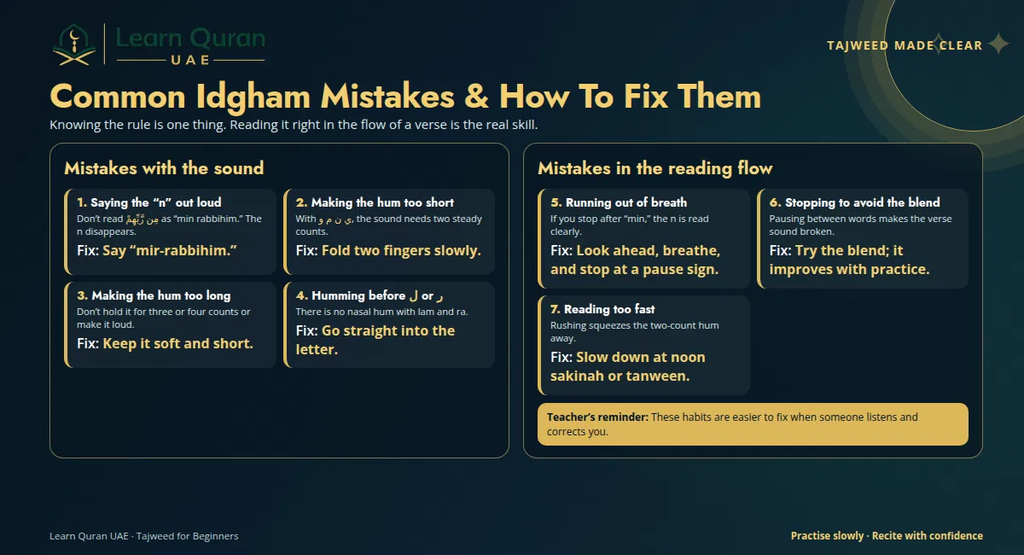
Mistakes With The Sound
Almost every beginner makes one of these. Don’t worry, they’re all easy to fix.
- Saying the “n” out loud: You see مِن رَّبِّهِمْ and read it min rabbihim, with a clear “n.” That’s how it looks, so it feels right. But in idgham, the “n” disappears. Just say mir-rabbihim and move on.
- Making the hum too short: You blend the noon, but the hum is over before it starts. With ي ن م و, the hum needs two counts. Try folding two fingers slowly as you read. That’s about the right length.
- Making The Hum Too Long: Some learners love the hum a little too much. They hold it for three or four counts, or make it really loud. Keep it soft and short. Two counts is enough.
- 4. Humming before ل or ر: With lam and ra, there’s no hum at all. You go straight into the letter. You might hear some reciters hum here, because they read in a different style. As a beginner, stick to the common way and keep it clean.
Mistakes In The Reading Flow
Idgham only happens when you read the two words together. If you stop in between, the rule doesn’t apply. That leads to a few common mistakes.
1. Running out of breath in the middle
Say you’re reading مِن رَّبِّهِمْ and you run out of air right after min. Since you stopped, the “n” is read clearly. Then you start again with the next word.
That’s fine once in a while. To stop it from happening often, look ahead before you start a line. Take a breath, and plan to stop at a pause sign in the mushaf, not between two words.
2. Stopping on purpose to avoid the blend
Some beginners find blending hard, so they pause between the words on purpose. Each word sounds correct on its own, but the verse sounds broken. And if you keep doing it, you never really learn idgham.
It’s better to try the blend and get it a little wrong at first. That’s how you get better.
3. Reading too fast
When you rush, the two-count hum gets squeezed down to almost nothing. Slow down whenever you see a noon sakinah or tanween. Speed will come later, once the sound is right.
These habits are much easier to fix when someone is listening to you. You can see what other learners say about their classes on the Learn Quran UAE student reviews page.

Other Types Of Idgham In Tajweed
The noon sakinah rule is only one kind of idgham. The same idea of blending a silent letter into the next one shows up with other letters too. Each type is named by how close the two letters are in the mouth.
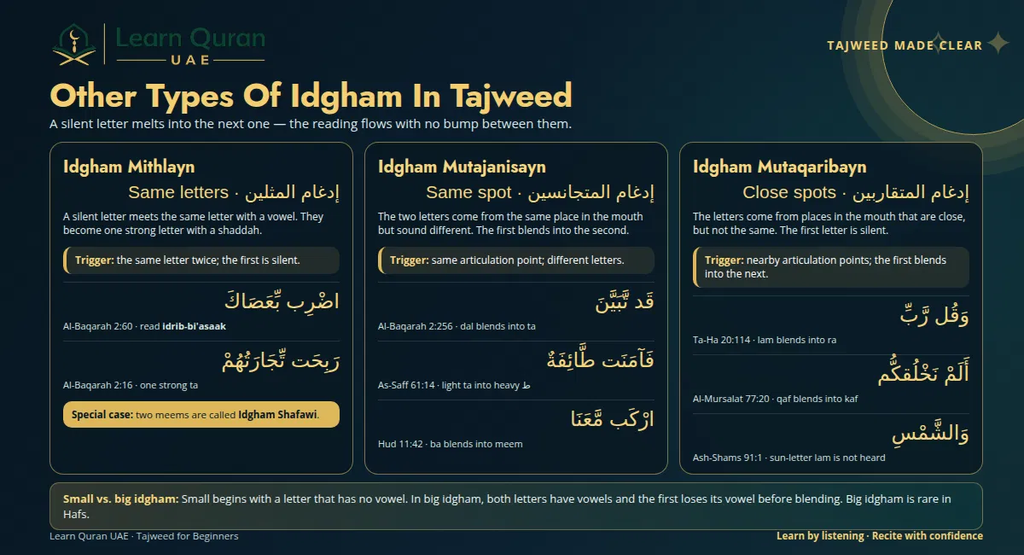
Scholars also split idgham into small (saghir) and big (kabir). In small idgham, the first letter already has no vowel. In big idgham, both letters have vowels, and the first one loses its vowel before it blends. Big idgham is rare in Hafs.
You can read more on Surah Quran’s page on small and big idgham.
Idgham Mithlayn: Two Of The Same Letter
Idgham mithlayn (إدغام المثلين) happens when a letter with no vowel meets the same letter with a vowel. The two turn into one letter with a shaddah.
A clear example is اضْرِب بِّعَصَاكَ (Al-Baqarah 2:60). The first ba has no vowel. The second ba has one. You read it as idrib-bi’asaak, with one strong ba.
Another is رَبِحَت تِّجَارَتُهُمْ (Al-Baqarah 2:16). Here a silent ta meets a voweled ta, and you hear one strong ta.
When both letters are meem, the rule gets its own name: idgham shafawi (الإدغام الشفوي). It is one of the meem sakinah rules, as in وَلَكُم مَّا كَسَبْتُمْ (Al-Baqarah 2:134). It is easy to confuse with the noon rule because of the name, but the trigger letter is different.
The noon sakinah rule with the letter noon, as in مِن نِّعْمَةٍ, is also a meeting of two same letters. That is why scholars call it a blend by sameness.
This is the easiest type to spot. If you see the same letter twice in a row and the first is silent, you blend them. You can read more about this type on Wikipedia’s idgham page.
Idgham Mutajanisayn: Letters From The Same Spot
Idgham mutajanisayn happens when two letters come from the same place in the mouth but sound different. The first letter is silent and blends into the second.
One example is قَد تَّبَيَّنَ (Al-Baqarah 2:256). The dal and the ta both come from the tip of the tongue. The dal blends into the ta, so you read qat-tabayyan.
Another is فَآمَنَت طَّائِفَةٌ (As-Saff 61:14). Here a light ta blends into a heavy ta (ط). The result is one heavy ta with a shaddah.
A third example is ارْكَب مَّعَنَا (Hud 11:42). The ba and the meem both come from the lips, so the ba blends into the meem.
The tricky one is أَحَطتُ (An-Naml 27:22). The heavy ط blends into the light ت, but its heavy quality stays. This is a partial blend. Old scholars said details like this are only learned by hearing a teacher, not from books. Hidayat al-Qari on IslamWeb explains this example in detail.
Idgham Mutaqaribayn: Letters From Close Spots
Idgham mutaqaribayn happens when two letters come from places in the mouth that are close, but not the same. Again, the first letter is silent and blends into the second.
A clear example is وَقُل رَّبِّ (Ta-Ha 20:114). The lam blends into the ra, so you read wa qur-rabbi. This is the same kind of closeness that lets noon blend into lam and ra.
Another example is أَلَمْ نَخْلُقكُّم (Al-Mursalat 77:20). The qaf blends into the kaf. Most reciters read it as a full blend, with one strong kaf and no trace of the qaf.
The lam in “al” (the) follows the same idea. Before letters like ش and ر, the lam is not said. So وَالشَّمْسِ (Ash-Shams 91:1) is read wash-shams. These are called sun letters, named after this very word.
All three types share one goal. A silent letter melts into the next one, and the reading flows with no bump between them.
For more on how scholars group these types, see Surah Quran’s page on small and big idgham.
A quick look at learning with us
See how a live class works, from the teacher’s explanation to the student’s recitation. It’s a simple way to know what to expect before your first lesson.
Start Learning Quran with Expert Tutors in the UAE
Accredited online Quran and Arabic classes tailored for adults and children. Schedule your session today.
Book Your Free TrialLearn Tajweed With Learn Quran UAE: Try Your First Class Free
Reading about idgham teaches you the rules. Reading it well, verse after verse, needs a teacher who listens and corrects you.
At Learn Quran UAE, the online Quran academy in the UAE, you get:
- A free trial class. Meet your teacher and try a lesson before you pay anything.
- A course for every level. Start with Tajweed for Beginners, then move up to the Advanced Tajweed Course or the Tajweed Ijazah Course.
- Classes for the whole family. There are tajweed courses for kids, adults, and ladies.
- Female teachers if you prefer. Sisters and young girls can learn with female Quran teachers.
- A schedule that fits your week. Pick 30- or 45-minute classes, from one to five days a week. Weekend classes are open too.
- Fair prices. Plans start at $16.99 a month. See all plans on the pricing page.
- Learn from home, anywhere in the UAE. Join from Dubai, Abu Dhabi, Sharjah, or any other emirate.
Stop guessing whether your idgham is right. Try your first class today and hear the change in your recitation.

Our Tajweed Courses
Don’t wait for the perfect minute, because it will never come. Browse our Tajweed courses and click free trial.
- Tajweed Course
- Learn Quran Online with Tajweed
- Tajweed for Kids Course
- Tajweed for Adults Course
- Tajweed for Ladies / Sisters Course
- Tajweed for Beginners Course
- Advanced Tajweed Course
Conclusion
Idgham is how the Quran keeps its flow when a noon meets one of six letters. Instead of a stop and a restart, the noon melts into the next sound. Sometimes a soft hum stays, and sometimes nothing is left.
The heart of the rule fits in two words. Yarmaloon tells you which letters cause idgham. Yanmoo tells you which of them keep the hum. Lam and ra are the two that let the noon vanish fully.
Where the noon sits matters just as much as the letter. The blend only happens across two words, in connected reading. That is why dunyaa stays clear, and why a pause on the first word cancels the rule.
The marks in your mushaf can guide you. A shaddah on the next letter means a full blend. No shaddah on ya or waw means part of the noon is still there. Learning to read these marks saves you from guessing.
Once this rule feels natural, the other kinds of idgham get much easier. Mithlayn, mutajanisayn, mutaqaribayn, and the sun letters all work on the same idea. You are not learning four new things. You are using one idea in new places.
The best next step is steady practice. Pick one page a day. Find every noon sakinah and tanween, run the 3-Step Idgham Check, and read each one out loud. Then read that page to a teacher who can hear what you can’t. A few weeks of this turns a rule on paper into a habit in your voice.
FAQs
These are questions learners often ask after they learn the basic rule. Each answer is short, so you can find what you need fast.
How Do You Pronounce The Word “Idgham”?
You say it as id-ghaam. The “gh” is a soft sound from the back of the throat, like a French “r.” The “aa” is long.
Where Can I Find Idgham In The Short Surahs?
Surah Al-Ikhlas has one in وَلَمْ يَكُن لَّهُ (112:4), where noon blends into lam with no hum. Surah Al-Masad has two in حَبْلٌ مِّن مَّسَدٍ (111:5), both with a hum.
Is Idgham Read The Same Way In All The Qira’at?
No, there are small differences. For example, Khalaf from Hamzah blends the noon into waw and ya without any hum.
What Is The Difference Between Idgham And Ikhfa?
In idgham, the noon blends fully into the next letter, and that letter gets a shaddah. In ikhfa, the noon is half hidden with a hum, and the next letter is not doubled.
What Is The Difference Between Idgham And Iqlab?
In idgham, the noon blends into one of the six yarmaloon letters. In iqlab, the noon comes before ba and turns into a light meem sound with a hum.
Is It A Sin To Read Without Idgham?
Most scholars class leaving out idgham as a “hidden” error, which is less serious than a “clear” error that changes a letter or a vowel. Our guide Is Tajweed Obligatory? explains how scholars rule on each.
Can Kids Learn Idgham?
Yes, kids can learn idgham once they read Arabic letters with vowels. Short verses and the nose-touch test make it fun, and the Tajweed for Kids Course teaches it step by step.
Can I Learn Idgham Online?
Yes, you can learn idgham well in live online classes. A teacher listens to you in real time and corrects your hum and your blends, just like in a face-to-face class.



Leave a Reply