 Hifz
Hifz
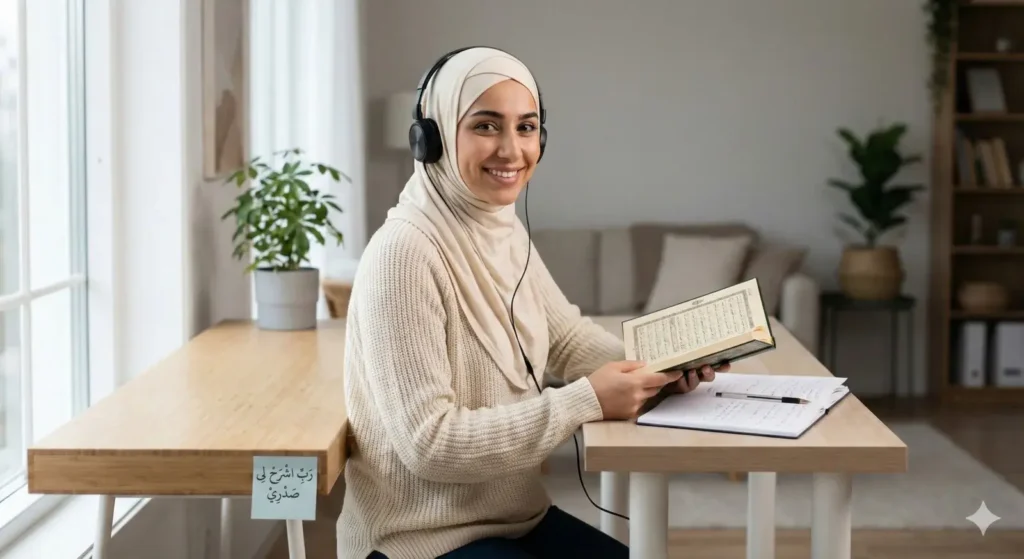
Many Muslims reach a point where reading the Quran occasionally no longer feels like enough. They want the words in their heart, not just in their hands — during Salah, during hard days, and as something their children carry for life.
The benefits and rewards of memorizing the Quran answer exactly that need. Hifz strengthens faith, sharpens the mind, and builds a relationship with Allah that stays with a person for the rest of their life and beyond it.
This guide covers the ten core rewards described directly in the Quran and Sunnah, plus the everyday cognitive benefits and the mistakes that slow most beginners down.
Hifz is the practice of committing the entire Quran — all 6,236 verses across 114 surahs — to memory through structured, repeated recitation. A person who completes this is called a Hafiz (male) or Hafiza (female).
Hifz differs from simply reading the Quran regularly. Reading requires the mushaf in front of you; Hifz means the words live in your chest and can be recited from memory, in prayer or outside it, at any moment.
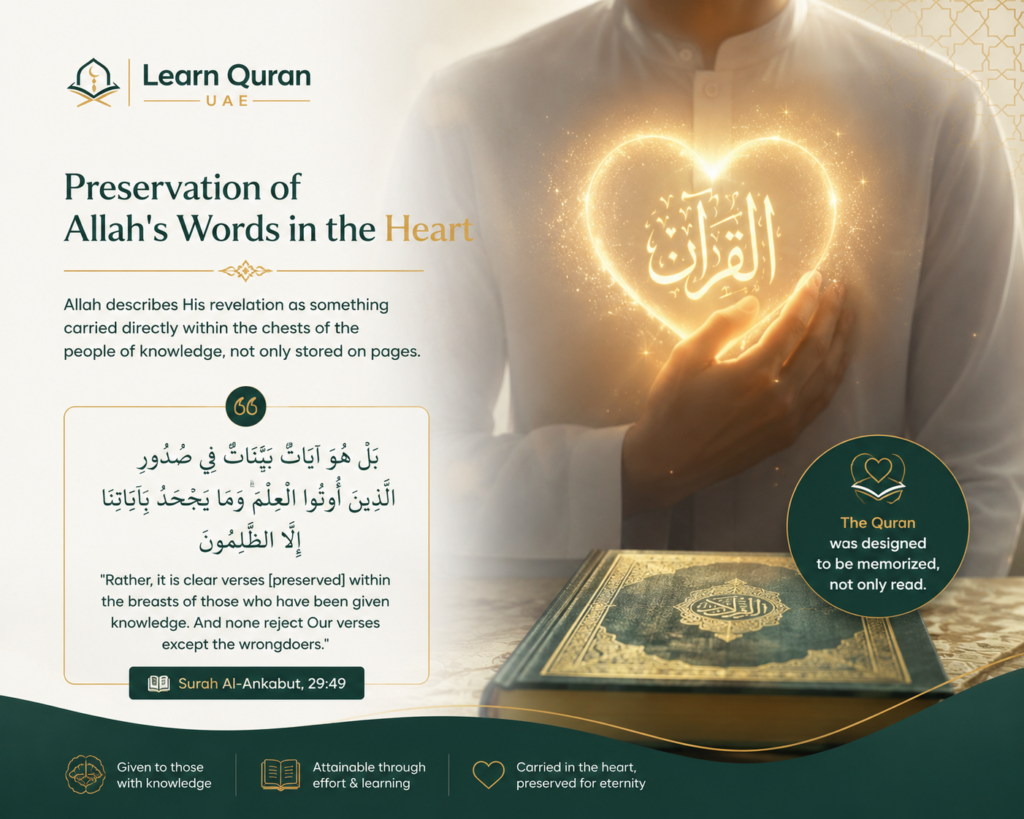
1. Preservation of Allah’s Words in the Heart
Allah describes His revelation as something carried directly within the chests of the people of knowledge, not only stored on pages.
بَلْ هُوَ آيَاتٌ بَيِّنَاتٌ فِي صُدُورِ الَّذِينَ أُوتُوا الْعِلْمَ ۚ وَمَا يَجْحَدُ بِآيَاتِنَا إِلَّا الظَّالِمُونَ
“Rather, it is clear verses [preserved] within the breasts of those who have been given knowledge. And none reject Our verses except the wrongdoers.” — Surah Al-Ankabut, 29:49
This ayah is often cited as the foundation for Hifz itself: the Quran was designed to be memorized, not only read. It also offers a practical reassurance — the ability to hold the Quran in memory is described as a gift given to “those given knowledge,” meaning it is attainable through effort and learning, not reserved for a select few.
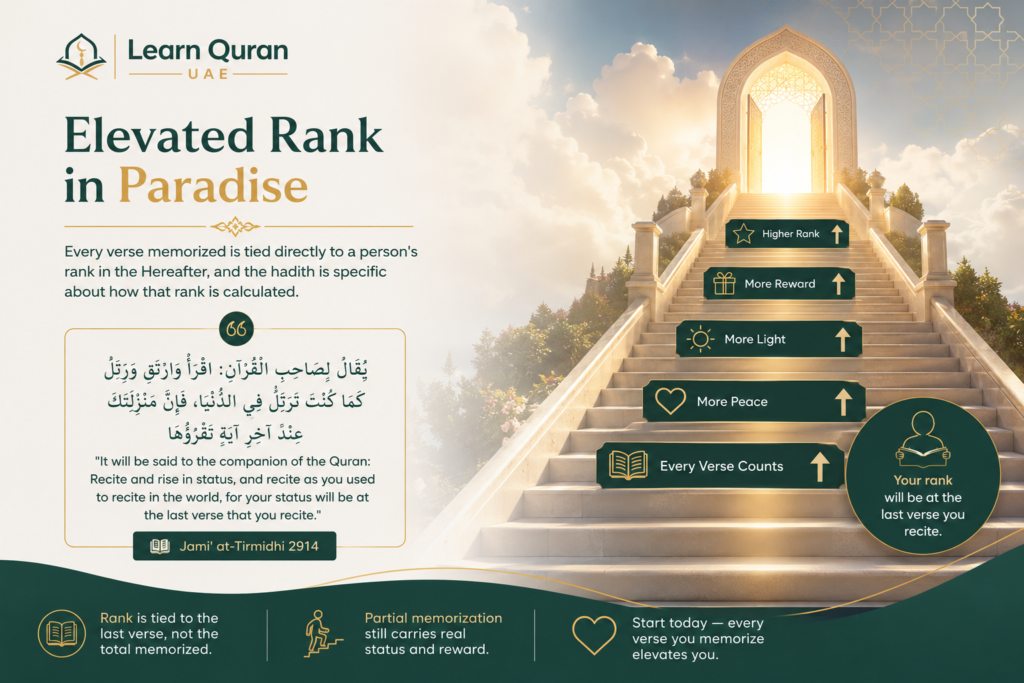
2. Elevated Rank in Paradise
Every verse memorized is tied directly to a person’s rank in the Hereafter, and the hadith is specific about how that rank is calculated.
يُقَالُ لِصَاحِبِ الْقُرْآنِ: اقْرَأْ وَارْتَقِ وَرَتِّلْ كَمَا كُنْتَ تُرَتِّلُ فِي الدُّنْيَا، فَإِنَّ مَنْزِلَتَكَ عِنْدَ آخِرِ آيَةٍ تَقْرَؤُهَا
“It will be said to the companion of the Quran: Recite and rise in status, and recite as you used to recite in the world, for your status will be at the last verse that you recite.” — Jami’ at-Tirmidhi 2914
The detail worth noting here is that rank is tied to the last verse a person recites, not the total number memorized. That means partial memorization still carries real reward — a point worth remembering for anyone worried they’re too far behind to start.
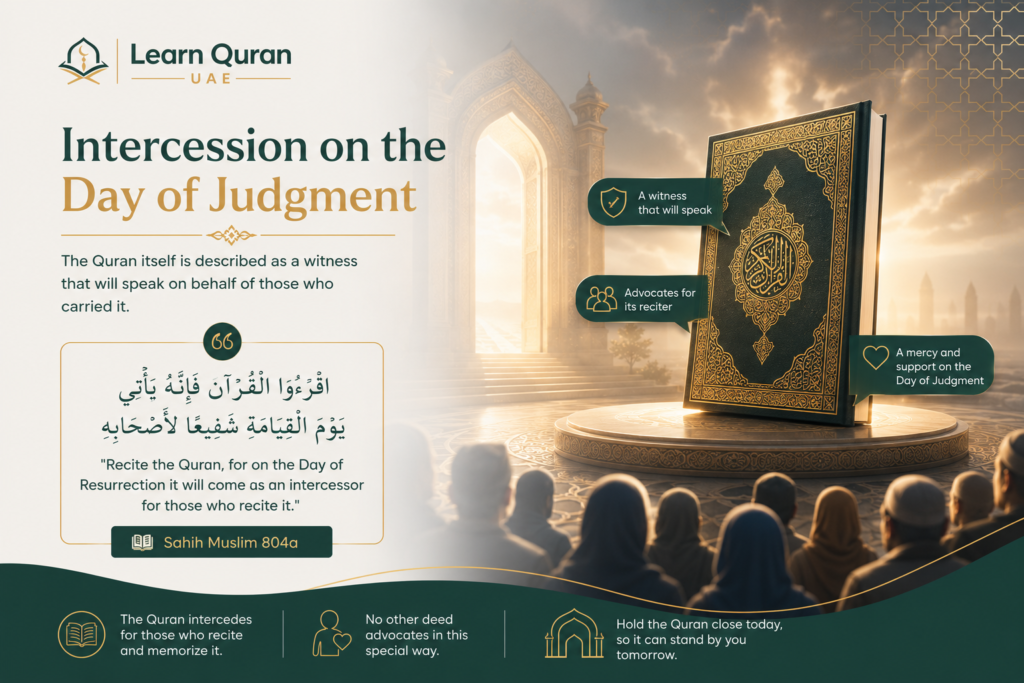
3. Intercession on the Day of Judgment
The Quran itself is described as a witness that will speak on behalf of those who carried it.
اقْرَءُوا الْقُرْآنَ فَإِنَّهُ يَأْتِي يَوْمَ الْقِيَامَةِ شَفِيعًا لِأَصْحَابِهِ
“Recite the Quran, for on the Day of Resurrection it will come as an intercessor for those who recite it.” — Sahih Muslim 804a
This hadith describes a form of support no other deed replaces in this specific way — the Quran advocating directly for its reciter before Allah.
4. Protection From the Fire
Memorizing and living by the Quran is described as evidence that will either support or stand against a person.
وَالْقُرْآنُ حُجَّةٌ لَكَ أَوْ عَلَيْكَ
“The Quran is a proof for you or against you.” — Sahih Muslim 223
This hadith is a reminder that Hifz is not a checklist item. Scholars consistently explain that the protection described here is tied to acting on what is memorized, not memorization in isolation.

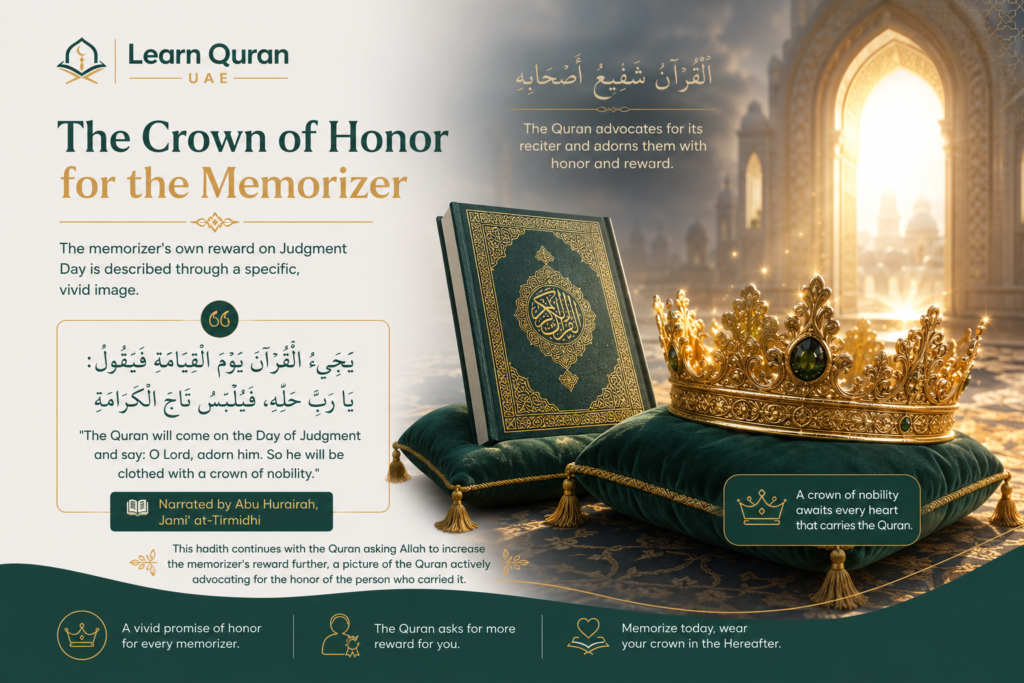
5. The Crown of Honor for the Memorizer
The memorizer’s own reward on Judgment Day is described through a specific, vivid image.
يَجِيءُ الْقُرْآنُ يَوْمَ الْقِيَامَةِ فَيَقُولُ: يَا رَبِّ حَلِّهِ، فَيُلْبَسُ تَاجَ الْكَرَامَةِ
“The Quran will come on the Day of Judgment and say: O Lord, adorn him. So he will be clothed with a crown of nobility.” — Narrated by Abu Hurairah, Jami’ at-Tirmidhi
This hadith continues with the Quran asking Allah to increase the memorizer’s reward further, a picture of the Quran actively advocating for the honor of the person who carried it.
Read also: 7 Qirat of the Quran – Full Guide
6. The Reward Parents Receive
A separate hadith extends this honor to the parents who supported a child’s memorization, which is why many families treat Hifz as a shared investment.
مَنْ قَرَأَ الْقُرْآنَ وَعَمِلَ بِمَا فِيهِ أُلْبِسَ وَالِدَاهُ تَاجًا يَوْمَ الْقِيَامَةِ ضَوْؤُهُ أَحْسَنُ مِنْ ضَوْءِ الشَّمْسِ فِي بُيُوتِ الدُّنْيَا
“If anyone recites the Quran and acts according to its content, on the Day of Judgment his parents will be given to wear a crown whose light is better than the light of the sun in the dwellings of this world.” — Narrated by Mu’adh al-Juhani, Sunan Abi Dawud 1453
This hadith explicitly separates the parents’ reward from the child’s own — meaning support and encouragement during the memorization years is itself a rewarded act, not just a parenting duty.

If you’re weighing whether to start your child’s Hifz journey now or wait, UAE Quran Academy’s Hifz program removes most of the guesswork. A teacher tracks retention from day one, so nothing is memorized and then quietly forgotten.
Experience a Live Quran Class
Watch a short sample from one of our online Quran classes and discover our engaging teaching style, interactive lessons, and personalized learning approach.
Start Learning Quran with Expert Tutors in the UAE
Accredited online Quran and Arabic classes tailored for adults and children. Schedule your session today.
Book Your Free Trial7. Deeper Understanding of Quranic Arabic
Repeated exposure to the same roots, grammatical patterns, and phrases naturally builds familiarity with Quranic Arabic, even for non-native speakers. Words that once needed translation start to register instantly, because the same root appears dozens of times across different surahs.
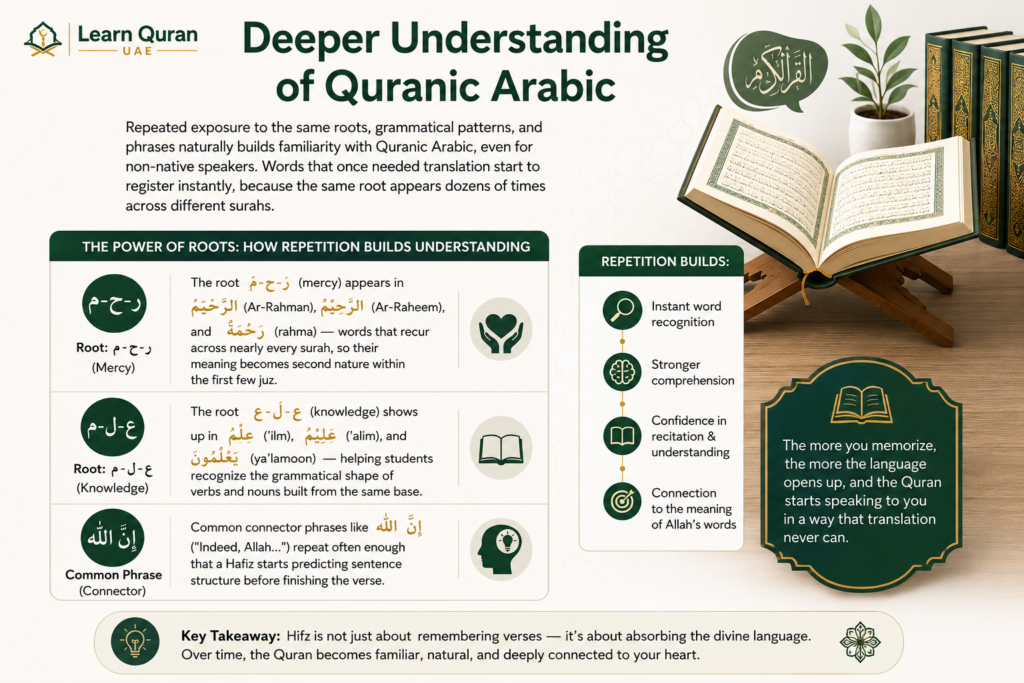
Arabic is built on a root system, where a single three-letter root generates dozens of related words. A few examples show how this repetition plays out in practice:
- The root ر-ح-م (mercy) appears in Rahman, Raheem, and rahma — words that recur across nearly every surah, so their meaning becomes second nature within the first few juz.
- The root ع-ل-م (knowledge) shows up in ‘ilm, ‘alim, and ya’lamoon — helping students recognize the grammatical shape of verbs and nouns built from the same base.
- Common connector phrases like إِنَّ اللَّهَ (“Indeed, Allah…”) repeat often enough that a Hafiz starts predicting sentence structure before finishing the verse.
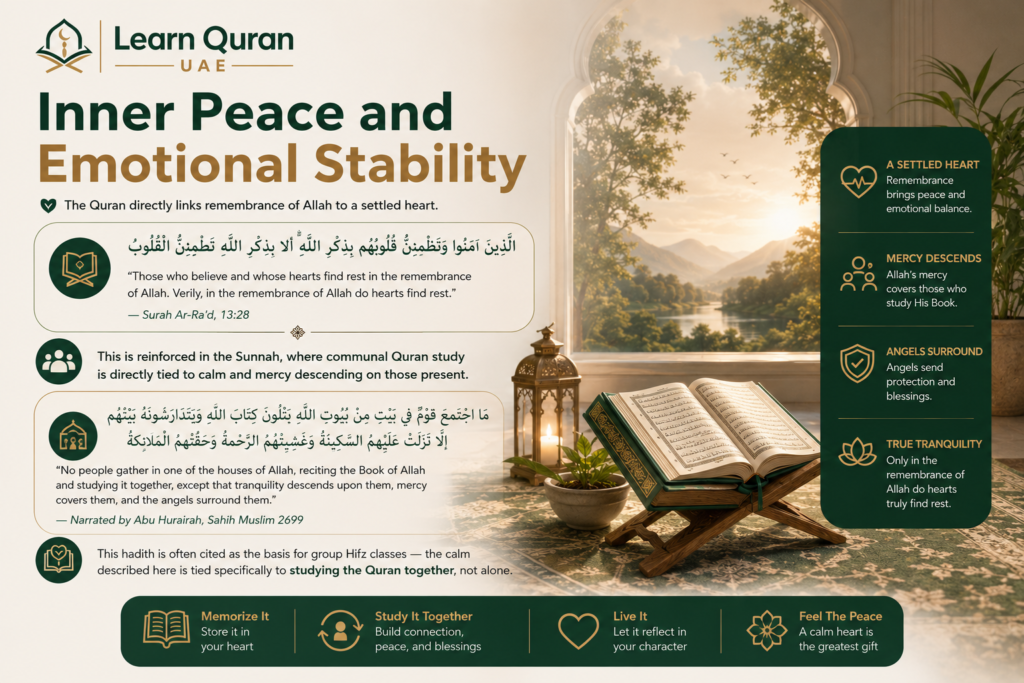
8. Inner Peace and Emotional Stability
The Quran directly links remembrance of Allah to a settled heart.
الَّذِينَ آمَنُوا وَتَطْمَئِنُّ قُلُوبُهُمْ بِذِكْرِ اللَّهِ ۗ أَلَا بِذِكْرِ اللَّهِ تَطْمَئِنُّ الْقُلُوبُ
“Those who believe and whose hearts find rest in the remembrance of Allah. Verily, in the remembrance of Allah do hearts find rest.” — Surah Ar-Ra’d, 13:28
This is reinforced in the Sunnah, where communal Quran study is directly tied to calm and mercy descending on those present.
مَا اجْتَمَعَ قَوْمٌ فِي بَيْتٍ مِنْ بُيُوتِ اللَّهِ يَتْلُونَ كِتَابَ اللَّهِ وَيَتَدَارَسُونَهُ بَيْنَهُمْ إِلَّا نَزَلَتْ عَلَيْهِمُ السَّكِينَةُ وَغَشِيَتْهُمُ الرَّحْمَةُ وَحَفَّتْهُمُ الْمَلَائِكَةُ
“No people gather in one of the houses of Allah, reciting the Book of Allah and studying it together, except that tranquility descends upon them, mercy covers them, and the angels surround them.” — Narrated by Abu Hurairah, Sahih Muslim 2699
This hadith is often cited as the basis for group Hifz classes — the calm described here is tied specifically to studying the Quran together, not alone.
9. Improved Quality of Salah
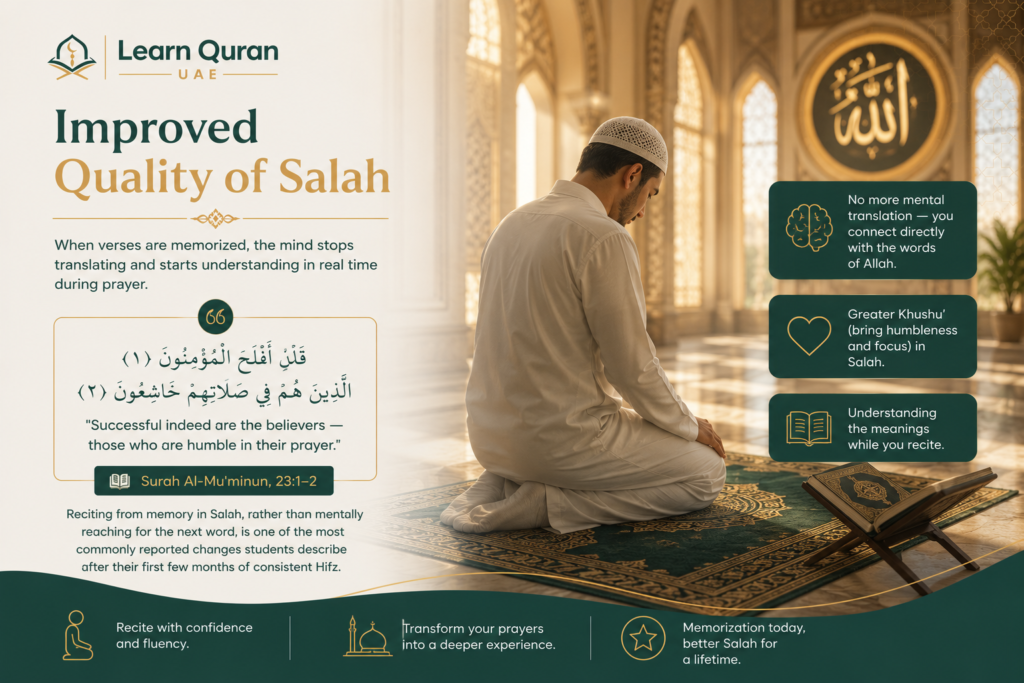
When verses are memorized, the mind stops translating and starts understanding in real time during prayer.
قَدْ أَفْلَحَ الْمُؤْمِنُونَ ﴿١﴾ الَّذِينَ هُمْ فِي صَلَاتِهِمْ خَاشِعُونَ ﴿٢﴾
“Successful indeed are the believers — those who are humble in their prayer.” — Surah Al-Mu’minun, 23:1–2
Reciting from memory in Salah, rather than mentally reaching for the next word, is one of the most commonly reported changes students describe after their first few months of consistent Hifz.
10. Stronger Character and Ongoing Reward Through Teaching
The Prophet ﷺ made this connection explicit in describing the ideal community.
خَيْرُكُمْ مَنْ تَعَلَّمَ الْقُرْآنَ وَعَلَّمَهُ
“The best of you are those who learn the Quran and teach it.” — Narrated by Uthman ibn Affan, Sahih al-Bukhari 5027
This hadith places teaching alongside learning, meaning the reward structure of Hifz keeps growing as a memorizer eventually passes the Quran on to their own children or students — a reward that continues after the memorizer’s own life ends.
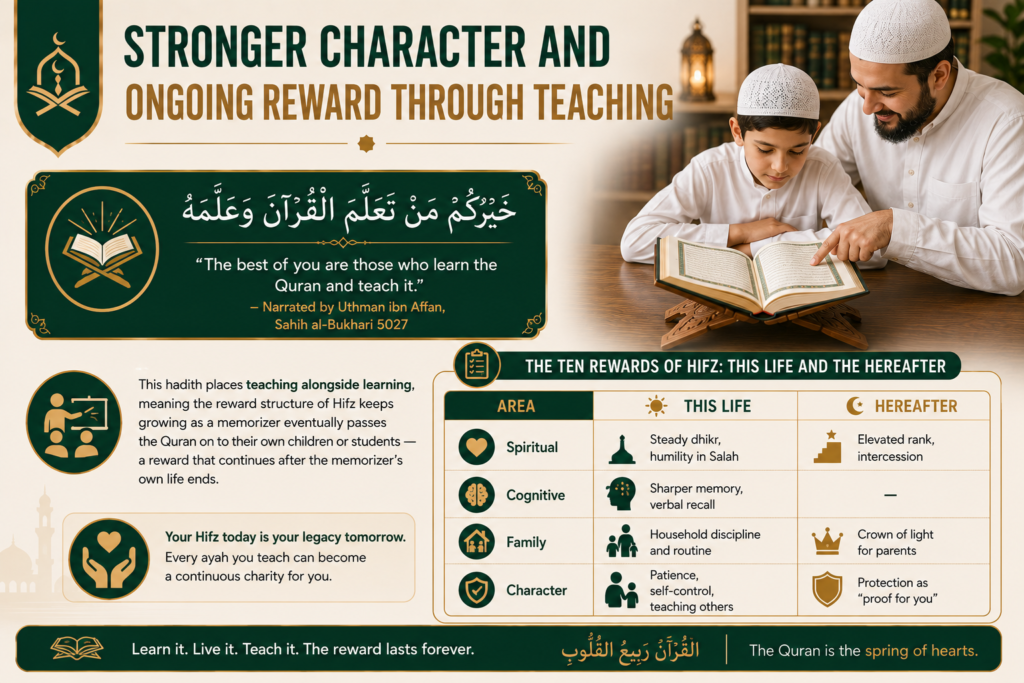
The table below summarizes how these ten rewards divide between this life and the Hereafter.
| Area | This Life | Hereafter |
| Spiritual | Steady dhikr, humility in Salah | Elevated rank, intercession |
| Cognitive | Sharper memory, verbal recall | — |
| Family | Household discipline and routine | Crown of light for parents |
| Character | Patience, self-control, teaching others | Protection as “proof for you” |
Read also: Levels of Quran Recitation – Full Guide
Does Memorizing the Quran Improve Memory?
Yes, memorizing the Quran improves memory because Hifz is repetition-based recall under structured correction — the same process used in cognitive training for verbal memory. This is one of the most searched questions about Hifz, so it deserves a direct, mechanism-based answer.
Each Hifz session involves listening, repeating, self-correcting, and reviewing older material (muraja’ah), which is a heavier cognitive load than passive reading. Over months of daily practice, this repetition builds stronger recall pathways for verbal and sequential information — the same skill set used in studying, public speaking, and structured problem-solving.
Age matters in practice, not just in theory: younger learners generally acquire new material faster because they memorize daily with less resistance, while adults often see slower initial gains but stronger retention once a verse is fully embedded, since adult memorization is usually paired with more conscious repetition and understanding of meaning.
Getting this cognitive benefit consistently depends on structured, corrected practice rather than self-study alone. UAE Quran Academy’s certified Hifz track builds this correction into every session, so retention is verified rather than assumed.

What Mistakes Slow Down Most Hifz Beginners?
Most students don’t quit Hifz because it’s too hard — they quit because of a handful of avoidable planning mistakes. Almost every one of these traces back to the same root cause: prioritizing new memorization over review.
The list below covers the mistakes that appear most often in self-directed memorization attempts:
- Skipping daily revision to add new verses faster, which causes older surahs to fade within weeks
- Memorizing without a qualified teacher, leading to embedded pronunciation and Tajweed errors that are harder to unlearn later
- Setting unrealistic daily targets, which leads to burnout within the first month
- Treating Hifz as a race rather than a lifelong relationship with the text
A reliable rule used by experienced Hifz teachers is “old before new”: no new verse is added to a session until the previous day’s portion has been recited correctly from memory. This single habit prevents the most common failure pattern in self-directed memorization — fast initial progress followed by steady forgetting.
If self-paced study keeps stalling at this exact point, a fixed weekly schedule makes the difference. UAE Quran Academy’s weekend Quran classes apply this same old-before-new structure for students who can only commit to set days each week.
See How Our Online Classes Work
Get a glimpse of a real online session and explore how students learn Quran with experienced teachers in a supportive and interactive environment.
Start Your Hifz Journey Today
Every reward described above — the elevated rank, the crown for your parents, the sharper memory, the calm in Salah — starts with a single verse memorized correctly and reviewed consistently.
UAE Quran Academy structures that process for you: qualified teachers, one-on-one correction, and a revision system built to prevent the old-before-new problem from the start. Whether your schedule only allows weekend sessions or you’re ready for a full weekly Hifz plan, the structure is what makes the difference between starting and finishing.
Book your free trial Hifz class now →
Our Quran Memorization Courses
- Quran Memorization (Hifz) Course
- Hifz for Kids Course
- Hifz for Adults Course
- Hifz for Ladies / Sisters Course
- Hifz for Men Course
- Quran Memorization Center (UAE)
- Juz Amma Memorization Program
- Hifz Completion & Hafiz Certification
Enroll today and begin your journey toward becoming a Hafiz with expert guidance, personalized learning plans, and flexible online classes.
Start Learning Quran with Expert Tutors in the UAE
Accredited online Quran and Arabic classes tailored for adults and children. Schedule your session today.
Book Your Free Trial
Conclusion
The benefits and rewards of memorizing the Quran cover every part of a person’s life: an elevated rank in Paradise, intercession and protection on the Day of Judgment, a crown of light shared with parents, and, in this world, a sharper memory, calmer heart, and more focused Salah. None of these rewards require perfection — the hadith on rank makes clear that reward is tied to consistent effort, not speed.
What separates students who complete Hifz from those who stall is rarely motivation. It’s structure. A clear daily revision system, a qualified teacher, and realistic pacing turn Quran memorization from an intimidating goal into a sustainable, lifelong practice that keeps paying rewards long after the last verse is recited.
FAQs
What are the main benefits of memorizing the Quran?
The main benefits split into spiritual and worldly categories: elevated rank in Paradise, intercession on Judgment Day, and a crown of light for parents on the spiritual side; sharper memory, deeper Arabic comprehension, and improved focus in Salah on the practical side.
Does memorizing the Quran improve memory?
Yes — Hifz trains verbal memory through daily repetition, recall, and structured review, the same cognitive process used in memory training generally. Students typically notice stronger recall and focus after several months of consistent practice.
What is the reward for memorizing the Quran in Islam?
Authentic hadith describe several rewards: rising one rank in Paradise for every verse recited (Tirmidhi 2914), the Quran interceding on the memorizer’s behalf (Sahih Muslim 804a), and a crown of light given to the memorizer’s parents (Sunan Abi Dawud 1453).
Why is memorizing the Quran important for children?
Starting Hifz early takes advantage of a child’s strong verbal memory and builds a lifelong habit of recitation, while also earning specific rewards promised to parents who support their child’s memorization.
How long does it take to memorize the Quran?
This depends on daily pace, prior Arabic reading ability, and revision consistency. Full Hifz can range from two to five years with steady daily sessions, though partial memorization of specific surahs or juz brings reward at any stage.
Can adults still memorize the Quran effectively?
Yes. Adults often memorize more slowly at first but retain material well once it’s embedded, especially when memorization is paired with understanding the meaning of the verses.

Leave a Reply