 Quran
Quran

Every reciter eventually asks the same question: how fast should I actually read the Quran? The answer lies in the levels of Quran recitation — a framework scholars established centuries ago to balance accuracy, fluency, and reflection.
These levels are not arbitrary reading speeds. They are recognized categories within the science of Tajweed, each with its own rules, purpose, and ideal use case. Understanding them is the difference between reciting correctly and reciting by guesswork.
This article breaks down each level, explains which one scholars rank highest, and shows how to choose the right pace for your stage of learning.
The Three Levels of Quran Recitation
The levels of Quran recitation are the recognized speeds at which the Quran can be recited while still applying every rule of Tajweed correctly. Scholars of Tajweed, including Ibn al-Jazari, classified recitation into three primary levels based on pace: Al-Tahqeeq, Al-Tadweer, and Al-Hadr.
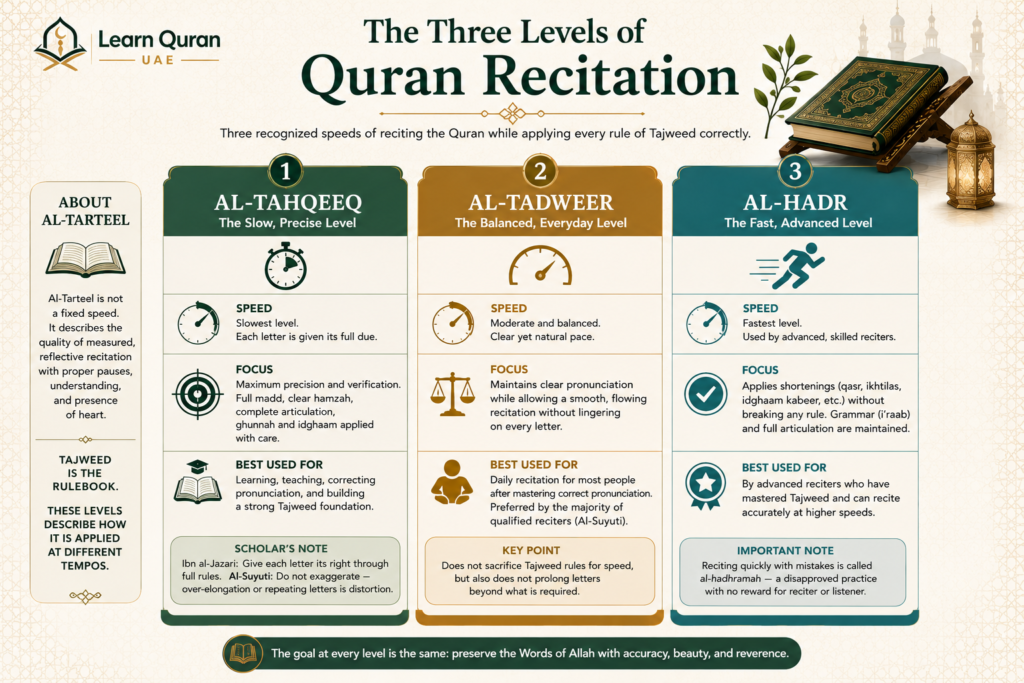
A fourth term, Al-Tarteel, is often mentioned alongside them, but it functions differently — it describes the quality of measured, reflective recitation rather than a fixed speed. The distinction between recitation and Tajweed matters here: Tajweed is the rulebook, while these levels describe how that rulebook is applied at different tempos.
1. Al-Tahqeeq: The Slow, Precise Level
Al-Tahqeeq means precision and verification in Arabic. In practice, it is the slowest recitation level, giving every letter its full due — complete elongation (madd) where required, full articulation of the hamzah, and careful application of every Tajweed rule without rushing.
Ibn al-Jazari defined it as giving each letter its right through full madd, precise hamzah pronunciation, complete vowel movements, and correct application of ghunnah and idghaam. This level is designed for training the tongue and correcting pronunciation, which is why it is the standard starting point in structured tajweed classes.
Al-Suyuti cautioned that Tahqeeq should not tip into exaggeration — over-elongating vowels or repeating letters like the raa beyond what Tajweed requires turns careful recitation into distortion.
2. Al-Tadweer: The Balanced, Everyday Level
Al-Tadweer sits between Tahqeeq and Hadr. It keeps pronunciation clear while allowing a more natural, flowing pace — which is why most scholars of recitation, according to Al-Suyuti, consider it the method used by the majority of qualified reciters.
This is the level most reciters settle into for daily reading once their pronunciation is accurate. It does not sacrifice Tajweed rules for speed, but it does not linger on every letter the way Tahqeeq does either.
3. Al-Hadr: The Fast, Advanced Level
Al-Hadr means haste. It is the fastest recognized level, used by reciters who have already mastered Tajweed and can apply shortenings — such as qasr, ikhtilas, and idghaam kabeer — without breaking any rule.
Speed here is not carelessness. Ibn al-Jazari’s definition of Hadr still requires maintaining correct grammar (i’raab) and full articulation of letters. Reciting quickly with mistakes is a separate, disapproved practice known as al-hadhramah, and it carries no reward for either the reciter or the listener.
Al-Tarteel and Its Relationship to the Three Levels
Al-Tarteel is not a fourth speed sitting alongside the other three — it is the quality of composed, reflective recitation that should run through all of them. Allah commands this directly:
وَرَتِّلِ الْقُرْآنَ تَرْتِيلًا
“And recite the Qur’an with measured recitation.” — Surah Al-Muzzammil, 73:4
Scholars note a precise relationship: every instance of Tahqeeq qualifies as Tarteel, but not every Tarteel is Tahqeeq. Tahqeeq is used specifically for training and instruction; Tarteel is used for contemplation and extracting meaning. One is broader (Tarteel), the other more specific (Tahqeeq).
The Scholarly Ranking of Recitation Levels
Scholars are not unanimous on which level earns the most reward, and the disagreement itself is instructive.
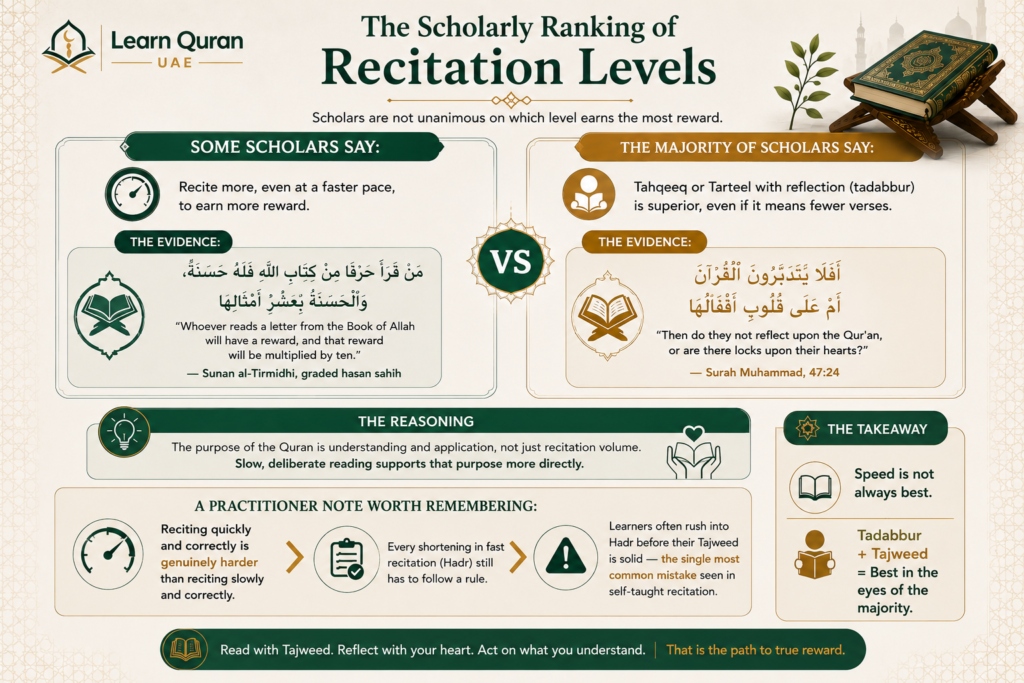
Some scholars favor reciting more of the Quran, even at a faster pace, citing the hadith of Abdullah ibn Mas’ud:
مَنْ قَرَأَ حَرْفًا مِنْ كِتَابِ اللَّهِ فَلَهُ حَسَنَةٌ، وَالْحَسَنَةُ بِعَشْرِ أَمْثَالِهَا
“Whoever reads a letter from the Book of Allah will have a reward, and that reward will be multiplied by ten.” — Sunan al-Tirmidhi, graded hasan sahih
The majority of early and later scholars, however, hold that Tahqeeq or Tarteel combined with reflection (tadabbur) is superior, even if it means covering fewer verses. Their evidence is the Quran’s own rebuke of recitation without reflection:
أَفَلَا يَتَدَبَّرُونَ الْقُرْآنَ أَمْ عَلَى قُلُوبٍ أَقْفَالُهَا
“Then do they not reflect upon the Qur’an, or are there locks upon their hearts?” — Surah Muhammad, 47:24
The reasoning is straightforward: the purpose of the Quran is understanding and application, not just recitation volume. Slow, deliberate reading supports that purpose more directly. This is one reason structured programs pair recitation practice with actual comprehension of the text, rather than treating speed as the goal.
A practitioner note worth remembering: reciting quickly and correctly is genuinely harder than reciting slowly and correctly, because every shortening still has to follow a rule. Learners often rush into Hadr before their Tajweed is solid, which is the single most common mistake seen in self-taught recitation.
Understanding the difference between levels of recitation and Qira’at
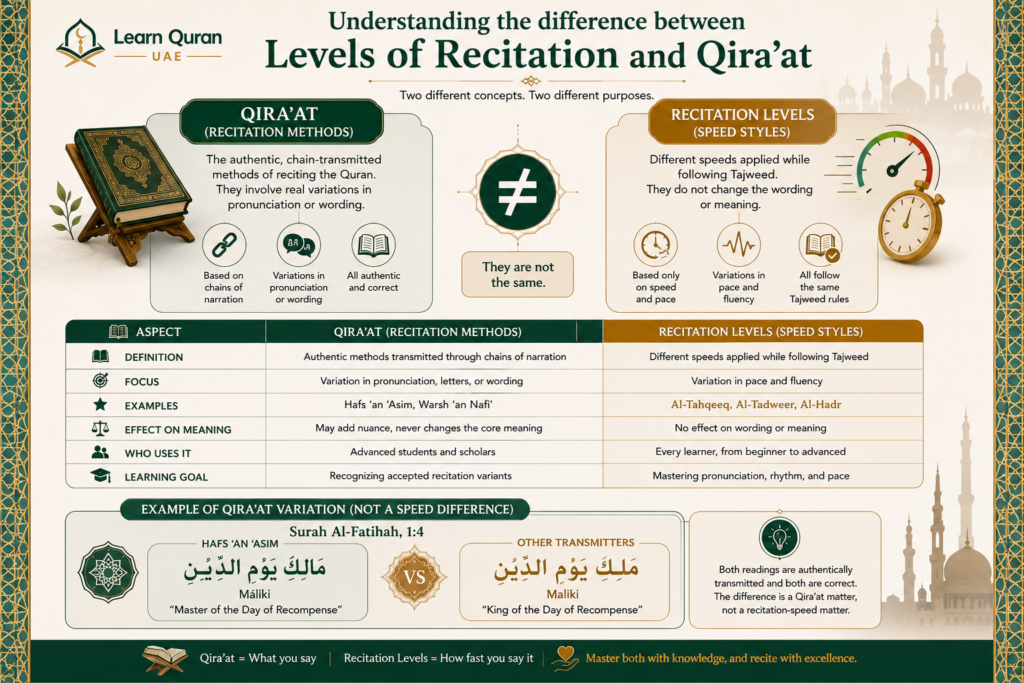
Recitation levels and Qira’at are frequently confused, but they describe two entirely different things. Qira’at refers to the authentic, chain-transmitted methods of reciting the Quran — such as Hafs ‘an ‘Asim or Warsh ‘an Nafi’ — which involve genuine variations in pronunciation or wording. Recitation levels refer only to speed.
The table below sets out the distinction clearly.
| Aspect | Qira’at (Recitation Methods) | Recitation Levels (Speed Styles) |
| Definition | Authentic methods transmitted through chains of narration | Different speeds applied while following Tajweed |
| Focus | Variation in pronunciation, letters, or wording | Variation in pace and fluency |
| Examples | Hafs ‘an ‘Asim, Warsh ‘an Nafi’ | Al-Tahqeeq, Al-Tadweer, Al-Hadr |
| Effect on meaning | May add nuance, never changes the core meaning | No effect on wording or meaning |
| Who uses it | Advanced students and scholars | Every learner, from beginner to advanced |
| Learning goal | Recognizing accepted recitation variants | Mastering pronunciation, rhythm, and pace |
A concrete example of a Qira’at variation appears in Surah Al-Fatihah, 1:4. Hafs ‘an ‘Asim recites مَالِكِ يَوْمِ الدِّينِ (Māliki), meaning “Master of the Day of Recompense,” while other transmitters recite مَلِكِ يَوْمِ الدِّينِ (Maliki), meaning “King of the Day of Recompense” Both are authentically transmitted and both are correct — the difference is a Qira’at matter, not a recitation-speed matter.
Read also: 7 Qirat of the Quran – Full Guide
Experience a Live Quran Class
Watch a short sample from one of our online Quran classes and discover our engaging teaching style, interactive lessons, and personalized learning approach.
Start Learning Quran with Expert Tutors in the UAE
Accredited online Quran and Arabic classes tailored for adults and children. Schedule your session today.
Book Your Free TrialRulings That Apply During Recitation: Isti’adhah and Basmalah
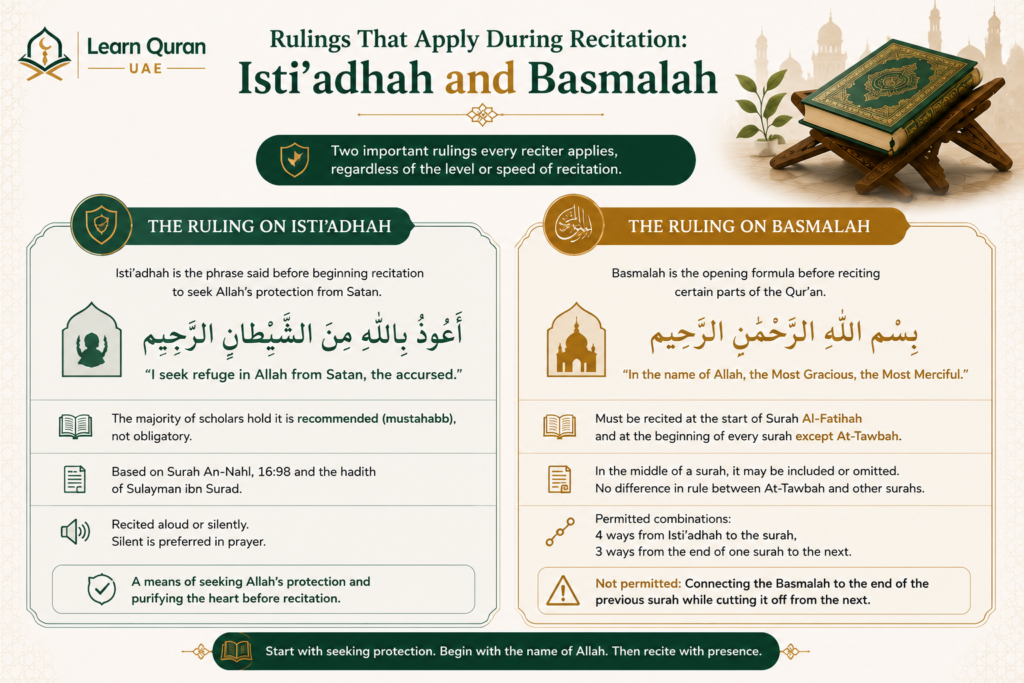
Before covering how fast to recite, it helps to know two rulings every reciter applies regardless of level: seeking refuge (Isti’adhah) and the opening formula (Basmalah).
The Ruling on Isti’adhah
Isti’adhah is the phrase said before beginning recitation to seek Allah’s protection from Satan. The majority of scholars, including most reciters, hold that saying it is recommended (mustahabb) rather than obligatory, based on:
فَإِذَا قَرَأْتَ الْقُرْآنَ فَاسْتَعِذْ بِاللَّهِ مِنَ الشَّيْطَانِ الرَّجِيمِ
“So when you recite the Qur’an, seek refuge in Allah from Satan, the expelled.” — Surah An-Nahl, 16:98
The standard wording, agreed upon by all reciters, is أَعُوذُ بِاللَّهِ مِنَ الشَّيْطَانِ الرَّجِيمِ
(“I seek refuge in Allah from Satan, the accursed”).
This exact phrasing is also reported from the Prophet ﷺ in the hadith of Sulayman ibn Surad Reciters may say it aloud or silently — silent recitation is preferred inside prayer, since the person praying behind the imam is already listening in silence.
The Ruling on Basmalah
Basmalah refers to saying بِسْمِ اللَّهِ الرَّحْمَٰنِ الرَّحِيمِ
(“In the name of Allah, the Most Gracious, the Most Merciful”).
All reciters agree it must be recited at the start of Surah Al-Fatihah and at the beginning of every surah except Surah At-Tawbah, since it is written that way in the Mus’haf.
In the middle of a surah, reciters have the option to include or omit the Basmalah — there is no difference in this rule between At-Tawbah and any other surah, though some scholars treat At-Tawbah more strictly given how it opens. Reciters are permitted four combinations when moving from Isti’adhah into the Basmalah and the surah, and three combinations when moving from the end of one surah into the Basmalah of the next — the only combination scholars agree is not permitted is connecting the Basmalah to the end of the previous surah while cutting it off from the surah that follows.
Choosing the Right Recitation Level as a Beginner
Choosing a recitation level is not about preference — it is about matching your current Tajweed accuracy to the right pace.
- Start with Al-Tahqeeq. Slow recitation is the only level that gives you time to correct articulation (makhraj) before habits form.
- Prioritize accuracy over speed. A mistake practiced repeatedly at speed is far harder to unlearn than one caught early at a slow pace.
- Practice in short, daily sessions. Ten focused minutes a day builds recognition faster than one long session a week.
- Move to Al-Tadweer once accuracy holds. This is the natural next step once letters and vowels are consistently correct.
- Get direct feedback from a qualified teacher. Self-correction misses the errors a trained ear catches immediately.
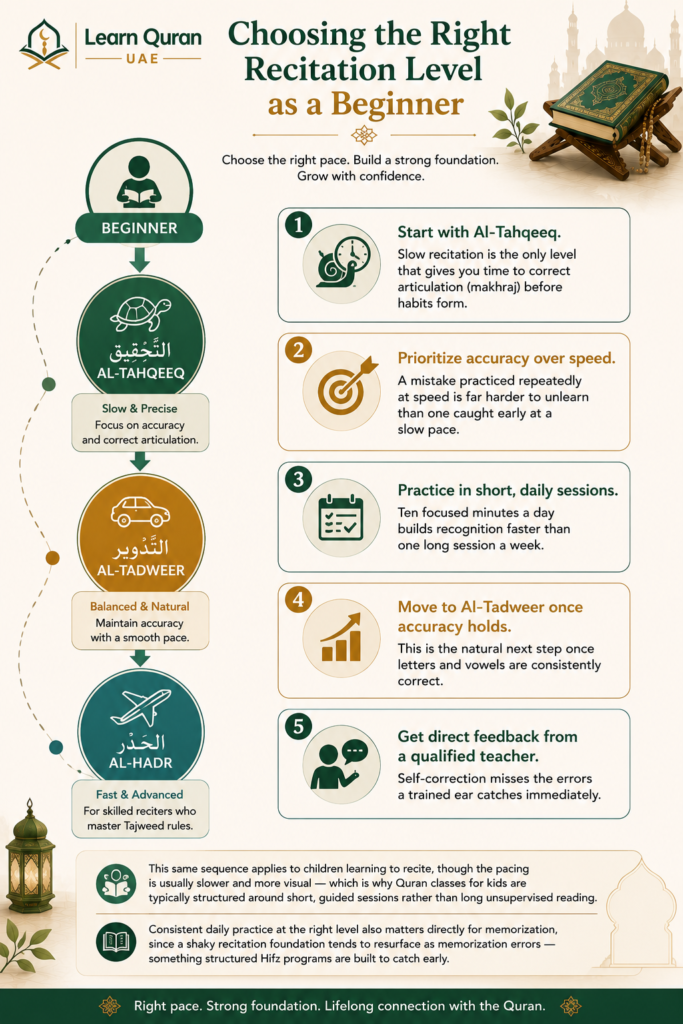
This same sequence applies to children learning to recite, though the pacing is usually slower and more visual — which is why Quran classes for kids are typically structured around short, guided sessions rather than long unsupervised reading. Consistent daily practice at the right level also matters directly for memorization, since a shaky recitation foundation tends to resurface as memorization errors — something structured Hifz programs are built to catch early.
Read also: Benefits & Rewards of Memorizing the Quran: A Complete Guide
See How Our Online Classes Work
Get a glimpse of a real online session and explore how students learn Quran with experienced teachers in a supportive and interactive environment.
Start Reciting with Confidence, Not Guesswork
Getting the levels of Quran recitation right on your own is slow going — most learners either rush past Tahqeeq or never move beyond it. A qualified Tajweed teacher shortens that path considerably, correcting pronunciation in real time instead of letting habits set in.
UAE Quran Academy pairs every student with a certified Tajweed instructor, whether you are starting from zero or refining your pace toward Al-Hadr. Book a free trial class and find out exactly which level fits where you are now.
[Book Your Free Trial Class Today]
Our Quran Courses
- Noorani Qaida Course
- Noorani Qaida for Kids Course
- Noorani Qaida with Tajweed Course
- Noor Al-Bayan Course
- Quran Reading Course
- Quran Reading for Kids Course
- Quran Reading for Beginners Course
- Quran Reading with Tajweed Course
- Quran Recitation Course
- Quran Recitation for Kids Course
- Quran Tafseer Course
- Tafseer for Kids Course
- Quran Ijazah Program
- Tajweed Ijazah Course
- Ten Qirat Course
Enroll today and start learning the Quran from the comfort of your home with expert instructors at UAE Quran Academy.
Start Learning Quran with Expert Tutors in the UAE
Accredited online Quran and Arabic classes tailored for adults and children. Schedule your session today.
Book Your Free Trial
Conclusion
The levels of Quran recitation — Al-Tahqeeq, Al-Tadweer, and Al-Hadr — exist to give every reciter, at every stage, a correct way to read the Quran at their own pace. Tahqeeq builds the foundation, Tadweer carries it into daily practice, and Hadr rewards reciters who have already mastered the rules. Tarteel, meanwhile, is the reflective quality that should run through all three.
Scholars differ on which level earns more reward, but the stronger position — reciting with Tahqeeq or Tarteel and real reflection — points to the same conclusion: understanding the Quran matters more than covering it quickly. Getting the levels of Quran recitation right starts with slow, correct practice, not speed.
Frequently Asked Questions
What are the levels of Quran recitation?
The levels of Quran recitation are Al-Tahqeeq (slow), Al-Tadweer (moderate), and Al-Hadr (fast), each requiring full application of Tajweed rules regardless of pace.
Is Al-Tarteel a separate recitation level?
No, Al-Tarteel is not a separate speed — it describes reflective, composed recitation that can occur within any of the three levels, most commonly within Tahqeeq.
Do recitation levels change the meaning of the Quran?
No, recitation levels only affect speed and fluency. They do not alter wording or meaning, unlike Qira’at variations, which involve authentic differences in pronunciation.
Which recitation level should beginners start with?
Beginners should start with Al-Tahqeeq, since its slow pace allows time to correct pronunciation and apply Tajweed rules before building speed.
Is saying Isti’adhah before reciting the Quran obligatory?
Most scholars hold that Isti’adhah is recommended rather than obligatory, based on Surah An-Nahl 16:98, though a minority view considers it required at least once in a reciter’s life.
Can I learn all three recitation levels online?
Yes, structured online Tajweed classes with a certified teacher can guide a student through Tahqeeq, Tadweer, and Hadr in sequence, with direct correction at each stage.


Leave a Reply