 Hifz
Hifz
You have been asking yourself this question for months, maybe years. You open the Mushaf, feel the weight of 604 pages in your hands, and close it again — not because you lack the desire, but because you cannot commit to something with no visible finish line. The fear is not laziness. It is the very human need to know what you are walking into before you take the first step. That hesitation is costing you more time than the memorization itself ever would.
How long does it take to memorize the Quran is one of the most searched questions in Islamic education — and the honest answer is that it depends almost entirely on five factors you can measure and control. This guide breaks each of them down, gives you realistic timelines based on different daily targets, and shows you exactly what separates students who complete their Hifz from those who restart repeatedly.
How Long Does It Take to Memorize the Quran?
How long does it take to memorize the Quran depends on several factors, including your daily memorization target, consistency, reading ability, and commitment to regular review. Most students who memorize half a page to one page per day complete their Hifz in 2 to 4 years, while those following an intensive schedule may finish much sooner. The key is not speed but maintaining a steady routine with structured revision to ensure long-term retention.
There is no single timeline that fits everyone. Children, adults, beginners, and experienced readers all progress at different rates. Students with strong Quran reading skills and guidance from a qualified teacher often memorize more efficiently because they avoid pronunciation mistakes and build a stronger foundation. With realistic goals, daily practice, and consistent review, memorizing the Quran becomes an achievable journey for learners of any age.
Here are the factors that affect the time it takes to memorize the Quran:
1. How Much of the Quran You Are Actually Memorizing
Before any timeline makes sense, you need a clear structural picture of the task. The Quran contains 30 Juz, and each Juz contains 20 pages. That gives you 600 pages of Arabic text to work through. Each page holds approximately 15 lines, and each line contains between 8 and 12 words depending on the Uthmani script edition you are using.
These numbers feel large until you break them into daily targets. When you do, the math becomes surprisingly manageable. A student memorizing just one page per day — roughly 15 lines — will complete the full Quran in under two years. That is less than 30 minutes of focused daily memorization at a standard adult pace.
| Daily Memorization Target | Approximate Time to Complete |
| 5 to 10 lines (half a page) | 3 to 4 years |
| 1 full page | 1.5 to 2 years |
| 2 pages | 10 to 12 months |
| 3 to 4 pages | 5 to 6 months |
| 1 full Juz (20 pages) | 30 days (intensive) |
These figures assume daily consistency and active review running in parallel. They are not upper bounds — they are what actually happens when students follow a structured daily plan without significant interruption. The question is never really “how long does it take to memorize the Quran” in the abstract. The question is always “how many pages can I realistically memorize and review each day without losing what I have already built.”
Students who struggle with reading Arabic accurately before beginning Hifz are doing two cognitive tasks simultaneously — decoding text and trying to retain it — which doubles the difficulty and stretches every timeline above.
If that describes your current situation, building a reading foundation first will shorten your total Hifz timeline, not lengthen it. The Quran Reading Course at UAE Quran Academy is designed exactly for this: taking students from uncertain reading to confident, accurate recitation before memorization begins.

Build strong Quran reading skills before starting your Hifz journey.
2. Your Daily Time Commitment Determines Everything
The single most important variable in how long it takes to memorize the Quran is how much time you protect for it each day — not how talented you are, not how young you started, and not how naturally you retain information.
Scholars across the Arab world have consistently pointed to the time after Fajr as the primary memorization window. The reason is not ceremonial. The mind is rested after sleep, there are no competing demands from the day yet, and the quiet of early morning removes the audio distractions that fragment attention during other parts of the day. The period after Asr is the second-best slot, particularly for reviewing material memorized earlier that morning.
What matters more than which slot you choose is that the slot is fixed and non-negotiable. Memorization performed at variable hours does not build a habit. It builds inconsistency, and inconsistency is the primary reason most self-guided Hifz attempts stall before the fifth Juz.
A practical daily time allocation that works for most adult learners looks like this:
- 30 to 45 minutes for new memorization (morning, preferably after Fajr).
- 20 to 30 minutes for near-past review — the last 5 to 10 pages memorized.
- 20 minutes for far-past review — rotating through older material on a weekly cycle.

That is roughly 70 to 90 minutes daily. Students who cannot protect that full block can begin with 30 to 40 minutes for new memorization and near-past review only, then add far-past review once the habit is established.
3. Your Reading Level Before Starting Hifz Affects Your Timeline More Than You Think
A student who reads Arabic fluently with correct Tajweed and a student who reads slowly with pronunciation errors are not starting the same journey — even if they set the same daily page target.
The student with strong reading fluency uses their memorization session for one cognitive task: retention. The student who is still working through letter pronunciation is using the same session for two tasks: decoding and retention. That difference compounds across hundreds of sessions and can add a full year or more to the total Hifz timeline.
This is not a reason to delay starting. It is a reason to be accurate about where you are before you set a timeline. If you read Arabic with hesitation, mispronounce letters, or are unsure of Tajweed rules, the most time-efficient thing you can do before beginning Hifz is close that gap.
For students who want to build this foundation properly, the Quran Reading with Tajweed Course at UAE Quran Academy provides a structured path from uncertain recitation to accurate reading under qualified teacher supervision — which is exactly the prerequisite state that makes subsequent Hifz both faster and more durable.
Start today and build a strong Quran reading foundation.
4. Review Plan Is Not Optional — It Is What Makes Memorization Real
Most students who ask how long it takes to memorize the Quran are thinking only about new memorization. They are not accounting for the review time that determines whether what they memorize actually stays.
Recall strength decays rapidly in the first 24 to 48 hours after initial memorization, then stabilizes if the memory is revisited. A student who memorizes a page on Monday and does not review it until Friday has effectively forgotten most of it. Skipping review for even two or three consecutive days can erase an entire week of memorization work.
The Prophet ﷺ described this precisely:
“تَعَاهَدُوا الْقُرْآنَ فَوَالَّذِي نَفْسِي بِيَدِهِ لَهُوَ أَشَدُّ تَفَصِّيًا مِنَ الإِبِلِ فِي عُقُلِهَا”
“Ta’aahadu al-Qur’ana fa-walladhee nafsee bi-yadihi la-huwa ashaddu tafassiyan minal ibili fee ‘uquliha.”
“Keep refreshing your knowledge of the Quran, for by the One in Whose hand my soul is, it slips away faster than a camel from its tying ropes.”
Effective review operates on three levels simultaneously:
| Review Category | What It Covers | Recommended Frequency |
| Near-past review | Last 5 pages memorized | Daily, non-negotiable |
| Mid-past review | Pages 6 to 20 behind current position | Daily, increasing gradually |
| Far-past review | Everything memorized before that | Weekly rotation |
The Hifz programs that produce consistent completions all share one structural feature: review receives equal or greater priority than new memorization. On days when time is short, experienced teachers advise reviewing existing material rather than adding new verses, because protecting what you have is more important than expanding it.
For sisters who want structured daily review built into their program from day one, the Hifz for Ladies Classes at UAE Quran Academy provides female teachers who track both new memorization and review simultaneously, with accountability built into every session.

Enroll and begin with daily review structure from your first class.
Experience a Live Quran Class
Watch a short sample from one of our online Quran classes and discover our engaging teaching style, interactive lessons, and personalized learning approach.
Start Learning Quran with Expert Tutors in the UAE
Accredited online Quran and Arabic classes tailored for adults and children. Schedule your session today.
Book Your Free TrialRead also: Benefits & Rewards of Memorizing the Quran: A Complete Guide
5. The Age Affects How Long It Takes to Memorize the Quran
There is a widespread belief that memorizing the Quran becomes impossible or impractical after childhood. This belief is not supported by the experience of qualified teachers or by the history of Hifz in the Muslim world.
Children do have certain advantages. They have fewer competing cognitive demands, their brains are in a period of high neuroplasticity, and they tend to absorb auditory patterns quickly and naturally. A child memorizing the Quran in a structured program will often reach completion faster in raw years than an adult following the same daily target.
Adults, however, bring their own genuine advantages. They have stronger comprehension, which means they understand the meaning of what they are memorizing — and meaning-based memory is significantly more durable than pure acoustic memory. They have greater discipline and the ability to maintain a structured schedule deliberately rather than relying on an externally imposed one. They also have context for why each ayah matters, which motivates consistent review in a way that abstract habit-building does not.
A realistic look at age-based timelines:
- Children in dedicated Hifz programs (ages 7 to 15): 2 to 5 years depending on daily hours and program structure.
- Teenagers with daily school schedules: 3 to 6 years at half to one page daily.
- Adults with working hours and family responsibilities: 2 to 5 years at half to one page daily with consistent review.
- Adults in intensive programs: 6 to 18 months at 2 to 4 pages daily

The most important point is that none of these timelines are fixed. They are averages based on the consistency of the student and the quality of the program. A 45-year-old adult with one hour daily after Fajr and a qualified teacher can complete the Quran faster than a teenager with irregular habits and no teacher supervision.
6. The Interruptions Do to Your Timeline and How to Recover
Interruptions are not the exception in Hifz — they are the rule. Work pressure, travel, illness, family obligations, and periods of low motivation all break the daily rhythm at some point in every student’s journey. The question is not whether interruptions will happen. It is how you return after them.
The most common mistake after a break is trying to compensate by memorizing double the usual amount. This approach generates new material that has no review base under it, which means it disappears within days and the student ends up further behind than before the attempt at recovery. A correct return after interruption looks like this:
- First two days back: review only, no new memorization
- Next three to four days: return to half the usual daily target
- End of the first week back: resume normal daily target
This paced return protects everything memorized before the interruption and prevents the discouragement that causes students to abandon Hifz entirely after a break. The students who complete the Quran are rarely those who never stopped — they are those who returned correctly every time they did.
The Quran Memorization (Hifz) Course at UAE Quran Academy is built around exactly this reality. Teachers track where each student stopped, what needs reviewing, and how to re-enter the program at a pace that protects prior memorization rather than sacrificing it for the appearance of rapid progress.

Begin your structured Hifz journey today.
7. Memorizing Without a Teacher Takes Longer and Produces Weaker Results
Self-guided Hifz is not impossible. Students have memorized the Quran alone using recordings and written texts. But it is slower, less accurate, and significantly more prone to the kind of embedded errors that become extremely difficult to correct later.
The reason is structural. A qualified teacher catches errors that a student cannot detect in themselves: incorrect articulation points for Arabic letters, Tajweed rule violations that sound minor but alter meaning, incorrect verse boundaries that cause pauses in the wrong place, and substitutions where a student fills a forgotten word with one that sounds similar but is wrong. None of these can be reliably identified through self-review, and audio recordings cannot respond to what a specific student is actually saying in a given session.
The oral transmission of the Quran is not incidental — it is the defining feature of how the Quran has been preserved across fourteen centuries. Every word in the Mushaf exists exactly as it does because of an unbroken chain of teachers and students correcting each other in real time. Memorizing from text alone removes that error-correction mechanism.
Allah سبحانه وتعالى says:
“إِنَّا نَحْنُ نَزَّلْنَا الذِّكْرَ وَإِنَّا لَهُ لَحَافِظُونَ”
“Inna nahnu nazzalna adh-dhikra wa inna lahu lahafithoon.”
“Indeed, it is We who sent down the Quran and indeed, We will be its guardian.”
Allah preserves the Quran through the community of those who carry it correctly — and that chain begins with a qualified teacher.
For brothers who want that teacher-led structure built around their specific schedule and learning level, the Hifz for Men Course at UAE Quran Academy provides personalized one-to-one online sessions with certified teachers who correct Tajweed in real time, set daily targets, and track progress across every session.

Enroll today and achieve your Hifz with expert guidance.
Read also: Levels of Quran Recitation – Full Guide
Realistic Timelines Based on Actual Student Profiles
Rather than abstract timelines, it helps to look at what how long Quran memorization actually takes for different types of real learners.
The full-time student (age 10 to 15, dedicated Hifz school):
It will take 2 to 3 years for a 10 to 15 student to memotize the Quran. This student memorizes 1 to 2 pages daily in a structured program with daily teacher sessions, morning and afternoon memorization blocks, and constant peer review. This is the fastest realistic timeline for complete Hifz.
The working adult with 45 to 60 minutes daily:
If your plan is to memorize the Quran in 3 to 4 years at half a page daily. This student memorizes after Fajr and reviews during Asr or before sleep. Consistency rather than volume is the defining factor. This student finishes the Quran reliably if they do not skip review.
The student memorizing 1 full Juz per day (intensive 30-day plan):
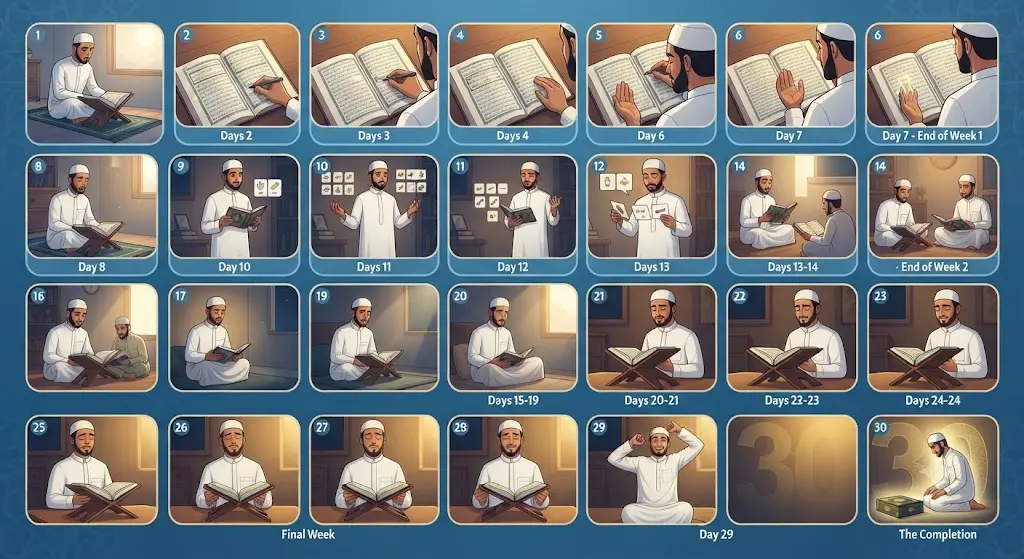
The 30-day plan to memorize thefull Quran. This timeline requires 4 to 6 hours of daily memorization and review, split across the five prayer times. It is achievable for students with strong reading fluency and no competing obligations, but demands extraordinary commitment and daily teacher recitation sessions to prevent errors from compounding.
The busy parent or professional with 20 to 30 minutes daily:
It takes 5 to 7 years at a quarter page daily for busy parents to memorize the Quran. This is slower than ideal but fully valid. A student who memorizes a quarter page every single day for five years will finish the Quran with durable retention — which is more than most people who attempt faster timelines without consistency ever achieve.
For children specifically, the Hifz for Kids Classes at UAE Quran Academy offer age-appropriate daily targets, structured review plans, and qualified teachers who understand how children retain and forget differently from adults.

See How Our Online Classes Work
Get a glimpse of a real online session and explore how students learn Quran with experienced teachers in a supportive and interactive environment.
Start Your Hifz Journey with UAE Quran Academy
Most people who have been asking how long does it take to memorize the Quran are not lacking the desire or the capability. They are lacking a structured environment that turns the daily habit into something that holds.
UAE Quran Academy offers a complete range of Hifz programs delivered one-to-one with certified teachers online, available from anywhere in the UAE and beyond. Every program includes personalized daily and weekly targets, real-time Tajweed correction, structured near-past and far-past review plans, and flexible scheduling that fits around work, school, and family life.
- Quran Memorization (Hifz) Course: structured Juz-by-Juz memorization with qualified teachers from verse one to the final page
- Hifz for Men Course: personalized for brothers with focused one-to-one sessions built around your schedule
- Hifz for Ladies Classes: female teachers, private learning environment, flexible timing
- Hifz for Adults Classes: built for real-life schedules, no prior memorization experience required
- Hifz for Kids Classes: age-appropriate daily targets with child-friendly pacing and engagement
The fastest way to memorize the Quran is not a shortcut. It is a system — and the right system starts with the right teacher.
Book your free trial session at UAE Quran Academy today.
Start Learning Quran with Expert Tutors in the UAE
Accredited online Quran and Arabic classes tailored for adults and children. Schedule your session today.
Book Your Free TrialConclusion
How long does it take to memorize the Quran is ultimately a question about daily decisions, not innate talent. The Quran is 604 pages. Your daily page target, the consistency of your review, the accuracy of your reading, and the quality of your teacher supervision determine whether your timeline is two years or seven. What does not determine it is your age, your background, or how many times you have tried and stopped before.
Every correct return after interruption is more valuable than an unbroken streak that never existed. Start where you are, protect your daily session, prioritize review above new memorization on difficult days, and memorize under the supervision of a qualified teacher from your first session. At UAE Quran Academy, every one of those elements is built into the curriculum and delivered through live, personalized online instruction.
Frequently Asked Questions
How long does it take to memorize the Quran for an average adult?
Most adults memorizing half a page to one page daily complete the Quran in 2 to 4 years. Adults with stronger prior reading fluency and structured review habits tend toward the lower end of that range. The single most important factor is daily consistency, not memorization volume per session.
Is it possible to memorize the Quran in 30 days?
Yes. Memorizing the Quran in 30 days requires completing one Juz (20 pages) daily. This demands 4-6 hours of intense study, high reading fluency, zero distractions, and an expert teacher to audit your daily recitation.
Does age affect how long it takes to memorize the Quran?
Age affects memorization style rather than capability. Children possess higher cognitive flexibility and fewer distractions, absorbing text quickly. Adults excel in comprehension, discipline, and intrinsic motivation, making the goal completely achievable at any age regardless of timeline.
What happens to my Hifz timeline if I stop for a few weeks?
A break weakens recent memorization. To return, review exclusively for two days, then resume at half-pace. Avoid doubling targets to compensate, as this causes rapid forgetting and discouragement.
Do I need a teacher to memorize the Quran, or can I use recordings?
Recordings aid listening, but cannot replace a teacher. Teachers correct Makhraj and Tajweed errors in real time. Without live feedback, mistakes permanently embed into your memorization and become incredibly difficult to fix.

Leave a Reply