 Tajweed
Most students who study the Noon Sakinah rules sail through Ith-har, Idgham, and Ikhfa without much trouble — then hit Iqlab and stall. The rule sounds deceptively simple: one letter, one situation.
But what actually happens inside the mouth during Iqlab, how it differs from ikhfa examples they already know, and how ikhfa shafawi connects to the same family of sounds — these distinctions remain blurry for most learners until a qualified teacher demonstrates them in real time.
If you have been reciting the Quran without fully understanding what is iqlab in Tajweed, you are almost certainly mispronouncing a category of words that appears dozens of times across the Mushaf. This guide covers the definition, the single trigger letter, the three conditions for correct application, Quranic examples with Arabic text, and how Iqlab sits alongside ikhfa examples and ikhfa shafawi in the broader system of Noon and Meem rules.
What Is Iqlab in Tajweed?
Iqlab is the third of the four rulings that govern Noon Sakinah and Tanween. Understanding what is iqlab in Tajweed requires separating its linguistic meaning from its technical application.
The Linguistic Definition
Linguistically, Iqlab (إقلاب) means “to flip” or “to transform something from its original form.” The word comes from the Arabic root qalaba (قلب), meaning to turn something over or convert it into something else. This root gives the rule its name because the essence of Iqlab is transformation: the Noon does not simply soften or merge — it is replaced entirely by a different sound.
The Technical Definition Of Iqlab
In Tajweed terminology, Iqlab is defined as: converting the Noon Sakinah or Tanween into a Meem sound, then concealing that Meem before the letter Ba, while sustaining a clear ghunnah (nasal resonance) of two counts duration. The scholars of Tajweed define it precisely as: “قلب النون الساكنة أو التنوين ميماً مخفاةً بغنة” — converting the Noon Sakinah or Tanween into a concealed Meem with ghunnah.
The Letter of Iqlab
Iqlab has only one trigger letter in all of the Arabic language: the Ba (ب). This makes it the simplest of all the Noon Sakinah rules to identify, even if its execution requires precision.
When Iqlab Applies
The Ba triggers Iqlab in three different grammatical positions, all of which must be handled identically.
Noon Sakinah within a single word: When a Noon Sakinah appears inside a word and is followed immediately by a Ba in that same word. The Noon is converted to Meem in pronunciation though the written Noon remains unchanged in the Mushaf.
Noon Sakinah across two words: When the last letter of one word is a Noon Sakinah and the first letter of the next word is Ba. The conversion happens across the word boundary.
Tanween followed by Ba: When a word ends in Tanween (the doubled vowel sign indicating nunation) and the following word begins with Ba. Tanween always appears between two words, so this case is structurally different from the single-word case.
There is also a fourth, rare case involving the Noon of emphasis (نون التوكيد الخفيفة), which appears only once in the Quran in Surah Al-Alaq, verse 15. This Noon behaves like Tanween and therefore also takes the Iqlab ruling before Ba.
| Position | Description | Example Source |
| Noon Sakinah in one word | Noon and Ba in same word | أنبتت (Al-Baqarah 261) |
| Noon Sakinah across two words | Last Noon, next word starts with Ba | مِن بَعد (Al-Baqarah 246) |
| Tanween before Ba | Word ends in Tanween, next begins Ba | عليمٌ بِذات (Al-Imran 119) |
| Noon of emphasis before Ba | Rare — once in the Quran | لنسفعاً بِالناصية (Al-Alaq 15) |
How the Mushaf Signals Iqlab?
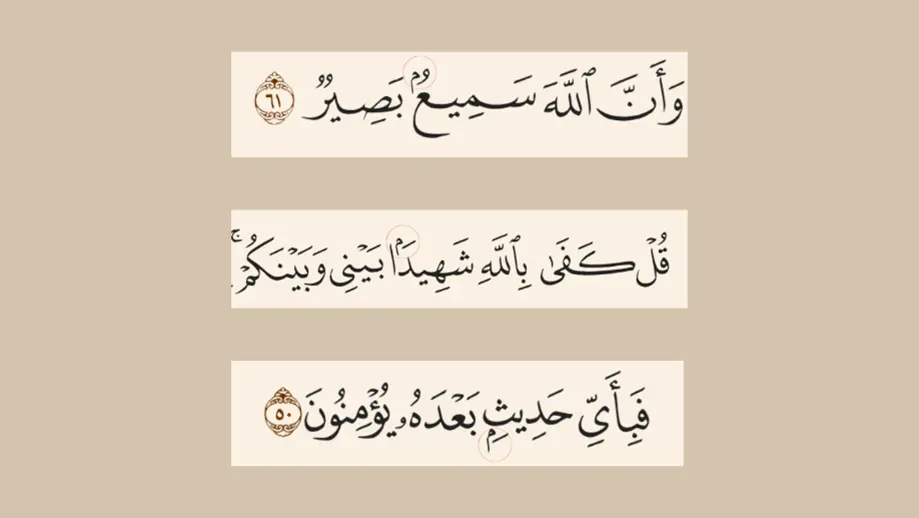
Every authenticated Mushaf marks Iqlab with a small standing Meem (م) placed above the Noon Sakinah or above the Tanween mark. When you see this small Meem in your Mushaf, you know immediately that a Ba follows and that you must apply the Iqlab ruling. No other Tajweed ruling uses this notation, which makes Iqlab visually the most distinct rule in the Mushaf.
The Three Conditions for Correct Iqlab
Scholars of Tajweed specify that Iqlab is only correctly performed when three conditions are all fulfilled simultaneously. Meeting only one or two produces a defective recitation.
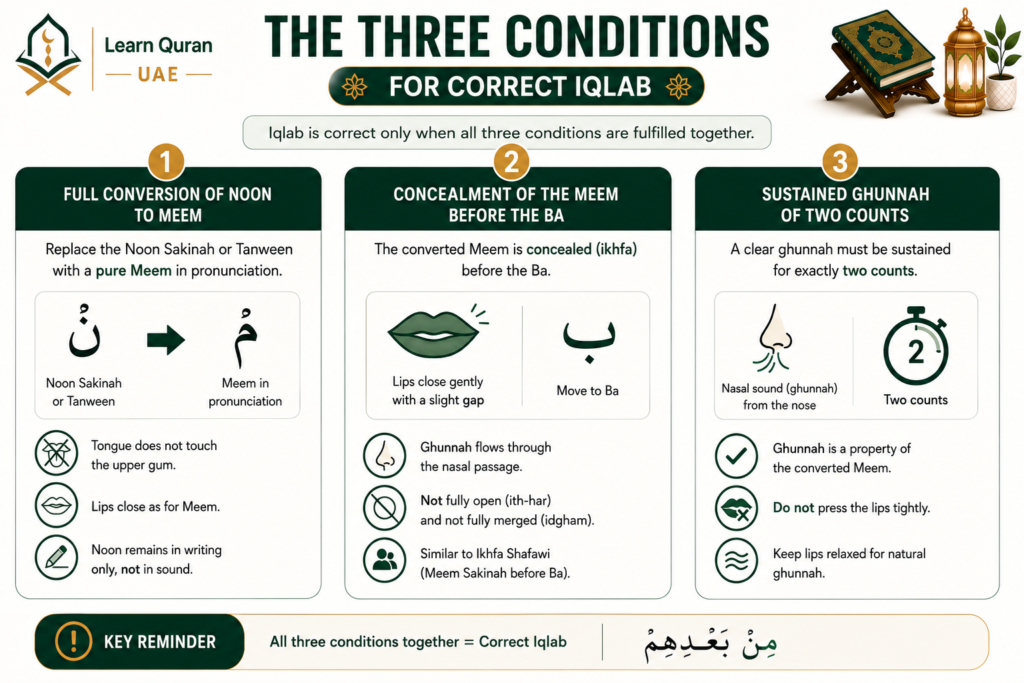
Condition One: Full Conversion of Noon to Meem in Pronunciation
The Noon Sakinah or Tanween must be replaced in pronunciation by a pure Meem. This means the tongue does not touch the upper gum area at all — the articulation point of the Noon is abandoned entirely. The lips come together as if pronouncing a Meem, and the Noon exists only in the written form of the word, not in its recited form. The conversion is complete in sound, though the Noon remains in the script.
Condition Two: Concealment of the Meem Before the Ba
Once the Noon has been converted to Meem, that Meem is not pronounced fully — it is concealed (ikhfa). This is where Iqlab connects directly to the concept of ikhfa examples in Tajweed. Concealment here means the lips come together gently without pressing hard or snapping shut. A very slight gap remains between the lips, and the Meem is held in this partially closed position while the ghunnah flows through the nasal passage. The Meem is not sounded fully open (Ith-har) nor fully merged into the Ba (Idgham) — it occupies a middle state.
This concealment specifically before Ba parallels the ruling of ikhfa shafawi, which is the concealment of Meem Sakinah before Ba. Both Iqlab and ikhfa shafawi involve a Meem sound held in a partially closed lip position before a Ba. This structural similarity is why students often confuse the two rules, and why studying them together clarifies both.
Condition Three: Sustained Ghunnah of Two Counts
Throughout both the conversion and the concealment, a clear nasal tone must flow for a duration of two counts (two finger beats). The ghunnah in Iqlab is a property of the converted Meem, not of the original Noon. The nasal resonance comes from the Khayshoom (the upper nasal cavity) and must be audible and sustained — not cut short after the Noon-to-Meem conversion and not extended beyond its prescribed duration.
A critical warning from the classical scholars: do not press the lips tightly when holding the converted Meem. Pressing hard produces an exaggerated, dragging ghunnah that distorts the sound. The lips should remain relaxed and lightly closed, allowing the ghunnah to flow naturally without force.
Iqlab Examples from the Quran
The following Quranic examples illustrate Iqlab across its different grammatical positions. Each example shows where the Noon Sakinah or Tanween appears and how it is applied before the Ba.
Examples of Iqlab with Noon Sakinah in One Word
“كَمَثَلِ حَبَّةٍ أَنـبَتَتْ سَبْعَ سَنَابِلَ فِي كُلِّ سُنبُلَةٍ مِّئَةُ حَبَّةٍ”
Kamathali habbatin anbatatsa’ba sanabila fi kulli sunbulatin mi’atu habbah
“The example of those who spend their wealth in the way of Allah is like a seed of grain which grows seven spikes; in each spike is a hundred grains.”
In أنبتت, the Noon Sakinah inside the word is followed immediately by Ba. The Noon converts to Meem in pronunciation, is concealed with ghunnah, and the reciter then moves into the Ba and the rest of the word.
“ذَلِكَ مِنْ أَنبَاءِ الْغَيْبِ نُوحِيهِ إِلَيكَ”
Dhalika min anbā’il-ghaybi nūhīhi ilayk
“That is from the news of the unseen which We reveal to you.”
Examples of Iqlab with Noon Sakinah Across Two Words
“أَلَمْ تَرَ إِلَى الْمَلإِ مِن بَنِي إِسْرَائِيلَ مِن بَعْدِ مُوسَى”
Alam tara ilal-mala’i min banī isrā’īla min ba’di mūsā
“Have you not considered the assembly of the Children of Israel after Moses?”
Two separate instances of Iqlab appear in this single verse. Both مِن بَنِي and مِن بَعْدِ contain a Noon Sakinah at the end of مِن followed by a Ba at the start of the next word. Both are converted, concealed, and held with ghunnah before moving to the Ba.
Examples of Iqlab with Tanween Before Ba
“وَاللّهُ عَلِيمٌ بِالظَّالِمِينَ”
Wallāhu ‘alīmun biz-zālimīn
“And Allah is Knowing of the wrongdoers.”
The Tanween on عَلِيمٌ (indicated by the double damma) converts to a concealed Meem before the Ba of بِالظَّالِمِينَ. The Meem is held briefly with ghunnah, then the Ba is sounded.
“وَاللّهُ بَصِيرٌ بِالْعِبَادِ”
Wallāhu basīrun bil-‘ibād
“And Allah is Seeing of His servants.”
Experience a Live Quran Class
Watch a short sample from one of our online Quran classes and discover our engaging teaching style, interactive lessons, and personalized learning approach.
Start Learning Quran with Expert Tutors in the UAE
Accredited online Quran and Arabic classes tailored for adults and children. Schedule your session today.
Book Your Free TrialThe Rare Noon of Emphasis Example
“كَلَّا لَئِن لَّمْ يَنتَهِ لَنَسْفَعًا بِالنَّاصِيَةِ”
Kallā la’in lam yantahi lanasfa’an bin-nāsiyah
“No! If he does not desist, We will surely drag him by the forelock.”
This is the only instance in the entire Quran where a Noon of emphasis (not Tanween) takes the Iqlab ruling. The scholars note it because students sometimes question why a Noon that is not technically Tanween receives the same treatment. The answer is that it behaves phonetically like Tanween at a word boundary before Ba, so the ruling follows the function rather than the grammatical classification.
For adult learners who want to correct years of habitual recitation errors, the Tajweed for Adults Course is built around your schedule and experience level, allowing you to address specific weaknesses including Iqlab application without starting over from absolute basics.

Read also: Madd Rules in Tajweed – A Complete Guide to Every Type of Madd
How Iqlab Differs from Ikhfa and Ikhfa Shafawi
Students who have studied ikhfa examples and ikhfa shafawi alongside Iqlab often conflate the three. The table below clarifies exactly where each rule applies and what distinguishes them.
| Feature | Iqlab | Ikhfa (Haqiqi) | Ikhfa Shafawi |
| Applies to | Noon Sakinah / Tanween | Noon Sakinah / Tanween | Meem Sakinah |
| Trigger letters | Ba only (1 letter) | 15 letters | Ba only (1 letter) |
| Sound substitution | Yes — Noon becomes Meem | No — Noon is softened only | No — Meem is softened only |
| Articulation point | Lips (after conversion) | Varies with trigger letter | Lips |
| Ghunnah required | Yes, 2 counts | Yes, 2 counts | Yes, 2 counts |
| Marker in Mushaf | Small Meem above Noon | No special marker | No special marker |
The Key Distinction Between Iqlab and Ikhfa Examples
With standard ikhfa examples, the Noon Sakinah or Tanween is held in a position between full sounding (Ith-har) and full merging (Idgham) — but the Noon itself does not change into another letter. The tongue approaches but does not complete the articulation of the Noon, and the ghunnah carries the sound forward.
With Iqlab, by contrast, there is a genuine substitution. The Noon ceases to exist as a sound entirely and is replaced by a Meem. Only after this substitution does concealment (ikhfa) apply — and what is being concealed is the Meem, not the Noon. This is what makes Iqlab structurally unique among the four rulings.
The Relationship Between Iqlab and Ikhfa Shafawi
Ikhfa shafawi applies when a Meem Sakinah (a Meem with sukoon) is followed by a Ba. In this case, the Meem Sakinah is held in a partially closed lip position with ghunnah — it is concealed before the Ba without being fully merged into it. The parallel with Iqlab is striking: in Iqlab, a converted Meem is also concealed before a Ba. The difference is the origin of the Meem.
In ikhfa shafawi, the Meem was always a Meem in the written text. In Iqlab, the Meem was originally a Noon that was converted. The sound produced in both cases is phonetically similar — a partially concealed nasal Meem before Ba — which is why confusing them is so common and why studying both together is the most efficient approach.
Common Mistakes When Applying Iqlab
Knowing the rule intellectually does not guarantee correct recitation. These are the errors that qualified Tajweed teachers most frequently correct in students applying what is iqlab in Tajweed.
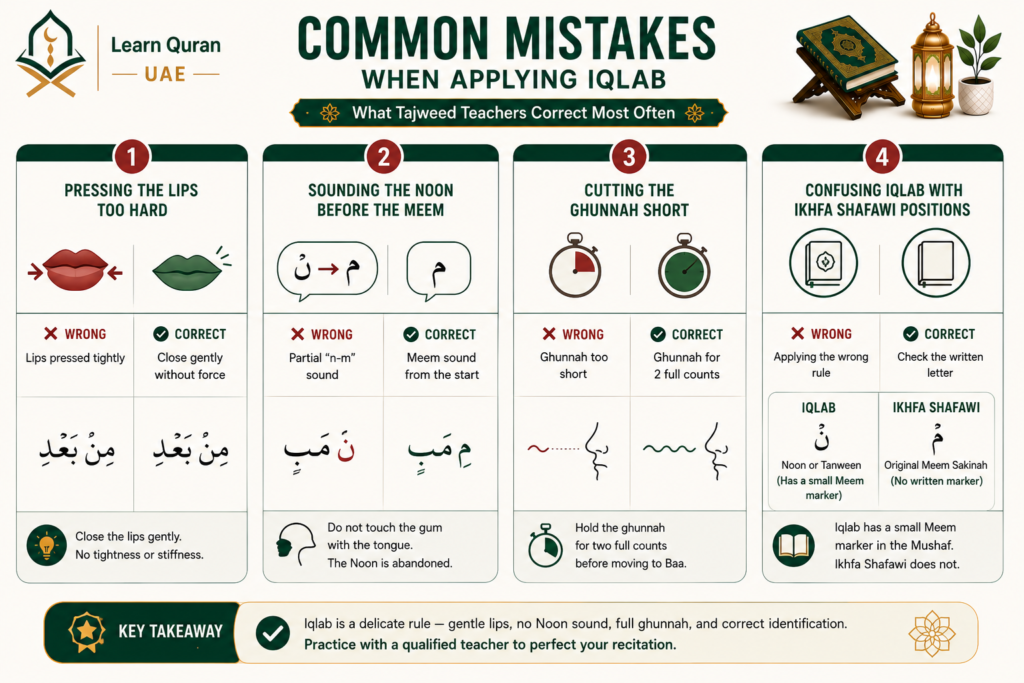
Mistake One: Pressing the Lips Too Hard
When the lips close to hold the converted Meem, students often press them together firmly as if sounding a full Meem. This creates an exaggerated, heavy sound that the classical scholars explicitly warned against. The instruction from the scholars is to close the lips gently (بتلطف) without force or stiffness. A slight gap or softness in the lip closure is correct — complete lip compression is wrong.
Mistake Two: Sounding the Noon Before the Meem
Some students partially articulate the Noon before transitioning to the Meem, producing a brief “n-m” sound before the Ba. This defeats the purpose of Iqlab entirely. The tongue must not touch the upper gum at all. The Noon is abandoned at its articulation point before any nasal sound begins; the Meem takes over from the start.
Mistake Three: Cutting the Ghunnah Short
The ghunnah must last two full counts. Students under recitation pressure sometimes rush past the concealment phase and move directly to the Ba. This produces a sound closer to Idgham (merging) than to Iqlab (concealed conversion). The pause at the Meem position, however brief, is what distinguishes a correctly performed Iqlab from a carelessly merged transition.
Mistake Four: Confusing Iqlab with Ikhfa Shafawi Positions
Because both Iqlab and ikhfa shafawi involve a Meem-like sound before Ba, students sometimes apply the wrong ruling to the wrong context. The test is simple: check whether the written letter is a Noon (or Tanween), in which case Iqlab applies, or whether it is an original Meem Sakinah, in which case ikhfa shafawi applies. The small Meem marker in the Mushaf always signals Iqlab; ikhfa shafawi has no written marker.
Iqlab in the Context of All Noon Sakinah Rulings
Iqlab is the third of four rulings in the Noon Sakinah and Tanween system. Seeing where it sits within the full system helps students understand why scholars placed it where they did.
| Ruling | Letters | Condition |
| Ith-har (Clear Sounding) | 6 throat letters | Noon/Tanween before hamza, ha, ain, ghain, kha, ha |
| Idgham (Merging) | 6 letters (يرملون) | Noon/Tanween before these letters across two words |
| Iqlab (Conversion) | Ba only | Noon/Tanween before Ba — converted to Meem then concealed |
| Ikhfa (Concealment) | 15 remaining letters | Noon/Tanween before any of the 15 remaining letters |
Iqlab was placed third in the traditional sequence because its nature — involving substitution rather than simple concealment — places it between Idgham (which involves full merging) and Ikhfa (which involves partial concealment). The Meem substitution in Iqlab borrows from both: it shares the complete replacement aspect of Idgham but stops short of full merging, while the concealment that follows resembles Ikhfa but applies to a substituted sound rather than the original Noon.
The scholars of Tajweed explain the reason (وجه الإقلاب) for this arrangement clearly: the Noon and Ba share neither makhraj (articulation point) nor sifah (attribute) in a way that would allow easy Ith-har or natural Idgham. The Noon exits from the tip of the tongue; the Ba closes the lips. Converting the Noon to a Meem — which shares the lip articulation point with Ba — and then concealing it before the Ba produces the smoothest possible transition without sacrificing the ghunnah.
If you are starting your Tajweed journey, the Tajweed for Beginners Course builds your foundation from the ground up, covering all Noon Sakinah rulings including what is iqlab in Tajweed, ikhfa examples, and ikhfa shafawi in a structured sequence that prevents confusion from the start.

Read also: Ikhfa Rules in Tajweed – Meaning, Types, and Ikhfaa Examples
See How Our Online Classes Work
Get a glimpse of a real online session and explore how students learn Quran with experienced teachers in a supportive and interactive environment.
Start Learning Tajweed with Qualified Teachers at UAE Quran Academy
If reading this article has shown you that Iqlab — and the broader system of Noon Sakinah, ikhfa examples, and ikhfa shafawi — is more nuanced than you realized, you are not alone. These are rules that require live correction, because the errors most students make are ones they cannot detect in their own recitation. Pressing the lips too hard, sounding a partial Noon before the Meem, or cutting the ghunnah short — none of these can be reliably caught by a student listening to themselves.
UAE Quran Academy provides structured, live, one-to-one Tajweed instruction delivered online by certified teachers who correct every error in real time.
Every program at UAE Quran Academy includes one-to-one sessions, real-time Tajweed correction, and flexible scheduling that fits around school, work, and family. Accurate recitation is not a privilege reserved for scholars — it is an obligation that every Muslim can fulfill with the right teacher beside them.
Enroll at UAE Quran Academy and begin your first free trial session today.
Our Tajweed Courses
- Tajweed Course
- Learn Quran Online with Tajweed
- Tajweed for Kids Course
- Tajweed for Adults Course
- Tajweed for Ladies / Sisters Course
- Tajweed for Beginners Course
- Advanced Tajweed Course
Enroll today and take the first step toward beautiful, accurate Quran recitation with expert guidance.
Start Learning Quran with Expert Tutors in the UAE
Accredited online Quran and Arabic classes tailored for adults and children. Schedule your session today.
Book Your Free TrialConclusion
Iqlab in Tajweed is precise in its trigger — only the letter Ba — and equally precise in its execution: a full conversion of Noon to Meem, followed by concealment of that Meem before the Ba, with a sustained ghunnah of two counts held throughout. What is iqlab in Tajweed is not simply a softening or a merging — it is a substitution, and that substitution is what makes it distinct from the ikhfa examples that govern the other fifteen letters in the Noon Sakinah system. Its relationship to ikhfa shafawi — which conceals an original Meem Sakinah before Ba — makes the two rules natural study partners, and understanding their shared structure clarifies both simultaneously.
The Mushaf marks every instance of Iqlab with a small Meem above the Noon, so identifying it in the text is never a matter of guesswork. Applying it correctly, however, is a different matter — one that benefits enormously from the kind of real-time feedback that only a qualified teacher can provide.
Frequently Asked Questions
What is iqlab in Tajweed?
Iqlab is one of the four rulings of Noon Sakinah and Tanween. It means converting the Noon Sakinah or Tanween into a Meem sound when the letter Ba follows, then concealing that Meem with a sustained nasal ghunnah of two counts. The word Iqlab literally means “to flip or convert,” which describes the sound substitution at the heart of the rule.
What is the difference between iqlab and ikhfa in Tajweed?
In ikhfa (Ikhfa Haqiqi), the Noon Sakinah or Tanween is held in a middle position between full sounding and full merging before any of fifteen specific letters — no substitution occurs. In Iqlab, the Noon is completely replaced by a Meem sound before concealment begins. Iqlab involves an actual letter conversion; ikhfa involves a softening of the original Noon without replacing it.
How many letters trigger iqlab?
Only one: the Ba (ب). This makes Iqlab the easiest of the Noon Sakinah rulings to identify in terms of its trigger letter, even though its application requires careful attention to lip position and ghunnah duration.
What are ikhfa shafawi examples and how do they relate to iqlab?
Ikhfa Shafawi examples include تَرْمِيهِمْ بِحِجَارَةٍ. It applies when Meem Sakinah meets Ba (ب). Both Ikhfa Shafawi and Iqlab sound identical, requiring a two-count Ghunnah and gentle lip closure. The only difference is origin: Ikhfa Shafawi starts with an original Meem, while Iqlab converts a Noon into a Meem before Ba.
How is iqlab marked in the Mushaf?
A small standing Meem (م) is placed above the Noon Sakinah or above the Tanween mark wherever Iqlab applies. This is the only Tajweed ruling with a dedicated written symbol in the Mushaf, making it visually the easiest rule to identify during recitation.



Leave a Reply