 Tajweed
You have been reciting the Quran for years, yet something still feels off when your tongue hits a Noon Sakinah before certain letters. The pause feels awkward. The sound is unclear. You are not sure whether to fully pronounce the Noon or merge it into the next letter. This uncertainty is not carelessness — it is a gap in foundational Tajweed knowledge that most learners carry silently for years.
Ikhfa is one of the most frequently occurring rules in Quranic recitation, yet it is consistently misunderstood or mispronounced because learners never received a clear, structured explanation of what it is, which letters trigger it, and how to produce it correctly. If you have ever stumbled on a Noon Sakinah mid-recitation or felt unsure whether you were applying Idgham or Ikhfa, this article resolves every one of those doubts — with detailed Ikhfaa examples, a full breakdown of Ikhfa Shafawi examples, and a clear answer to the question what is Iqlab in Tajweed.
What Is Ikhfa in Tajweed?
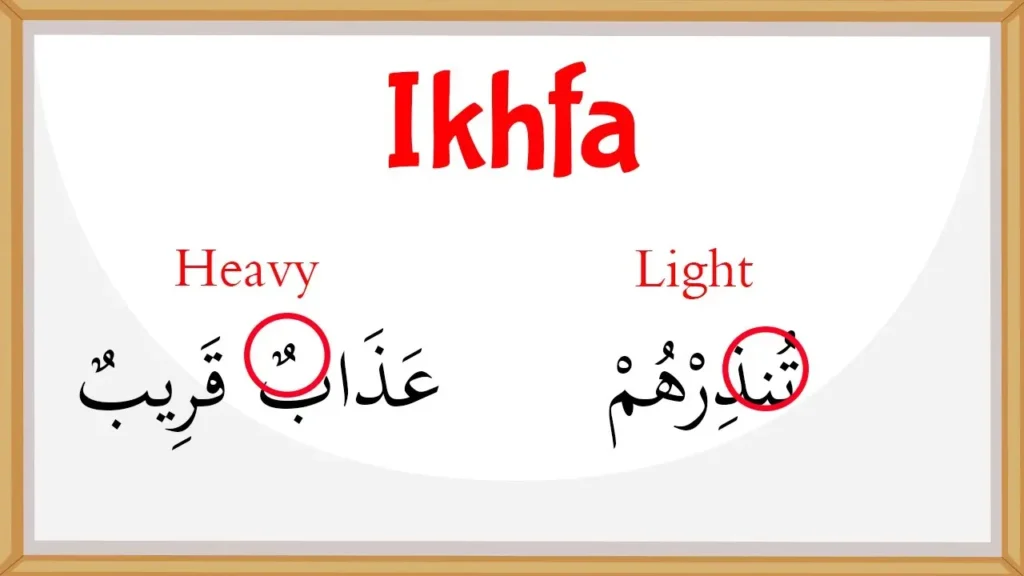
Ikhfa literally means concealment or covering. In Tajweed terminology, it refers to pronouncing the Noon Sakinah or Tanween in a state that sits exactly between full clarity (Ithhar) and full merging (Idgham), while maintaining the nasal sound (Ghunnah) for a duration of two counts.
The classical scholars defined it precisely. Al-Murshidi described it as the disappearance of the Noon or Tanween from actual pronunciation while their characteristic — the Ghunnah — remains. The tongue lifts slightly away from the upper gum ridge where it would normally sit to pronounce a full Noon, and instead moves toward the articulation point of the following Ikhfa letter.
What distinguishes Ikhfa from Idgham at a practical level is the absence of shaddah (doubling). In Idgham, the first letter fully merges into the second and the second letter is stressed. In Ikhfa, there is no stress on the following letter — the Noon fades while the nasal resonance continues for two counts before the following letter begins.
A critical pronunciation warning applies here: a common error is extending the Ghunnah until it transforms into a vowel sound. Pronouncing كُنْتُمْ as كونتم — inserting a Waw sound into the Ghunnah — is a clear recitation mistake that changes the word. The Ghunnah must remain nasal and should last exactly two counts, not longer.
The 15 Letters of Ikhfa and How to Identify Them
The 15 letters that trigger the Ikhfa ruling are traditionally memorized through the opening letters of a famous mnemonic verse from classical Tajweed texts:
صِفْ ذَا ثَنَا كَمْ جَادَ شَخْصٌ قَدْ سَمَا دُمْ طَيِّبَاً زِدْ فِي تُقى ضَعْ ظَالِمَا
The 15 Ikhfa letters drawn from this verse are: ص، ذ، ث، ك، ج، ش، ق، س، د، ط، ز، ف، ت، ض، ظ
| Letter | Example (Noon Sakinah in one word) | Example (Noun Sakinah across two words) |
| ص | وَالْأَنْصَارُ | أَنْ صَدُّوكُمْ |
| ذ | وَأَنْذِرْهُمْ | مِنْ ذَهَبٍ |
| ث | وَالْأُنْثَى | قَوْلاً ثَقِيلاً |
| ك | الْمُنْكَرِ | مَنْ كَانَ |
| ج | أَنْجَيْنَاكُمْ | إِنْ جَاءَكُمْ |
| ش | فَأَنْشَرْنَا | إِنْ شَاءَ |
| ق | انْقَلَبُوا | مِنْ قَرَارٍ |
| س | الْإِنْسَانُ | مِنْ سُلَالَةٍ |
| د | أَنْدَاداً | مِنْ دَابَّةٍ |
| ط | بِقِنْطَارٍ | مِنْ طِينٍ |
| ز | أُنْزِلَ | مِنْ زَوَالٍ |
| ف | فَانْفَلَقَ | مِنْ فَضْلٍ |
| ت | كُنْتُمْ | وَمَنْ تَابَ |
| ض | مَنْضُودٍ | وَمَنْ ضَلَّ |
| ظ | يُنْظَرُونَ | مِنْ ظَهِيرٍ |
The ruling applies whether the Noon Sakinah and its Ikhfa letter appear within a single word or across two separate words. Both situations are equally subject to the Ikhfa ruling.
The Three Levels of Ikhfa Intensity
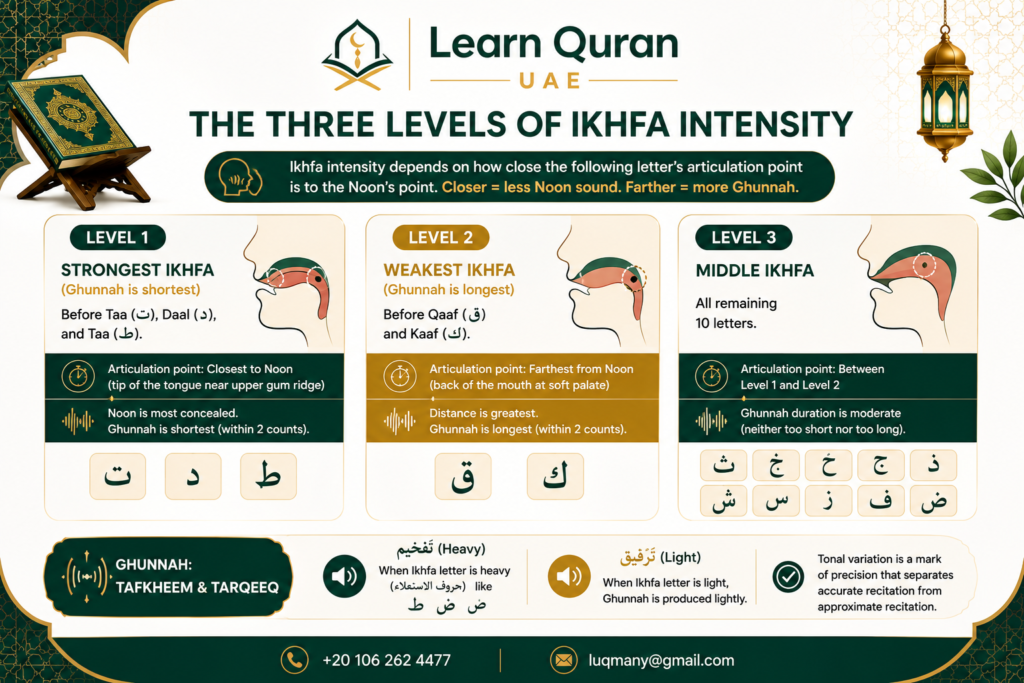
Not all Ikhfaa examples sound identical. Scholars of Tajweed divide the Ikhfa ruling into three levels based on how close the articulation point of the Ikhfa letter is to the articulation point of the Noon itself.
Al-Murshidi explained this with precision: the closer the following letter’s articulation point is to the Noon’s point, the less of the Noon remains audible. Conversely, when the following letter’s articulation point is further from the Noon’s, the Ghunnah sound is more prominent and lingers longer.
Level 1: Strongest Ikhfa (Ghunnah is shortest):
This occurs before Taa (ت), Daal (د), and Taa (ط), which are articulated closest to the Noon’s own point (the tip of the tongue near the upper gum ridge). The Noon is most concealed here, and the Ghunnah duration is at its shortest within the two-count rule.
Level 2: Weakest Ikhfa (Ghunnah is longest):
This occurs before Qaaf (ق) and Kaaf (ك), which are articulated far back in the mouth at the soft palate. Because the distance from the Noon’s point is greatest, the Noon’s nasal sound persists longer before transitioning to the following letter.
Level 3: Middle Ikhfa:
All remaining 10 letters fall in this category. The Ghunnah duration is moderate — neither as short as Level 1 nor as extended as Level 2.
A practical note on Ghunnah tafkheem and tarqeeq: when the Ikhfa letter is a heavy letter (حروف الاستعلاء) such as Saad (ص), Daad (ض), or Taa (ط), the Ghunnah itself is produced with a heavier, fuller resonance. When the Ikhfa letter is a light letter, the Ghunnah is produced lightly. This tonal variation is a mark of precision that separates accurate recitation from approximate recitation.
Ikhfaa Examples from the Quran
Reading rules without seeing them in actual Quranic text produces knowledge that does not transfer to recitation. The following Ikhfaa examples draw directly from well-known verses to anchor each level of the ruling in familiar text.
Ikhfaa examples with Noon Sakinah inside a single word:
“وَإِذْ فَرَقْنَا بِكُمُ الْبَحْرَ فَأَنجَيْنَاكُمْ وَأَغْرَقْنَا آلَ فِرْعَوْنَ وَأَنتُمْ تَنظُرُونَ”
In أَنجَيْنَاكُمْ, the Noon Sakinah meets Jeem — a Level 3 Ikhfa. In وَأَنتُمْ, the Noon Sakinah meets Taa — a Level 1 Ikhfa, with the shortest Ghunnah. In تَنظُرُونَ, the Noon Sakinah meets Dhaa — also Level 3.
Ikhfaa examples with Tanween across two words:
“لَن تَنَالُواْ الْبِرَّ حَتَّى تُنفِقُواْ مِمَّا تُحِبُّونَ وَمَا تُنفِقُواْ مِن شَيْءٍ فَإِنَّ اللّهَ بِهِ عَلِيمٌ”
In مِن شَيْءٍ, the Noon Sakinah meets Sheen — Level 3 Ikhfa. This is one of the most commonly recited Ikhfaa examples in daily prayer.
“اللَّهُ الَّذِي خَلَقَكُم مِّن ضَعْفٍ ثُمَّ جَعَلَ مِن بَعْدِ ضَعْفٍ قُوَّةً ثُمَّ جَعَلَ مِن بَعْدِ قُوَّةٍ ضَعْفاً وَشَيْبَةً”
In مِّن ضَعْفٍ, the Noon Sakinah meets Daad — a heavy letter (Level 3 Ikhfa) with a heavy Ghunnah. The reciter must produce a fuller nasal sound here compared to a light-letter Ikhfa.
If you find yourself unsure whether you are producing these Ikhfaa examples correctly — or if you have been reciting without a teacher for some time — there is a real risk that your Ghunnah production has developed errors you cannot hear yourself. The Quran Reading with Tajweed Course at UAE Quran Academy provides structured, one-on-one sessions with qualified teachers who correct Makhraj and Ghunnah errors in real time, before they become embedded habits.

Enroll today and perfect your Tajweed with expert guidance.
Ikhfa Shafawi
Ikhfa Shafawi is a separate ruling that applies specifically to the Meem Sakinah, not the Noon Sakinah. It is triggered when a Meem Sakinah is followed by the letter Ba (ب).
The term Shafawi comes from the Arabic word for lips (شفة), because both Meem and Ba are produced at the lips. When Meem Sakinah meets Ba, the ruling requires a light touching of the lips — without pressing them firmly together as one would for a full Meem pronunciation — while maintaining the Ghunnah for two counts.
This is precisely where many reciters make a consistent error: they either press the lips firmly (producing a full Meem sound, which makes it Ithhar Shafawi) or they fail to maintain the Ghunnah entirely. The correct application sits between these two extremes — lips lightly closed, nasal resonance sustained.
Ikhfa Shafawi examples from the Quran:
| Verse | Ikhfa Shafawi Location |
| سَلْهُمْ أَيُّهُم بِذَلِكَ زَعِيمٌ (Al-Qalam: 40) | هُمْ بِ |
| فَإِذَا هُم بِالسَّاهِرَةِ (An-Nazi’at: 14) | هُمْ بِ |
| وَمَا صَاحِبُكُم بِمَجْنُونٍ (At-Takwir: 22) | كُمْ بِ |
| ثُمَّ يُقَالُ هَذَا الَّذِي كُنتُم بِهِ تُكَذِّبُونَ (Al-Mutaffifin: 17) | تُمْ بِ |
| فَبَشِّرْهُم بِعَذَابٍ أَلِيمٍ (Al-Inshiqaq: 24) | هُمْ بِ |
| أَلَمْ يَعْلَم بِأَنَّ اللَّهَ يَرَى (Al-‘Alaq: 14) | يَعْلَمْ بِ |
| تَرْمِيهِم بِحِجَارَةٍ مِّن سِجِّيلٍ (Al-Fil: 4) | يهِمْ بِ |
An important note regarding these Ikhfa Shafawi examples: classical scholars indicate that both Ikhfa Shafawi and Ithhar Shafawi (full pronunciation of the Meem before Ba) are valid recitation positions. However, Ikhfa Shafawi is the stronger and more widely adopted position and is what UAE Quran Academy teaches in its structured programs.
If you are a woman looking for precise correction in rulings like Ikhfa Shafawi within a private, structured environment, the Hifz for Ladies Classes at UAE Quran Academy integrates Tajweed correction directly into memorization sessions, so accuracy and retention are built simultaneously.

Join today and memorize the Quran with confidence and precision.
Is Iqlab in Tajweed
What is Iqlab in Tajweed is a question that frequently arises alongside Ikhfa study because both rulings involve the letter Ba and both involve a Ghunnah. However, they are distinct rulings that apply to different letters under different conditions.
Iqlab literally means “to transform” or “to convert.” In Tajweed, it refers to converting the Noon Sakinah or Tanween into a Meem sound when followed by the letter Ba (ب), while simultaneously maintaining the Ghunnah for two counts.
The Iqlab ruling applies only in one situation: Noon Sakinah or Tanween + Ba. There is no other letter that triggers Iqlab.
How Iqlab works in practice: The Noon Sakinah does not simply disappear as in Ikhfa. It is converted — the mouth begins forming a Meem sound (lips touching lightly) while the nasal resonance continues. The result is a Meem-like nasal sound sustained for two counts before the Ba is articulated.
“مِن بَعْدِ ضَعْفٍ قُوَّةً”
Here, the Noon Sakinah in مِن meets Ba — this is Iqlab. The reciter converts the Noon into a nasal Meem sound, sustains the Ghunnah, then pronounces Ba.
Read also: Madd Rules in Tajweed – A Complete Guide to Every Type of Madd
Experience a Live Quran Class
Watch a short sample from one of our online Quran classes and discover our engaging teaching style, interactive lessons, and personalized learning approach.
Start Learning Quran with Expert Tutors in the UAE
Accredited online Quran and Arabic classes tailored for adults and children. Schedule your session today.
Book Your Free TrialWhat is Iqlab in Tajweed vs. Ikhfa — the key distinction:
| Feature | Ikhfa | Iqlab |
| Applied to | Noon Sakinah or Tanween | Noon Sakinah or Tanween |
| Triggering letters | 15 letters | Only Ba (ب) |
| What happens to the Noon | Concealed; Ghunnah remains | Converted to Meem sound |
| Lip involvement | None (tongue-based) | Lips touch lightly (Meem formation) |
| Shaddah on following letter | No | No |
Understanding what is Iqlab in Tajweed is essential for any serious reciter, because confusing it with Ikhfa produces a sound that is neither correct Iqlab nor correct Ikhfa — the Noon is partially audible, the Ghunnah is weak, and the transition to Ba is abrupt. All three are errors that a qualified teacher can identify and correct from the first session.
The Quran Memorization (Hifz) Course at UAE Quran Academy builds Tajweed accuracy — including Iqlab and Ikhfa — directly into the memorization curriculum, so students carry correct recitation into their Hifz from day one rather than correcting errors later.

Start your Hifz journey with accurate Tajweed from day one.
How to Practice Ikhfa Rules Until They Become Automatic?
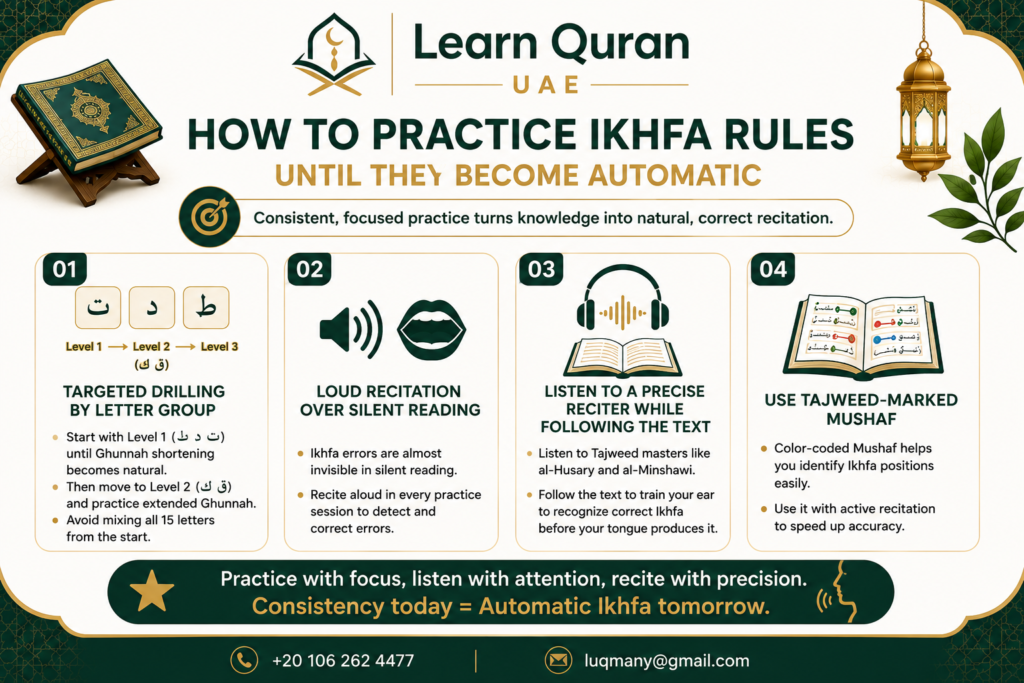
Knowing the Ikhfa rules intellectually is not the same as producing them correctly under recitation pressure. The path from knowledge to automatic correct recitation requires specific, structured practice.
Targeted drilling by letter group: Begin with Level 1 Ikhfa letters (Taa, Daal, Taa) and drill until the Ghunnah shortening becomes natural. Then move to Level 2 (Qaaf, Kaaf) and practice the extended Ghunnah. Mixing all 15 letters from the start produces confusion rather than precision.
Loud recitation over silent reading: Ikhfa errors are almost invisible in silent reading. The errors only become detectable — and correctable — when the reciter recites aloud. Every practice session involving Ikhfa rules should be done vocally.
Listening to a precise reciter while following the text: Reciters known for Tajweed precision such as al-Husary and al-Minshawi produce clearly audible Ghunnah transitions at Ikhfa positions. Following the text while listening trains the ear to recognize what correct Ikhfa sounds like before the tongue attempts to produce it.
The role of Mushaf notation: A Tajweed-marked Mushaf color-codes or annotates positions where Ikhfa applies, making it easier for learners to identify all Ikhfaa examples in a given page before reciting. Using this alongside active recitation accelerates accuracy.
“أَفَلَا يَتَدَبَّرُونَ الْقُرْآنَ أَمْ عَلَىٰ قُلُوبٍ أَقْفَالُهَا”
Afalā yatadabbarūna al-Qur’āna am ʿalā qulūbin aqfāluhā
“Then do they not reflect upon the Qur’an, or are there locks upon [their] hearts?”
Reflection during recitation includes attention to correctness. The act of reciting with precision — placing the Ghunnah, respecting the Ikhfa position, transitioning smoothly — is itself a form of Quranic engagement that goes beyond mechanical reading.
Common Errors in Ikhfa Recitation and How to Avoid Them
Errors in Ikhfa are pervasive and largely self-reinforcing — once a wrong habit is established, the ear stops flagging it as an error. Identifying the most common mistakes in advance allows reciters to self-monitor more effectively.
Error 1: Fully pronouncing the Noon (treating Ikhfa as Ithhar)
This is the most common error. The reciter articulates the Noon fully before moving to the following letter, producing two distinct sounds instead of the nasal blend that Ikhfa requires. This usually happens when the reciter is reading at speed without conscious attention to the Noon’s status.
Error 2: Fully merging the Noon (treating Ikhfa as Idgham)
Some reciters go in the opposite direction and merge the Noon completely into the following letter, applying Idgham rules to letters that do not belong in the Idgham category. This produces a shaddah on the following letter where none should exist.
Error 3: Inserting a vowel into the Ghunnah
As noted by classical scholars, extending the nasal sound until it resembles a Waw or Yaa vowel is a recognized error in Ikhfa recitation. The Ghunnah in Ikhfa is pure nasal resonance — it does not morph into a vowel. Pronouncing كُنْتُمْ as كونتم is the textbook example of this error.
Error 4: Failing to adjust Ghunnah weight before heavy letters
Producing a light, unweighted Ghunnah before heavy (mufakhkham) Ikhfa letters such as Saad, Daad, and Taa means the transition sounds tonally inconsistent. The Ghunnah must carry the same heaviness as the following letter.
Error 5: Confusing Ikhfa Shafawi with Ithhar Shafawi
Pressing the lips firmly together when Meem Sakinah meets Ba produces a full Meem sound, which is Ithhar, not Ikhfa. The correct application requires only a light lip contact — enough to prepare the Meem articulation without fully closing and releasing the lips.
None of these errors can be reliably self-detected by a learner reciting alone. This is precisely why the Learn Quran Online with Tajweed program at UAE Quran Academy is built around one-to-one sessions — every error is caught and corrected in real time, session by session, until the correct sound becomes the only sound the reciter produces.

Enroll today and perfect your Quran recitation with expert guidance.
Ikhfa in the Context of All Noon Sakinah Rulings
To fully understand Ikhfa, it helps to see where it sits within the complete framework of Noon Sakinah and Tanween rulings. There are four rulings in total, and each one applies depending on which letter follows the Noon Sakinah or Tanween.
| Ruling | Arabic Term | Letters That Trigger It | What Happens |
| Full Pronunciation | Ithhar | ء ه ع ح غ خ (6 throat letters) | Noon fully pronounced; no nasal extension |
| Merging | Idgham | ي ر م ل و ن (6 letters) | Noon disappears; following letter stressed (with or without Ghunnah depending on the letter) |
| Conversion | Iqlab | ب (Ba only) | Noon converts to Meem nasal sound; Ghunnah maintained |
| Concealment | Ikhfa | 15 letters (see table above) | Noon concealed; Ghunnah maintained for two counts |
This framework clarifies why what is Iqlab in Tajweed is its own ruling rather than a subset of Ikhfa, despite both involving Ba. Iqlab converts the Noon sound into a different sound entirely (Meem). Ikhfa conceals the Noon while preserving its nasal quality without conversion.
Memorizing this framework as a whole — rather than studying each ruling in isolation — allows reciters to apply the correct ruling instantly when reading, without pausing to recall which category each letter belongs to.
For students who want to advance beyond rule memorization into fluent, automatic application, the Advanced Tajweed Course at UAE Quran Academy covers the compound rule interactions that only become visible after the foundational rules are solid — building the recitation accuracy that turns knowledge into genuine Tajweed.

Advance your Tajweed skills with expert-led lessons today.
Read also: Iqlab in Tajweed – The Complete Guide With Examples
See How Our Online Classes Work
Get a glimpse of a real online session and explore how students learn Quran with experienced teachers in a supportive and interactive environment.
Start Reciting the Quran with Precision at UAE Quran Academy
Most reciters who struggle with Ikhfa, Ikhfa Shafawi, or Iqlab are not lacking effort — they are lacking structured feedback. A wrong Ghunnah that goes uncorrected for six months becomes the sound the brain accepts as correct. Reversing that takes supervised practice, and the earlier correction begins, the faster accuracy develops.
UAE Quran Academy offers a complete range of online Tajweed programs designed for every level of learner, delivered one-to-one with certified teachers who correct every Makhraj error, every Ghunnah timing issue, and every misapplied ruling in real time..Every program at UAE Quran Academy includes flexible scheduling, certified teachers, and personalized feedback at every session. Accurate recitation is not a talent — it is a result of the right teaching.
Enroll in UAE Quran Academy today and begin reciting with the precision that the Quran deserves.
Our Tajweed Courses
- Tajweed Course
- Learn Quran Online with Tajweed
- Tajweed for Kids Course
- Tajweed for Adults Course
- Tajweed for Ladies / Sisters Course
- Tajweed for Beginners Course
- Advanced Tajweed Course
Enroll today and take the first step toward beautiful, accurate Quran recitation with expert guidance.
Start Learning Quran with Expert Tutors in the UAE
Accredited online Quran and Arabic classes tailored for adults and children. Schedule your session today.
Book Your Free TrialConclusion
Ikhfa rules govern one of the most frequently occurring recitation situations in the entire Quran — the Noon Sakinah or Tanween meeting any of 15 designated letters — and yet they remain among the most inconsistently applied rules among self-taught reciters. This article has covered the complete Ikhfa framework: its linguistic and technical definitions, the 15 triggering letters and their three levels of intensity, detailed Ikhfaa examples drawn from Quranic verses, the distinct ruling of Ikhfa Shafawi with full Ikhfa Shafawi examples, and a thorough answer to the question what is Iqlab in Tajweed and how it differs from Ikhfa.
Accurate application of these rules requires more than reading about them — it requires producing them aloud, under the guidance of a teacher who can hear what you cannot. UAE Quran Academy provides exactly that: structured, certified, one-to-one online Tajweed instruction that turns theoretical knowledge into recitation that is both correct and confident.
Frequently Asked Questions
What is Ikhfa in Tajweed and how is it different from Idgham?
Ikhfa means concealing Noon Sakinah/Tanween before 15 specific letters, pronouncing it between clear delivery and merging with a Ghunnah. Idgham completely merges the Noon into the next letter, making it stressed (shaddah).
How many letters trigger the Ikhfa ruling?
There are exactly 15 letters that trigger Ikhfa for the Noon Sakinah or Tanween. They are traditionally memorized through the opening letters of the classical verse beginning with صف ذا ثنا. These 15 letters are: ص، ذ، ث، ك، ج، ش، ق، س، د، ط، ز، ف، ت، ض، ظ.
What is Iqlab in Tajweed and which letter triggers it?
Iqlab is converting Noon Sakinah or Tanween into a hidden Meem sound when followed by the single letter Ba (ب). It requires a two-count Ghunnah (nasal sound) while replacing the Noon completely.
What are the Ikhfa Shafawi examples and where do they occur?
Ikhfa Shafawi occurs when Meem Sakinah is followed by Ba (ب) between two words. Examples include تَرْمِيهِمْ بِحِجَارَةٍ and هُمْ بِالسَّاهِرَةِ. Pronounce it with light lip closure and a two-count Ghunnah.
Can I learn Ikhfa rules correctly without a teacher?
No. While theory is easy to learn independently, mastering exact pronunciation, Ghunnah timing, and subtle lip placement requires an expert teacher to listen, audit your mistakes, and correct your sound production.



Leave a Reply