 Tajweed
You have been reading the Quran for years, yet something feels off every time you recite. Maybe you rush through certain letters, drop a nasal sound where it should ring, or stretch a vowel far beyond its measure without knowing it. The problem is not effort or sincerity — it is the absence of a clear, structured understanding of tajweed rules. Without knowing what governs each sound, every recitation becomes guesswork, and mistakes become permanent habits that grow harder to break the longer they go uncorrected.
Tajweed comes from the Arabic root j-w-d, which carries the meaning of doing something excellently or making it beautiful. As a discipline, tajweed is the science of reciting the Quran by giving each letter its full due: producing it from its correct articulation point, applying its inherent characteristics, and observing every interaction between adjacent sounds.
The obligation is not scholarly — it is Quranic. Allah says:
“وَرَتِّلِ الْقُرْآنَ تَرْتِيلًا”
Wa rattili l-Qur’āna tartīlā
“And recite the Quran with measured recitation.”
The word tarteel in this verse is the command form of tartala, which scholars of recitation have defined as giving each letter its right in terms of articulation, characteristics, and the rules that govern its behavior alongside other letters. Tajweed is the systematic science that fulfills this command.
Scholars have stated that reciting the Quran with tajweed is obligatory for every Muslim who recites it. The science itself — knowing rules by name and definition — is a collective obligation (Fard Kifayah). Applying the rules in actual recitation is an individual obligation (Fard Ayn). This distinction matters practically: not everyone must become a tajweed scholar, but everyone who recites the Quran must recite it correctly.
1. Makharij Al-Huroof: Articulation Points of the Letters
No tajweed rule can be applied correctly if the letter itself is being produced from the wrong place in the mouth or throat. Makharij Al-Huroof — the articulation points — are the physical locations from which each Arabic letter originates, and they are the foundation everything else is built on.
Scholars have identified seventeen primary articulation points grouped into five regions of the vocal tract.
The Five Regions of Articulation
| Region | Arabic Term | Letters Produced There |
| The Empty Oral/Throat Cavity | Al-Jawf | Medd letters (Alif, Waaw, Yaa when extended) |
| The Throat | Al-Halq | ء ه ع ح غ خ |
| The Tongue | Al-Lisaan | ق ك ج ش ي ض ل ن ر ط د ت ص ز س ذ ظ ث |
| The Two Lips | Al-Shafataan | ب م و ف |
| The Nasal Passage | Al-Khayshoom | The nasal resonance (Ghunnah) |
Each of the seventeen specific articulation points within these regions governs one or more letters. The Qaaf (ق), for example, originates from the back of the tongue meeting the soft palate — distinctly different from the Kaaf (ك), which originates slightly forward on the same tongue-palate contact. Confusing the two produces a mispronounced letter regardless of which tajweed rule follows.
Sifaat Al-Huroof: Characteristics of the Letters
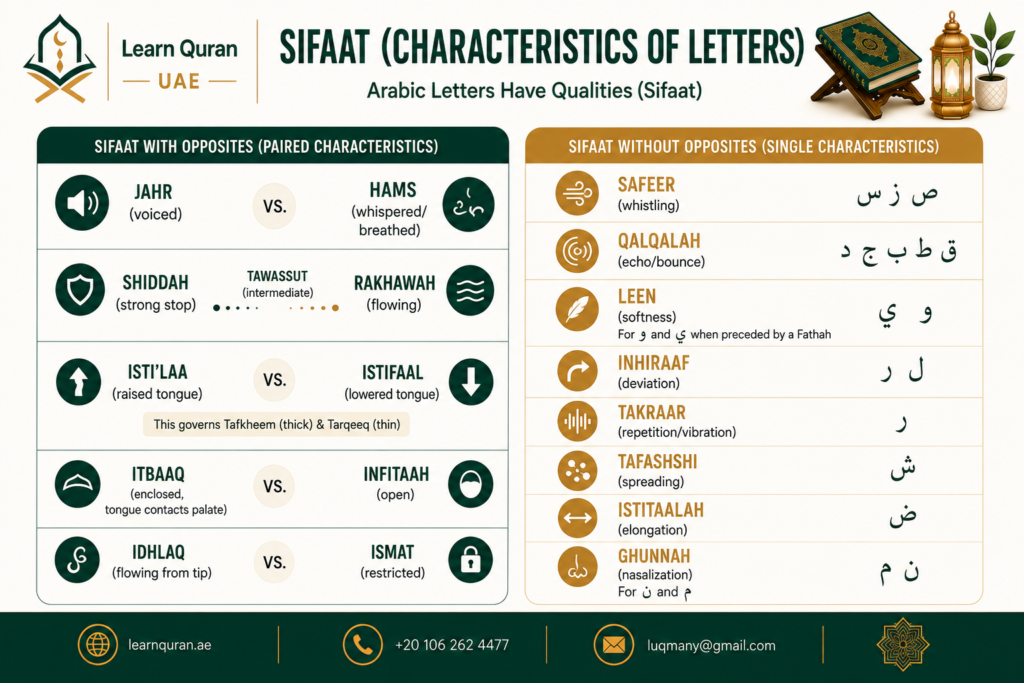
Every Arabic letter carries inherent characteristics (Sifaat) that describe the quality of the sound produced at its articulation point. These characteristics are divided into two categories.
Sifaat with opposites (paired characteristics):
- Jahr (voiced) vs. Hams (whispered/breathed).
- Shiddah (strong stop) vs. Rakhawah (flowing) with Tawassut (intermediate) between them.
- Isti’laa (raised tongue) vs. Istifaal (lowered tongue) — this governs tafkheem and tarqeeq.
- Itbaaq (enclosed, tongue contacts palate) vs. Infitaah (open).
- Idhlaq (flowing from tip) vs. Ismat (restricted).
Sifaat without opposites (single characteristics):
- Safeer (whistling) — for ص ز س.
- Qalqalah (echo/bounce) — for ق ط ب ج د.
- Leen (softness) — for و and ي when preceded by a Fathah.
- Inhiraaf (deviation) — for ل and ر.
- Takraar (repetition/vibration) — for ر.
- Tafashshi (spreading) — for ش.
- Istitaalah (elongation) — for ض.
- Ghunnah (nasalization) — for ن and م.
Understanding Qalqalah is especially important for beginners. The five Qalqalah letters (ق ط ب ج د) produce a slight bouncing echo when they appear with Sukoon (vowelless). This is not decoration — it is an intrinsic quality of these letters that must be applied.
If you are finding it difficult to identify your articulation points and apply Sifaat without someone correcting you in real time, the Tajweed Course at UAE Quran Academy gives you one-to-one instruction with a qualified teacher who checks every letter from your first session. Enroll now and build the foundation that makes every rule you learn actually sound correct.

Master Tajweed with personalized guidance from qualified teachers.
2. Tajweed Rules for Noon Saakinah and Tanween
The rules governing Noon Saakinah (a Noon letter with no vowel) and Tanween (double vowel markers that produce a nasal sound) are the most frequently encountered tajweed rules in the entire Quran. Every time these sounds appear before another letter, one of four rules applies.
Rule 1: Izhaar (Clear Pronunciation)
Izhaar means to pronounce the Noon Saakinah or Tanween clearly, without any nasal resonance bleeding into the following letter. It applies when the letter after the Noon or Tanween is one of the six throat letters:
ء ه ع ح غ خ
These letters are called Huroof Al-Halq (throat letters), and because they originate far back in the throat, the Noon cannot merge with them or be assimilated. Each must be pronounced distinctly.
Example: مَنْ أَحسَنَ — the Noon is fully clear before the Hamzah.
Rule 2: Idghaam (Merging)
Idghaam means inserting the Noon or Tanween into the following letter so completely that both become one stressed sound with a Shaddah. It applies to six letters collected in the phrase: يَرْمَلُون (Y R M L W N).
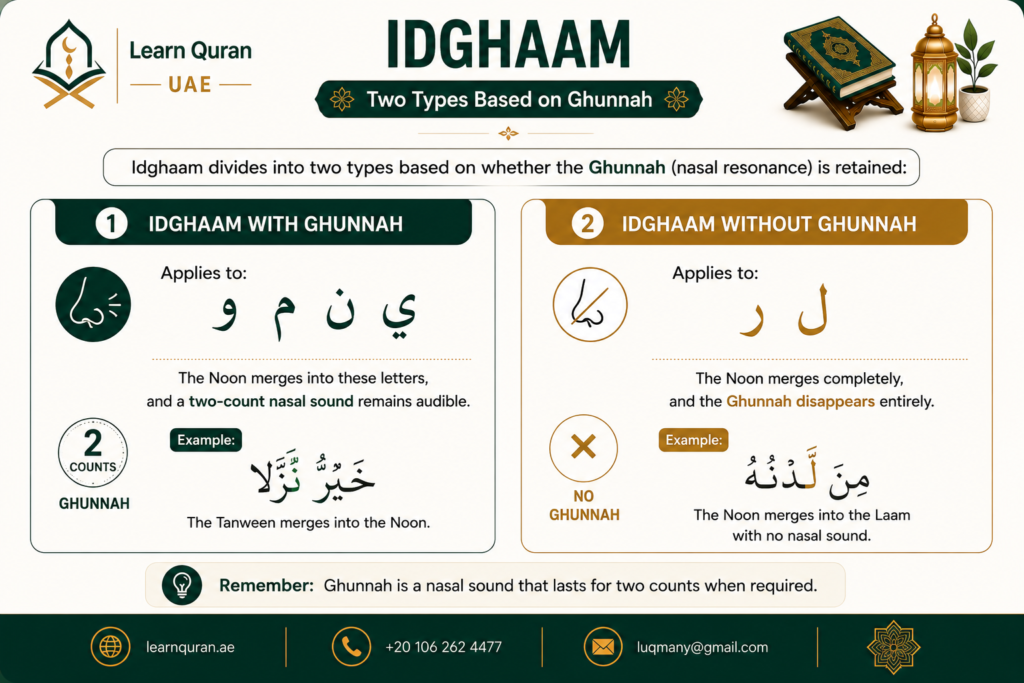
Idghaam divides into two types based on whether the Ghunnah (nasal resonance) is retained:
Idghaam with Ghunnah applies to: ي ن م و The Noon merges into these letters, and a two-count nasal sound remains audible. Example: خَيْرٌ نُّزُلًا — the Tanween merges into the Noon.
Idghaam without Ghunnah applies to: ل ر The Noon merges completely, and the Ghunnah disappears entirely. Example: مِن لَّدُنْهُ — the Noon merges into the Laam with no nasal sound.
Important exception: Idghaam does not apply when the Noon Saakinah and the Idghaam letter appear within the same word. Words like دُنْيَا and قِنْوَانٌ are pronounced with clear Izhaar despite containing ن followed by ي or و.
Rule 3: Iqlaab (Conversion)
Iqlaab means converting the Noon Saakinah or Tanween into a Meem when the letter Baa (ب) follows. The conversion is not written in the Mus’haf but is indicated by a small Meem symbol above or below the Noon. The resulting Meem is held with Ghunnah for two counts while the lips close in preparation for the Baa.
Example: يُنبِتُ لَكُم — the Noon before the Baa becomes a nasal Meem sound.
Rule 4: Ikhfaa (Concealment)
Ikhfaa applies to all remaining fifteen letters that are not covered by Izhaar, Idghaam, or Iqlaab. These fifteen letters are:
ت ث ج د ذ ز س ش ص ض ط ظ ف ق ك
When Noon Saakinah or Tanween appears before any of these letters, it is neither fully pronounced (Izhaar) nor fully merged (Idghaam). Instead, it is held in a middle state — the tongue begins moving toward the following letter while a two-count Ghunnah resonates through the nasal passage.
Example: رِيحًا صَرْصَرًا — the Tanween is concealed before the Saad.
3. Tajweed Rules for Meem Saakinah
The Meem Saakinah (vowelless Meem) has its own set of three rules, separate from the Noon rules, because the Meem originates from the two lips (Shafataan) rather than the throat or tongue.
Ikhfaa Shafawi (Lip Concealment)
When Meem Saakinah is followed by a Baa, the Meem is concealed with Ghunnah for two counts. The lips close for the Meem but do not open and re-close for the Baa — the transition between them is smooth, connected through nasal resonance.
Example: وَهُم بِالْآخِرَةِ
The term Shafawi (labial) indicates that both letters originate from the lips, which is what makes this concealment distinct from Ikhfaa Noon.
Idghaam Shafawi (Lip Merging)
When Meem Saakinah is followed by another Meem, the first Meem merges completely into the second, producing one stressed Meem with a Shaddah and a two-count Ghunnah. This is also called Idghaam Al-Mutamaathilayn Al-Sagheer (small merging of identical letters).
Example: إِن كُنتُم مُّؤْمِنِينَ
Izhaar Shafawi (Lip Clarity)
When Meem Saakinah is followed by any letter other than Meem or Baa, the Meem is pronounced clearly with no nasal resonance and no merging. The mouth opens fully from the Meem before the following letter sounds.
Example: وَلَا يَجْرِمَنَّكُمْ شَنَآنُ
4. The Rules of Ghunnah: The Nasal Resonance That Runs Through All Tajweed
Ghunnah is the resonant nasal sound that originates from the Khayshoom (the nasal passage). It is not a rule that applies in certain situations only — it is a permanent characteristic of the letters Noon (ن) and Meem (م) that is present whenever these letters carry a Shaddah.
“إِنَّا نَحْنُ نَزَّلْنَا الذِّكْرَ وَإِنَّا لَهُ لَحَافِظُونَ”
Innā nahnu nazzalnā l-dhikra wa-innā lahu lahāfiẓūn
“Indeed, it is We who sent down the Quran and indeed, We will be its guardian.”
The standard measure of Ghunnah is two counts (Harakatayn). In the context of Ikhfaa and Idghaam with Ghunnah, this two-count nasal sound is what distinguishes the rule from Izhaar or full Idghaam.
A common mistake among beginners is applying Ghunnah inconsistently — either elongating it beyond two counts in normal recitation, or dropping it entirely during Ikhfaa because the nasal resonance feels unnatural. Both errors require correction from a teacher who can hear them.
Read also: Quran Memorization Planner & Tracker – The Complete System to Stay on Schedule
5. The Medd Rules: Prolongation in Quran with Tajweed Rules
Medd (prolongation) rules govern how long the three Medd letters (Alif, Waaw, Yaa in their vowelless extended forms) are held when they appear in specific contexts. Without a clear understanding of Medd, recitation either rushes through sounds that must be extended or stretches ordinary vowels unnecessarily.
Medd Asli (Natural Medd)
This is the baseline Medd present in every Medd letter when no Hamzah or Sukoon follows. Its length is always two counts and never changes. It is called Asli (original) because it is the natural duration of the Medd letter itself, not caused by any external factor.
Example: مَالِكِ يَوْمِ الدِّينِ — each elongated vowel holds for exactly two counts.
Medd Fariy: Extended Prolongations
Medd Fariy covers all prolongations beyond two counts. They occur because of two causes: a Hamzah (Medd caused by Hamzah) or a Sukoon (Medd caused by stopping).
| Medd Type | Cause | Length | Example |
| Medd Muttasil | Hamzah in same word after Medd letter | 4-5 counts (obligatory) | جَاءَ |
| Medd Munfasil | Hamzah in next word after Medd letter | 4-5 counts (permitted) | إِنَّا أَعْطَيْنَاكَ |
| Medd Aarid Lil-Sukoon | Stopping on a word ending in Medd | 2, 4, or 6 counts | نَسْتَعِينُ (when stopping) |
| Medd Laazim | Permanent Sukoon after Medd in same word | 6 counts (obligatory) | الضَّالِّينَ |
| Medd Leen | Waaw or Yaa with Fathah before it, followed by Sukoon at stop | 2, 4, or 6 counts | خَوْفٍ (when stopping) |
| Medd Badal | Hamzah followed by Medd letter (Hamzah became Medd) | 2 counts normally | آمَنُوا |
Medd Muttasil is obligatory and its minimum is four counts. Skipping it or reducing it to two counts is an error in recitation that changes the phonetic integrity of the verse.
Medd Aarid Lil-Sukoon is the most frequently encountered Medd in actual recitation because it applies every time a reader pauses at the end of a verse. Its flexibility (2, 4, or 6 counts) is permitted, but the reader must be consistent within a single recitation session.
Many students who recite Quran with tajweed rules apply Medd Muttasil and Medd Munfasil correctly in isolation but become inconsistent during Surah-length recitation because they have not drilled these rules into muscle memory under supervision. The Quran Reading with Tajweed Course at UAE Quran Academy drills every category of Medd in live recitation sessions with a certified teacher who flags every inconsistency in real time. Start learning today and make your Medd measurements automatic.

Perfect your Medd rules through guided live Tajweed practice.
Experience a Live Quran Class
Watch a short sample from one of our online Quran classes and discover our engaging teaching style, interactive lessons, and personalized learning approach.
Start Learning Quran with Expert Tutors in the UAE
Accredited online Quran and Arabic classes tailored for adults and children. Schedule your session today.
Book Your Free Trial6. The Rules of Tafkheem and Tarqeeq: Heavy and Light Pronunciation
Tafkheem means heavy or full pronunciation, where the mouth fills with sound and the tongue rises toward the upper palate. Tarqeeq means light or thin pronunciation, where the sound is clear and fronted without the resonant heaviness.
Letters That Are Always Heavy (Mufakhkham)
The seven letters of Isti’laa are always pronounced with Tafkheem:
خ ص ض غ ط ق ظ
These letters carry the characteristic of raising the back of the tongue toward the roof of the mouth, which produces the full, rounded sound of Tafkheem regardless of what precedes or follows them.
Letters That Are Always Light (Muraqqaq)
All remaining Arabic letters are pronounced with Tarqeeq except for two that have conditional rules: the Laam in the divine name Allah, and the letter Raa.
The Raa: The Most Nuanced Letter
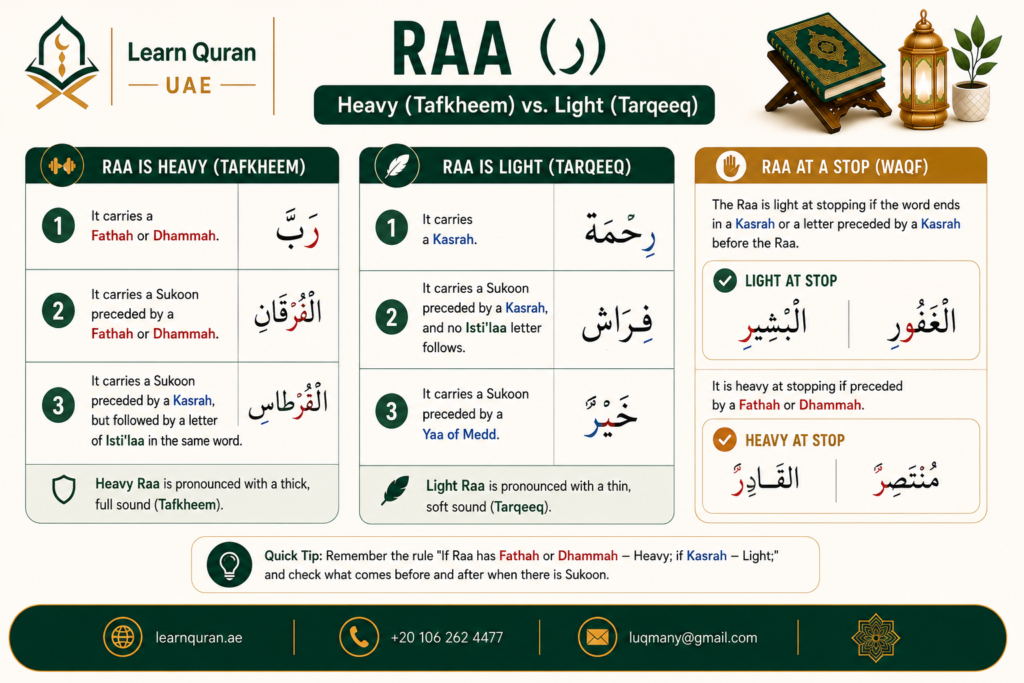
The Raa follows specific rules that determine whether it is heavy or light based on its vowel, its position in the word, and the vowels of the letters around it.
Raa is heavy when:
- It carries a Fathah or Dhammah
- It carries a Sukoon preceded by a Fathah or Dhammah
- It carries a Sukoon preceded by a Kasrah, but followed by a letter of Isti’laa in the same word
Raa is light when:
- It carries a Kasrah
- It carries a Sukoon preceded by a Kasrah, and no Isti’laa letter follows
- It carries a Sukoon preceded by a Yaa of Medd
Raa at a stop (Waqf): The Raa is light at stopping if the word ends in a Kasrah or a letter preceded by a Kasrah before the Raa. It is heavy at stopping if preceded by a Fathah or Dhammah.
The Laam in the Name of Allah
The Laam in the divine name (الله) is pronounced with Tafkheem when the word before it carries a Fathah or Dhammah. It is pronounced with Tarqeeq when the word before it carries a Kasrah.
Examples:
- قَالَ اللَّهُ — Fathah before the Laam: Tafkheem
- بِسْمِ اللَّهِ — Kasrah before the Laam: Tarqeeq
7. The Rules of Qalqalah: The Echo Sound in Five Letters
Qalqalah is an inherent characteristic of five letters that produce a slight bouncing or echoing quality when they appear with Sukoon (no vowel). These letters are grouped in the phrase:
قُطْبُ جَدٍّ — ق ط ب ج د
The echo occurs because these letters have the characteristic of Shiddah (complete stoppage of airflow) combined with Jahr (voicing), which creates a brief pressure buildup that releases as a distinct echo when the airflow is cut by the Sukoon.
Levels of Qalqalah
Minor Qalqalah (Qalqalah Sughra): The Qalqalah letter carries a Sukoon within the word during normal continuous recitation. The echo is slight.
Major Qalqalah (Qalqalah Kubra): The Qalqalah letter appears at the end of a word when the reader stops. The echo is more pronounced, especially if the letter carries a Shaddah.
Example of Qalqalah Kubra: stopping on the word الْحَقّ — the Qaaf with Shaddah at the stop produces a strong echo that must not be swallowed or suppressed.
8. The Rules of Istiadhah, Basmalah, and Beginning Recitation
Before a recitation session begins, two specific phrases precede the actual Quranic text. The rules governing how they are connected to each other and to the following verse are part of basic tajweed rules pdf content in any classical primer.
Al-Istiadhah
The Istiadhah is the phrase: أَعُوذُ بِاللَّهِ مِنَ الشَّيْطَانِ الرَّجِيمِ
It is recited before beginning recitation and is based on Allah’s command:
“فَإِذَا قَرَأْتَ الْقُرْآنَ فَاسْتَعِذْ بِاللَّهِ مِنَ الشَّيْطَانِ الرَّجِيمِ”
Fa-idhā qara’ta l-Qur’āna fasta’idh billāhi mina l-shayṭāni l-rajīm
“So when you recite the Quran, seek refuge with Allah from Satan, the expelled.”
Al-Basmalah
The Basmalah is: بِسْمِ اللَّهِ الرَّحْمَانِ الرَّحِيمِ
It is recited before every Surah except Surah At-Tawbah (Al-Baraa’ah). The connection between the Istiadhah, Basmalah, and the first verse of a Surah has four permitted forms:
- Separating all three — pause after Istiadhah, pause after Basmalah, begin verse.
- Connecting Basmalah to the verse — pause after Istiadhah, then recite Basmalah directly into the verse.
- Connecting Istiadhah to Basmalah — recite both together, then pause before the verse.
- Connecting all three — recite Istiadhah, Basmalah, and first verse in one breath without pausing.
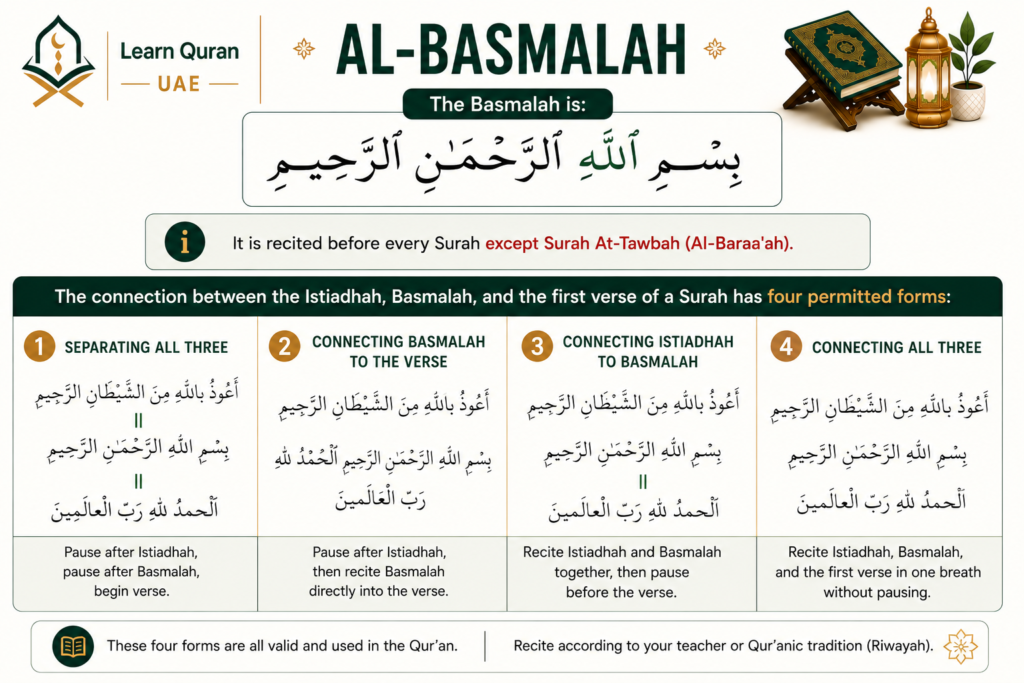
All four forms are valid. The single form that is not permitted is connecting the end of the previous Surah directly to the Basmalah and then pausing before the next Surah begins, which creates the appearance that the Basmalah belongs to the previous Surah.
Read also: Noon Sakinah and Tanween Rules – The Complete Guide
9. The Rules Of Waqf and Ibtidaa: Stopping and Starting
Waqf (stopping) and Ibtidaa (starting) rules determine where a reader may pause during recitation and where recitation should resume after a pause. These rules are essential because stopping in the wrong place can alter the meaning of a verse drastically.
Categories of Waqf
| Waqf Type | Symbol in Mus’haf | Ruling | Meaning |
| Waqf Taam (Complete) | none / ط | Stopping preferred | Sentence is grammatically and thematically complete |
| Waqf Kaafi (Sufficient) | none | Stopping permitted | Sentence is complete but connected to next in theme |
| Waqf Hasan (Good) | none | Stopping permitted | Meaning is sufficient but grammar continues |
| Waqf Qabeeh (Ugly) | لا | Stopping not permitted | Stopping here distorts or reverses meaning |
| Waqf Jaiz (Permissible) | ج | Equal choice | Stopping or continuing are both acceptable |
| Waqf Murakhkhas (Necessitated) | ص | Stop only if needed | Only acceptable if breath runs out |
| Signs of Equal Choice | قلى / صلى | Conditional guidance | Stopping or continuing depending on context |
The laa (لا) symbol in the Mus’haf marks positions where stopping is forbidden because it would either distort meaning or separate a word from what grammatically depends on it. Readers who do not know Waqf rules commonly stop at these positions without realizing the error.
Rules of Ibtidaa
After stopping, recitation must resume from a point that produces a complete or at least meaningful fragment on its own. Starting from the middle of a sentence in a way that implies the opposite of the intended meaning is an error in Ibtidaa even if the Waqf that preceded it was correct.
If you have been reciting without attention to Waqf symbols or do not know how to read them, the Advanced Tajweed Course at UAE Quran Academy covers Waqf and Ibtidaa in dedicated sessions alongside Sifaat and Medd analysis. This is the course for students who already read the Quran but want their recitation certified to an accurate standard. Enroll now and move beyond surface-level recitation.

Advance your Tajweed with expert-guided recitation training.
10. Levels of Recitation: Tarteel, Tadweer, and Hadr
Tajweed rules do not apply only to slow recitation. They apply across all three accepted levels of recitation speed, and a correct understanding of these levels prevents the common mistake of believing that reciting faster means relaxing the rules.
Tarteel
Tarteel is the measured, unhurried recitation described in the Quranic command quoted at the opening of this article. It is characterized by careful attention to every articulation point, full application of all Medd measures, distinct Ghunnah, and deliberate pausing at appropriate Waqf positions. This level is ideal for learning, revision, and reflective recitation.
Tadweer
Tadweer is the intermediate level — faster than Tarteel but slower than Hadr. All tajweed rules are observed, but the pace allows for recitation of longer passages in a given time. Most scholars and reciters in Salah use this level for non-Fajr prayers where longer Surahs are read.
Hadr
Hadr is the fastest permitted level of recitation. All tajweed rules still apply in full — Medd measures are not shortened, Ghunnah is not dropped, and letters are not swallowed. The speed simply reduces the time between applying rules. Hadr is used by those who have memorized the Quran and recite entire Juz in a single sitting, such as during Taraweeh.
What is not recognized as a fourth level — and what is not permitted — is recitation so fast that letters merge into each other, Medd disappears, or Ghunnah becomes inaudible. That is not Hadr; it is recitation with errors.
11. Noon and Meem Mushaddadah: The Obligatory Ghunnah
When Noon or Meem carries a Shaddah (ّ), the Ghunnah is obligatory and must be held for exactly two counts. This applies in every position — beginning, middle, or end of a word — without exception.
“مَثَلُ الَّذِي يَقْرَأُ الْقُرْآنَ وَهُوَ حَافِظٌ لَهُ مَعَ السَّفَرَةِ الْكِرَامِ الْبَرَرَةِ، وَمَثَلُ الَّذِي يَقْرَأُ الْقُرْآنَ وَهُوَ يَتَعَاهَدُهُ وَهُوَ عَلَيْهِ شَدِيدٌ، فَلَهُ أَجْرَانِ”
“Such a person as recites the Qur’an and masters it by heart, will be with the noble righteous scribes (in Heaven). And such a person exerts himself to learn the Qur’an by heart, and recites it with great difficulty, will have a double reward.”
Common examples of Noon and Meem Mushaddadah with obligatory Ghunnah:
- إِنَّ الَّذِينَ — the Noon Mushaddadah carries a clear two-count nasal sound.
- مِمَّ خُلِقَ — the Meem Mushaddadah carries the same two-count resonance.
The Ghunnah in these cases is not optional and does not vary based on recitation level. Whether the reader is in Tarteel or Hadr, the two-count Ghunnah on a Mushaddad Noon or Meem must be audible.
See How Our Online Classes Work
Get a glimpse of a real online session and explore how students learn Quran with experienced teachers in a supportive and interactive environment.
Start Learning Tajweed Rules with UAE Quran Academy
Most students who struggle with tajweed rules are not missing intelligence or effort — they are missing live correction. Reading about Medd or Ikhfaa is useful, but the moment you recite, a teacher must be there to confirm whether you are applying it correctly or building a confident error. There is no substitute for real-time feedback from someone qualified to give it.
UAE Quran Academy offers a full range of tajweed programs built for every type of learner, delivered one-to-one with certified teachers online from anywhere in the UAE and beyond.
For students beginning with zero tajweed knowledge, the Tajweed for Beginners Course starts from Makharij and builds every rule step by step without overwhelming you from day one.
Learners who already read the Quran and want to elevate their accuracy will find the Quran Reading with Tajweed Course the right fit — taking uncertain recitation to confident, rule-compliant reading.
For children, the Tajweed for Kids Course uses an age-appropriate approach that makes correct articulation natural and engaging rather than a burden.
Sisters looking for a comfortable learning environment can enroll in the Tajweed for Ladies Course, delivered by qualified female teachers with flexible scheduling.
Every program at UAE Quran Academy includes:
- One-to-one sessions with a certified, experienced Quran teacher
- Real-time correction of Makharij, Sifaat, and rule application from the first lesson
- Structured progression from foundational rules to complex Medd and Waqf analysis
- Flexible scheduling that fits around work, school, and family commitments
Correct recitation is not a goal you approach gradually — every session either builds correct habits or entrenches wrong ones. Start with the right teacher from the beginning.
Our Tajweed Courses
- Tajweed Course
- Learn Quran Online with Tajweed
- Tajweed for Kids Course
- Tajweed for Adults Course
- Tajweed for Ladies / Sisters Course
- Tajweed for Beginners Course
- Advanced Tajweed Course
Enroll today and take the first step toward beautiful, accurate Quran recitation with expert guidance.
Start Learning Quran with Expert Tutors in the UAE
Accredited online Quran and Arabic classes tailored for adults and children. Schedule your session today.
Book Your Free TrialEnroll in UAE Quran Academy’s Tajweed Programs Today
Conclusion
Tajweed rules are not an academic exercise for scholars. They are the precise, practical framework that ensures the Quran is recited the way it was revealed — from the correct articulation points, with the correct characteristics, with sounds that interact according to established laws rather than personal habit. This guide has covered every major category: Makharij and Sifaat, the four rules of Noon and Tanween, the three rules of Meem Saakinah, Medd in all its types, Tafkheem and Tarqeeq, Qalqalah, Waqf and Ibtidaa, and the three recitation levels.
Knowing what is tajweed rules on paper is the beginning, not the destination. The rules become part of your recitation only through regular supervised practice where a qualified teacher hears every letter and corrects every deviation before it becomes permanent. UAE Quran Academy provides exactly that structure — personalized, certified, live instruction in every tajweed course they offer. Begin today and let every verse you recite reflect the transmission that has reached us unbroken across fourteen centuries.
Frequently Asked Questions
What is tajweed rules in simple terms?
Tajweed rules are the precise laws that govern how every letter in the Quran is pronounced, how adjacent sounds interact, and how long vowels are held. They ensure that recitation matches the way the Quran was transmitted from the Prophet ﷺ through an unbroken chain of qualified reciters.
Can I find basic tajweed rules PDF resources to study from?
Yes, classical primers like Al-Jazariyyah and Tuhfat Al-Atfaal are available as PDFs and are widely used in structured courses. However, no PDF or written resource can replace a qualified teacher who corrects your pronunciation in real time — the PDF gives you theory, but the teacher gives you accuracy.
What is the difference between Medd Muttasil and Medd Munfasil?
Medd Muttasil occurs when the Medd letter and the Hamzah that causes it are in the same word. Medd Munfasil occurs when the Medd letter is at the end of one word and the Hamzah begins the next word. Medd Muttasil is obligatory (four to five counts minimum). Medd Munfasil is permitted at four to five counts but may be reduced in certain recitation approaches.
How long does it take to learn quran with tajweed rules properly?
Foundational rules like Makharij and basic Medd take a few months to understand. However, applying them automatically during full recitation typically requires one to two years of consistent daily practice under expert teacher supervision.
Is it sinful to recite the Quran without tajweed?
No, if you are actively learning. Scholars separate ignorance from negligence. Reciting with difficulty while striving to improve earns a double reward, but deliberately ignoring known mistakes without attempting to correct them is considered blameworthy.
Why Errors in Recitation Are a Serious Matter
Mistakes in Quranic recitation fall into two categories: Lahn Jalee (clear error) and Lahn Khafee (subtle error). A clear error changes a letter entirely or distorts it so badly that the meaning shifts. A subtle error applies rules incorrectly in ways an untrained ear may not detect but that deviate from the authentic transmission. Both categories are problems, but Lahn Jalee is considered sinful when done intentionally, and Lahn Khafee weakens the quality and accuracy of what is being transmitted.



Leave a Reply