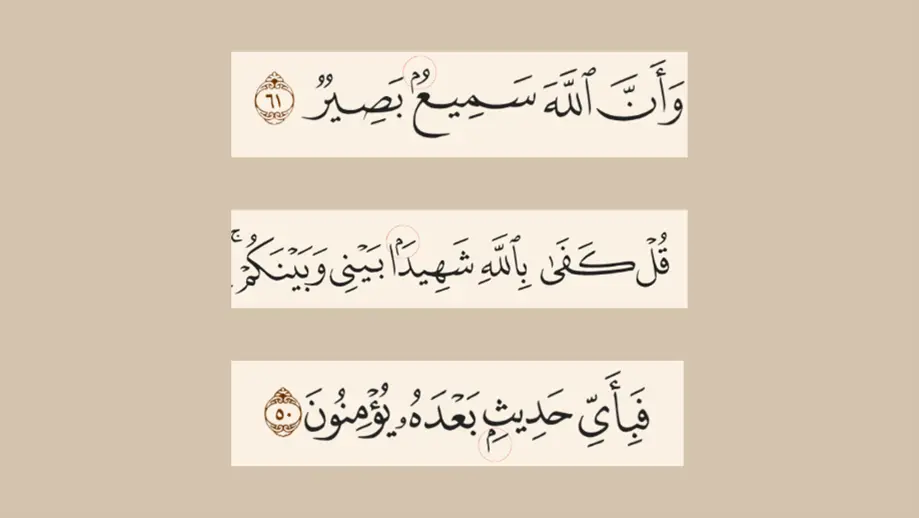
 Tajweed

If you pray, you already use izhar. Every time you recite Al-Fatihah and reach أَنْعَمْتَ (anʿamta) in verse 7, the noon in that word is read clearly. That clear noon is izhar.
Learning izhar in Tajweed starts with the 6 throat letters. When one of them comes after a noon saakinah or tanween, you say the “n” plainly, just as it’s written. Most teachers start here because it’s the easiest noon rule to get right.
Easy doesn’t mean students never slip, though. A lot of people hold the noon in the nose a bit too long, or let it run into the next letter without noticing. Below, you’ll find the rule in plain words, the six letters, verses to practice with, and the mistakes teachers hear most often.
What you’ll learn in this article:
- What izhar means and why it is called izhar halqi.
- The 6 izhar letters, where each one comes from, and how to remember them.
- Full Quran examples with links so you can listen to each verse.
- A quick way to spot izhar in the mushaf, plus a short practice quiz.
- The most common izhar mistakes and how to fix them.
What Is Izhar In Tajweed?
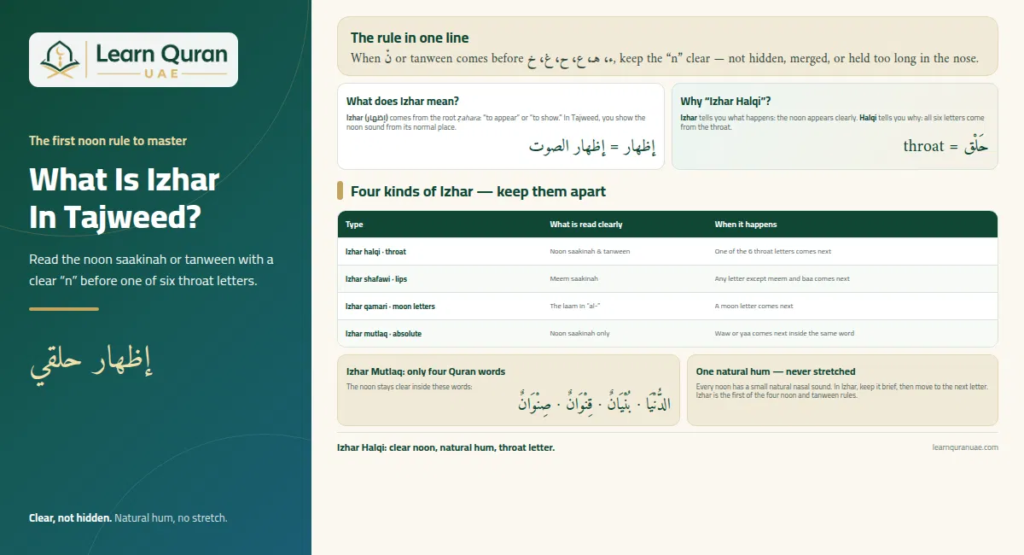
Izhar in Tajweed means reading a noon saakinah (نْ) or tanween with a clear “n” sound when one of six throat letters comes right after it. These letters are ء, هـ, ع, ح, غ, and خ. The noon is not hidden, not merged, and not held in the nose.
To use this rule well, it helps to know two things. First, what the word izhar means. Second, why scholars gave it the full name izhar halqi.
Izhar Meaning In Arabic And In Tajweed
The word izhar (إظهار) comes from the Arabic root ẓahara. It means “to appear” or “to show.” So izhar means making something clear and easy to see. In Tajweed, the thing you make clear is the sound of the noon.
When izhar happens, you say the noon from its normal place. The tip of your tongue touches the gum just behind your top front teeth. Then you move on to the next letter. You do not change the noon into anything else.
Some students think izhar means the noon has no nasal sound at all. That is not quite right. Classical teachers explain that every noon has a small natural hum in the nose. In izhar, you keep that tiny hum, but you do not stretch it.
Izhar works on two things. The first is noon saakinah, which is a noon with no vowel on it, like the noon in min or ʿan. The second is tanween, the double vowel marks at the end of a noun. Izhar is the first of the four rules of noon saakinah and tanween. The other three are idgham, iqlab, and ikhfa.
You can see all four side by side in our full guide to Noon Sakinah and Tanween rules.
Why It Is Called Izhar Halqi, And How It Differs From Other Izhar
The name has two parts, and each part tells you something. “Izhar” tells you what happens: the noon shows clearly. “Halqi” tells you why: all six letters that cause it come from the halq, the Arabic word for throat.
The second word matters because Tajweed has more than one kind of izhar. Each kind makes a different letter clear for a different reason. The table below helps you keep them apart.
| Type of izhar | Which letter is read clearly | When it happens |
| Izhar halqi (throat) | Noon saakinah and tanween | One of the 6 throat letters comes next |
| Izhar shafawi (lips) | Meem saakinah | Any letter except meem and baa comes next |
| Izhar qamari (moon letters) | The laam in “al-“ | A moon letter comes next |
| Izhar mutlaq (absolute) | Noon saakinah only | Waw or yaa comes next inside the same word |
Izhar mutlaq is a special case. It shows up in only four words in the whole Quran: الدُّنْيَا (ad-dunyā), بُنْيَانٌ (bunyān), قِنْوَانٌ (qinwān), and صِنْوَانٌ (ṣinwān). The noon stays clear in these words so they keep their true meaning.
So when a teacher says “izhar” in a lesson on noon saakinah, they almost always mean izhar halqi, and that’s the rule this article covers.
The 6 Izhar Letters
The izhar letters are easy to learn once you see them in order. Below you will find where each letter sits in the throat, two ways to remember them, and how strong the izhar is with each pair.
The Six Letters And Their Place In The Throat
The six letters of izhar are hamzah, haa, ʿayn, ḥaa, ghayn, and khaa. They sit in pairs inside three parts of the throat. The deepest part is near your chest. The top part is near your mouth.
| Letter | Name | Sound tip for English speakers | Place in the throat |
| ء | Hamzah | The small catch in “uh-oh” | Deepest part |
| هـ | Haa | A soft “h,” like in “hat” | Deepest part |
| ع | ʿAyn | A deep squeeze in the throat, with no English match | Middle |
| ح | Ḥaa | A strong, breathy “h,” like fogging up a mirror | Middle |
| غ | Ghayn | Close to the French “r” in “Paris” | Top, near the mouth |
| خ | Khaa | Like the “ch” in Scottish “loch” | Top, near the mouth |
A quick way to see the order is to split the letters into three pairs: ء هـ | ع ح | غ خ. Read them from right to left, the same way you read Arabic. You start deep in the throat and move up toward the mouth.
It also helps to get each letter right on its own before you worry about the noon. If your ع (ʿayn) or غ (ghayn) comes out weak, the whole word will sound off, even when your izhar is perfect.
For a full map of where every Arabic letter comes from, read our guide to Makharij Al-Huroof.
Two Easy Ways To Remember The Letters Of Izhar
The most popular memory trick is a short Arabic phrase. Each word starts with one izhar letter, in the same order as the throat.
The phrase is:
Akhī hāka ʿilman ḥāzahu ghayru khāsir
(أخي هاك علمًا حازه غير خاسر).
It means, “My brother, here is knowledge.
The one who gets it does not lose.” Here is how each word gives you a letter:
| Word | First letter |
| Akhī (أخي) | ء |
| Hāka (هاك) | هـ |
| ʿIlman (علمًا) | ع |
| Ḥāzahu (حازه) | ح |
| Ghayru (غير) | غ |
| Khāsir (خاسر) | خ |
The second way is a line of poetry. Imam al-Jamzuri wrote it in Tuhfat al-Atfal, a well-known Tajweed poem that many children learn by heart:
هَمْزٌ فَهَاءٌ ثُمَّ عَيْنٌ حَاءُ … مُهْمَلَتَانِ ثُمَّ غَيْنٌ خَاءُ
Hamzun fa-hā’un thumma ʿaynun ḥā’u, muhmalatāni thumma ghaynun khā’u.
The word muhmalatān means “the two without dots.” It tells you that the ع and ح here are the undotted letters, so you don’t mix them up with غ and خ. You can read the full section of the poem in the Egyptian Ministry of Awqaf’s lesson on the noon rules.
Pick the one that feels easier for you. Children often like the poem because it has a beat. Adults often like the phrase because it is short.
Read also: Idgham in Tajweed: Types, Letters & Examples
The Three Levels Of Izhar: From Strongest To Lightest
Izhar is not the same strength with every letter. Scholars put it in three levels. The farther a letter is from the noon, the stronger and clearer the izhar is.
- The top level is with hamzah and haa. These come from the deepest part of the throat, so they are the farthest from the noon. Here the noon stands out the most.
- The middle level is with ʿayn and ḥaa. They sit in the middle of the throat. The izhar is still clear, but a little softer.
- The lowest level is with ghayn and khaa. They are the closest throat letters to the mouth. The izhar here is the lightest of the three.
“Lightest” does not mean “optional.” In the reading of Hafs, which most people in the UAE use, izhar is required with all six letters. A light izhar is still a full, clear noon.
See How Our Online Classes Work
Get a glimpse of a real online session and explore how students learn Quran with experienced teachers in a supportive and interactive environment.
Why The Noon Stays Clear Before Throat Letters
The reason is distance. The noon comes from the tip of the tongue at the front of the mouth. The six izhar letters come from the throat, which is the deepest point of speech. These two places are far apart.
Think of two rooms at opposite ends of a house. You cannot step from one into the other in a single move. In the same way, the noon cannot blend into a throat letter.
Merging (idgham) only works when two letters come from close places. Hiding (ikhfa) needs a middle distance, not too close and not too far. You can see how that middle distance works in our guide to Ikhfa rules in Tajweed.
Old Tajweed books add one more point. The noon is an easy letter to say. Throat letters take more effort. If you tried to hide an easy sound right before a hard one, both would come out unclear. So the best choice is to say the noon fully, then say the throat letter.
Knowing the letters is the first step. Hearing yourself say them right is the next one. In the Quran Reading Course at UAE Quran Academy, you practice each noon rule in live classes, one rule at a time, until it feels natural.

Start Learning Quran with Expert Tutors in the UAE
Accredited online Quran and Arabic classes tailored for adults and children. Schedule your session today.
Book Your Free TrialIzhar Examples From The Quran
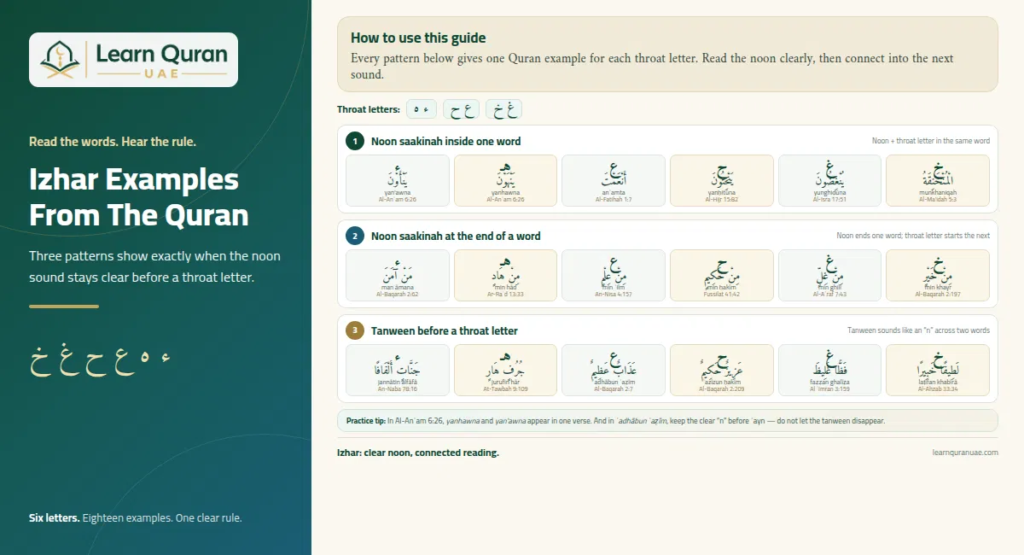
Izhar shows up in three patterns. Each pattern below has six examples, one for each throat letter. Every reference links to the verse on Quran.com, so you can read it and listen to a reciter.
Noon Saakinah Inside One Word
In this pattern, the noon and the throat letter sit inside the same word. The noon comes first, and the throat letter comes right after it.
| Letter | Example | Where to find it |
| ء | يَنْأَوْنَ yan’awna | Al-Anʿam 6:26 |
| هـ | يَنْهَوْنَ yanhawna | Al-Anʿam 6:26 |
| ع | أَنْعَمْتَ anʿamta | Al-Fatihah 1:7 |
| ح | يَنْحِتُونَ yanḥitūna | Al-Hijr 15:82 |
| غ | فَسَيُنْغِضُونَ fa-sayunghiḍūna | Al-Isra 17:51 |
| خ | وَالْمُنْخَنِقَةُ wal-munkhaniqah | Al-Ma’idah 5:3 |
Take a look at Al-Anʿam 6:26. This one verse holds two izhar words, يَنْهَوْنَ (yanhawna) and يَنْأَوْنَ (yan’awna), which makes it a great place to practice the strongest level of izhar.
Three words in this table are worth remembering because they’re so rare: يَنْأَوْنَ (yan’awna), فَسَيُنْغِضُونَ (fa-sayunghiḍūna), and وَالْمُنْخَنِقَةُ (wal-munkhaniqah). They’re the only places in the whole Quran where a noon saakinah meets ء, غ, or خ inside one word. Learn these three, and you’ve covered every case for those letters.
The letter هـ is the opposite. It’s the most common letter in this pattern, and you’ll see it all the time in short words like مِنْهَا (minhā, from it) and عَنْهُ (ʿanhu, about him).
Noon Saakinah At The End Of A Word
In this pattern, the noon is the last letter of one word. The throat letter is the first letter of the next word. This is the pattern you will meet most often when you read.
| Letter | Example | Where to find it |
| ء | مَنْ آمَنَ man āmana | Al-Baqarah 2:62 |
| هـ | مِنْ هَادٍ min hād | Ar-Raʿd 13:33 |
| ع | مِنْ عِلْمٍ min ʿilm | An-Nisa 4:157 |
| ح | مِنْ حَكِيمٍ min ḥakīm | Fussilat 41:42 |
| غ | مِنْ غِلٍّ min ghill | Al-Aʿraf 7:43 |
| خ | مِنْ خَيْرٍ min khayr | Al-Baqarah 2:197 |
Most of these cases come from a handful of small, everyday words: مِنْ (min, from), مَنْ (man, who), إِنْ (in, if), and عَنْ (ʿan, about). Each one ends in a noon saakinah, so whenever the next word starts with a throat letter, you read izhar.
When you read them, keep the two words together in one breath. The izhar only shows up when you connect them, so say the noon clearly and then flow right into the next word.
Tanween Before A Throat Letter
Tanween is the double vowel mark at the end of a noun: ـٌ (un), ـً (an), or ـٍ (in). You see two vowel marks, but you hear an “n.” In other words, tanween is a noon saakinah that you hear but do not see written.
Because tanween only comes at the end of a word, its izhar always happens across two words. The throat letter starts the next word.
| Letter | Example | Where to find it |
| ء | وَجَنَّاتٍ أَلْفَافًا wa jannātin alfāfā | An-Naba 78:16 |
| هـ | جُرُفٍ هَارٍ jurufin hār | At-Tawbah 9:109 |
| ع | عَذَابٌ عَظِيمٌ ʿadhābun ʿaẓīm | Al-Baqarah 2:7 |
| ح | عَزِيزٌ حَكِيمٌ ʿazīzun ḥakīm | Al-Baqarah 2:209 |
| غ | فَظًّا غَلِيظَ faẓẓan ghalīẓa | Al ʿImran 3:159 |
| خ | لَطِيفًا خَبِيرًا laṭīfan khabīrā | Al-Ahzab 33:34 |
Say ʿadhābun ʿaẓīm out loud. You should hear a clear “n” at the end of ʿadhābun, then the ʿayn. If you hear “ʿadhābu ʿaẓīm” with no “n,” the tanween is lost.
How To Find Izhar In The Mushaf Using Two Easy Signs
The Madani mushaf, the most common print in the UAE, marks the noon rules for you. Once you know what to look for, you can spot izhar in about two seconds. We call this the Sukun-and-Stack check, and it takes four quick steps.
- Find the noon or the tanween. Look for a noon with no vowel on it, or a word that ends with a double vowel mark (ـٌ ـً ـٍ).
- If it’s a noon, look for the sukun. A noon saakinah with izhar has a small sukun mark on top, like in مِنْ (min) or أَنْعَمْتَ (anʿamta). If the noon has no sukun at all, as in مِن جُوعٍ (min jūʿ), the rule is ikhfa or idgham, not izhar.
- If it’s a tanween, check how the two marks sit. When the marks are stacked right on top of each other, as in عَذَابٌ عَظِيمٌ (ʿadhābun ʿaẓīm), it’s izhar. When they’re staggered, one a little after the other, it’s ikhfa or idgham.
- Confirm the next letter. Make sure the letter right after the noon or tanween is one of the six: ء، هـ، ع، ح، غ، خ. If it is, read the noon clearly and move straight on.
Keep in mind that these signs follow the standard Madani print. Other prints may mark the rules differently, so check the guide page at the back of your mushaf if you use another one.
How To Pronounce Izhar Step By Step
Saying izhar well comes down to three small moves, all done in one smooth flow. Go slowly at first, then build up to your normal reading pace once it feels easy.
- Say the noon from its place. Press the tip of your tongue against the gum just behind your top front teeth. That’s where every ن comes from.
- Keep the hum short. You’ll feel a tiny buzz in your nose, and that’s fine. Just don’t hold onto it.
- Go straight to the throat letter. Move from the noon into the next letter without stopping, so the two sounds flow together.
Want a quick way to check yourself? Lightly touch the side of your nose and read مِنْ عِنْدِ (min ʿindi) from Al-Baqarah 2:79. You should feel a very short buzz on the noon that stops the moment you reach the ع. If the buzz keeps going, you’re holding the noon too long.
Practice: Find Izhar In Short Surahs You Already Know
The best practice uses surahs you already know by heart. Read each part below, find the izhar, then check the answer. One question has a trap.
| Verse | Find the izhar | Answer |
| Al-Kawthar 108:2 | وَانْحَرْ | The ن meets ح inside the same word |
| Al-Masad 111:2 | مَا أَغْنَىٰ عَنْهُ مَالُهُ | In عَنْهُ, the ن meets هـ inside the same word |
| Al-Ikhlas 112:4 | كُفُوًا أَحَدٌ | The tanween on كُفُوًا meets ء at the start of the next word |
| Al-Qariʿah 101:11 | نَارٌ حَامِيَةٌ | The tanween on نَارٌ meets ح at the start of the next word |
| Quraysh 106:4 | مِنْ جُوعٍ … مِنْ خَوْفٍ | Watch out, this one’s a trap. مِن جُوعٍ is ikhfa because ج isn’t a throat letter. مِنْ خَوْفٍ is izhar because the ن meets خ |
If you got the trap right, you are already checking the next letter instead of just seeing a noon. That habit is the heart of every noon rule.
Common Izhar Mistakes And How To Fix Them
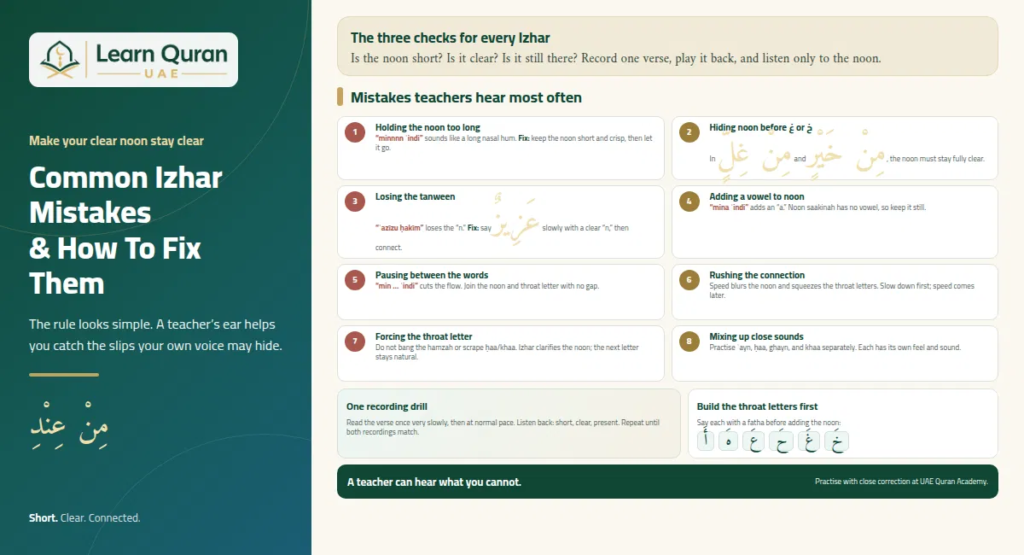
Izhar looks simple on paper. In real reading, though, teachers hear the same slips again and again. Most students cannot hear these mistakes in their own voice, so they need someone else to listen.
a. Mistakes With The Noon Sound
- The mistake teachers hear most is holding the noon too long. A student reads مِنْ عِنْدِ (min ʿindi) as “minnnn ʿindi,” with a long hum in the nose, and the izhar ends up sounding like ikhfa. The fix is simple: keep the noon short and crisp, then let it go.
- The second slip is hiding the noon before غ and خ. Since these two sit closest to the mouth, many students start hiding the noon a little without meaning to. Listen closely to yourself on مِنْ غِلٍّ (min ghill) and مِنْ خَيْرٍ (min khayr). The noon should stay fully clear in both.
- The third one is losing the tanween altogether.
عَزِيزٌ حَكِيمٌ (ʿazīzun ḥakīm) comes out as “ʿazīzu ḥakīm,” and the “n” just disappears. To fix it, say the tanween word slowly with a clear “n” at the end, and only then join it to the next word.
A good way to catch all three is to record yourself reading one verse with izhar. Play it back and listen only to the noon. Is it short? Is it clear? Is it there at all?
b. Mistakes With Timing And Flow
Some students add a vowel to the noon. They read مِنْ عِنْدِ (min ʿindi) as “mina ʿindi,” slipping a short “a” in after the noon. This is a clear error because it changes the shape of the word. A noon saakinah has no vowel, so it has to stay still.
Others pause between the noon and the throat letter, so it sounds like “min … ʿindi.” That tiny break cuts the flow of the verse. The noon and the next letter should run together with no gap at all.
Behind many of these slips is rushing. When you read fast, the throat letters get squeezed and the noon gets blurry. Slow down and give each letter its time. You can pick up speed later, once your mouth knows the moves.
One trick that really helps: read the verse once very slowly, almost word by word, then read it again at your normal pace. Try to keep the same clear noon both times.
c. Mistakes with the throat letter
Some students try too hard on the throat letter. They push the ء into a hard bang, or scrape the ح and خ from the back of the throat. But izhar is about making the noon clear. It doesn’t ask you to press harder on the letter that comes next, so just say the throat letter the normal way.
Another common slip is mixing up throat letters that sound close. English speakers often say ع like a ء, or ح like a soft هـ. When that happens, مِنْ عِلْمٍ (min ʿilm) turns into “min ‘ilm,” and the meaning can change.
It also helps to remember that each throat letter has its own feel.
ح is breathy and light, while غ is voiced and heavy. If they all come out sounding the same, your izhar might be right, but the word is still wrong.
The fix is to practice the six letters on their own first. Say each one with a fatha: أَ، هَ، عَ، حَ، غَ، خَ (a, ha, ʿa, ḥa, gha, kha). Once every letter sounds right by itself, put the noon in front of it.
Most of these slips are easy to fix when a teacher is listening closely. You can compare the plans and pick the one that fits your week on the UAE Quran Academy pricing page.

Izhar In Other Quran Readings
Everything in this guide follows the reading of Hafs ʿan ʿAsim, the one printed in most mushafs across the UAE and the Gulf. A few other readings handle some izhar letters differently. You don’t need to learn them, but knowing about them helps if you ever hear a reciter who sounds “different.”
| Reading | What changes | Example |
| Warsh ʿan Nafiʿ | The hamzah drops, so there’s no izhar with ء across two words | مَنْ آمَنَ is read “manāmana” |
| Abu Jaʿfar | The noon is hidden with a hum before غ and خ in most places | مِنْ غِلٍّ is read with ikhfa, not izhar |
- In the reading of Warsh, a rule called naql moves the vowel of the hamzah back onto the letter before it, then drops the hamzah. So مَنْ آمَنَ (man āmana) becomes “manāmana.” With no hamzah left to say, there’s nothing for the izhar to happen before.
- In the reading of Abu Jaʿfar, the noon is usually hidden before غ and خ. He still reads izhar in three places: إِن يَكُنْ غَنِيًّا (in yakun ghaniyyan, An-Nisa 4:135), وَالْمُنْخَنِقَةُ (wal-munkhaniqah, Al-Ma’idah 5:3), and فَسَيُنْغِضُونَ (fa-sayunghiḍūna, Al-Isra 17:51).
- If you read with Hafs, none of this changes anything for you. Izhar stays required with all six throat letters.
Experience a Live Quran Class
Watch a short sample from one of our online Quran classes and discover our engaging teaching style, interactive lessons, and personalized learning approach.
Start Learning Quran with Expert Tutors in the UAE
Accredited online Quran and Arabic classes tailored for adults and children. Schedule your session today.
Book Your Free TrialBook Your Free Trial Class At UAE Quran Academy TODAY
You now know the six izhar letters, the three patterns, and the mistakes to watch for. The last step is making it sound right every single time you read. That only happens when a trained teacher listens to you and corrects you on the spot.
Here is what you get with UAE Quran Academy:
- Your teacher listens only to you in one-on-one classes, so every mistake is fixed right away.
- Lessons are repeated and made simpler until you truly get it, with no rush.
- You see the words and marks on screen while your teacher explains them.
- You learn from home in any emirate, at times that fit your day.
- Sisters and young girls can learn with female Quran teachers.
- There are Tajweed classes for kids, adults, ladies, and beginners, with a path all the way to Ijazah.
Try a class first and see how it feels. Your first step is a free trial class.

Our Online Quran Courses Include:
Check our available courses and pick the one that suits you best.
- Online Quran Classes in UAE
- Quran Classes for Kids
- Quran Classes for Adults
- Quran Classes for Ladies / Sisters
- Quran Classes for Men
- Quran Course for Beginners
- Quran Classes for Toddlers
- Weekend Quran Classes
- Intensive Quran Course
- Al-Azhar Quran Course
Conclusion
Izhar in Tajweed is the rule of reading the noon clearly before the 6 throat letters: ء, هـ, ع, ح, غ, and خ. The name says it all. “Izhar” means the noon shows, and “halqi” means the letters come from the throat.
The reason behind it is simple. The noon comes from the front of the mouth, and the throat letters come from deep inside. They are too far apart to merge or hide. So you say the noon fully, then move on.
You also learned that izhar comes in three patterns. A noon can meet a throat letter inside one word, at the end of a word, or as tanween before the next word. The examples from Al-Fatihah, Al-Anʿam, and the short surahs give you real verses to practice with every day.
The Sukun-and-Stack check makes izhar easy to find. A sukun on the noon or a stacked tanween in the Madani mushaf tells you to read clearly. Paired with the three pronunciation steps and the nose test, you can check yourself as you read.
Keep the common mistakes in mind as well. Do not hold the noon, do not hide it before ghayn and khaa, and do not drop the tanween. Watch your timing and give each throat letter its own sound.
The main lesson is this: izhar is easy to understand but easy to get a little wrong. Steady practice with a teacher who listens is the surest way to read it correctly. Once izhar feels natural, the other noon rules will be much easier to learn.
FAQs
These are the questions students ask most when they first learn izhar. Each answer is short, so you can find what you need fast.
What Are The 6 Letters Of Izhar?
The 6 letters of izhar are hamzah (ء), haa (هـ), ʿayn (ع), ḥaa (ح), ghayn (غ), and khaa (خ). All six come from the throat. You can remember them with the phrase Akhī hāka ʿilman ḥāzahu ghayru khāsir.
What Is The Izhar Meaning In Tajweed?
Izhar means reading the noon saakinah or tanween with a clear “n” sound. It applies when one of the six throat letters comes right after it.
Is There Ghunnah In Izhar?
There is no long ghunnah in izhar. The noon keeps only its tiny natural hum, which is not held. In ikhfa, idgham with ghunnah, and iqlab, the hum is held for about two counts.
Why Is Izhar Called Izhar Halqi?
It is called izhar halqi because all six letters that cause it come from the throat. Halq is the Arabic word for throat.
Can Tanween Have Izhar Inside One Word?
No, tanween can only have izhar across two words. Tanween always comes at the end of a noun, so the throat letter must start the next word.
Which Izhar Words Appear Only Once In The Quran?
Three words are unique: yan’awna (Al-Anʿam 6:26), fa-sayunghiḍūna (Al-Isra 17:51), and al-munkhaniqah (Al-Ma’idah 5:3). They are the only cases of noon saakinah meeting hamzah, ghayn, or khaa inside one word.
What Is The Difference Between Izhar And Ikhfa?
In izhar, the noon is said clearly with no long hum. In ikhfa, the noon is half hidden and the hum is held for about two counts. Izhar happens before throat letters, and ikhfa happens before fifteen other letters.
Can I Learn Izhar Online?
Yes, you can learn izhar well in live online classes. A teacher listens to your reading and corrects your noon right away, which is what you need to fix small mistakes.




[…] Read also: Izhar In Tajweed—The 6 Throat Letters […]