 Tajweed
You have been reciting the Quran for months, maybe years, and somewhere in the back of your mind you know something is slightly off. The words flow, but a nagging feeling remains: are you pronouncing the noon correctly when it meets certain letters? Are you applying the right ruling in every situation, or are you guessing? This is one of the most common pain points among Quran reciters at every level.
The rules of noon sakinah and tanween are among the most frequently applied rulings in all of Tajweed, appearing dozens of times on every single page of the Mushaf. Getting them wrong does not just affect your recitation technically — in certain cases, changing the sound of a letter can alter the meaning of the word entirely. This guide covers every ruling, every letter, and every category, so that the next time you open the Mushaf, you recite with confidence rather than doubt.
What Is Noon Sakinah and How Does It Differ from Tanween?
Before studying the four rulings, every reciter must be clear on what is noon sakinah and how it differs from tanween — because both carry the same four rulings but behave differently in structure and position.
Defining Noon Sakinah
Noon sakinah is the Arabic letter Noon (ن) that carries no vowel marking — no fathah, dammah, or kasrah. It is a permanent part of the word’s structure, written in the Mushaf and pronounced both when continuing to the next word (wasl) and when stopping (waqf). It appears in nouns, verbs, and particles alike, and it can sit in the middle of a word or at its end.
Examples include:
- (وَالأَنْعَامُ) (Al-An’am — middle of noun)
- (أَنْعَمَ) (An’ama — middle of verb).
- (عَنْ) (‘An — particle in its entirety).
Defining Tanween
Tanween is a supplementary silent noon added to the end of nouns only. It is not written as an actual letter in the Mushaf; instead, it appears as doubled vowel markings: two fathahs (ً), two dammahs (ٌ), or two kasrahs (ٍ). It is pronounced in connected recitation (wasl) but dropped at a pause (waqf). Tanween never appears in verbs or particles.
Key Differences at a Glance
| Feature | Noon Sakinah | Tanween |
| Type | Original or extra letter | Supplementary silent noon |
| Written in Mushaf | Yes, as ن | No, shown as doubled vowel markings |
| Position in word | Middle or end | End only |
| Word categories | Nouns, verbs, particles | Nouns only |
| Pronounced at waqf | Yes | No |
| Occurs within one word | Yes | No — always across two words |
Rule 1: Izhar (الإظهار) — Clear Pronunciation
Izhar means pronouncing the noon sakinah or tanween clearly and distinctly, with no blending, no assimilation, and no nasal quality added to the following letter. It takes its name from the Arabic word for clarity and openness.
The Six Throat Letters of Izhar
Izhar applies whenever noon sakinah or tanween is followed by one of the six throat letters (حروف الحلق). These six letters all originate from the throat, which is physically far from the articulation point of the noon. That distance is precisely the reason the noon must be pronounced clearly rather than blended. The six letters are:
ء (Hamzah) — ه (Ha) — ع (‘Ain) — ح (Ha) — غ (Ghain) — خ (Kha)
Izhar Examples
| Letter | With Noon Sakinah | With Tanween |
| ء | (مَنْ آمَنَ) | (كُفُوًا أَحَدٌ) |
| ه | (مِنْ هَادٍ) | (سَلاَمٌ هِيَ) |
| ع | (وَالأَنْعَامُ) | (حَكِيمٌ عَلِيمٌ) |
| ح | (يَنْحِتُونَ) | (عَلِيمًا حَكِيمًا) |
| غ | (مِنْ غِلٍّ) | (حَلِيمًا غَفُورًا) |
| خ | (وَالْمُنْخَنِقَةُ) | (عَلِيمٌ خَبِيرٌ) |
The highest degree of Izhar occurs with Hamzah and Ha, the middle degree with ‘Ain and Ha, and the lowest degree with Ghain and Kha. All three degrees are still Izhar — the noon must remain clearly pronounced in every case.
If you find yourself naturally wanting to blend the noon into one of these letters, that is a sign your ear has picked up Idgham habits and is misapplying them. A qualified teacher can identify and correct this quickly.
Rule 2: Idgham (الإدغام) — Assimilation into the Following Letter
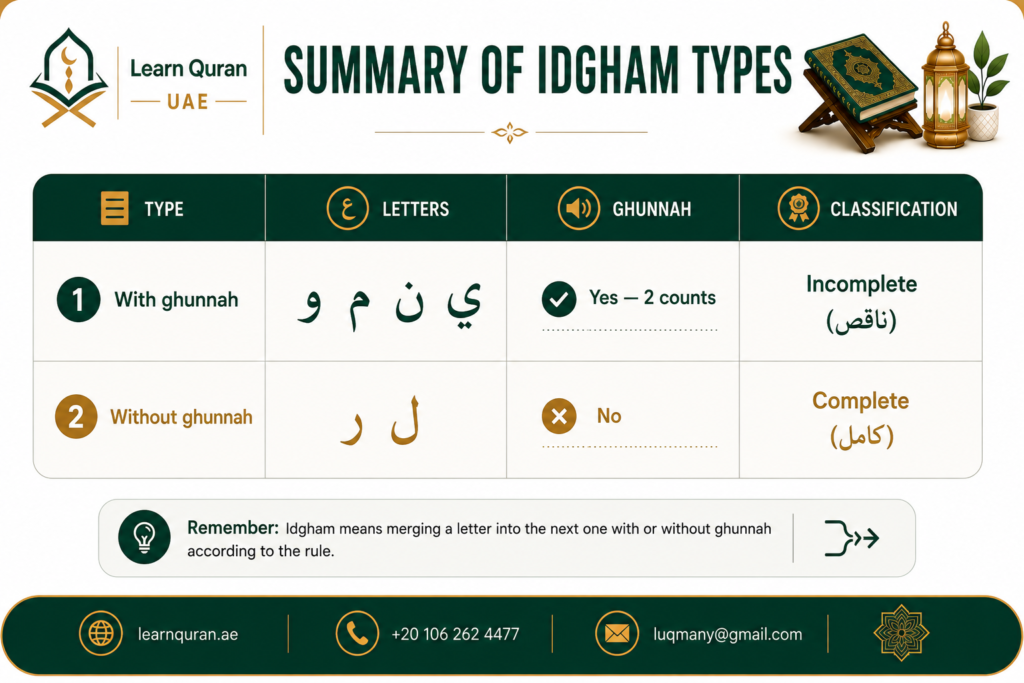
Idgham means merging the noon sakinah or tanween into the following letter so that the two become one stressed (shaddah) sound. Scholars describe it as “inserting the first letter into the second so that they become one doubled letter.” Among the rules of noon sakinah and tanween, Idgham is the most nuanced because it divides into two distinct types.
Important Condition for Idgham
Idgham of noon sakinah only occurs when the noon is at the end of one word and the Idgham letter begins the next word. If both letters appear within a single word, Idgham does not apply — instead the noon is pronounced clearly. The four words where this exception applies in the Quran are: دُنْيَا, صِنْوَان, قِنْوَان, and بُنْيَان.
The Six Idgham Letters: يرملون (Yarmaloon)
The six letters that trigger Idgham are collected in the mnemonic word يرملون: ي – ر – م – ل – و – ن
Type 1: Idgham with Ghunnah (بغنة)
Four of the six letters assimilate the noon with a nasal sound (ghunnah) held for the duration of two vowel counts. These four letters are grouped in ينمو or يومن: ي – ن – م – و
This type is called “incomplete Idgham” (ناقص) because the letter itself disappears but its characteristic — the ghunnah — remains audible.
| Letter | Noon Sakinah Example | Tanween Example |
| ي | (مَنْ يَقُولُ) | (وَبَرْقٌ يَجْعَلُونَ) |
| ن | (مِنْ نَذِيرٍ) | (يَوْمَئِذٍ نَّاعِمَةٌ) |
| م | (مِنْ مَسَدٍ) | (عَذَابٌ مُقِيمٌ) |
| و | (مِنْ وَلِيٍّ) | (يَوْمَئِذٍ وَاهِيَةٌ) |
Type 2: Idgham without Ghunnah (بغير غنة)
The remaining two letters — ل and ر — assimilate the noon completely, with no ghunnah remaining. This is called “complete Idgham” (كامل) because both the letter and its characteristic disappear entirely.
| Letter | Noon Sakinah Example | Tanween Example |
| ل | (وَلَكِنْ لَا يَعْلَمُونَ) | (هُدًى لِلْمُتَّقِينَ) |
| ر | (مِنْ رَّبِّهِمْ) | (غَفُورٌ رَّحِيمٌ) |
Rule 3: Iqlab (الإقلاب) — Conversion to Meem
Iqlab means converting the noon sakinah or tanween into a meem (م) when the letter Ba (ب) follows, then pronouncing that meem in a concealed, nasalized manner with both lips lightly pressed together. The word Iqlab itself means “to flip” or “to convert a thing from its original form.”
Why Only Ba?
The reason Ba triggers Iqlab rather than Izhar or Idgham is a matter of articulation. The noon and the Ba are neither close enough to merge (as in Idgham) nor far enough apart to pronounce clearly and separately (as in Izhar). Assimilating the noon into a meem — which shares the same labial articulation point as Ba — provides a smooth, natural transition between the two sounds while preserving the ghunnah.
Iqlab in Practice
The meem produced in Iqlab is not a full, open meem. It is an ikhfa meem — concealed, with ghunnah held for two vowel counts, the lips not fully pressed together but lightly closed. Listeners familiar with the Quran will hear a nasal hum at the Ba, which is the signature sound of this ruling.
| Context | Quranic Example | Recited As |
| Noon sakinah in one word | (أَنْبِئْهُمْ) | أَمْبِئْهُمْ (with ghunnah) |
| Noon sakinah across two words | (مَنْ بَخِلَ) | مَمْ بَخِلَ (with ghunnah) |
| Tanween across two words | (سَمِيعٌ بَصِيرٌ) | سَمِيعُمْ بَصِيرٌ (with ghunnah) |
Iqlab has only one letter — Ba — making it the simplest of the four rulings to identify, even if applying it correctly requires careful attention to the ghunnah and the concealment of the converted meem.
Many reciters who want to understand the rules of noon sakinah and tanween in practice find that Iqlab is the ruling they most often apply incorrectly — either by fully pronouncing the noon before the Ba or by omitting the ghunnah entirely. If you are unsure whether you are applying it correctly, live teacher correction is the only reliable way to confirm.
The Tajweed Course at UAE Quran Academy teaches Iqlab and all other Tajweed rulings through one-to-one sessions with certified teachers. Every student recites directly to their teacher and receives real-time correction — exactly what this ruling requires. Enroll today and recite the Quran the way it was meant to be recited.

Learn Tajweed correctly with personalized one-to-one instruction.
Rule 4: Ikhfa (الإخفاء) — Concealment with Nasal Sound
Ikhfa is the most commonly encountered ruling among the rules of noon sakinah and tanween, and it applies to the largest group of letters — fifteen in total. The word Ikhfa means concealment or concealing. In Tajweed terminology it refers to pronouncing the noon sakinah or tanween in a state between full Izhar and full Idgham: the noon is neither clearly pronounced nor fully merged, but held in a concealed, nasalized state for two vowel counts.
What Ikhfa Sounds Like
The tongue moves to the articulation position of the following letter without completing the full sound of the noon. A nasal hum (ghunnah) remains throughout. The degree of concealment varies slightly depending on which letter follows, but the governing principle is consistent: the noon disappears into the nasal passage while the following letter prepares to sound.
Experience a Live Quran Class
Watch a short sample from one of our online Quran classes and discover our engaging teaching style, interactive lessons, and personalized learning approach.
Start Learning Quran with Expert Tutors in the UAE
Accredited online Quran and Arabic classes tailored for adults and children. Schedule your session today.
Book Your Free TrialThe Fifteen Ikhfa Letters
The fifteen letters are those remaining after removing the Izhar letters (6), Idgham letters (6), and Iqlab letter (1) from the twenty-eight Arabic letters. Scholars of Tajweed collected them in the opening letters of this famous verse:
صِفْ ذَا ثَنَا كَمْ جَادَ شَخْصٌ قَدْ سَمَا دُمْ طَيِّبًا زِدْ فِي تُقًى ضَعْ ظَالِمَا
The fifteen letters are: ص – ذ – ث – ك – ج – ش – ق – س – د – ط – ز – ف – ت – ض – ظ
Ikhfa Examples with Noon Sakinah
| Letter | In One Word | Across Two Words |
| ص | (مَنْصُورًا) | (أَنْ صَدُّوكُمْ) |
| ذ | (مُنْذِرٌ) | (مِنْ ذَكَرٍ) |
| ث | (الأُنْثَى) | (مِنْ ثَمَرَةٍ) |
| ك | (يَنْكُثُونَ) | (مِنْ كُلٍّ) |
| ج | (أَنْجَيْنَاكُمْ) | (أَنْ جَاءَكُمْ) |
| ش | (الْمُنْشِئُونَ) | (لِمَنْ شَاءَ) |
| ق | (يَنْقُضُونَ) | (فَإِنْ قَاتَلُوكُمْ) |
| س | (الإِنْسَان) | (مِنْ سِدْرٍ) |
| د | (أَنْدَادًا) | (مِنْ دَابَّةٍ) |
| ط | (يَنْطِقُونَ) | (مِنْ طَيِّبَاتِ) |
| ز | (أَنْزَلْنَا) | (فَإِنْ زَلَلْتُمْ) |
| ف | (أَنْفُسَكُمْ) | (وَإِنْ فَاتَكُمْ) |
| ت | (كُنْتُمْ) | (لَنْ تَنَالُوا) |
| ض | (مَنْضُودٍ) | (مَنْ ضَلَّ) |
| ظ | (انْظُرُوا) | (مِنْ ظَهِيرٍ) |
Read also: Quran Memorization Planner & Tracker – The Complete System to Stay on Schedule
Degrees of Ikhfa
Not all fifteen Ikhfa letters produce the same degree of concealment. Scholars identify three levels:
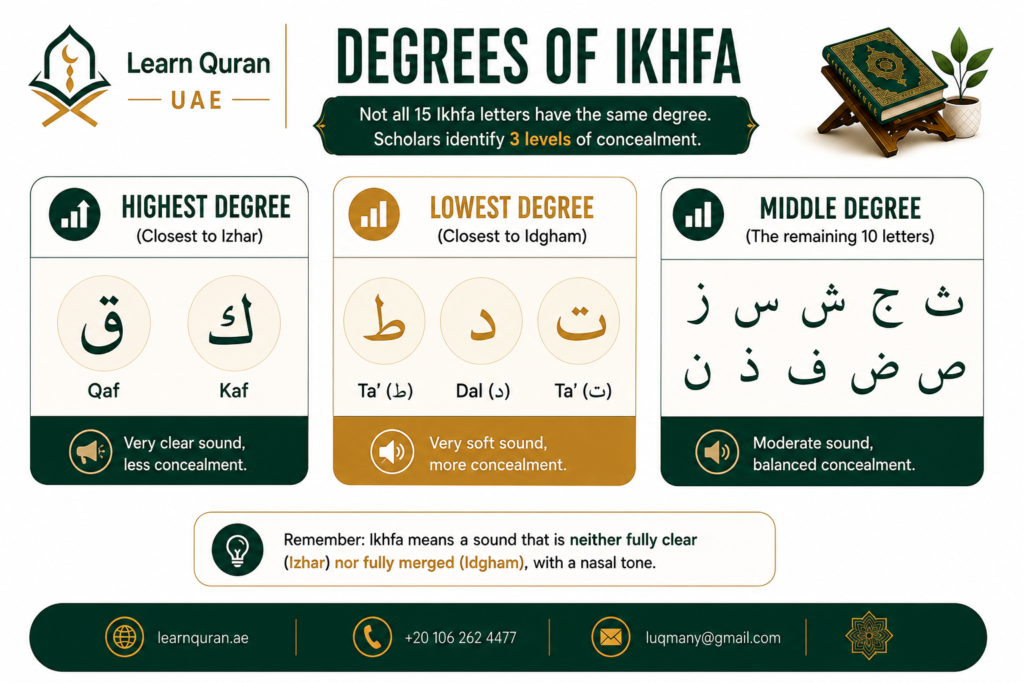
- Highest degree (closest to Izhar): Qaf (ق) and Kaf (ك).
- Lowest degree (closest to Idgham): Ta (ط), Dal (د), and Ta (ت).
- Middle degree: The remaining ten letters.
For most reciters, understanding the three degrees matters less immediately than simply applying the correct ruling for each letter. As recitation deepens and a teacher refines your recitation, the distinctions between degrees become more perceptible and more important.
The Complete Four-Rule Overview Table
| Rule | Arabic | Letters | Ghunnah | Key Sign |
| Izhar | الإظهار | ء ه ع ح غ خ (6 letters) | None | Noon sounds clear and distinct |
| Idgham with ghunnah | الإدغام بغنة | ي ن م و (4 letters) | Yes — 2 counts | Noon merges, nasal hum remains |
| Idgham without ghunnah | الإدغام بغير غنة | ل ر (2 letters) | None | Noon fully disappears |
| Iqlab | الإقلاب | ب (1 letter) | Yes — 2 counts | Noon converts to meem |
| Ikhfa | الإخفاء | 15 letters | Yes — 2 counts | Noon is concealed, nasal hum held |
The Quranic Command to Recite with Precision
Allah did not reveal the Quran to be read carelessly. The command to recite it with precision and measured delivery is explicit:
“وَرَتِّلِ الْقُرْآنَ تَرْتِيلًا”
Wa rattili l-Qur’āna tartīlā “And recite the Quran with measured recitation.”
The word tarteel in this verse refers to reciting with deliberateness, clarity, and correctness in pronunciation — which is precisely what the noon sakinah and tanween rules are designed to govern. Learning what is noon sakinah and applying its rulings correctly is not optional detail work; it is part of fulfilling the command of this verse every time the Mushaf is opened.
Common Mistakes Reciters Make with Noon Sakinah and Tanween
Understanding the rules of noon sakinah and tanween in theory and applying them correctly in live recitation are two different things. These are the most frequently encountered errors, drawn from the Tajweed sources in the attached references:
- Applying Idgham within a single word: The words دُنْيَا and صِنْوَان have noon sakinah followed by Idgham letters, but because both letters are in the same word, Izhar applies. Many reciters incorrectly merge the noon here.
- Dropping the ghunnah in Idgham with ghunnah: The nasal sound is not ornamental — it is part of the ruling. Omitting it turns the recitation into Idgham without ghunnah, which applies only to Lam and Ra.
- Applying Ikhfa without any nasal sound: Ikhfa is not silent Izhar. The ghunnah is obligatory for two vowel counts. Reciters who rush through it produce a sound that is neither correct Ikhfa nor correct Izhar.
- Fully pronouncing the noon before Ba: In Iqlab, the noon should convert to a meem-like sound before the Ba is sounded. Pronouncing a full, clear noon before the Ba is a violation of this ruling.
- Confusing the Ikhfa and Idgham letter sets: Several letters are adjacent in articulation to the Idgham letters, and without systematic study, reciters mix them up.
Every one of these mistakes is easy to embed in memory through repetition — and very difficult to correct once embedded. The only reliable solution is reciting to a qualified teacher who can identify the error the moment it occurs, before it becomes a habit.
The Tajweed for Beginners Course at UAE Quran Academy is built specifically for students who want to learn noon sakinah and tanween rules correctly from the first lesson, with live teacher feedback at every session. If you have been reciting without formal Tajweed study, this is the course that will bring your recitation into alignment with how the Quran is meant to be read. Enroll now and begin learning with a certified teacher today.
Begin your Tajweed journey with expert guidance today.
How Noon Sakinah and Tanween Rules Apply in Daily Salah?
Every Muslim recites Al-Fatiha in each rak’ah of prayer — and Al-Fatiha alone contains multiple applications of the noon sakinah and tanween rules. Consider these examples from just the opening Surah:
- (الرَّحِيمِ) followed by (مَالِكِ) — tanween meets Meem: Idgham with ghunnah.
- (أَنْعَمْتَ) — noon sakinah meets ‘Ain: Izhar.
- (غَيْرِ) at end of Al-Fatiha with tanween meeting the following Surah’s opening: applies based on what follows.

Beyond Al-Fatiha, every Surah recited in prayer will contain dozens of applications of these rules. A reciter who has not mastered the rules of noon sakinah and tanween is making Tajweed errors in every single prayer — silently, unknowingly, every day.
This is not a theoretical concern. It is a practical reality for millions of Muslims who learned to recite the Quran informally and were never taught these rulings in a structured way. The Prophet ﷺ was himself corrected by Jibreel in every recitation session — the tradition of correction by a qualified teacher is the original and correct method.
“إِنَّ اللَّهَ يَأْمُرُكُمْ أَنْ تُؤَدُّوا الْأَمَانَاتِ إِلَىٰ أَهْلِهَا”
Inna Allāha ya’murukum an tu’addū l-amānāti ilā ahlihā
“Indeed, Allah commands you to render trusts to whom they are due.”
The trust of Quranic recitation belongs to those who have learned it correctly and transmit it correctly to the next generation.
Read also: Tajweed Rules – The 11 Major Rules With Examples In Details
See How Our Online Classes Work
Get a glimpse of a real online session and explore how students learn Quran with experienced teachers in a supportive and interactive environment.
Learning Noon Sakinah and Tanween Rules by Age Group
The four rules of noon sakinah and tanween are taught at every level of Quranic study, but the approach must match the learner’s age and background:
For Children
Children learn these rules best through repetition, audio modeling, and short, focused examples. Introducing all four rules at once is counterproductive. The correct sequence is: Izhar first (easiest to hear and apply), then Idgham (most common in practice), then Iqlab (only one letter — easy to memorize), then Ikhfa (most letters but a consistent pattern).
The Tajweed for Kids Course at UAE Quran Academy sequences these rulings in exactly the right order for young learners, using age-appropriate examples and live teacher interaction to make each ruling stick before the next is introduced. Enroll your child today and give them the Tajweed foundation they will carry for life.

For Adults
Adults bring comprehension skills and stronger analytical ability to the study of Tajweed. The rules of noon sakinah and tanween make logical sense when explained systematically, and adult learners typically internalize the letter sets quickly. The challenge for adults is usually not memorizing the rules but overwriting incorrect habits already embedded in their recitation.
The Tajweed for Adults Course at UAE Quran Academy addresses this directly by combining rule explanation with active recitation correction in every session. If you have been reciting for years without formal Tajweed study, this course will identify exactly where your application of noon sakinah and tanween rules has drifted and correct it precisely. Book your free trial today.

For Ladies Seeking a Comfortable Learning Environment
Many sisters want to study Tajweed but feel more comfortable learning with a female teacher in a private, structured setting. Understanding what is noon sakinah and applying the rules correctly should not require compromising on that comfort.
The Tajweed for Ladies Course at UAE Quran Academy is delivered entirely by qualified female teachers in one-to-one online sessions. All four rules of noon sakinah and tanween are covered in a structured, supportive environment with direct feedback. Enroll today and recite the Quran the way it deserves to be recited.

Enroll in UAE Quran Academy’s Tajweed Programs Today
Our Tajweed Courses
- Tajweed Course
- Learn Quran Online with Tajweed
- Tajweed for Kids Course
- Tajweed for Adults Course
- Tajweed for Ladies / Sisters Course
- Tajweed for Beginners Course
- Advanced Tajweed Course
Enroll today and take the first step toward beautiful, accurate Quran recitation with expert guidance.
Start Learning Quran with Expert Tutors in the UAE
Accredited online Quran and Arabic classes tailored for adults and children. Schedule your session today.
Book Your Free TrialConclusion
The rules of noon sakinah and tanween are four: Izhar when followed by the six throat letters, Idgham when followed by the letters of يرملون (with or without ghunnah depending on the letter), Iqlab when followed exclusively by Ba, and Ikhfa when followed by any of the fifteen remaining letters. These four categories account for every possible letter that can follow a noon sakinah or tanween in the Quran — no letter is left without a ruling.
Understanding what is noon sakinah and how it differs from tanween is the necessary starting point. Memorizing the letter sets for each ruling is the next step. But applying the noon sakinah and tanween rules accurately in live, flowing recitation requires something that charts and tables cannot provide: a qualified teacher who listens, corrects, and confirms. At UAE Quran Academy, that teacher is available for every student, at every level, through live one-to-one online instruction.
Frequently Asked Questions
What is noon sakinah in Tajweed?
Noon sakinah is the Arabic letter Noon carrying no vowel sound. It appears in nouns, verbs, and particles, either within a word or at its end, and is both written in the Mushaf and pronounced at pauses. It shares four Tajweed rulings with tanween: Izhar, Idgham, Iqlab, and Ikhfa, determined by the letter that follows it.
What are the 4 rules of noon sakinah and tanween?
The four rules are Izhar (clear pronunciation before the six throat letters), Idgham (assimilation into the six letters of يرملون), Iqlab (conversion to meem before Ba), and Ikhfa (concealed nasalization before fifteen letters). Every letter in Arabic triggers exactly one of these four rulings when it follows a noon sakinah or tanween.
How is tanween different from noon sakinah?
Tanween is a silent noon added to the end of nouns only, written as doubled vowel markings and dropped at a pause. Noon sakinah is a permanent letter in the word’s structure, written as ن, and pronounced both when continuing and when pausing. Both carry the same four Tajweed rulings when a letter follows them.
How many letters trigger Ikhfa for noon sakinah and tanween?
Fifteen letters trigger Ikhfa, collected in the mnemonic line: صِفْ ذَا ثَنَا كَمْ جَادَ شَخْصٌ قَدْ سَمَا دُمْ طَيِّبًا زِدْ فِي تُقًى ضَعْ ظَالِمَا. These are all the Arabic letters not already assigned to Izhar, Idgham, or Iqlab.
Can I learn noon sakinah and tanween rules without a teacher?
You can study the theory independently, but correct application requires live feedback. Noon Sakinah and Tanween rules involve precise sounds—Ghunnah duration and concealment levels—that you cannot reliably self-assess. A teacher is essential to correct your mistakes.


Leave a Reply