 Tajweed
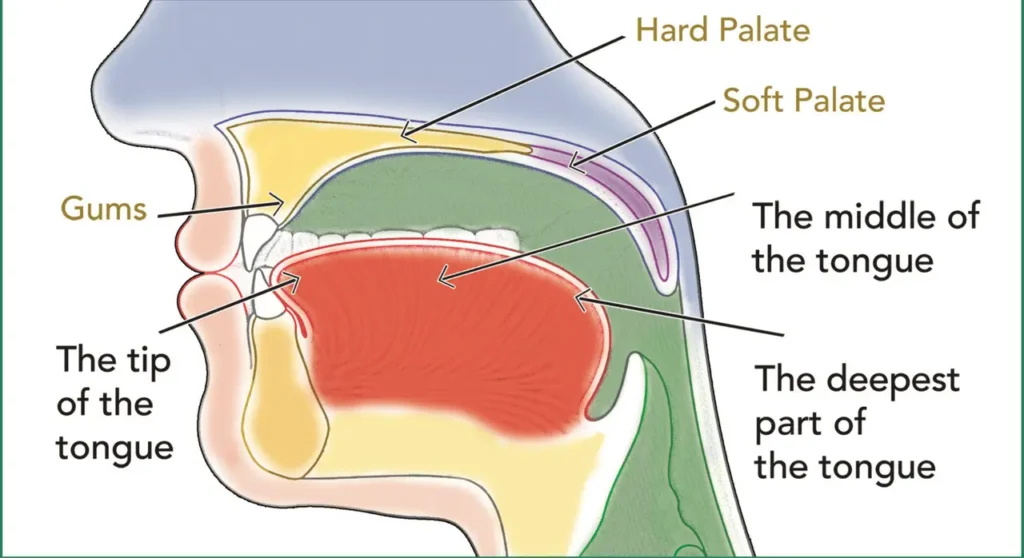
Every Muslim who recites the Quran has experienced this discomfort: you know the words, you have memorized the verses, but something about your recitation still sounds uncertain. You confuse ح with ه, or ض with ظ, and you cannot explain why. You have been told to “improve your Tajweed,” but nobody has shown you where the problem actually starts. The problem starts in your mouth, specifically in the exact location where each Arabic letter is produced.
Correct recitation of the Quran is not a talent some people are born with. It is a skill built on precise anatomical knowledge that scholars have preserved and transmitted for over fourteen centuries. That knowledge begins here.
What Is Makhraj in Tajweed and Why Does It Matter?
Makhraj in Tajweed is the specific location in the vocal tract where a letter’s sound terminates and becomes distinct from other letters. Scholars define it as the point at which the airflow is interrupted to produce a unique sound. It is the anatomical foundation on which all Tajweed rules are built.
The Arabic word makhraj (مَخْرَج) literally means “the place of exit.” In Tajweed terminology, scholars define it as the location where the sound of a letter ends and that letter becomes distinguishable from every other letter in the Arabic alphabet. Ibn al-Jazari, the foremost authority on Tajweed, identified 17 specific articulation points distributed across the vocal tract.
The Relationship Between Makhraj and Correct Quran Recitation
Allah commanded believers to recite the Quran with care and precision:
“وَرَتِّلِ ٱلْقُرْءَانَ تَرْتِيلًا”
Wa rattili l-qur’āna tartīlā
“And recite the Quran with measured recitation.”
Scholars of Tajweed consistently interpret tarteel as encompassing both correct makhraj and correct application of Tajweed rules. One cannot exist properly without the other.
The Complete 17 Makharij: A Reference Overview
The 17 specific articulation points across the five major regions, as established by Ibn al-Jazari and accepted by the majority of Tajweed scholars, are organized as follows:
| Region | Number of Makharij | Letters |
| Al-Jawf | 1 | ا و ي (Madd forms) |
| Al-Halq | 3 | ء هـ ع ح غ خ |
| Al-Lisan | 10 | ق ك ج ش ي ض ل ن ر ط د ت ص ز س ظ ذ ث |
| Al-Shafatan | 2 | ف ب م و (non-Madd) |
| Al-Khayshum | 1 | Ghunnah of م and ن |
| Total | 17 | 28 letters + Ghunnah |
This framework was summarized by Ibn al-Jazari in his famous Jazariyyah poem, a text that has been memorized and transmitted by Tajweed students for centuries:
“مَخَارِجُ الحُرُوفِ سَبْعَةَ عَشَرْ * عَلَى الَّذِي يَخْتَارُهُ مَنِ اخْتَبَرْ”
Makhāriju l-ḥurūfi sab’ata ‘ashar / ‘alā lladhī yakhtāruhu mani khtabar
“The articulation points of letters are seventeen, according to the view chosen by those who have verified it.”
[Al-Jazariyyah, Ibn al-Jazari]
Let’s discuss them in details
A. Al-Jawf Letters – The Letters That Come From Open Air
Al-Jawf (الجوف) means “the cavity” or “the hollow interior.” It describes the open space that runs from behind the throat through the mouth. Unlike all other makharij, Al-Jawf does not have a fixed physical point where the sound stops. The three letters that emerge from Al-Jawf are the Madd letters: the long Alif preceded by a fatha, the long Waw preceded by a damma, and the long Ya preceded by a kasra.
These three letters are also called Al-Huroof Al-Hawaa’iyyah (the air letters) because their sound flows freely through the open vocal tract and terminates only when the breath itself ends.
The Three Letters of Al-Jawf and Their Conditions
| Letter | Arabic | Condition for Jawf Makhraj | Example |
| Alif | ا | Preceded by a fatha (ـَا) | قَالَ (Qala) |
| Waw | و | Preceded by a damma (ـُو) | يَقُولُ (Yaqoolu) |
| Ya | ي | Preceded by a kasra (ـِي) | قِيلَ (Qeela) |
These three letters appear together in the word نُوحِيهَا in the verse:
“تِلْكَ مِنْ أَنۢبَآءِ ٱلْغَيْبِ نُوحِيهَآ إِلَيْكَ”
Tilka min anbā’i l-ghaybi nūḥīhā ilayk
“These are some of the news of the unseen which We reveal to you.”
Why Al-Jawf Letters Are Called “Estimated” in Makhraj
The makhraj of Al-Jawf letters is described by scholars as taqdeeri, meaning estimated or conceptual rather than physically fixed. When you say قَالَ, you cannot point to a specific location in your mouth or throat where the Alif sound cuts off. It extends until the breath stops. This is why Al-Jawf has only one makhraj containing three letters, and why these letters behave uniquely in Madd rules throughout Tajweed.
Common Errors Beginners Make With Al-Jawf Letters
Students who have not studied makharij al-huroof formally often shorten these vowel letters, treating them like ordinary short vowels. The Alif in قَالَ gets clipped to a short fatha sound. The Waw in يَقُولُ loses its extension. This shortening is a Lahn Khafi (subtle error) at minimum, and it disrupts the natural rhythm of Quranic recitation that Allah described as tarteel.
B. Al-Halq Letters: The Six Throat Letters and Their Three Positions
Al-Halq (الحلق) means the throat. Scholars divide the throat into three sections moving from deepest (closest to the chest) to shallowest (closest to the mouth). Each section produces two letters, giving six throat letters total across three makhraj positions.
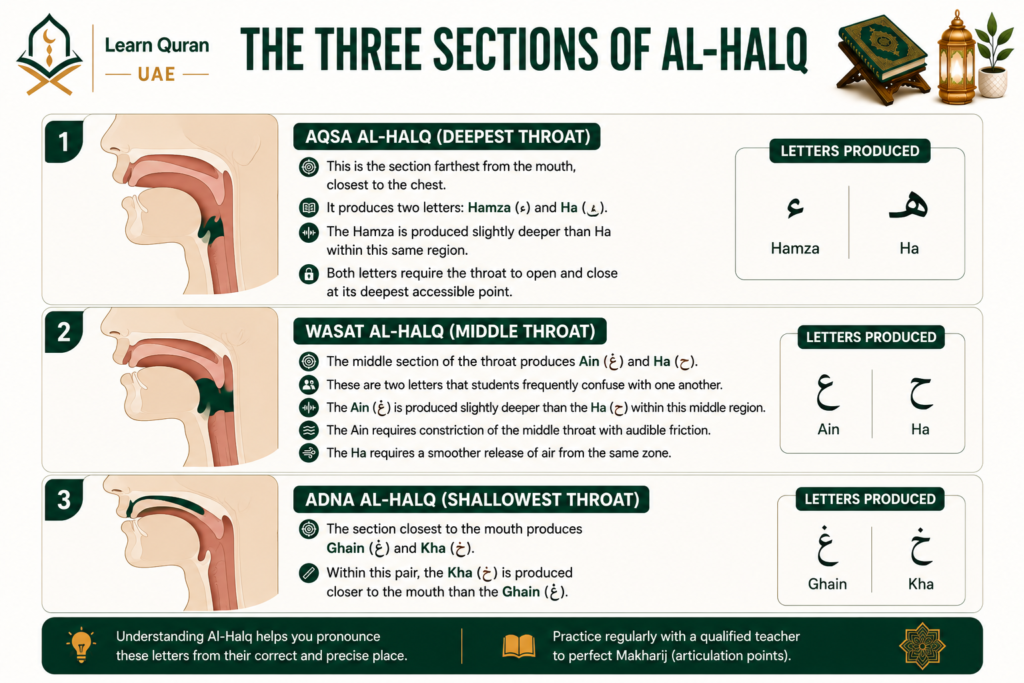
The Three Sections of Al-Halq
Aqsa Al-Halq (Deepest Throat)
This is the section farthest from the mouth, closest to the chest. It produces two letters: Hamza (ء) and Ha (هـ). The Hamza is produced slightly deeper than Ha within this same region. Both letters require the throat to open and close at its deepest accessible point.
Wasat Al-Halq (Middle Throat)
The middle section of the throat produces Ain (ع) and Ha (ح). These are two letters that students frequently confuse with one another. The Ain (ع) is produced slightly deeper than the Ha (ح) within this middle region. The Ain requires constriction of the middle throat with audible friction. The Ha requires a smoother release of air from the same zone.
Adna Al-Halq (Shallowest Throat)
The section closest to the mouth produces Ghain (غ) and Kha (خ). Within this pair, the Kha (خ) is produced closer to the mouth than the Ghain (غ).
The Most Common Throat Letter Errors
Non-native speakers and learners who have not studied makharij al-huroof formally collapse the throat letters into one another.
ح (Ha) gets produced like هـ (Ha), losing the friction that distinguishes them.
ع (Ain) gets softened into a vowel sound entirely.
غ (Ghain) becomes confused with خ (Kha). These are not cosmetic errors. Each of these pairs produces different Arabic words, meaning incorrect makhraj changes what is actually being recited.
If you recognize these errors in your own recitation, a structured course is the fastest path to correction. The Tajweed Course at UAE Quran Academy gives you one-to-one sessions with a qualified teacher who identifies and corrects throat letter errors in real time, something no self-study material can replicate.

Enroll in the Tajweed Course at UAE Quran Academy.
C. Al-Lisan Letters: The Ten Tongue Positions and Eighteen Letters
The tongue (اللسان) is the most active and versatile articulation organ in Arabic phonology. Ibn al-Jazari assigned it ten makhraj positions producing eighteen letters, more than any other region. Understanding these positions requires awareness of the tongue’s geography: its tip (tarf), its sides (hafataan), its middle (wasat), and its back (aqsa).
The Ten Tongue Positions
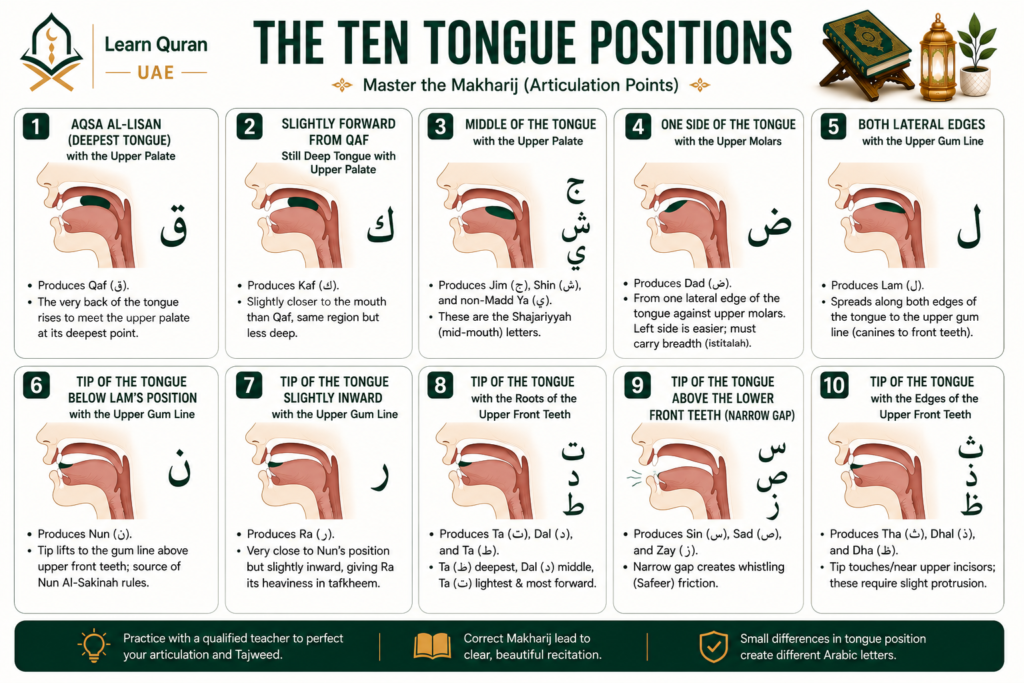
1- Aqsa Al-Lisan (Deepest Tongue) with the Upper Palate
This produces Qaf (ق). The very back of the tongue rises to meet the upper palate at its deepest accessible point.
2- Slightly Forward from Qaf, Still Deep Tongue with Upper Palate
This produces Kaf (ك). The Kaf position is slightly closer to the mouth than Qaf, using the same region but marginally less deep.
3- Middle of the Tongue with the Upper Palate
This produces three letters: Jim (ج), Shin (ش), and non-Madd Ya (ي). Jim requires the middle tongue to press fully against the upper palate. Shin and Ya use the same region with a gap that allows air to pass through. These three are called the Shajariyyah letters (letters of the tree or mid-mouth).
4- One Side of the Tongue with the Upper Molars
This produces Dad (ض), the letter famously described as the most difficult in Arabic to articulate correctly. It emerges from one lateral edge of the tongue pressed against the upper molars. The left side is more commonly used and considered easier, though the right side is also valid. Dad must carry breadth (istitalah) as it is produced, spreading along the tongue’s edge.
Read also: Ikhfa Rules in Tajweed – Meaning, Types, and Ikhfaa Examples
Experience a Live Quran Class
Watch a short sample from one of our online Quran classes and discover our engaging teaching style, interactive lessons, and personalized learning approach.
Start Learning Quran with Expert Tutors in the UAE
Accredited online Quran and Arabic classes tailored for adults and children. Schedule your session today.
Book Your Free Trial5- Both Lateral Edges of the Tongue with the Upper Gum Line
This produces Lam (ل). Unlike Dad which uses one side, Lam spreads along the front portion of the tongue’s edge toward the gum line of the upper teeth, from the canines through the front teeth area.
6- The Tip of the Tongue Below Lam’s Position, with the Upper Gum Line
This produces Nun (ن). The tip of the tongue lifts toward the gum line above the upper front teeth. When Nun is in a sukoon state (Nun Al-Sakinah), this is where it originates before Tajweed rules such as Idgham, Ikhfa, or Iqlab modify its behavior.
7- The Tip of the Tongue Slightly Inward, with the Upper Gum Line
This produces Ra (ر). Ra’s position is very close to Nun’s but is slightly more inward toward the back of the tongue. This slight depth gives Ra its characteristic heaviness in tafkheem positions.
8- The Tip of the Tongue with the Roots of the Upper Front Teeth
This produces three letters collectively called the Nit’iyyah (palatal) letters: Ta (ت), Dal (د), and Ta (ط). Among these, Ta (ط) is produced slightly deeper, Dal (د) in the middle, and Ta (ت) is the lightest and most forward.
9- The Tip of the Tongue Above the Lower Front Teeth with a Narrow Gap
This produces the Safeer (whistling) letters: Sin (س), Sad (ص), and Zay (ز). A controlled narrow space between the tongue tip and the lower front teeth allows a stream of air to produce the whistling friction distinctive to these letters.
10- The Tip of the Tongue with the Edges of the Upper Front Teeth
This produces the Lathawiyyah (gum) letters: Tha (ث), Dhal (ذ), and Dha (ظ). The tongue tip lightly touches or nearly touches the edges of the upper incisors. These are the three letters that require slight protrusion of the tongue tip.
The tongue’s complexity is precisely why articulation errors are so common and so persistent. A student may practice Tajweed rules for years but still produce ض like ظ if their makhraj was never corrected.
Students who want structured, expert-guided work on tongue positions will benefit from the Advanced Tajweed Course at UAE Quran Academy, which addresses the fine distinctions within Al-Lisan that foundational courses leave underdeveloped.

Join the Advanced Tajweed Course today.
D. Al-Shafatan Letters – The Two Lip Positions and Four Letters
The lips (الشفتان) form the final articulation region before sound exits the mouth entirely. Scholars identify two positions within this region.
The Two Lip Positions
Batn Al-Shafah Al-Sufla (Inner Lower Lip) with the Upper Incisors
This position produces Fa (ف). The soft inner surface of the lower lip makes light contact with the edges of the upper front teeth. This contact produces the friction-based sound of Fa. Crucially, it is the inner surface of the lower lip, not the outer surface, that contacts the teeth.
Between Both Lips Together
This single position produces three letters, differentiated by whether the lips press together fully or open slightly.
- Ba (ب): Both lips press together with firm closure, then release.
- Meem (م): Both lips press together with firm closure, but the sound carries nasal resonance through the Khayshum simultaneously.
- Non-Madd Waw (و): Both lips come together but do not close. They round and open slightly, allowing air to pass through the opening. This is the Waw in a moving or Leen (soft) state, not the extended Madd Waw which comes from Al-Jawf.
Distinguishing Ba, Meem, and Waw
| Letter | Lip Position | Closure | Additional Feature |
| ب | Both lips | Full closure, firm release | None |
| م | Both lips | Full closure | Ghunnah from Khayshum |
| و (non-Madd) | Both lips | Rounded opening, no closure | Air passes through |
The lip letters are generally easier for students to produce correctly than throat or tongue letters because the lips are visible and their movement is observable. However, the Fa is frequently produced too aggressively by learners whose native languages use a stronger dental-labial friction, creating a sound heavier than the Tajweed standard.
E. Al-Khayshum Letters – The Nasal Passage and the Ghunnah
Al-Khayshum (الخيشوم) refers to the inner nasal passage. It holds a unique position among the five major articulation regions because it does not produce an independent letter. Instead, it is the origin of Ghunnah (الغنة), the resonant nasal quality that accompanies Meem and Nun in particular Tajweed situations.
What Is Ghunnah and When Does It Appear
Ghunnah is an inherent nasal sound embedded in Meem (م) and Nun (ن). It is not optional or decorative. It is a foundational characteristic of these two letters. Scholars describe five levels of Ghunnah intensity, ranked from strongest to weakest:
- Level 1 (Strongest): Meem or Nun with Shaddah (doubling) such as إنَّ and أمَّا.
- Level 2: Nun Sakinah or Tanween in Idgham with Ghunnah situations (يومن letters: ي و م ن).
- Level 3: Nun Sakinah or Meem Sakinah in Ikhfa situations.
- Level 4: Meem Sakinah and Nun Sakinah in clear pronunciation (Idhar) situations.
- Level 5 (Weakest): Meem or Nun in a moving (mutaharrik) state.
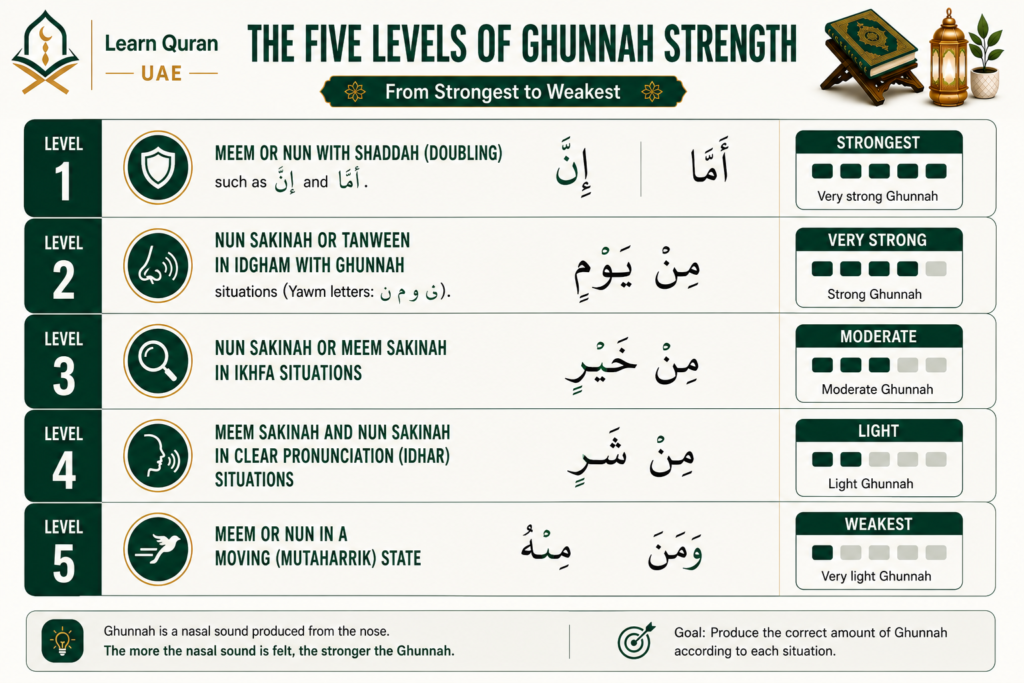
The Ghunnah in levels 1 through 3 must be held for a duration of two counts (harakatayn). This is a Tajweed obligation, not a preference.
Why Al-Khayshum Is Listed Among the Five Major Makharij
Ghunnah is unique among all letter characteristics in having its own dedicated makhraj independent from the letter it accompanies. All other letter attributes (Qalqalah, Tafkheem, Tarqeeq, etc.) are produced from the same makhraj as the letter itself. Ghunnah alone exits from the Khayshum regardless of whether Meem is being produced from the lips or Nun from the tongue tip.
If you have been told your Ghunnah is weak or absent, that is a makhraj problem specifically located in how effectively you are directing resonance through the nasal passage during Meem and Nun recitation. A teacher who can hear and correct this in real time is essential.
The Tajweed for Beginners Course at UAE Quran Academy covers Ghunnah in depth as part of its structured Tajweed curriculum, taught by qualified instructors who correct nasal resonance errors from the first session.
Start the Tajweed for Beginners Course at UAE Quran Academy.
How to Practice Makharij Al-Huroof Correctly?
Knowing the 17 articulation points intellectually is the first step. Producing them correctly and consistently is the result of deliberate, guided practice.
The Classical Method for Identifying Your Own Makhraj Errors
The scholars’ method for identifying a letter’s makhraj is also the method for training it. Take the letter you want to practice. Precede it with a sukoon-held version (no vowel). Sustain the sound. Pay attention to where the vibration or pressure terminates in your vocal tract. That endpoint is the makhraj. If it does not match the correct position, you have identified the error.
For throat letters, place your hand lightly on your throat during practice. You can often feel whether the constriction is happening at the right depth. For tongue letters, use a mirror to observe whether the tongue tip is reaching the correct position relative to your teeth and gum line.
Using Repetition to Build Makhraj Muscle Memory
- Isolate the target letter with no vowel first.
- Add a short vowel (fatha, kasra, or damma) and practice the letter in an open syllable.
- Practice the letter in Quranic words where it appears in different positions (beginning, middle, end of a word).
- Practice pairs of letters that share a nearby makhraj (ح and ه, ض and ظ, ت and ط) to train the ear to distinguish them.
Why a Qualified Teacher Is Irreplaceable in Makhraj Training
The Prophet (peace be upon him) established the Sunnah of oral transmission for Quranic recitation:
“خَيْرُكُمْ مَنْ تَعَلَّمَ الْقُرْآنَ وَعَلَّمَهُ”
“Khayrukum man ta’allama al-qur’āna wa ‘allamah”
“The best of you are those who learn the Quran and teach it.”
This hadith reflects that Quranic recitation has always been transmitted through a living chain of teachers and students. The reason is not tradition alone. It is because articulation errors cannot be reliably self-diagnosed. You cannot hear yourself the way others hear you. A qualified teacher identifies exactly which makhraj is producing incorrectly and demonstrates the correction in real time, which no audio recording or written guide can replicate.
Read also: Iqlab in Tajweed – The Complete Guide With Examples
Makharij Al-Huroof for Children: Building the Foundation Early
Children acquire pronunciation patterns through repetition and imitation from their earliest years. A child who hears and practices correct Quranic articulation from age five or six absorbs those patterns into their natural speech. A teenager or adult who has been mispronouncing Arabic letters for ten years faces a much more difficult correction journey because those patterns are deeply embedded in muscle memory.
What Young Students Should Learn First
Young learners approaching makharij should begin in this sequence. They start with Al-Shafatan (lip letters) because these are visible and the child can observe the correct position. They then move to Al-Halq (throat letters) with a teacher demonstrating and correcting. Al-Lisan (tongue positions) come next, progressing from the larger, easier distinctions toward the finer ones like Dad and Dha. Ghunnah awareness follows naturally as the child learns Meem and Nun.
The Role of Structured Programs in Children’s Makhraj Development
Children need engagement, structure, and a teacher who knows how to communicate these concepts at an age-appropriate level. Abstract explanations of tongue positions mean nothing to a seven-year-old. Demonstration, imitation, and immediate feedback are what work.
The Tajweed for Kids Course at UAE Quran Academy is built specifically around how children learn articulation, using qualified teachers experienced in child-appropriate instruction who correct makhraj errors before they become permanent habits. Every session includes live demonstration and direct feedback.

Enroll your child in the Tajweed for Kids Course at UAE Quran Academy.
See How Our Online Classes Work
Get a glimpse of a real online session and explore how students learn Quran with experienced teachers in a supportive and interactive environment.
Start Learning Makharij Al-Huroof With UAE Quran Academy
Most students who struggle with Quranic recitation are not lacking effort. They are reciting consistently but from incorrect articulation points they were never shown how to correct. The gap between reading the Quran and reciting it the way Allah commanded it to be recited is almost always a makhraj problem.
UAE Quran Academy offers a full range of Tajweed programs delivered online, one-to-one with qualified teachers, designed for every type of learner.
The Tajweed Course provides a complete curriculum covering all 17 makharij al-huroof alongside the full set of Tajweed rules, with personalized correction at every session. For students who want to begin from the foundational level, the Tajweed for Beginners Course starts from the very first articulation point and builds systematically upward.
Learners who already have some Tajweed knowledge and want to address the finer distinctions will find the Advanced Tajweed Course designed for exactly that purpose. Children benefit from the Tajweed for Kids Course, taught by teachers experienced in making makhraj training engaging and effective for young minds.
Every program at UAE Quran Academy includes:
- One-to-one online sessions with a qualified, certified teacher
- Real-time makhraj and Tajweed correction from the first lesson
- Structured progression through all articulation points and recitation rules
- Flexible scheduling designed to fit around work, school, and family commitments
- Female teachers available for sisters who prefer that environment
Correct recitation of the Quran begins with knowing where each letter comes from. That knowledge deserves to be taught properly, with a qualified teacher who has transmitted it through the same unbroken chain that preserves the Quran itself.
Begin your free trial session at UAE Quran Academy today.
Our Tajweed Courses
- Tajweed Course
- Learn Quran Online with Tajweed
- Tajweed for Kids Course
- Tajweed for Adults Course
- Tajweed for Ladies / Sisters Course
- Tajweed for Beginners Course
- Advanced Tajweed Course
Enroll today and take the first step toward beautiful, accurate Quran recitation with expert guidance.
Start Learning Quran with Expert Tutors in the UAE
Accredited online Quran and Arabic classes tailored for adults and children. Schedule your session today.
Book Your Free TrialConclusion
Makharij al-huroof is the anatomical foundation of Quranic recitation. The 17 articulation points distributed across Al-Jawf, Al-Halq, Al-Lisan, Al-Shafatan, and Al-Khayshum determine where each Arabic letter originates in the vocal tract. Understanding what makhraj in Tajweed means, and understanding the difference between makhraj and Tajweed more broadly, reveals that recitation accuracy is not a matter of effort alone. It is a matter of knowing exactly where each sound is supposed to come from and training the muscles of the vocal tract to produce it consistently.
This knowledge was preserved across fourteen centuries through an unbroken chain of teachers and students. It is available to every Muslim who seeks it today, online, one-to-one, with qualified teachers who carry that same chain. UAE Quran Academy provides exactly that access, through structured programs built around every type of learner and every stage of the recitation journey.
Frequently Asked Questions
What is makhraj in Tajweed?
Makhraj in Tajweed is the specific point in the vocal tract where a letter’s sound terminates and the letter becomes distinct from all other Arabic letters. Scholars define it as the location of physical sound interruption that gives each letter its unique identity. There are 17 makhraj points in total, grouped under five major regions.
How many makharij al-huroof are there?
According to the majority of Tajweed scholars, including Ibn al-Jazari whose classification is the accepted standard, there are 17 specific makharij (articulation points) grouped under 5 major regions: Al-Jawf (1), Al-Halq (3), Al-Lisan (10), Al-Shafatan (2), and Al-Khayshum (1).
What is the difference between makhraj and Tajweed?
Makhraj refers to the point of origin of a letter, where it is physically produced in the vocal tract. Tajweed is the broader system of rules governing how that letter behaves in the context of Quranic recitation, including elongation, merging, nasalization, and stopping. Makhraj answers where a letter comes from. Tajweed answers how it is recited.
Which makhraj is the most difficult to learn?
Al-Lisan (the tongue) is the most complex makhraj region because it contains ten distinct positions producing eighteen letters. The most challenging individual letters for non-native Arabic speakers are typically Dad (ض), Ain (ع), and Ha (ح) because their articulation points have no equivalent in most other languages.
Can I learn makharij al-huroof without a teacher?
You can study the theory independently, but correct sound production requires a qualified teacher. You cannot objectively self-audit your own articulation errors. A teacher identifies incorrect placement in real time, preserving the authentic oral transmission of the Quran.

Leave a Reply