 Tajweed
Next time you hear a reciter finish Surah Al-Falaq, listen to the last word. The qaf doesn’t just stop. It gives a tiny kick, like a small knock on a door. That kick is called qalqalah.
If you’re looking for qalqalah: the letters, types & examples, you’re in the right place. We’ll go through the five letters, the two main types, and real verses you can open and check yourself. We’ll also cover the slips almost every learner makes at the start.
Qalqalah is one of the first Tajweed rules most students learn, and it’s easy to see why. Once your ear picks it up, you’ll notice it on nearly every page of the Quran.
What you’ll learn in this article
- What qalqalah means and why it happens.
- The five qalqalah letters and an easy way to remember them.
- When a letter gets qalqalah, including letters with shaddah.
- The two types of qalqalah, with verses you can look up.
- How to make the sound and which mistakes to avoid.
What Is Qalqalah?
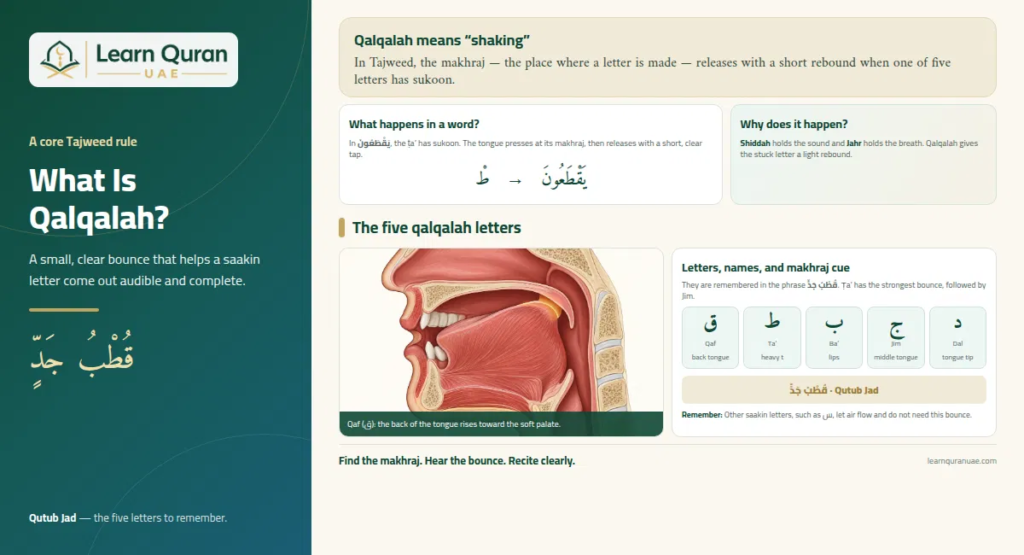
Qalqalah is a small bounce in the sound of a letter. It happens when one of five letters has a sukoon, which means no vowel comes after it.
The word is Arabic and means “shaking.” In Tajweed, the shaking happens in one spot: the place where the letter is made in the mouth or throat. This spot is called the makhraj.
Take the word يَقْطَعُونَ (yaqṭa’ūn). The ṭa’ has a sukoon. When you read it, your tongue presses up, then lets go with a short, clear tap. You can hear the ṭa’ even though no vowel follows it.
Scholars describe it the same way. The Arabic Wikipedia entry on qalqalah calls it a shaking of the makhraj when the letter has sukoon, strong enough to be heard. SurahQuran’s Tajweed page adds that the sukoon can belong to the letter or come from stopping on it.
Why Does Qalqalah Happen?
Qalqalah happens because the five letters are both strong and voiced. In Tajweed terms, they have shiddah and jahr.
Shiddah means the sound is held back. Jahr means the breath is held back. Put the two together and a letter with sukoon gets stuck. No sound flows out, and no air flows out.
Left like that, the letter would sound cut off or unclear. A listener might miss it. Qalqalah solves this. Your tongue or lips let go with a light rebound, and the full letter comes out.
Other letters don’t have this problem. A saakin س (seen) lets air pass, so you hear it without any bounce.
To feel where the bounce starts, you need to know where each letter is made. Our guide to Makharij al-Huroof shows the exact spot for every Arabic letter.
The 5 Qalqalah Letters
There are five letters of qalqalah: ق, ط, ب, ج, and د. Scholars put them into a short phrase so they are easy to remember: قُطْبُ جَدٍّ, read Qutbu Jad and often written Qutub Jad.
| Arabic letter | Name | How it sounds | Where it sits in “Qutub Jad” |
| ق | Qaf | A deep “q” from the back of the tongue | Qutub |
| ط | Ta’ | A heavy “t” | Qutub |
| ب | Ba’ | “b” | Qutub |
| ج | Jim | “j” | Jad |
| د | Dal | “d” | Jad |
The five are not equal in strength. Ṭa’ has the strongest bounce, then jim, then the other three, as Mawdoo3’s article on qalqalah explains.
When Does A Letter Get Qalqalah?
A qalqalah letter only bounces when it has no vowel. There are three ways this happens. Two are easy to spot on the page. The third, shaddah, trips up a lot of learners.
Sukoon You Can See, And Sukoon From Stopping
The first case is a written sukoon. You see the small circle (ْ) on the letter, as in يَقْطَعُونَ. This letter always bounces. It makes no difference if you stop or keep reading.
For example, in قَدْ أَفْلَحَ (qad aflaḥa), Al-Mu’minun 23:1, the dal has a sukoon. You read straight through, and the dal still gets its bounce.
The second case comes from stopping. When you stop on a word, its last vowel or tanween drops, and the letter becomes saakin. So أَحَدٌ (aḥadun) turns into أَحَدْ (aḥad), and ٱلْفَلَقِ (al-falaqi) turns into ٱلْفَلَقْ (al-falaq).
This only happens when you actually stop. If you join the word to the next one, the vowel stays and there is no qalqalah.
Shaddah: The Hidden Sukoon
A shaddah looks like one letter, but it stands for two. The first one is saakin and the second one has a vowel. So وَتَبَّ (wa tabba) is really read ta-b-ba.
When you stop on a shaddah qalqalah letter, both halves become saakin. That gives the strongest bounce you will hear in the Quran.
When you keep reading, things change. The saakin half blends into the second half, so there is no separate bounce. Classical scholars state this as a rule: a letter that merges into the next one gets no qalqalah.
The same thing happens between two words. In قَدْ تَبَيَّنَ (qad tabayyana), the dal blends into the ta’. The dal has a written sukoon, yet you read it with no bounce at all.
What happens in a UAE Quran Academy class?
This short sample shows you a real lesson in action, with clear explanations, live practice, and gentle correction from the teacher.
Start Learning Quran with Expert Tutors in the UAE
Accredited online Quran and Arabic classes tailored for adults and children. Schedule your session today.
Book Your Free TrialThe 2 Types Of Qalqalah
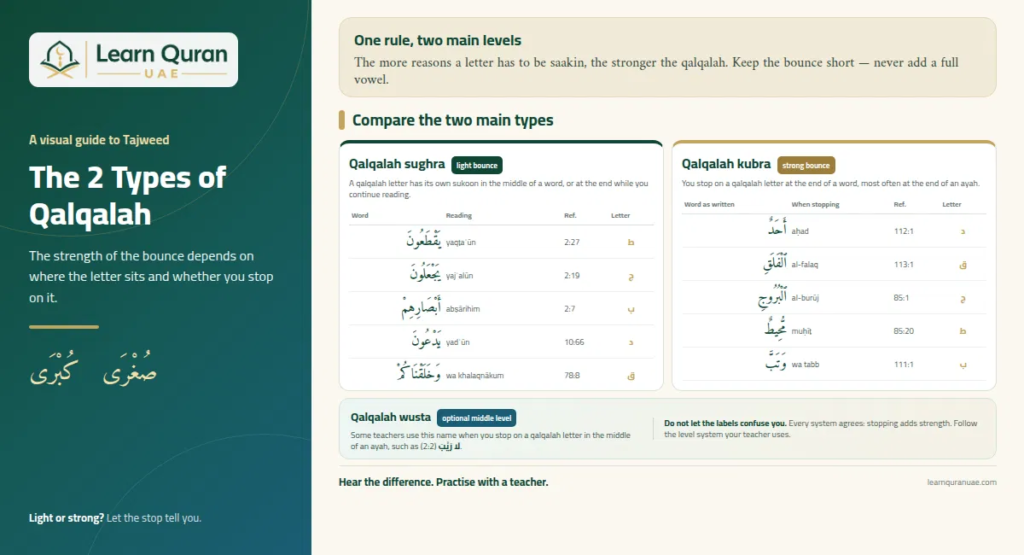
Most teachers split qalqalah into two types: light and strong. Which one you use depends on two things: where the letter sits, and whether you stop on it.
Qalqalah Sughra: The Light Bounce
Qalqalah sughra is the light bounce. You hear it when a qalqalah letter has its own sukoon in the middle of a word, or at the end of a word while you keep reading.
Keep the tap short and quick. It should be heard, but it shouldn’t jump out. Here are five examples, one for each letter:
| Word | How to say it | Where to find it | Letter |
| يَقْطَعُونَ | yaqṭa’ūn | Al-Baqarah 2:27 | ط |
| يَجْعَلُونَ | yaj’alūn | Al-Baqarah 2:19 | ج |
| أَبْصَارِهِمْ | abṣārihim | Al-Baqarah 2:7 | ب |
| يَدْعُونَ | yad’ūn | Yunus 10:66 | د |
| وَخَلَقْنَاكُمْ | wa khalaqnākum | An-Naba’ 78:8 | ق |
Qalqalah Kubra: The Strong Bounce
Qalqalah kubra is the strong bounce. You hear it when you stop on a qalqalah letter at the end of a word, and most of the time that’s the end of an ayah.
It’s stronger because two things push at once: the letter’s own bounce and the sukoon you add by stopping. Give it more weight than sughra, but don’t drag it out.
| Word as written | How to say it when stopping | Where to find it | Letter |
| أَحَدٌ | aḥad | Al-Ikhlas 112:1 | د |
| ٱلْفَلَقِ | al-falaq | Al-Falaq 113:1 | ق |
| ٱلْبُرُوجِ | al-burūj | Al-Buruj 85:1 | ج |
| مُّحِيطٌ | muḥīṭ | Al-Buruj 85:20 | ط |
| وَتَبَّ | wa tabb | Al-Masad 111:1 | ب (with shaddah) |
Telling a light bounce from a strong one is tricky when you’re reading alone. In the Quran Reading Course at UAE Quran Academy, a teacher reads along with you, points out each qalqalah letter as it comes up, and helps you get the bounce right before you move on.
Why Do Some Books List 3 Types Of Qalqalah?
Some books list three types because they split one of the two main types into smaller steps. The sound doesn’t change. Only the names do.
One group of teachers adds a middle step called wusta. They use it when you stop on a qalqalah letter in the middle of an ayah. A good example is لَا رَيْبَ (lā rayb) in Al-Baqarah 2:2, where the Mushaf lets you stop before the ayah ends.
Another group, including Sheikh Ayman Suwaid, adds a top step called akbar. They save it for stopping on a qalqalah letter with shaddah, like وَتَبَّ. In the two-type system, this is simply the strongest form of kubra.
So which one is right? All of them agree on the same idea: the more reasons a letter has to be saakin, the stronger the bounce. Learn the two main types first, then follow whatever names your teacher uses.
Read also: Idgham in Tajweed: Types, Letters & Examples
How To Make The Qalqalah Sound
Knowing the rule is half the job. The other half is getting the sound right, and that comes with practice. Follow these steps in order.
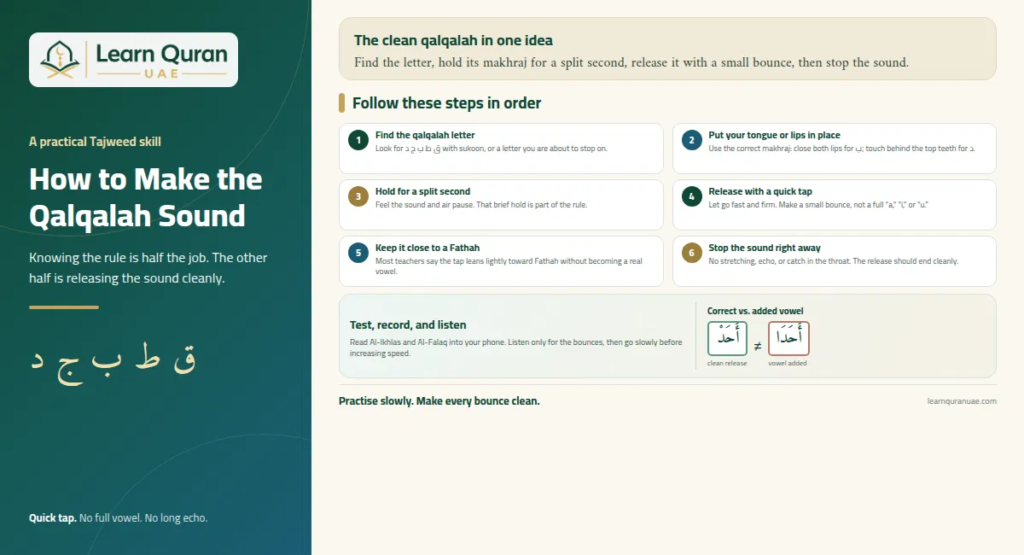
- Find the qalqalah letter. Look for one of the five letters of Qutub Jad (ق ط ب ج د) with a sukoon, or one you are about to stop on.
- Put your tongue or lips in place. Press the spot where the letter is made, its makhraj, just as you would for the normal letter. For ب, close your lips. For د, touch the tip of your tongue behind your top teeth.
- Hold for a split second. You’ll feel the sound and air get stuck. That’s normal. It’s the reason qalqalah exists.
- Let go with a quick tap. Release the spot fast and firm, so a small bounce comes out. Don’t open your mouth into a full vowel.
- Keep the bounce close to a fatha. Most teachers say the tap leans slightly toward a fatha sound every time, without becoming a real fatha. A second view says it copies the vowel before it, like a light kasra in اقْرَأْ (iqra’) or a light damma in تُبْلَى (tublā). Many scholars see that view as the weaker one, so follow your teacher.
- Stop the sound right away. The tap should end cleanly. No stretching, no echo, and no catch in the throat.
- Test yourself. Say أَحَدْ (aḥad) and stop. Then say أَحَدَا (aḥadā). The first should end in a crisp release of the dal. The second adds a vowel, and that’s the mistake to avoid.
- Record and listen. Read Surah Al-Ikhlas and Surah Al-Falaq into your phone. Both are short and full of light and strong qalqalah. Play it back and listen only for the bounces.
- Go slow, then speed up. Read slowly at first. Pick up speed only when every bounce sounds clean.
If you want a full plan for your daily reading, our guide on how to recite Quran with Tajweed walks you through it step by step.
Common Qalqalah Mistakes
Most qalqalah mistakes come from doing too much or too little. Some only change the sound. Others can change the word itself.
Mistakes In The Sound Itself
- Mistake 1: Turning the bounce into a vowel. This is the most common one. Many people read قَدْ (qad), يُبْدِئُ (yubdi’u), and سُبْحَانَ (subḥāna) with half a kasra on the qalqalah letter. That removes the sukoon and changes the word.
- Mistake 2: Stretching the bounce. Qalqalah is a tap, not a long echo. Holding it adds a sound that isn’t part of the letter.
- Mistake 3: Ending with a catch in the throat. Some readers finish the bounce with a sharp stop, so ٱلْفَلَقْ sounds like “al-falaq-a’.” The tap should end cleanly at the makhraj.
- Mistake 4: Making the bounce too soft. This one goes the other way. Some readers make the tap so light that it disappears. If no one can hear it, it isn’t qalqalah.
Mistakes In Where You Use It
- Mistake 5: Bouncing a letter that has a vowel. In ٱلْمُتَّقِينَ (al-muttaqīn), Al-Baqarah 2:2, the qaf has a kasra, so you read it normally.
- Mistake 6: Bouncing letters outside Qutub Jad. Letters like ك (kaf) or ت (ta) don’t get qalqalah. Only the five letters do.
- Mistake 7: Losing the bounce next to a saakin letter. A saakin letter beside the qalqalah letter often swallows the tap. Watch for this in ٱلْقَدْرْ (al-qadr) when you stop, and in فِسْق (fisq).
- Mistake 8: Weak bounces on two qalqalah letters in a row. In رُطْبْ (ruṭb), both letters need a clear bounce, not just the last one.
It’s hard to catch these in your own voice. UAE Quran Academy offers one-on-one Tajweed classes, and you can check the pricing plans to pick the number of classes that fits your week.

A quick look at learning with us
See how a live class works, from the teacher’s explanation to the student’s recitation. It’s a simple way to know what to expect before your first lesson.
Start Learning Quran with Expert Tutors in the UAE
Accredited online Quran and Arabic classes tailored for adults and children. Schedule your session today.
Book Your Free TrialStart Reciting With Confidence: Join UAE Quran Academy TODAY
You now know the letters, the types, and the mistakes. The next step is a teacher who listens to you and says, “That bounce is right,” or, “Try that one again.”
At UAE Quran Academy, you get:
- One teacher, one student. A qualified Tajweed teacher listens to every word you read and corrects you on the spot.
- A clear path. Lessons move from the makhraj of each letter to qalqalah, madd, and the rules of noon sakinah, with no gaps.
- Practice on actual verses. You work through every rule on the Quran itself, not just in theory.
- Your time, your pace. Classes fit your schedule, for kids, teens, and working adults in any time zone.
- Male and female teachers. Choose the teacher you are most comfortable with.
- A free first class. Try a lesson before you commit to anything.
Our Online Quran Courses Include:
Don’t know which course you can pick to start your Quran memorization journey? Check our available courses.
- Online Quran Classes in UAE
- Quran Classes for Kids
- Quran Classes for Adults
- Quran Classes for Ladies / Sisters
- Quran Classes for Men
- Quran Course for Beginners
- Quran Classes for Toddlers
- Weekend Quran Classes
- Intensive Quran Course
- Al-Azhar Quran Course
- Arabic & Quran Classes
- Zoom Quran Classes
- Skype Quran Classes
Conclusion
Qalqalah is a small rule with a big effect on how your recitation sounds. It exists for one reason: five letters are so strong that, without a vowel, their sound gets trapped. The bounce sets that sound free, so every letter comes out clear.
Those five letters are easy to carry with you. Just remember Qutub Jad: ق ط ب ج د. Spot one of them with a sukoon, or one you’re about to stop on, and you know a bounce is coming.
The type of bounce depends on where you are. A written sukoon in the middle of reading gives you qalqalah sughra, the light tap.
Stopping at the end of a word or ayah gives you qalqalah kubra, the strong one. Some books split these into three levels, but the idea never changes: more reasons for sukoon mean a stronger bounce.
Watch for the cases that catch people out. A shaddah hides a sukoon, so stopping on it gives the strongest tap of all. A letter that blends into the next one, like the dal in قَدْ تَبَيَّنَ, gets no bounce at all.
When you practise, aim for a tap that is short, firm, and clean. Don’t add a vowel, don’t stretch it, and don’t let it fade away. Recording yourself on Surah Al-Ikhlas and Surah Al-Falaq is one of the fastest ways to hear where you stand.
Learn these points well, and qalqalah: the letters, types & examples stops being a rule on a page. It becomes something you hear, feel, and get right every time you open the Quran.
FAQs
These are the questions learners ask most about qalqalah. Each answer is short, so you can find what you need fast.
What Is Qalqalah In Simple Words?
Qalqalah is a small bounce in the sound of five Arabic letters when they have no vowel. It keeps the letter clear so it doesn’t sound cut off.
What Are The 5 Letters Of Qalqalah?
The five letters are ق, ط, ب, ج, and د. You can remember them with the phrase قُطْبُ جَدٍّ, often written Qutub Jad.
How Many Types Of Qalqalah Are There?
There are two main types: sughra, the light bounce, and kubra, the strong bounce. Some teachers add a middle level called wusta.
Do You Apply Qalqalah If You Don’t Stop?
Yes, if the letter has a written sukoon. In قَدْ أَفْلَحَ (Al-Mu’minun 23:1), the dal bounces even while you keep reading.
Which Letter Has The Strongest Qalqalah?
Ṭa’ (ط) has the strongest qalqalah. Jim (ج) comes next, followed by qaf, ba’, and dal.
Why Are ك And ت Not Qalqalah Letters?
Kaf and ta are strong letters, but they are whispered, so breath still flows out. Because the air escapes, the letter doesn’t get stuck and doesn’t need a bounce.
Is Skipping Qalqalah A Big Mistake?
Tajweed scholars count a weak or missing qalqalah as a hidden error, known as lahn khafi. Turning the sukoon into a vowel is more serious, because it can change the word.
Is Qalqalah The Same As An Echo?
No. Qalqalah is a quick tap that ends right away. An echo rings on, and stretching the bounce like that is a mistake.




Leave a Reply