 Quran
Have you ever heard an imam recite a word a little differently from how you learned it? Or opened a mushaf printed in Morocco and noticed marks you’d never seen before? Many people have, and some wonder if something is wrong. Usually, nothing is. They’ve just met a different qirat.
So, what is qirat? It’s one of the approved ways to recite the Quran. There are ten of them. The Prophet Muhammad ﷺ taught them all, and every one of them recites the same Quran. Scholars have guarded each sound in them for more than 1,400 years.
Thus, we are here to learn together the meaning of qirat, the six types of qira’at, and how scholars decide which readings are real. We’ll also walk through real examples, so you can hear the differences for yourself.
What you’ll learn in this article
- What the word qirat means, and how it differs from tajweed.
- The three tests every reading must pass.
- The six types of qira’at, and which ones count as Quran.
- Why some books say 7 qira’at and others say 10.
- Real examples of the differences, and the right way to start learning them.
What Is Qirat? Meaning in Language and Terminology
Qirat is the study of how the words of the Quran are spoken, just as the Prophet ﷺ taught them. To really understand it, you need two things: what the word means in Arabic, and what scholars mean when they use it. Once those are clear, the related terms riwayah and tariq fall into place.
Qirat in Language
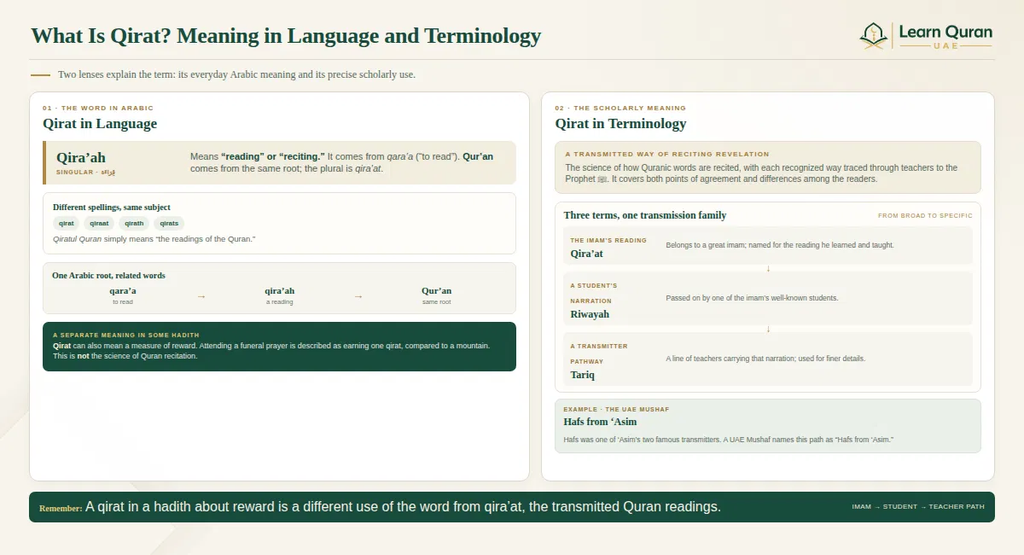
In Arabic, qira’ah means “reading” or “reciting.” It comes from the verb qara’a, “to read.” The word Quran comes from the same root, which is why the two words sound so alike. The plural of qira’ah is qira’at.
In English, you’ll see the word spelled in many ways. Qirat, qiraat, qirath, and qirats all point to the same thing. You may also see qiratul Quran, which simply means “the readings of the Quran.”
The word has one more meaning that confuses a lot of people. In some hadith, a qirat is a measure of reward. The Prophet ﷺ said that a person who attends a funeral prayer earns one qirat, and he compared it to a mountain. If that’s the meaning you were searching for, it has nothing to do with recitation.
Qirat in Terminology
Inside Islamic study, the word gets much more exact. Scholars define qirat as the science of how the Quran’s words are said, with each way linked to the person who handed it on.
Another common definition calls the qira’at the ways of the great imams in saying the words of revelation. Each way is traced back to the Prophet ﷺ. It’s worth noticing that the science covers the places where the readers agree, too. It doesn’t only list their differences.
Every qirat carries the name of a great teacher, called an imam. He didn’t invent his reading. He learned it from his own teachers, stayed with it his whole life, and taught it to crowds of students. People linked his name to the reading simply because he was known for it.
The Difference Between Qirat, Riwayah, and Tariq
These three words show up in almost every book about the readings. The easiest way to picture them is as a family tree that runs from the top down.
- The qirat belongs to the imam. The qirat of Asim, for example, is the reading Imam Asim taught in Kufa.
- The riwayah belongs to one of the imam’s students who passed the reading on. Every imam has two famous students like this, and Hafs was one of Asim’s two.
- The tariq sits one step lower. It’s a line of teachers who took the reading from that student. Experts turn to the tariq when they need very fine details, like a small choice in how long to hold a sound.
That’s why the mushaf printed in the UAE says “the riwayah of Hafs from Asim” on its last pages. The full name tells you who taught the reading and who carried it forward.
Learning these three words early really pays off. Books on the subject become much easier to follow, and your teacher’s lessons will make more sense once they move past the basics.
How Is Qirat Different From Tajweed?
A qirat is the reading you recite. Tajweed is the set of rules for saying that reading well. Many websites treat the two words as one. That leaves learners unsure what they are actually studying.
| Qirat | Tajweed | |
| What it is | An approved way of reading the Quran | Rules for saying the words correctly |
| The question it answers | Which words and sounds do I recite? | How do I say each letter and sound? |
| Examples | Hafs from Asim, Warsh from Nafi’ | Makharij, ghunnah, idgham, qalqalah, madd |
| Where it comes from | Handed down from the Prophet ﷺ through the imams | Drawn from how the readings were recited |
Where Do Qirat and Tajweed Overlap?
Qirat and tajweed are two different things, but they always work together. Think of it like this: the qirat is what you read, and tajweed is how you say it. You can’t use tajweed on its own. You always use it inside one reading, like Hafs or Warsh.
Here’s an easy example. Some vowels in the Quran are long, so you hold the sound for a moment, a bit like singing a note. This is called madd.
Tajweed tells you to hold it. But the reading you follow tells you for how long. In one reading, you might hold it while counting to four. In another, you hold the same sound while counting to six.
Here’s another one. Sometimes an “a” sound leans a little toward an “e” sound, so “ah” sounds closer to “eh.” This is called imalah. If you read Hafs, you’ll only hear it once in the whole Quran, in the word majrēhā in Surah Hud 11:41.
But if you listen to the readings of Hamzah or al-Kisa’i, you’ll hear it again and again, in hundreds of places.
Want to build these habits in your own recitation? Our guide on how to recite Quran with tajweed is a good next read.
You can also join the Tajweed Course at UAE Quran Academy. There, a teacher fixes each rule with you live until it feels natural.

How Do Scholars Know a Qirat Is Authentic?
Imam Ibn al-Jazari set out three tests for any reading in his book al-Nashr. Later scholars, including al-Suyuti, adopted them. The first test carries the most weight.
Test One: A Sound Chain of Teachers (Sanad)
Sanad means the chain of teachers behind a reading. Each student recited the whole Quran out loud to his teacher. That teacher had done the same with his own teacher. The links go all the way back to the Prophet ﷺ. Scholars treat this as the strongest of the three tests.
Follow the chain of Hafs and you can see it clearly. Hafs read to Asim. Asim read to Abu Abd al-Rahman al-Sulami and Zirr ibn Hubaysh. They read to Companions such as Uthman, Ali, Ibn Mas’ud, Ubayy ibn Ka’b, and Zayd ibn Thabit. These Companions took the Quran from the Prophet ﷺ. He received it from the angel Jibril.
The chain lives through the ear. A teacher listens, stops the student, and corrects a sound on the spot. Tiny details, like the exact length of a vowel, are hard to capture on paper.
The chain is still growing today. When a teacher is satisfied with a student’s full recitation, he grants an ijazah. This written permission to teach adds the student’s name to the line.
Tests Two and Three: The Uthmani Script and Arabic Grammar
The second test is about how the words are written. When Caliph Uthman ibn Affan had the Quran copied, the scribes wrote it in a special way. We call this the Uthmani script, or rasm. Every reading has to fit this writing.
Back then, Arabic was written without dots and without vowel marks. So one word on the page could often be read in more than one way. For example, the same written shape could mean “you know” or “they know.” Both readings matched what was written, so both could be correct.
The third test is about language. The reading has to make sense in Arabic grammar, at least in one accepted way. Ibn al-Jazari said any known grammar rule is enough. It doesn’t have to be the most common rule. It can even be one that grammar experts still disagree about.
A reading has to pass all three tests, not just one or two. If the chain of teachers is strong but the reading doesn’t fit the writing, it’s rejected. And if it fits the writing perfectly but the chain is weak, it’s rejected too.
Experience a Live Quran Class
Watch a short sample from one of our online Quran classes and discover our engaging teaching style, interactive lessons, and personalized learning approach.
Start Learning Quran with Expert Tutors in the UAE
Accredited online Quran and Arabic classes tailored for adults and children. Schedule your session today.
Book Your Free TrialRead also: Sanad & Isnad: The Unbroken Chain of Transmission
What Are the Types of Qira’at?
Before we start, there’s one thing that confuses many readers. The types of qira’at and the names of the qira’at are two different things.
The types sort readings by how trustworthy they are. The names are the actual readings, like Nafi’ or Asim, and each one is named after the teacher who taught it. This section covers the types. The names come right after.
Al-Suyuti listed six types in his book al-Itqan. Each type depends on how strong the chain of teachers is and how many of the three tests the reading passes. Only the first two types are recited as Quran.
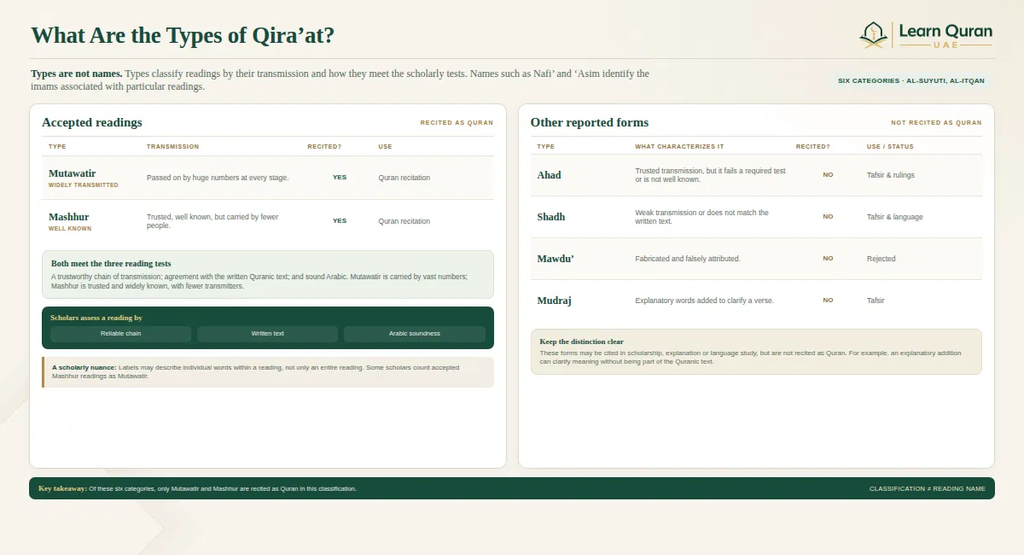
| Type | Chain of teachers | Recited as Quran? | What it’s used for |
| Mutawatir | Passed on by huge numbers of people | Yes | Recitation |
| Mashhur | Trusted and well known | Yes | Recitation |
| Ahad | Trusted, but fails a test | No | Tafsir and rulings |
| Shadh | Weak, or doesn’t match the text | No | Tafsir and language |
| Mawdu’ | Made up | No | Rejected |
| Mudraj | Has words added to explain | No | Tafsir |
Accepted Readings: Mutawatir and Mashhur
A mutawatir reading is one that a huge number of people passed on, at every step of the way. So many people carried it that there’s no chance they all got it wrong or made it up together. It also fits the written text and makes sense in Arabic. This is the group the ten qira’at belong to.
A mashhur reading is one step below. It came through trusted teachers, fits the written text, and makes sense in Arabic. Reciters know it well and never treated it as a mistake. The only difference is that fewer people passed it on.
Here’s a point that trips up even readers who know the subject. These labels are often given to single words, not to whole readings.
So a word inside one of the ten readings can be called mashhur if only some of the narrators reported it. The Moroccan Ministry of Habous gives an example from Abu Ja’far, one of the ten, in Surah al-Kahf 18:51.
Not every scholar accepts this split. Ibn al-Jazari said that if the great teachers accepted a reading, it counts as mutawatir. Scholars at Egypt’s Ministry of Awqaf agree. In their view, the words some books call mashhur are actually mutawatir too.
Rejected Readings: Ahad, Shadh, Mawdu’, and Mudraj
An ahad reading came through trusted people, but something about it doesn’t add up. Maybe it doesn’t match the written text. Maybe it doesn’t work in Arabic. Or maybe it never became well known.
Some scholars think readings like these were dropped near the end of the Prophet’s life ﷺ, when he went over the whole Quran with the angel Jibril one last time.
A shadh reading either came through people who can’t be trusted or doesn’t match the written text. One example is reading “malaka yawma al-dīn” in Surah al-Fatihah as if it meant “he ruled the Day of Judgment.” Still, some shadh readings are useful. When Ibn Mas’ud recited Surah al-Ma’idah 5:38, he said “aymānahumā,” which means “their right hands.” It isn’t recited as Quran, but it tells us which hand the verse means.
A mawdu’ reading is simply fake. Someone made it up and claimed a famous scholar taught it. For example, Muhammad ibn Ja’far al-Khuza’i collected some readings and falsely said they came from Abu Hanifa. Scholars rejected them completely.
A mudraj reading has extra words added to explain the verse. Sa’d ibn Abi Waqqas, for example, added “from the mother” when reciting Surah al-Nisa’ 4:12. Those words show which brothers and sisters the verse means. They help explain it, but they were never part of the Quran.
What Are The Names Of The Qira’at? From Seven To Ten
Now for the names. These are the actual readings, each named after the imam who taught it. Every imam had two famous students, called narrators, so the ten readings give us twenty riwayat in total.
You’ll often hear people say “the seven qira’at” and others say “the ten.” Both are right. The first seven rows in the table below were chosen first. The last three were confirmed about five centuries later.
| # | Imam | City | Narrator 1 | Narrator 2 |
| 1 | Nafi’ al-Madani | Madinah | Qalun | Warsh |
| 2 | Ibn Kathir al-Makki | Makkah | al-Bazzi | Qunbul |
| 3 | Abu Amr al-Basri | Basra | al-Duri | al-Susi |
| 4 | Ibn Amir al-Shami | Damascus | Hisham | Ibn Dhakwan |
| 5 | Asim al-Kufi | Kufa | Shu’bah | Hafs |
| 6 | Hamzah al-Zayyat | Kufa | Khalaf | Khallad |
| 7 | al-Kisa’i | Kufa | Abu al-Harith | al-Duri |
| 8 | Abu Ja’far al-Madani | Madinah | Ibn Wardan | Ibn Jammaz |
| 9 | Ya’qub al-Hadrami | Basra | Ruways | Rawh |
| 10 | Khalaf al-Ashir | Baghdad | Ishaq | Idris |
The Seven Readings Chosen by Ibn Mujahid
Imam Abu Bakr ibn Mujahid lived in Baghdad and died in 324 AH. He wrote a book called Kitab al-Sab’a, “The Book of the Seven.” In it, he named seven readers. He took them from the great cities of learning: Madinah, Makkah, Basra, Damascus, and Kufa.
Kufa gave him three names: Asim, Hamzah, and al-Kisa’i. It was one of the busiest centers of Quran teaching at the time. Each of the other cities gave him one reader.
Many other strong readers lived in his day. Still, his list spread fast. About 250 years later, Imam al-Shatibi (died 590 AH) put the seven readings into a poem of 1,173 lines, known as al-Shatibiyyah. Students have memorized it for centuries, which is why the seven became the readings everyone talked about.
Many other strong readers lived in his day. Still, his list spread fast. About 250 years later, Imam al-Shatibi (died 590 AH) put the seven readings into a poem of 1,173 lines. Its full name is Hirz al-Amani wa Wajh al-Tahani, but most people simply call it al-Shatibiyyah. Students have memorized it for centuries, which is why the seven became the readings everyone talked about.
Some people take “the seven qira’at” to mean only seven readings are valid. Ibn Mujahid never said that. He picked the best-known readers of his time and left room for more.
The Three Readings Added by Ibn al-Jazari
For a while, scholars disagreed about the readings of Abu Ja’far al-Madani, Ya’qub al-Hadrami, and Khalaf al-Ashir.
Some, like Jalal al-Din al-Bulqini, placed them in the ahad group. Ibn al-Jazari, who died in 833 AH, settled the question. He studied their chains closely and proved they passed every test the seven had passed.
These three were not newcomers. Abu Ja’far was one of the teachers of Nafi’, who is on the list of seven. Khalaf al-Ashir is the same Khalaf who narrates from Hamzah, and he also had a reading of his own.
Ibn al-Jazari wrote al-Durrah, a poem of about 240 lines on these three readings. He also wrote al-Nashr, a huge book on all ten, and turned it into a poem of about 1,000 lines. From then on, scholars agreed that ten readings are mutawatir.
Some books also mention fourteen readers. The extra four are Ibn Muhaysin, al-Yazidi, al-Hasan al-Basri, and al-A’mash. Experts study their readings for language and meaning. But those readings are counted as shadh, so nobody recites them as Quran.
Which Qirat Do Muslims Recite Today?
Most Muslims around the world read the riwayah of Hafs from Asim. It is the standard across the UAE and the Gulf, and in many countries beyond. If you learned the Quran at home or in your local mosque, it is almost surely the one you know.
Head to North and West Africa and the picture changes. There, most people follow the qirat of Nafi’. Some countries read his riwayah through Warsh. Others read it through Qalun. In parts of Sudan and in Hadramawt in Yemen, many people read al-Duri from Abu Amr.
So if you travel and pray in a mosque abroad, you may hear a reading that sounds new to you. That is normal, and it is still the Quran you know.
Printed copies exist for many of these riwayat. Put a Warsh mushaf next to a Hafs one and you will need a close look to spot the gaps. They sit in the vowel marks, the small signs above some letters, and a handful of words.
How Are the Qira’at Different? Real Examples
Differences between readings come in two kinds. Usul are general rules that repeat through the whole Quran, such as how long you hold a vowel. Farsh are changes in single words, in particular verses.
The two comparisons below show both kinds side by side. Why these four out of twenty? Hafs and Warsh are the two readings you’re most likely to hear today, in the Gulf and in North Africa. Ibn Kathir and Abu Amr show both kinds of difference in one place. Every other pair differs in these same two ways.
Hafs vs. Warsh
If you grew up with Hafs, Warsh is usually the first other reading you’ll hear. Most of the gap between them is in the general rules, so you notice it almost everywhere, not just in a few verses.
| What changes | Hafs | Warsh | What you’ll notice |
| Long vowels | Held for 4 or 5 counts | Held for up to 6 counts | Warsh sounds slower and more drawn out |
| The hamzah (the catch in the throat, like “uh-oh”) | Kept: yu’minūn, “they believe” | Softened: yūminūn | The little stop disappears |
| A hamzah after a silent letter | Kept: qad aflaha, “has succeeded” | Its vowel moves back: qadaflaha | Two words flow into one |
| The “L” in al-salāh, the prayer | Light | Heavy and deep | The word sounds fuller |
| One word in al-Fatihah 1:4 | Māliki yawm al-dīn, “Owner of the Day of Judgment” | Maliki yawm al-dīn, “King of the Day of Judgment” | A long “ā” becomes a short “a” |
The last row is a nice example of how a word difference adds meaning instead of changing it. Allah is both the Owner and the King of that Day, so each reading completes the other.
Ibn Kathir vs. Abu Amr
These two imams are less famous outside the world of qira’at, but they show both kinds of difference very clearly. Some are small sound habits, and one changes the grammar of a whole verse.
| What changes | Ibn Kathir | Abu Amr | What you’ll notice |
| The plural “m” | Adds a soft “oo”: alayhimū | Stops on the “m”: alayhim | An extra vowel at the end |
| The word “fīhi” before a consonant | Stretched: fīhī | Kept short: fīhi | A longer “ee” sound |
| Two matching letters across two words | Kept apart | Blended into one sound (as narrated by al-Susi) | Abu Amr’s reading feels smoother |
| The word sirāt in al-Fatihah 1:6 | Light “s,” as narrated by Qunbul | Heavy “ṣ,” the way most people know it | One letter sounds different |
| The grammar of al-Baqarah 2:37 | “Words from his Lord reached Adam” | “Adam received words from his Lord” | Subject and object swap places |
Common Myths About Qirat
Most confusion comes from a poor translation of the word or from mixing it up with other terms. Two myths cause more trouble than the rest.
Are the Qira’at Different Versions of the Quran?
No. There is one Quran. The ten readings all come from the Prophet ﷺ, and all of them fit the script that Uthman’s copies used. When Uthman gathered the Quran, he united Muslims on one written form. The readings live inside it.
“Version” is the wrong word. It suggests someone edited the text over time, and that never happened. Scholars also note that no sound reading from the Prophet ﷺ breaks the rules of Arabic. After all, he was the most eloquent of the Arabs.
A related myth says qirat means a lovely voice or a style of melody. The melody has its own name: maqam. Two reciters can use very different tunes on the same qirat. One tune can also carry any of the ten readings. In short, qirat decides the words and sounds, and maqam shapes the tune.
Are the Seven Qira’at the Same as the Seven Ahruf?
The Prophet ﷺ said the Quran came down in seven ahruf, or seven modes. A well-known hadith tells how Umar ibn al-Khattab heard Hisham ibn Hakim recite Surah al-Furqan differently from him. Upset, Umar brought him to the Prophet ﷺ.
The Prophet ﷺ listened to both and said each was revealed that way. Then he told Muslims to read as they had been taught.
The seven qira’at came about three centuries later, through Ibn Mujahid’s list. Both ideas use the number seven, so people often think they are the same.
Scholars agree they are not. The ahruf are the modes in which the Quran was revealed. The qira’at are readings carried down within what fits the Uthmani script. Exactly how the two connect is still discussed. But no serious scholar treats the seven readers as the seven ahruf.
When an article mixes up the two terms, read the rest of it with care.
See How Our Online Classes Work
Get a glimpse of a real online session and explore how students learn Quran with experienced teachers in a supportive and interactive environment.
What Is the Right Order to Learn the Qira’at?
Most teachers follow the same path. Each step builds on the one before it, so it’s best to take them in order.
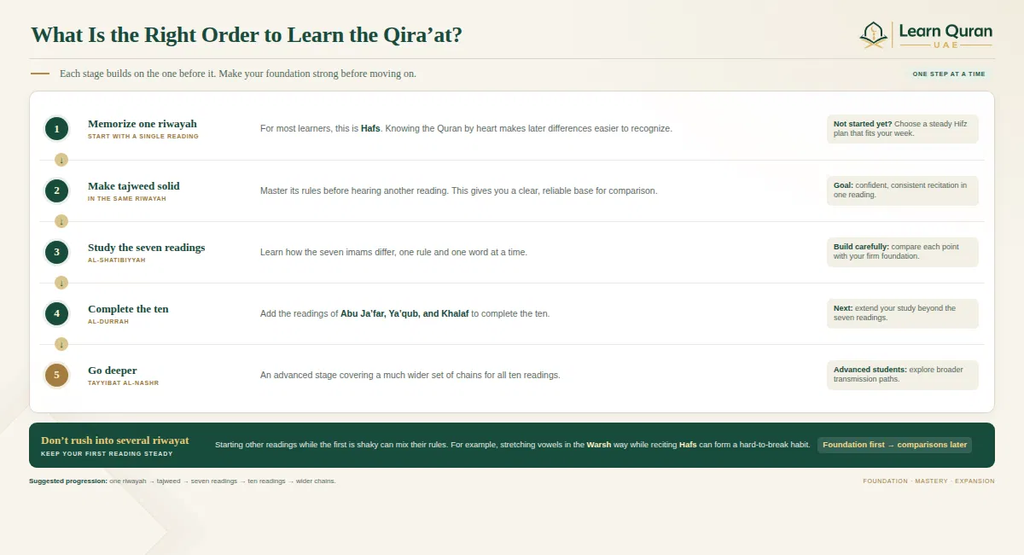
- Step 1: Memorize the Quran in one riwayah: For most people, that’s Hafs. Knowing the text by heart makes every later difference easier to spot. If you haven’t started yet, our article on online Quran memorization programs in the UAE can help you choose a plan.
- Step 2: Make your tajweed solid in that same riwayah: Get the rules right in one reading before you hear any other. This gives you a clear base to compare against.
- Step 3: Study the seven readings with al-Shatibiyyah: Here you start learning how the seven imams differ, one rule and one word at a time.
- Step 4: Complete the ten with al-Durrah: This adds the three readings of Abu Ja’far, Ya’qub, and Khalaf.
- Step 5: Go deeper with Tayyibat al-Nashr: This last step is for advanced students. It covers a much wider set of chains for all ten readings.
The biggest mistake is rushing into several riwayat while the first one is still shaky. Students who do this tend to mix the rules, like stretching vowels the Warsh way while reading Hafs. Undoing that habit can take longer than learning in order would have.
The teacher you pick matters just as much as the order. Our guide to the best Quran academies in the UAE explains what to look for.
When you’re ready, the Ten Qirat Course at UAE Quran Academy takes you through each of these steps. You only move ahead once your teacher signs off on the current one.
Start Learning Quran with Expert Tutors in the UAE
Accredited online Quran and Arabic classes tailored for adults and children. Schedule your session today.
Book Your Free TrialBook Your Free Trial Class at UAE Quran Academy Today
You now know what the qira’at are. The next step is to hear them, recite them, and get honest feedback from someone who holds the chain. UAE Quran Academy gives you that in live one-on-one classes from home.
When you join, you get:
- Al-Azhar certified teachers who each hold a verified ijazah with a real chain
- Live correction in every lesson, down to each letter and vowel
- A free placement test that finds your level and the right course
- The same teacher from your trial class through your whole program, whenever possible
- Male and female teachers, so women and girls can study with a woman
- Lessons explained in clear, fluent English
- Class times that suit any time zone, including evenings and weekends
- Regular progress reports before you move up a stage
- An academy with over 10 years of experience teaching children and adults
Your first class costs nothing. Pick a time, meet your teacher, and see where your recitation stands today.

Conclusion:
A qirat is an approved way of reciting the Quran, and the ten mutawatir qira’at all go back to the Prophet ﷺ. Knowing this changes how you hear the Quran. The next time an imam reads a word differently, you will recognize a riwayah. You will not need to worry about a mistake.
You also have a clear way to judge what you read online. A real qirat passes three tests: a sound chain, a fit with the Uthmani script, and correct Arabic. Only mutawatir and mashhur readings are recited. The seven and ten lists come from Ibn Mujahid and Ibn al-Jazari.
There is a deeper lesson here too. Scholars tracked every vowel length and every softened hamzah for over a thousand years. That shows how carefully the Quran was guarded. Far from being a weakness in its preservation, the readings are some of the best proof of it.
If this topic has caught your interest, try a small exercise. Listen to Surah al-Fatihah in Hafs, then in Warsh. Note one usul difference and one farsh difference. Moments like that turn the meaning of qirat from a definition into something you can hear for yourself.
FAQs
Once people learn the basics, the same practical questions tend to follow. The answers below cover the points this guide has not yet touched.
How Can I Tell Which Riwayah My Mushaf Uses?
Turn to the last few pages or the title page of your mushaf. Most printed copies state the riwayah there, for example “riwayat Hafs an Asim.”
Can I Recite Warsh in Prayer If My Local Mosque Reads Hafs?
Yes, any of the ten readings is valid in prayer. When leading others, though, imams usually keep to the local riwayah so the people behind them are not confused.
Can a Different Qirat Change a Ruling in Islam?
Mutawatir readings never contradict each other, but some give two related meanings that jurists study together. In Surah al-Nisa’ 4:43, most readers say “lāmastum,” with a long “ā,” while Hamzah and al-Kisa’i say “lamastum,” with a short “a.” Scholars draw on both when they discuss what breaks wudu.
Is It Allowed to Mix Two Qira’at in One Recitation?
Teachers advise keeping to one riwayah in a single recitation. Mixing rules from different readings can break their inner logic and leads to errors.
Is Learning the Qira’at Required for Every Muslim?
No, each Muslim only needs to recite one riwayah correctly. Scholars see preserving the full set of qira’at as a duty on the community, carried by those who specialize in it.
Can Women and Children Learn the Qira’at?
Yes, and many respected teachers of the Quran throughout history were women. Children usually start once they read fluently and have memorized a good part of the Quran.
How Long Does It Take to Learn the Ten Qira’at?
There is no fixed time. It depends on your memorization, your tajweed, and how often you study, and a teacher can map out a realistic plan after hearing you recite.
Where Can I Listen to Recitations in Other Qira’at?
Many well-known reciters have recorded the full Quran in riwayat other than Hafs. Sheikh Mahmoud Khalil al-Husary, for example, recorded Warsh, Qalun, and al-Duri, and these recordings are easy to find online.




Leave a Reply