 Quran
Quran

Learning the Quran is a lifelong commitment, but most people who search for how to learn the Quran get stuck at the same point: they don’t know whether to start with reading, memorizing, or understanding meaning — so they try all three at once and make slow progress on each.
The right approach follows a specific order: correct recitation first, then steady memorization, then understanding through Tafsir. Skip a step, and the ones that follow become unstable. This guide lays out that order, along with the practical habits that decide whether a learner sticks with it or quits within the first month.
1. Start Learning the Quran with a Qualified Teacher Matches The UAE Time
A qualified teacher is someone who has mastered Quran recitation and Tajweed and can correct your pronunciation in real time. This matters because mispronunciation is nearly impossible to self-detect — letters like ح and ه, or ص and س, sound almost identical to an untrained ear despite being entirely different letters with different articulation points (makharij).
Residents of Dubai, Abu Dhabi, Sharjah, and the other Emirates have access to well-established local mosques and Quran centers, but fixed class times don’t always match a UAE work schedule built around early starts, long commutes, and a Monday-to-Friday week. Online Quran classes solve this by offering live, one-to-one correction scheduled around GST, without sacrificing the feedback loop that makes correction possible in the first place.
For adults specifically, structured Quran classes for adults at UAE Quran Academy build this exact path — covering reading, Tajweed, and regular practice at a pace that fits around work and family commitments, rather than assuming a student’s full-time availability.

2. Make Online Quran Learning More Effective With a UAE-Friendly Schedule
Online Quran learning works when it replicates the live correction of in-person study — a teacher hearing your recitation and correcting errors immediately, not just a recorded video you watch passively. Removed from the equation is the commute across Dubai or Abu Dhabi traffic and the fixed scheduling of a physical center, which is often the deciding factor for adult learners who otherwise wouldn’t start at all.
A sustainable online study routine includes the following elements.
| Practice | Why It Matters |
| Live teacher sessions | Corrects pronunciation immediately, before errors set |
| Weekly revision | Prevents previously covered material from fading |
| Daily home practice | Builds fluency between sessions |
| Tajweed instruction | Improves recitation accuracy systematically |
| Teacher feedback | Catches mistakes before they become fixed habits |
A common mistake among self-directed online learners: treating the live session as the only study time. In practice, the session is where errors get caught — daily practice in between, timed around your own UAE work hours, is what actually builds the skill.

3. Build Your Quran Learning Journey with Sincere Intention
Sincere intention means learning the Quran for Allah’s sake, paired with consistently asking Him for ease and guidance throughout the process — not treating it as a purely academic task. This isn’t a soft add-on to the method; it’s framed in the Quran itself as a direct invitation to ask for help.
Allah says:
وَقَالَ رَبُّكُمُ ادْعُونِي أَسْتَجِبْ لَكُمْ
“And your Lord says, ‘Call upon Me; I will respond to you.'” (Surah Ghafir, 40:60)
A practical way to apply this: make dua specifically before each study or memorization session, asking for ease in retaining what you’re about to learn. Students who build this into their routine report fewer points of discouragement during difficult passages — not because the difficulty disappears, but because they approach it expecting to need help rather than expecting to manage alone.

4. Create a Sustainable Daily Quran Learning Routine Around Your Day
The most common reason learners quit is attempting to memorize large portions too quickly, then losing momentum when the pace becomes unsustainable. Consistency in small amounts consistently outperforms intensity in large ones — especially for UAE residents balancing long work hours, family time, and Friday Jummah commitments.
A sustainable daily routine follows this structure.
- Read a small section every day — not a fixed page count, but whatever you can review properly.
- Memorize only a few verses at a time.
- Repeat each verse multiple times before moving to the next.
- Review previously memorized passages daily, before adding anything new.
- Never add new memorization without first revising the old.
This last point is the one most learners skip under time pressure, and it’s the single biggest predictor of whether memorization actually lasts. Rushing to new material without revising old material creates the appearance of progress while the foundation quietly erodes underneath it.

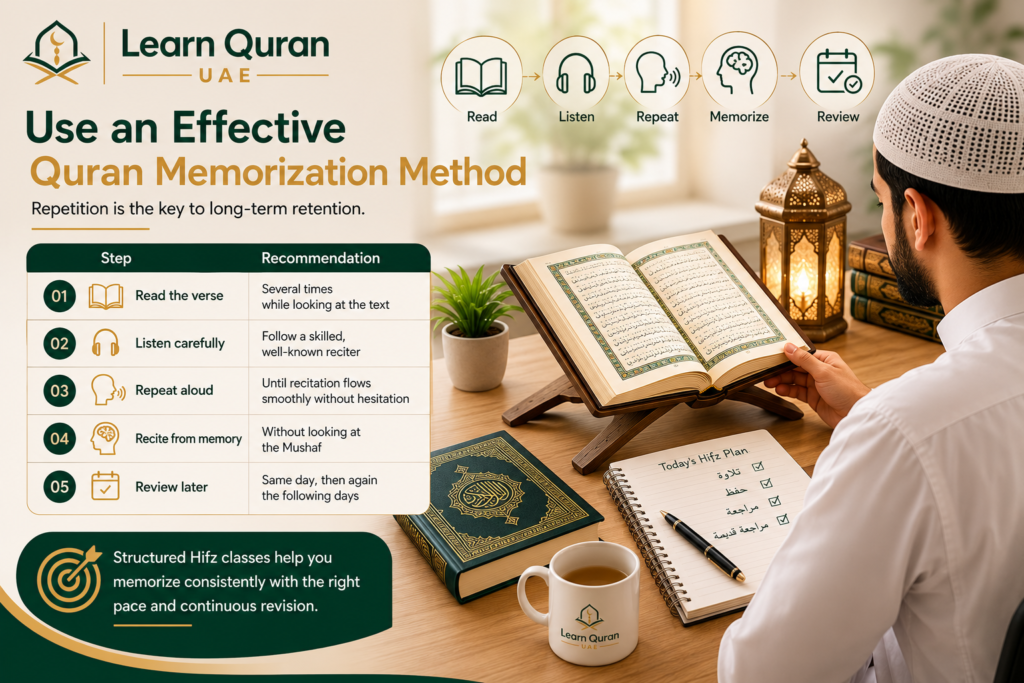
5. Use an Effective Quran Memorization Method
Many learners in the UAE find that setting memorization goals around their work or school schedule makes it easier to stay consistent throughout the year. Even 15–20 minutes of focused revision each day can produce steady long-term progress.
A practical memorization sequence follows these steps.
| Step | Recommendation |
| Read the verse | Several times while looking at the text |
| Listen carefully | Follow a skilled, well-known reciter |
| Repeat aloud | Until recitation flows smoothly without hesitation |
| Recite from memory | Without looking at the Mushaf |
| Review later | Same day, then again the following days |
Students aiming to memorize the entire Quran benefit from structured Hifz classes for men at UAE Quran Academy, where teachers set realistic memorization targets and build continuous revision into the schedule — rather than leaving pacing entirely up to the student, which is where most independent attempts break down.
Read also: Makharij Al-Huroof – Arabic Letter Articulation Points in Tajweed
6. Understand the Meaning of the Quran Through Tafsir
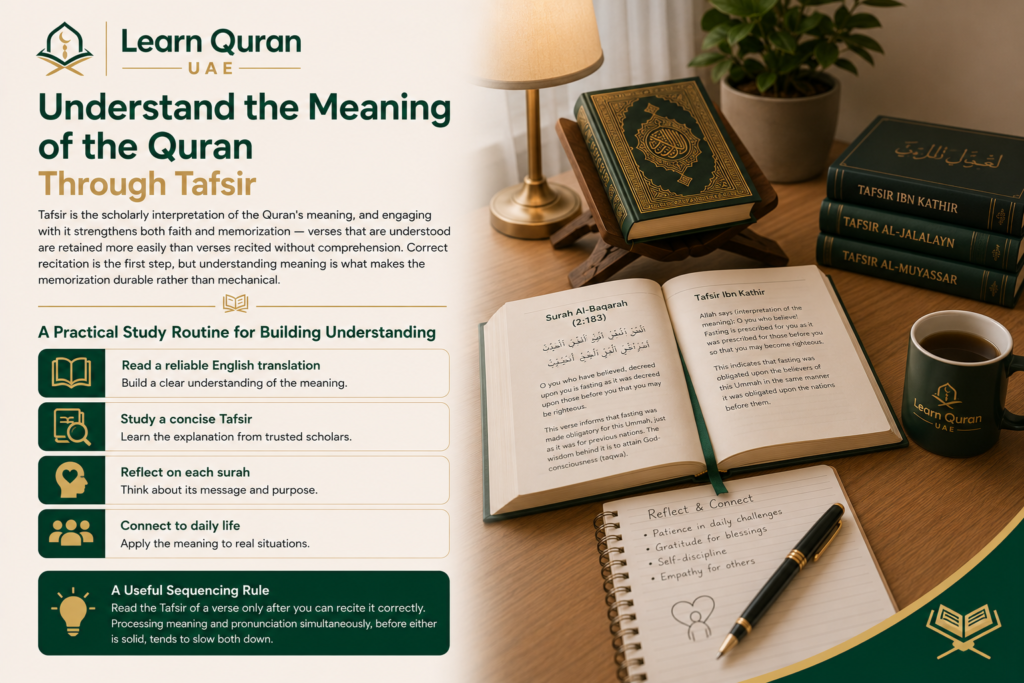
Tafsir is the scholarly interpretation of the Quran’s meaning, and engaging with it strengthens both faith and memorization — verses that are understood are retained more easily than verses recited without comprehension. Correct recitation is the first step, but understanding meaning is what makes the memorization durable rather than mechanical.
A practical study routine for building understanding includes reading a reliable English translation alongside a concise Tafsir, reflecting on the meaning of each surah individually, and actively connecting verses to situations in daily life rather than treating reflection as a separate, occasional activity.
A useful sequencing rule: read the Tafsir of a verse only after you can recite it correctly. Processing meaning and pronunciation simultaneously, before either is solid, tends to slow both down.
Experience a Live Quran Class
Watch a short sample from one of our online Quran classes and discover our engaging teaching style, interactive lessons, and personalized learning approach.
Start Learning Quran with Expert Tutors in the UAE
Accredited online Quran and Arabic classes tailored for adults and children. Schedule your session today.
Book Your Free Trial7. Learn Tajweed for Accurate Quran Recitation
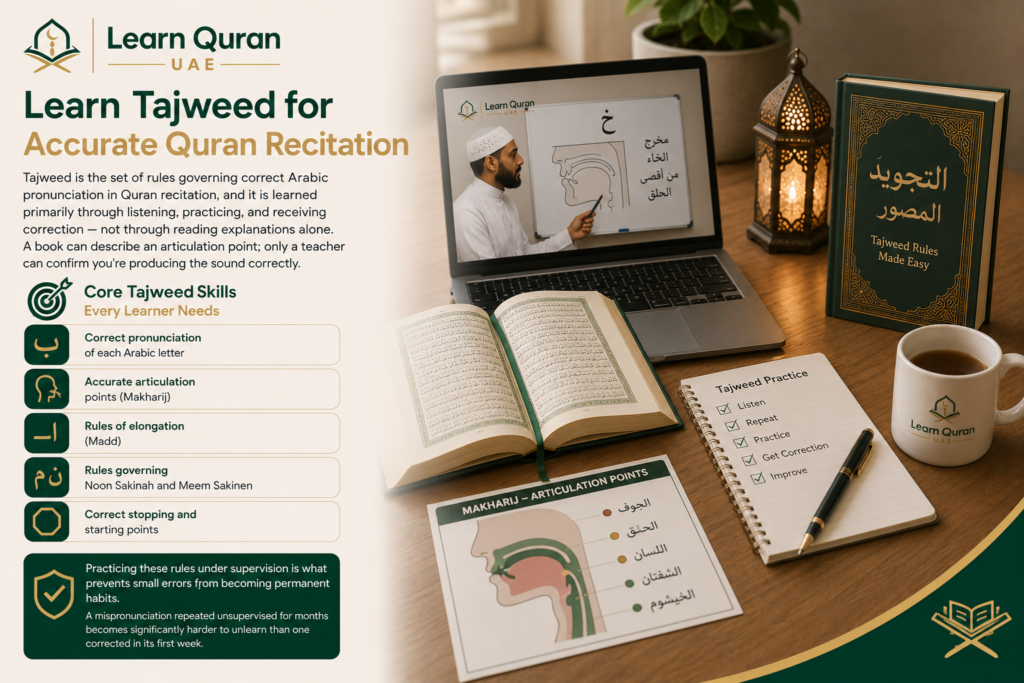
Tajweed is the set of rules governing correct Arabic pronunciation in Quran recitation, and it is learned primarily through listening, practicing, and receiving correction — not through reading explanations alone. A book can describe an articulation point; only a teacher can confirm you’re producing the sound correctly.
The core Tajweed skills every learner needs include correct pronunciation of each Arabic letter, accurate articulation points (Makharij), the rules of elongation (Madd), the rules governing Noon Sakinah and Meem Sakinen, and correct stopping and starting points during recitation.
Whether you attend classes at a local mosque or learn online from home in Dubai, Abu Dhabi, Sharjah, or another emirate, regular correction from a qualified teacher is the fastest way to develop accurate Tajweed.
8. Learn the Quran Independently While Avoiding Common Mistakes
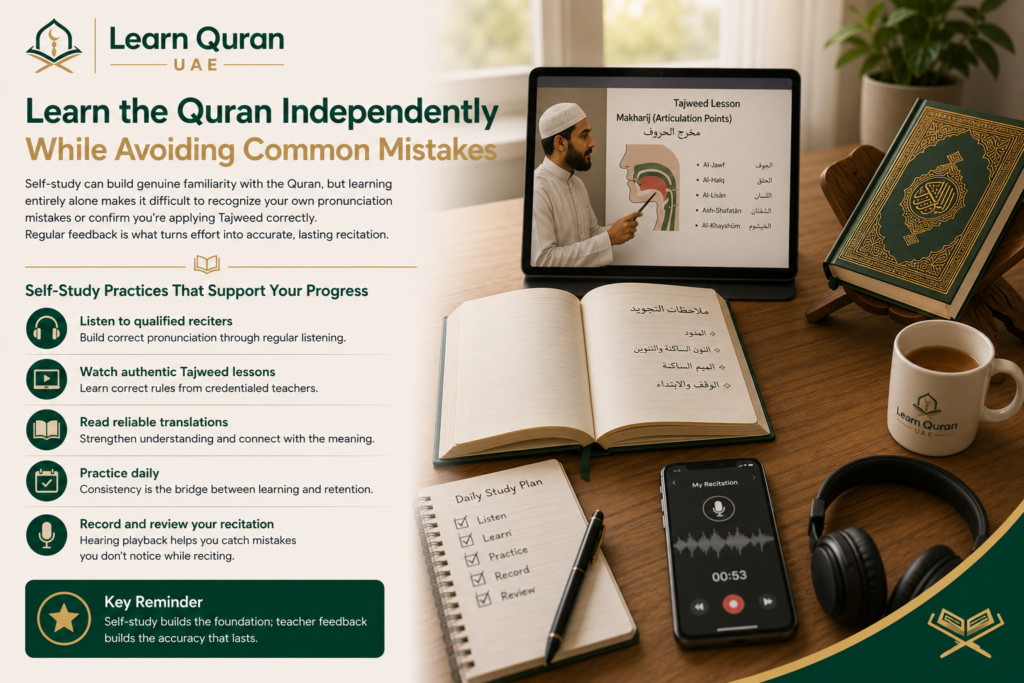
Self-study can build genuine familiarity with the Quran, but learning entirely alone makes it difficult to recognize your own pronunciation mistakes or confirm you’re applying Tajweed correctly. This is the core limitation of independent study — not motivation or effort, but the absence of an external check.
Self-study can still meaningfully support your progress through these practices: listening to qualified Quran reciters regularly, watching authentic Tajweed lessons from credentialed teachers, reading reliable Quran translations to build comprehension, practicing daily without exception, and recording your own recitation to review later.
That last practice — recording yourself — is one of the few self-correction tools that actually works, since hearing a playback gives you distance from your own recitation in a way that reciting live does not. Even so, regular teacher feedback remains the single biggest factor separating learners who develop correct, lasting recitation from those who plateau early.
9. Using Ramadan to Strengthen Your Routine
During Ramadan, many learners in the UAE increase their study schedule after Taraweeh prayers, when the household rhythm already shifts around worship. This makes the month one of the most effective windows in the year to push memorization forward.
UAE public holidays and school breaks around Eid al-Fitr and Eid al-Adha offer a similar opportunity — the daily work schedule loosens, which is a natural point to add extra revision sessions rather than let momentum pause entirely.
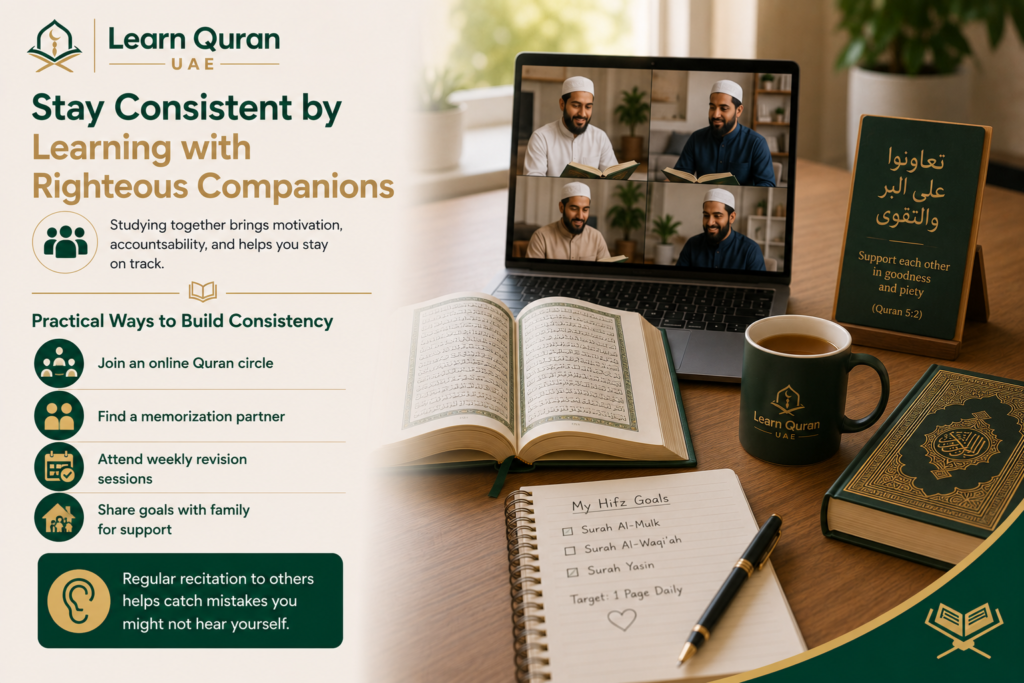
10. Stay Consistent by Learning with Righteous Companions
Studying alongside others increases both motivation and accountability, which directly affects whether a learner maintains a routine through difficult stretches. A memorization partner or study group provides the kind of external check that solo study structurally lacks.
Practical ways to build this into your routine include joining an online Quran circle, finding a dedicated memorization partner, participating in weekly revision sessions with others, and sharing your memorization goals with family members who can check in on your progress.
Having someone else listen to your recitation regularly — even informally — catches errors your own ear has stopped noticing.
Read also: How to Learn the Quran in the UAE?
11. Strengthen Your Quran Learning Through Righteous Actions
Many scholars link obedience to Allah directly with the preservation of beneficial knowledge, including Quran memorization — framing it not as a separate spiritual matter, but as a real contributing factor to how easily learning sticks.
Allah says:
وَمَنْ يَتَّقِ اللَّهَ يَجْعَلْ لَهُ مِنْ أَمْرِهِ يُسْرًا
“And whoever fears Allah — He will make for him ease in his matter.” (Surah At-Talaq, 65:4)
In practical terms, this means a learner’s overall conduct — not just their study habits — affects how smoothly memorization progresses. A life organized around obedience tends to also be a life with the focus and discipline that memorization requires; the two reinforce each other rather than existing separately.

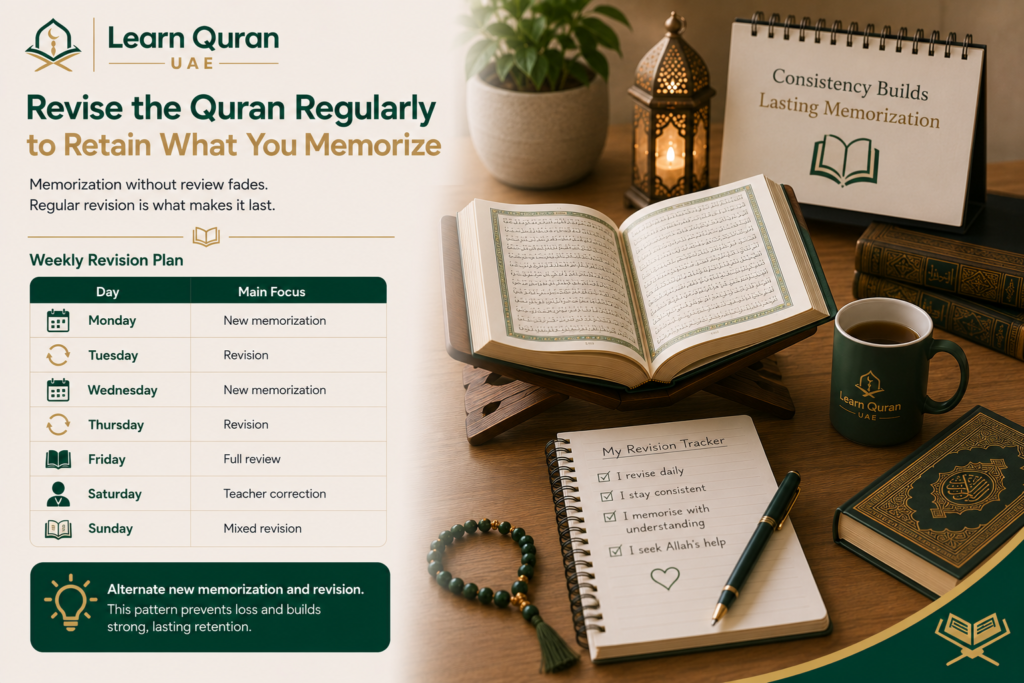
12. Revise the Quran Regularly to Retain What You Memorize
Memorization without review fades gradually, which is why successful Quran students dedicate significant time to revising previously memorized passages before adding new ones — revision is not an optional add-on to memorization, it’s the half of the process that makes the other half permanent.
A balanced weekly schedule might look like this.
| Day | Main Focus |
| Monday | New memorization |
| Tuesday | Revision |
| Wednesday | New memorization |
| Thursday | Revision |
| Friday | Full review |
| Saturday | Teacher correction |
| Sunday | Mixed revision |
The pattern worth noting here is the alternation: new material is never added on consecutive days without a revision day in between. This is intentional — it prevents the gradual erosion that happens when revision is treated as something to “get to later.”
13. Learn the Quran Through Mosques and Qualified Teachers in the UAE
Across the UAE, many mosques offer Quran classes and study circles for both children and adults, providing a welcoming environment to begin learning the Quran with qualified teachers. These local programs remain an important part of Islamic education, helping students improve their recitation and understanding. However, fixed class schedules may not suit everyone. For learners balancing work, school, or family responsibilities, live online Quran classes offer the flexibility to learn from experienced teachers while receiving the real-time correction that is essential for accurate Quran recitation.
Teach Children the Quran Using Age-Appropriate Methods
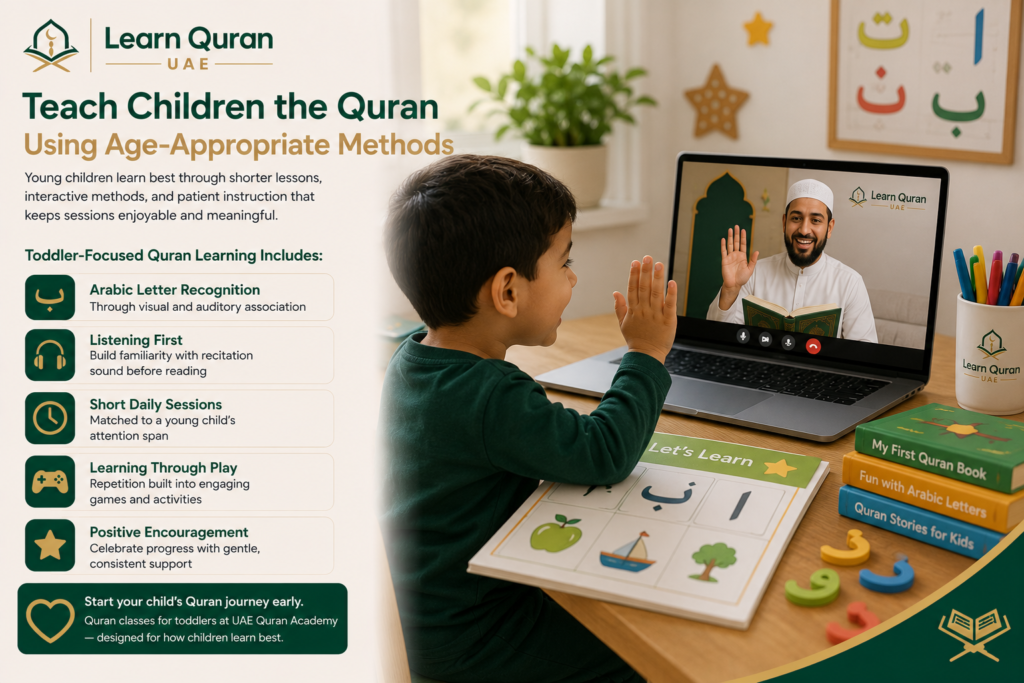
Young children learn best through shorter lessons, interactive methods, and patient instruction that keeps sessions enjoyable rather than rigid — the underlying sequence stays the same as for adults, but the format and pacing shift significantly.
Toddler-focused Quran programs typically include Arabic letter recognition through visual and auditory association, listening exercises that build familiarity with recitation sound before reading, short daily sessions matched to a young child’s attention span, repetition built into games rather than drills, and consistent positive encouragement rather than correction-heavy feedback.
Parents starting Quran education early can explore Quran classes for toddlers at UAE Quran Academy, designed specifically around how young children actually absorb sound and language rather than adapting adult methods downward.
The Virtue of Learning and Teaching the Quran
The Prophet ﷺ directly praised both learning and teaching the Quran as among the best actions a Muslim can undertake, framing it as a form of service that extends beyond personal worship.
خَيْرُكُمْ مَنْ تَعَلَّمَ الْقُرْآنَ وَعَلَّمَهُ
“The best among you are those who learn the Quran and teach it.”
Narrated by Uthman ibn Affan, recorded in Sahih al-Bukhari 5027.
This hadith reframes the entire learning process: it isn’t only a personal achievement, but something with value that extends outward once a learner is in a position to pass it on — to their children, their family, or eventually their own students.
Read also: Best Quran Academies in the UAE
See How Our Online Classes Work
Get a glimpse of a real online session and explore how students learn Quran with experienced teachers in a supportive and interactive environment.
Start Learning the Quran the Right Way Today
Whichever stage you’re at, the structural difference between learners who finish and learners who restart from scratch every few months almost always comes down to one thing: a teacher who can hear your recitation, correct it immediately, and keep your pace realistic.
UAE Quran Academy builds every class — for beginners, adults, men, or toddlers — around the exact sequence covered in this guide: correct reading first, paced memorization second, and consistent revision built in from day one.
Our Quran Courses
- Noorani Qaida Course
- Noorani Qaida for Kids Course
- Noorani Qaida with Tajweed Course
- Noor Al-Bayan Course
- Quran Reading Course
- Quran Reading for Kids Course
- Quran Reading for Beginners Course
- Quran Reading with Tajweed Course
- Quran Recitation Course
- Quran Recitation for Kids Course
- Quran Tafseer Course
- Tafseer for Kids Course
- Quran Ijazah Program
- Tajweed Ijazah Course
- Ten Qirat Course
Enroll today and start learning the Quran from the comfort of your home with expert instructors at UAE Quran Academy.
Start Learning Quran with Expert Tutors in the UAE
Accredited online Quran and Arabic classes tailored for adults and children. Schedule your session today.
Book Your Free Trial
Conclusion
Learning the Quran follows a clear order: correct recitation under a qualified teacher first, steady memorization in small daily portions second, consistent revision so nothing fades, and finally Tafsir to deepen understanding of what’s already memorized. Sincerity, dua, and avoiding sin run alongside every step — not as separate spiritual tasks, but as factors that genuinely affect how smoothly the process goes. Self-study can support progress, but it cannot replace the correction a qualified teacher provides. Start with whichever step matches where you are now, protect a fixed daily time for it, and let consistency do the rest.
Frequently Asked Questions
Can I learn to read the Quran correctly without a teacher?
It’s difficult but not impossible. Recorded lessons and Tajweed videos can teach the rules, but a learner cannot reliably hear their own mispronunciation. Live correction from a teacher — in person or online — remains the most reliable way to fix errors before they become permanent habits.
What’s the right order to learn the Quran in?
Correct recitation comes first, since memorizing mispronounced words simply locks in the errors. Memorization follows once recitation is stable, and understanding through Tafsir comes after that, building on what’s already correctly recited and memorized.
How much should a beginner memorize each day?
Less than feels ambitious. Memorizing a few verses thoroughly, with heavy repetition, produces far better retention than rushing through more material once. Reviewing yesterday’s portion before adding new material is the habit that makes this sustainable.
What happens if I stop revising what I’ve already memorized?
It fades gradually rather than suddenly, which is why successful students treat revision as equal in importance to new memorization. A weekly schedule that alternates new memorization with dedicated revision days prevents this slow loss.
Which Tafsir should a beginner start with?
A concise, accessible Tafsir paired with a reliable English translation works best for beginners, since dense classical commentaries can slow down a learner who is still building foundational understanding.
Is it better to learn the Quran in person or online?
Both work equally well if the teacher provides live, corrective feedback. In-person centers offer direct supervision; online classes offer the same correction remotely, with added flexibility for adults balancing work or family schedules.



Leave a Reply