 Quran
Quran

If you’re searching for how to learn Quran in the UAE, you’re likely ready to start — not just researching theory. This guide gives you the actual path: the methods available, the steps to follow from your first letter to memorization, and how to pick an academy or teacher that fits your age, level, and schedule.
Whether you’re a complete beginner, a parent enrolling your child, or a non-Arabic speaker starting from zero, the same structure applies — only the format and pace change.
Why Learning Quran in the UAE Is Easier Than Ever?
The UAE offers one of the most accessible environments for Quran education. Over the past few years, students have gained access to a wide variety of learning formats, making it possible to study regardless of age, experience, or location.
Instead of relying only on local Quran centers, students can now choose between certified online academies, private home tutors, traditional Quran institutes, and mosque-based classes. This flexibility allows every learner to study in a way that fits their daily routine.
For busy professionals, online Quran classes eliminate commuting while providing access to qualified teachers from the comfort of home. Parents benefit from flexible scheduling that fits around school hours, while non-Arabic speakers can study with instructors experienced in teaching complete beginners.
Different Ways to Learn Quran in the UAE
There isn’t one correct way to learn Quran — the right method depends on your schedule, your learning style, and whether you want one-on-one correction or a group setting.
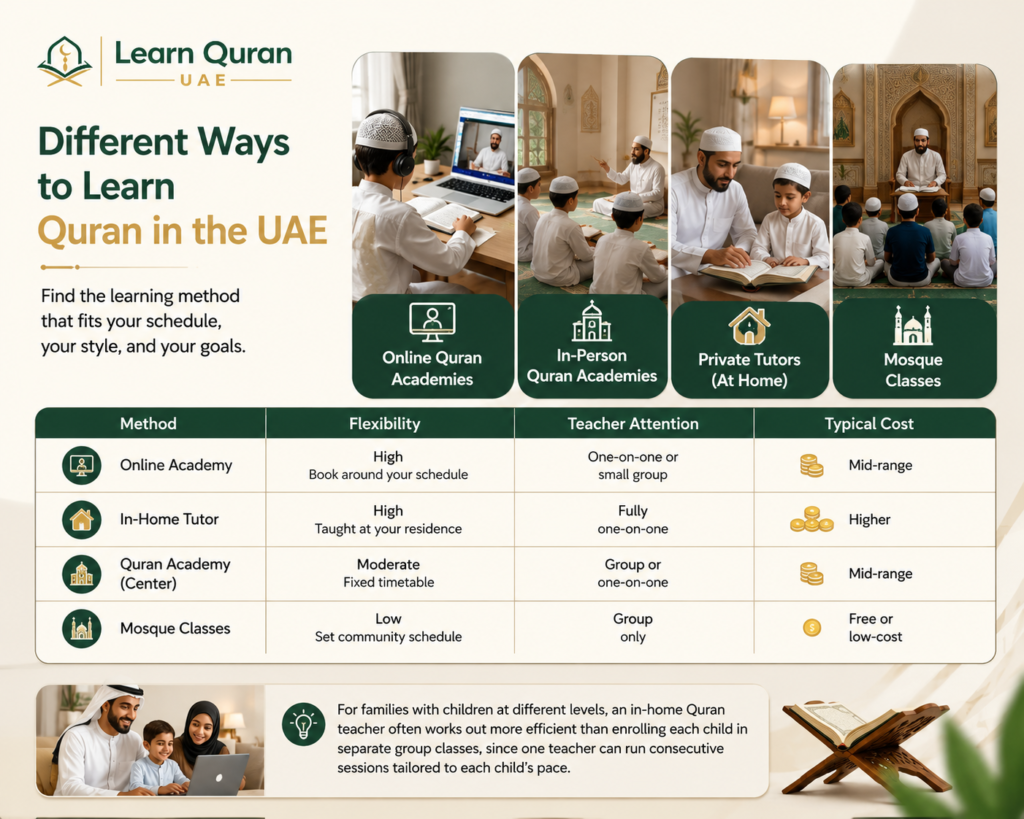
Before comparing, here are the four primary routes available in the UAE:
- Online Quran academies — certified teachers, flexible timing, lessons delivered by video call.
- In-person Quran academies — fixed locations with structured class schedules.
- Private tutors (at home) — one-on-one lessons delivered at your residence.
- Mosque classes — community-based group lessons, often free or low-cost.
| Method | Flexibility | Teacher attention | Typical cost |
| Online academy | High — book around your schedule | One-on-one or small group | Mid-range |
| In-home tutor | High — taught at your residence | Fully one-on-one | Higher |
| Quran academy (center) | Moderate — fixed timetable | Group or one-on-one | Mid-range |
| Mosque classes | Low — set community schedule | Group only | Free or low-cost |
For families with children at different levels, an in-home Quran teacher often works out more efficient than enrolling each child in separate group classes, since one teacher can run consecutive sessions tailored to each child’s pace.
Step-by-Step Guide to Learning Quran
There’s a fixed logical order to learning Quran correctly, and skipping a step is the most common reason students stall or develop pronunciation habits they later need to unlearn.
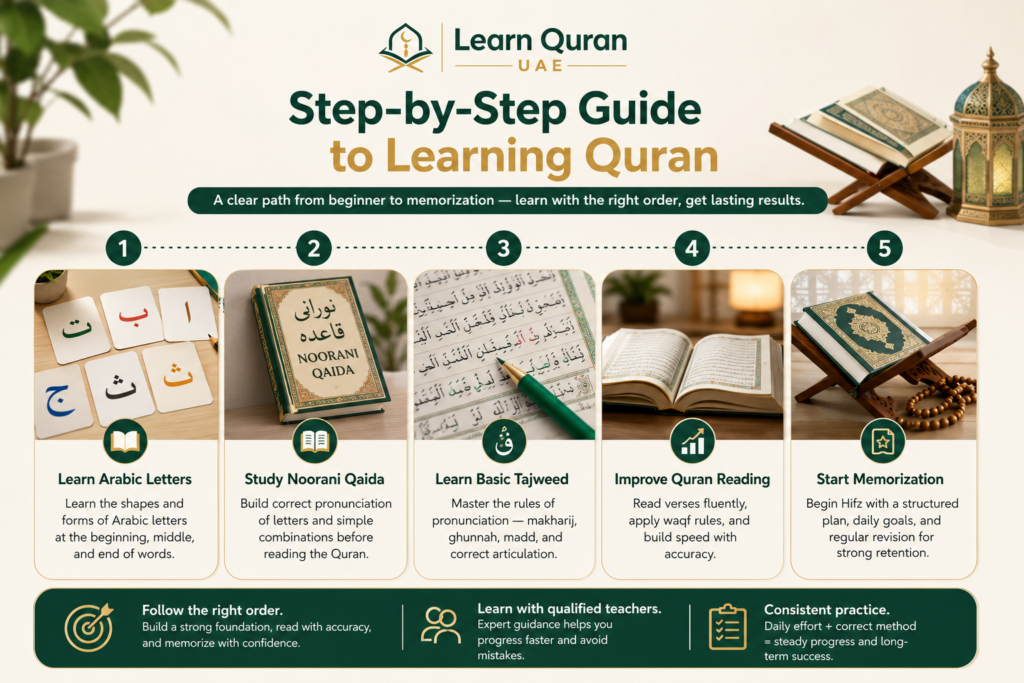
A bridge worth noting before the steps: each stage below builds directly on the one before it — moving to Tajweed before mastering Noorani Qaida, for example, means correcting letter-level errors while also trying to learn new rules at the same time, which slows progress rather than speeding it up.
1. Learn Arabic Letters
This stage covers basic letter recognition and shape — how each Arabic letter looks at the beginning, middle, and end of a word. This step is essential for non-Arabic speakers and for children who haven’t yet learned the alphabet, and it’s typically the fastest stage when taught with a teacher rather than self-study apps alone.
2. Study Noorani Qaida
Noorani Qaida is a foundational primer that teaches correct pronunciation of individual letters and basic letter combinations before a student touches full Quranic text. It’s the traditional bridge between knowing the alphabet and reading actual verses, and most certified academies treat it as a required step rather than optional.
3. Learn Basic Tajweed
Tajweed covers the rules governing how letters are pronounced in context — articulation points (makharij), nasalization (ghunnah), and elongation (madd). This stage is where most pronunciation correction happens, and it’s the stage a teacher’s qualifications matter most, since subtle errors here are hard to self-detect.
4. Improve Quran Reading
Once basic Tajweed is solid, the focus shifts to fluency — reading full passages smoothly, applying pause rules (waqf) correctly, and building reading speed without sacrificing accuracy. This stage often takes the longest, since fluency develops through repetition rather than new rule-learning.
5. Start Memorization
Memorization (Hifz) should only begin once pronunciation is consistently accurate, since memorizing with incorrect Tajweed means re-learning the same verses correctly later. A structured memorization program — with daily targets and a fixed revision cycle — tends to produce far more reliable retention than open-ended, self-paced memorization.
Read also: Makharij Al-Huroof – Arabic Letter Articulation Points in Tajweed
Online Quran Classes vs Traditional Classes in UAE
This section answers: should you choose online lessons or a traditional in-person class?
Both formats can produce the same result — the difference is logistics, not curriculum quality, as long as the teacher is properly certified in either case.
Online classes remove commute time entirely and let you book around work or school schedules, which is the main reason adult learners in the UAE increasingly choose this format. Traditional classes, by contrast, offer in-person structure and peer accountability, which can help younger children who benefit from a physical classroom routine.
The deciding factor usually comes down to one question: do you need flexibility, or do you need a fixed routine to stay consistent? If the answer is flexibility, online Quran classes typically suit working adults and busy families better than committing to a fixed weekly location.
Experience a Live Quran Class
Watch a short sample from one of our online Quran classes and discover our engaging teaching style, interactive lessons, and personalized learning approach.
Start Learning Quran with Expert Tutors in the UAE
Accredited online Quran and Arabic classes tailored for adults and children. Schedule your session today.
Book Your Free TrialHow to Choose the Best Quran Academy in the UAE?
Choosing the wrong academy is the most common reason students restart their learning path with someone new months in — so it’s worth checking these points before paying for any course.
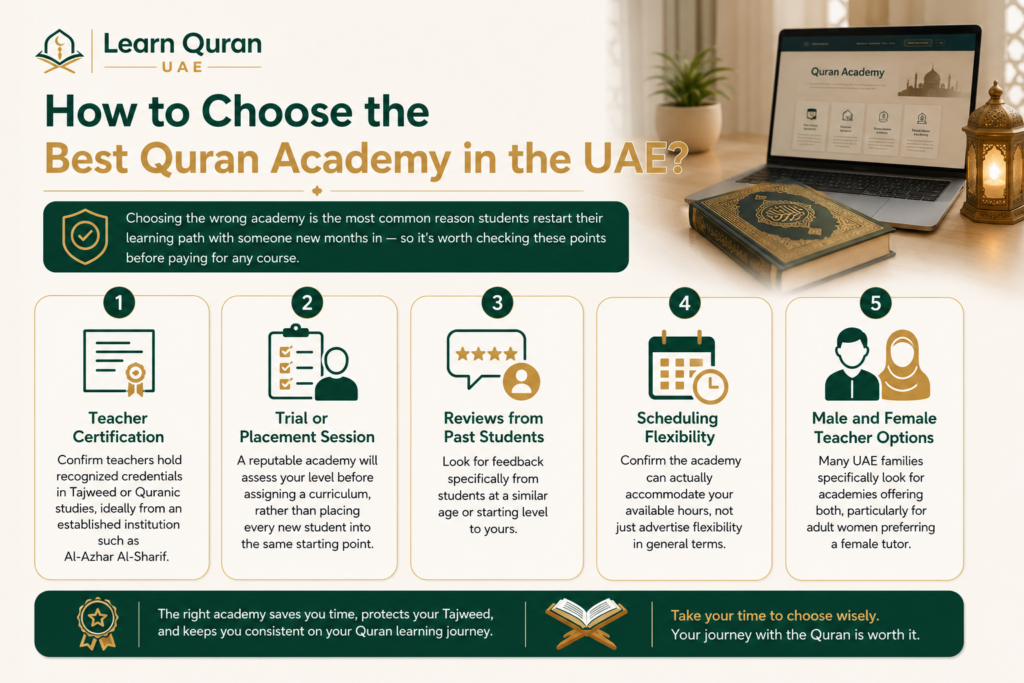
- Teacher certification. Confirm teachers hold recognized credentials in Tajweed or Quranic studies, ideally from an established institution such as Al-Azhar Al-Sharif.
- Trial or placement session. A reputable academy will assess your level before assigning a curriculum, rather than placing every new student into the same starting point.
- Reviews from past students. Look for feedback specifically from students at a similar age or starting level to yours.
- Scheduling flexibility. Confirm the academy can actually accommodate your available hours, not just advertise flexibility in general terms.
- Male and female teacher options. Many UAE families specifically look for academies offering both, particularly for adult women preferring a female tutor.
How Teachers Assess Your Level and Track Your Progress?
A qualified teacher doesn’t guess where to start you — they run a structured assessment first, then track specific markers as you advance.
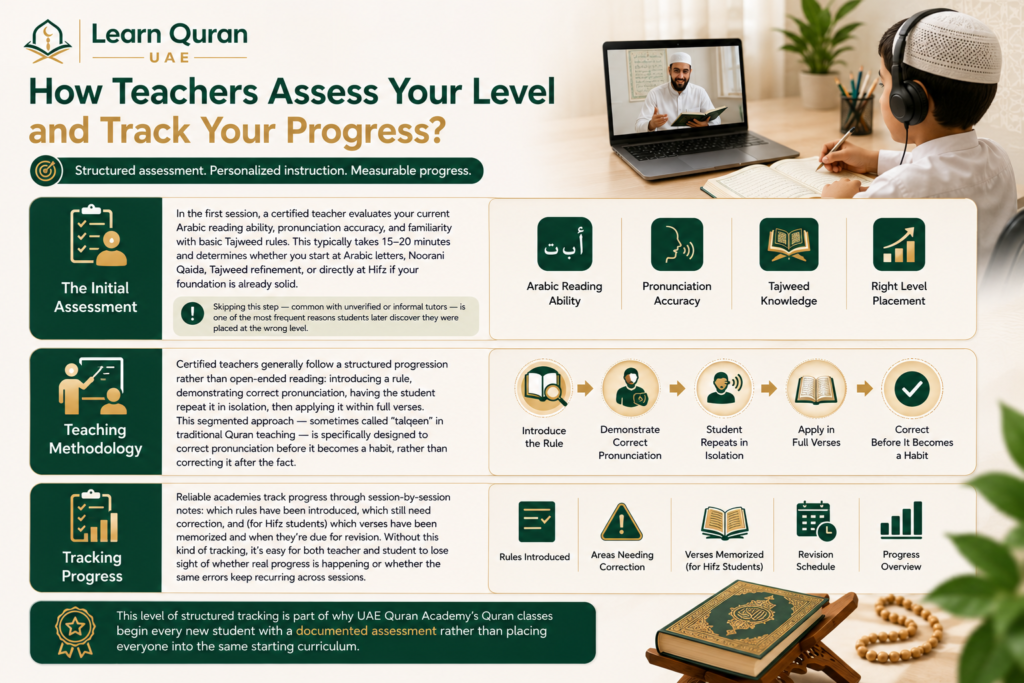
The Initial Assessment
In the first session, a certified teacher evaluates your current Arabic reading ability, pronunciation accuracy, and familiarity with basic Tajweed rules. This typically takes 15–20 minutes and determines whether you start at Arabic letters, Noorani Qaida, Tajweed refinement, or directly at Hifz if your foundation is already solid. Skipping this step — common with unverified or informal tutors — is one of the most frequent reasons students later discover they were placed at the wrong level.
Teaching Methodology
Certified teachers generally follow a structured progression rather than open-ended reading: introducing a rule, demonstrating correct pronunciation, having the student repeat it in isolation, then applying it within full verses. This segmented approach — sometimes called “talqeen” in traditional Quran teaching — is specifically designed to correct pronunciation before it becomes a habit, rather than correcting it after the fact.
Tracking Progress
Reliable academies track progress through session-by-session notes: which rules have been introduced, which still need correction, and (for Hifz students) which verses have been memorized and when they’re due for revision. Without this kind of tracking, it’s easy for both teacher and student to lose sight of whether real progress is happening or whether the same errors keep recurring across sessions.
This level of structured tracking is part of why UAE Quran Academy’s Quran classes begin every new student with a documented assessment rather than placing everyone into the same starting curriculum.
Benefits of Learning Quran Online in the UAE
Online Quran learning in the UAE has matured into a format with real, specific advantages — not just a fallback for when in-person isn’t convenient.
- Certified teachers, not just available ones. Reputable academies vet teacher credentials before assigning students, so quality doesn’t depend on geographic proximity.
- Flexible scheduling. Sessions can be booked early morning, late evening, or on weekends — useful for working adults and school-age children with packed schedules.
- Choice of male or female teacher. Online platforms make it straightforward to request a teacher matching your or your child’s preference.
- One-on-one sessions. Most online formats default to individual attention rather than group classes, which speeds up error correction significantly.
This combination — certified teachers, schedule flexibility, and one-on-one correction — is part of why online learning has become the default starting point for many UAE residents rather than a secondary option.
Read also: How to Learn the Quran? Step-by-Step Guide
See How Our Online Classes Work
Get a glimpse of a real online session and explore how students learn Quran with experienced teachers in a supportive and interactive environment.
Why Choose Learn Quran UAE Academy For learn Quran in the UAE?
UAE Quran Academy places every new student through a short assessment before assigning a teacher, so you start at the right stage — whether that’s Arabic letters, Noorani Qaida, Tajweed, or Hifz — rather than a fixed curriculum that ignores your actual level.
Teachers are certified, available for both male and female students, and sessions run on flexible scheduling built around your week. For families pursuing memorization specifically, the academy’s Hifz center program runs structured daily targets with built-in revision, so progress is tracked rather than left open-ended.
Our Online Quran Courses Include:
- Online Quran Classes in UAE
- Quran Classes for Kids
- Quran Classes for Adults
- Quran Classes for Ladies / Sisters
- Quran Classes for Men
- Quran Course for Beginners
- Quran Classes for Toddlers
- Weekend Quran Classes
- Intensive Quran Course
- Al-Azhar Quran Course
- Arabic & Quran Classes
- Zoom Quran Classes
- Skype Quran Classes
Start Learning Quran with Expert Tutors in the UAE
Accredited online Quran and Arabic classes tailored for adults and children. Schedule your session today.
Book Your Free TrialStart Your Quran Classes Today →

Conclusion
Learning Quran in the UAE follows a clear path: choose a method that fits your schedule (online, in-home, academy, or mosque), progress through the steps in order — Arabic letters, Noorani Qaida, Tajweed, fluent reading, then memorization — and pick an academy or teacher whose credentials and flexibility match your needs. Skipping steps or choosing an unverified teacher is the most common reason students restart later, so the structure above exists specifically to avoid that. With certified online and in-home options now widely available, the main step left is registering for your first assessment.
Frequently Asked Questions
How do I start learning Quran in the UAE if I don’t know Arabic at all?
Start by learning the Arabic alphabet, then move into Noorani Qaida, which teaches correct pronunciation of letters and combinations before you begin reading full verses — this sequence is essential for non-Arabic speakers specifically.
What’s the difference between online and in-person Quran classes in the UAE?
Online classes offer greater scheduling flexibility and remove commute time, while in-person classes provide a fixed routine and physical classroom structure — both can produce the same learning outcome if the teacher is properly certified.
Is online Quran learning suitable for young children?
Yes, many online academies offer child-specific teaching methods and can match children with teachers experienced in younger age groups, though some children benefit more from in-person structure depending on their attention span.
How long does it take to go from Arabic letters to reading the Quran fluently?
This varies by frequency of lessons and consistency, but most students with two to three sessions per week move from letter recognition through Noorani Qaida and basic Tajweed within a few months, with fluency developing over a longer period through continued practice.
Do UAE Quran academies offer both male and female teachers?
Yes, most reputable academies in the UAE offer a choice of male or female teachers, which is particularly relevant for adult women and families who prefer a specific gender match for their child’s teacher.
When should I move from reading the Quran to starting memorization (Hifz)?
You should move to Hifz only once a qualified teacher confirms your Tajweed pronunciation is consistently accurate, since memorizing with incorrect pronunciation usually means relearning the same verses correctly later.



Leave a Reply