 Hifz
Hifz

Every student who starts Hifz asks the same question sooner or later: why do some people memorize a page in a day while others take a week and still forget it by Friday? The difference is rarely talent. It’s method.
These tips on how to memorize the Quran faster are built around one principle: memorization and retention are two different skills, and most students only train the first one. You’ll learn how to structure your sessions, how to memorize a surah in a way that actually sticks, and how to stop the slow leak of forgetting that derails so many Hifz students after month three.
Allah describes His book as made easy for those who seek to remember it:
وَلَقَدْ يَسَّرْنَا الْقُرْآنَ لِلذِّكْرِ فَهَلْ مِن مُّدَّكِرٍ
“And We have certainly made the Qur’an easy for remembrance, so is there any who will remember?” — Surah Al-Qamar 54:17
Classical commentators read “made easy” as covering both the wording, which is easy to memorize, and the meaning, which is easy to understand for anyone who approaches it with sincere intent. That’s the premise of every technique below — the difficulty most students feel isn’t in the text itself, it’s in the method.
1. Start With the Right Intention Before You Memorize
Hifz is an act of worship before it’s a memory task, and that distinction affects how you approach setbacks. A student memorizing to please Allah treats a slow week as a normal part of the process. A student memorizing to prove something to others treats the same slow week as failure and quits.
Set your intention clearly before you begin: you are memorizing to preserve and carry the words of Allah, not to compete with a classmate’s pace or impress a parent. This isn’t a soft add-on — sincerity (ikhlas) is what sustains the discipline required through the harder stretches of Hifz, particularly past Juz 15, where most self-taught students slow down or stop.

2. Build a Daily Hifz Routine That Fits Your Life
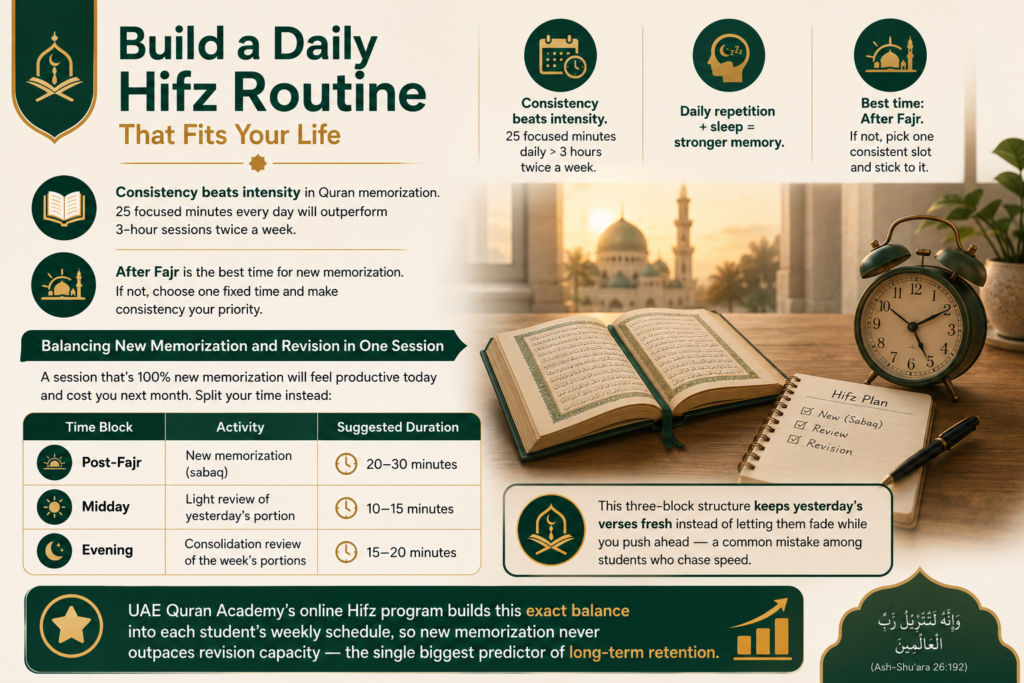
Consistency beats intensity in Quran memorization. A student who memorizes for 25 focused minutes every day will outperform one who does three-hour sessions twice a week, because the brain consolidates new memory during sleep — daily repetition gives it more consolidation cycles to work with.
The period after Fajr is widely recommended for new memorization, since the mind is rested and free of the day’s distractions. If Fajr isn’t practical for you, pick one consistent slot rather than memorizing at random hours — the routine itself is part of what makes memorization stick.
Balancing New Memorization and Revision in One Session
A session that’s 100% new memorization will feel productive today and cost you next month, because nothing is being reinforced. Split your time instead:
| Time Block | Activity | Suggested Duration |
| Post-Fajr | New memorization (sabaq) | 20–30 minutes |
| Midday | Light review of yesterday’s portion | 10–15 minutes |
| Evening | Consolidation review of the week’s portions | 15–20 minutes |
This three-block structure keeps yesterday’s verses fresh instead of letting them fade while you push ahead — a common mistake among students who chase speed and treat revision as optional.
UAE Quran Academy’s online Hifz program builds this exact balance into each student’s weekly schedule, so new memorization never outpaces revision capacity — the single biggest predictor of long-term retention.
3. Use Repetition, Recitation, and Listening to Lock In Verses
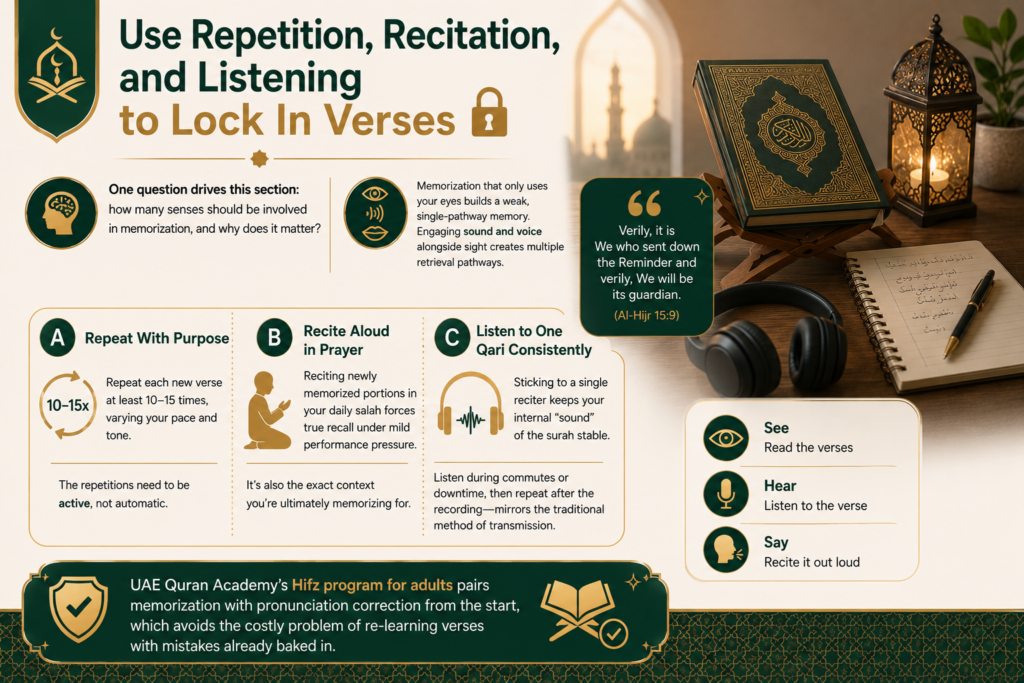
One question drives this section: how many senses should be involved in memorization, and why does it matter?
Memorization that only uses your eyes builds a weak, single-pathway memory. Engaging sound and voice alongside sight creates multiple retrieval pathways, so if one fails during recitation, another can still surface the verse.
A. Repeat With Purpose
Repeat each new verse at least 10–15 times, varying your pace and tone rather than droning it identically each time. Mechanical repetition without attention barely outperforms not repeating at all — the repetitions need to be active, not automatic.
B. Recite Aloud in Prayer
Reciting newly memorized portions in your daily salah is one of the most effective retention tools available, because it forces true recall under mild performance pressure, without a text in front of you. It’s also the exact context you’re ultimately memorizing for.
C. Listen to One Qari Consistently
Sticking to a single reciter’s style — rather than switching between several — keeps your internal “sound” of the surah stable, which speeds up both memorization and correct tajweed. Play the portion during commutes or downtime, then repeat after the recording; this mirrors the traditional method of Quran transmission from teacher to student.
For students working specifically on Tajweed alongside Hifz, UAE Quran Academy’s Hifz program for adults pairs memorization with pronunciation correction from the start, which avoids the common and costly problem of re-learning verses memorized with mistakes already baked in.
4. Revise Regularly So You Don’t Forget What You’ve Memorized
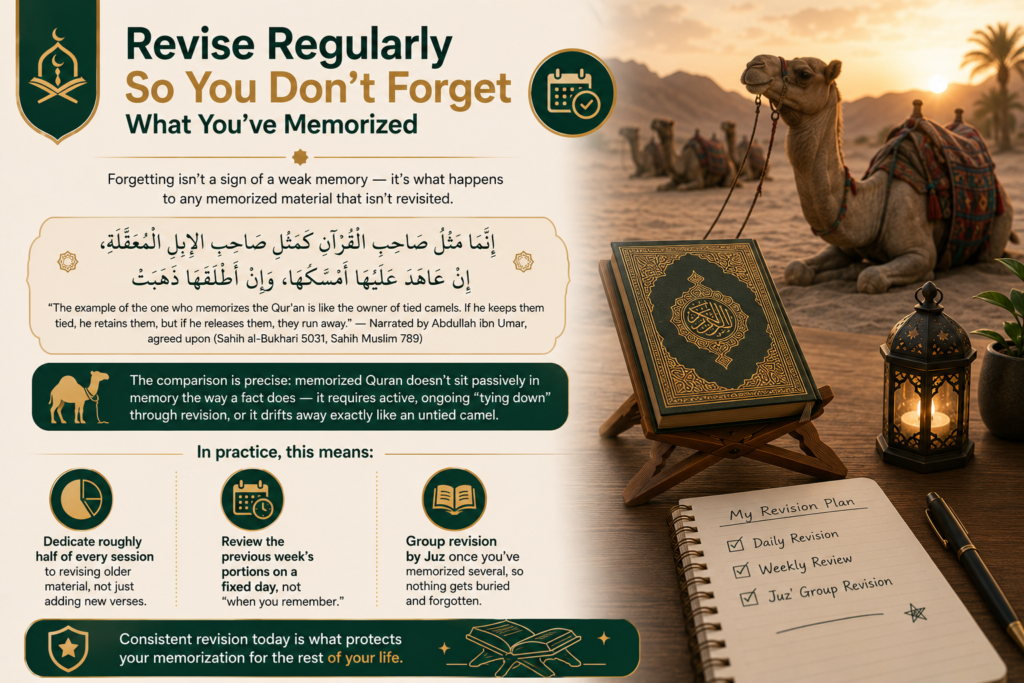
Forgetting isn’t a sign of a weak memory — it’s what happens to any memorized material that isn’t revisited. The Prophet ﷺ described this directly:
إِنَّمَا مَثَلُ صَاحِبِ الْقُرْآنِ كَمَثَلِ صَاحِبِ الْإِبِلِ الْمُعَقَّلَةِ، إِنْ عَاهَدَ عَلَيْهَا أَمْسَكَهَا، وَإِنْ أَطْلَقَهَا ذَهَبَتْ
“The example of the one who memorizes the Qur’an is like the owner of tied camels. If he keeps them tied, he retains them, but if he releases them, they run away.” — Narrated by Abdullah ibn Umar, agreed upon (Sahih al-Bukhari 5031, Sahih Muslim 789
The comparison is precise: memorized Quran doesn’t sit passively in memory the way a fact does — it requires active, ongoing “tying down” through revision, or it drifts away exactly like an untied camel.
In practice, this means:
- Dedicate roughly half of every session to revising older material, not just adding new verses.
- Review the previous week’s portions on a fixed day, not “when you remember.”
- Group revision by Juz once you’ve memorized several, so nothing gets buried and forgotten at the back of your memorized portions.
Read also: Juz Amma Memorization Plan – A Complete Step-by-Step Guide
5. Test Yourself Without Looking to Build Real Recall
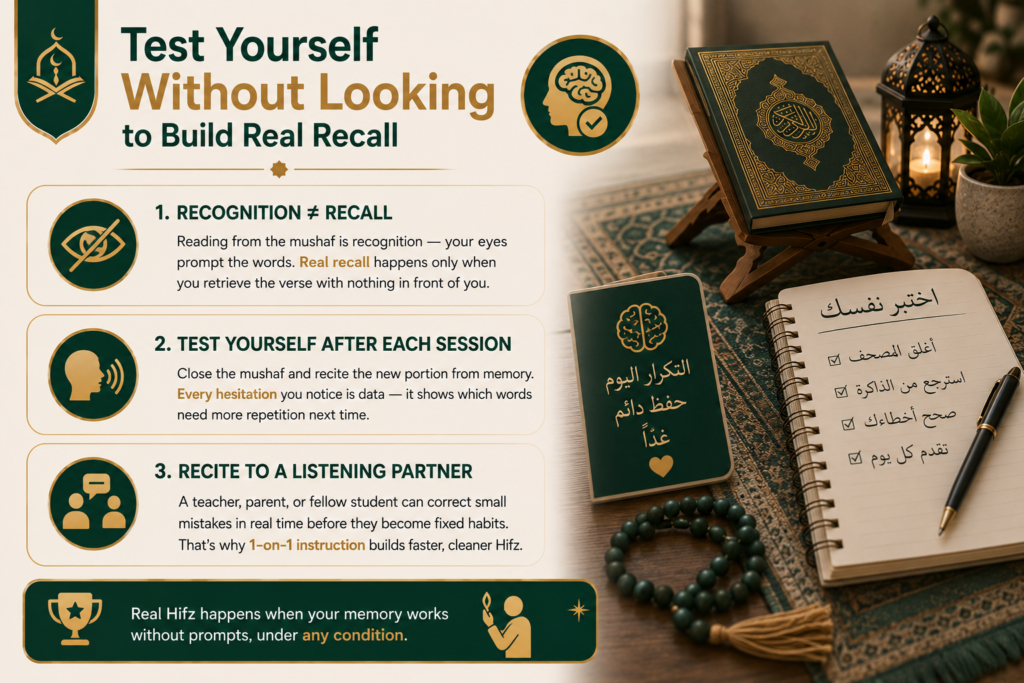
Reading a memorized verse from the mushaf feels like memorization, but it’s recognition — your eyes prompt the words rather than your memory producing them. Recall only strengthens when you retrieve the verse with nothing in front of you.
After each session, close the mushaf and recite the new portion from memory alone. Every hesitation you notice is data — it tells you exactly which words need more repetition next session, not the ones that came easily. Students who skip this step often discover their weak points for the first time mid-salah, which is the worst possible moment to find a gap.
Reciting to a listening partner — a teacher, parent, or fellow student — adds a layer testing yourself alone can’t replicate: real-time correction before a small mistake becomes a fixed habit. This is one reason 1-on-1 instruction tends to produce faster, cleaner Hifz results than group classes, where individual hesitations are easy to miss.
Experience a Live Quran Class
Watch a short sample from one of our online Quran classes and discover our engaging teaching style, interactive lessons, and personalized learning approach.
Start Learning Quran with Expert Tutors in the UAE
Accredited online Quran and Arabic classes tailored for adults and children. Schedule your session today.
Book Your Free Trial6. Track Your Progress With Measurable Milestones
A common but underestimated obstacle in Hifz isn’t cognitive difficulty — it’s not being able to see progress. Students who can’t measure how far they’ve come tend to lose consistency, which slows them down even further. Formal milestones fix this directly.
| Milestone | Example Achievement | Recommended Check |
| Weekly | A set number of new pages memorized | Log it and review Friday |
| Monthly | A complete surah memorized | Recite it fully to a teacher |
| Quarterly | A complete Juz memorized | Formal recitation test |
| Yearly | Several Juz completed | Ijazah-track review session |
This structure prevents the “endless effort, no visible result” feeling that causes many adult Hifz students to quietly stop — long before their skill level would justify it.
If you’re memorizing as a family, UAE Quran Academy’s Hifz program for kids uses the same milestone approach with age-appropriate recall tests at the end of each class, so gaps surface in a low-pressure classroom setting rather than during Salah at home.

7. Get a Qualified Teacher or Structured Hifz Program
Self-study can work, but a teacher shortens the path considerably by catching pronunciation errors before they become habits, and by keeping you accountable to a schedule you might otherwise let slip. This is especially true for adults balancing Hifz with work, and for children who need structure more than independence.
A structured program also solves the biggest weakness of self-study: nobody is listening. Silent, unchecked repetition can quietly reinforce a mispronounced word for months before anyone notices.
8. Healthy Habits That Support Faster Memorization
Memory retention is tied to physical state as much as method.
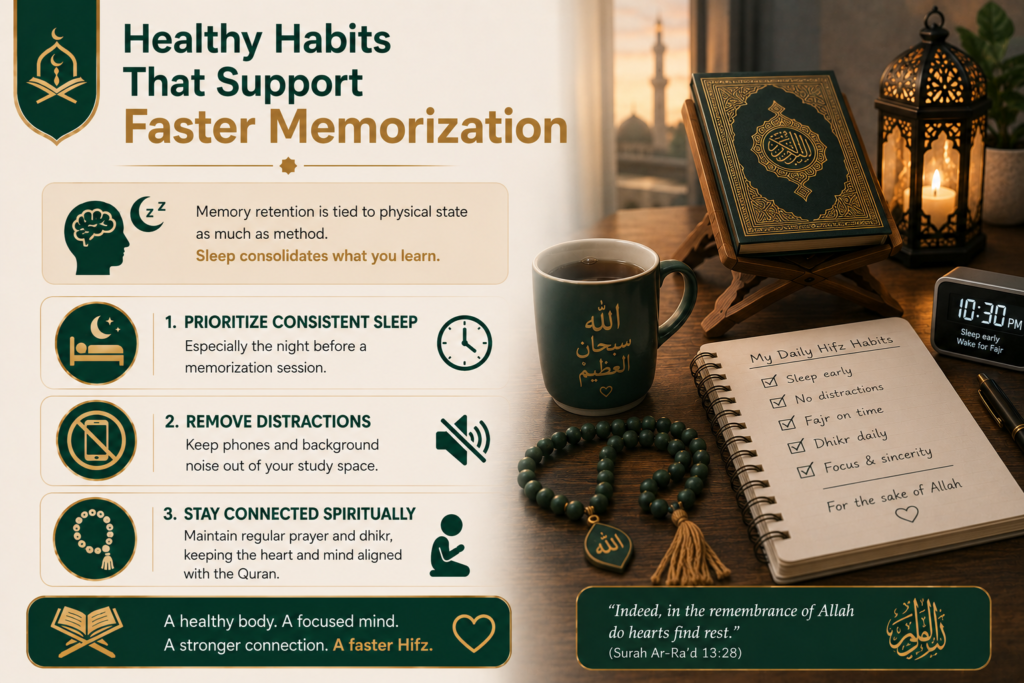
Sleep, in particular, is when the brain consolidates newly learned material — memorizing on too little sleep works against the exact process you’re relying on.
- Prioritize consistent sleep, especially the night before a memorization session.
- Keep phones and background noise out of your study space; divided attention weakens encoding.
- Maintain regular prayer and dhikr, which keeps the mind returning to the same spiritual frame the Quran itself is read in.
9. Break the Surah Into Small Portions
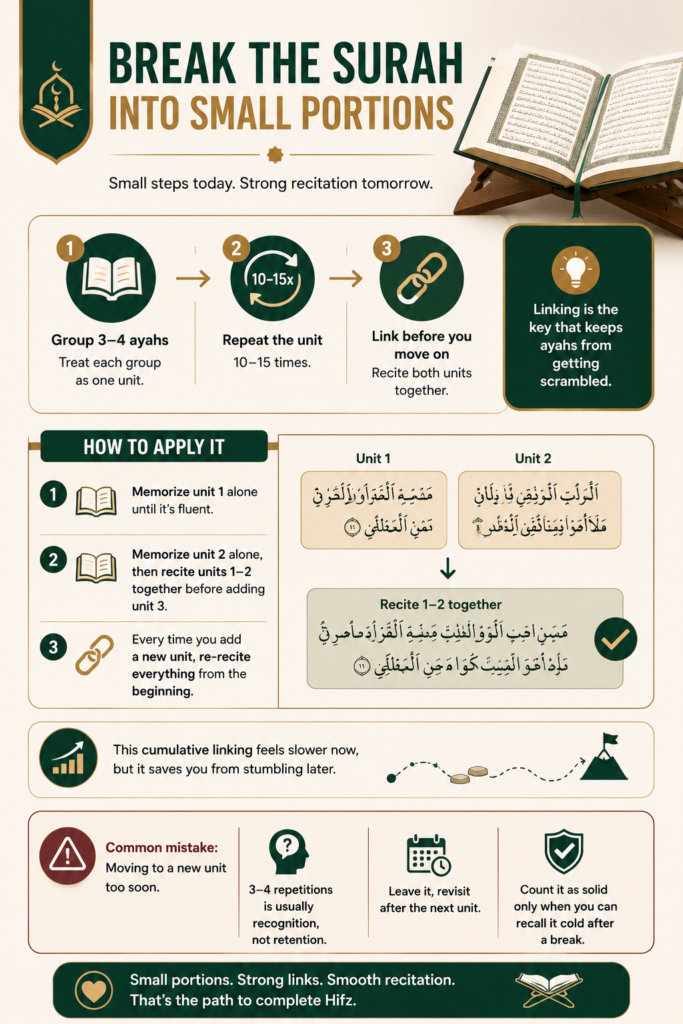
Divide the surah into groups of 3–4 ayahs and treat each group as its own unit. Repeat that unit 10–15 times before adding the next one, then recite both units together before moving on. This “linking” step is where most students skip ahead too fast — connecting new material to what’s already solid is what prevents ayahs from getting scrambled later.
For longer surahs, group by meaning rather than by a fixed ayah count. A verse that continues a sentence into the next ayah should stay in the same unit — splitting mid-thought makes both halves harder to recall independently.
A practical way to apply this:
- Memorize unit 1 alone until it’s fluent without looking.
- Memorize unit 2 alone, then recite units 1–2 together, start to finish, before adding unit 3.
- Every time you add a new unit, re-recite everything memorized so far in that session — not just the newest piece.
This “cumulative linking” is what most self-taught students miss. It feels slower in the first week because you’re re-reciting earlier units constantly, but it’s what prevents the common problem of knowing every ayah individually while being unable to recite the surah straight through without stumbling at the joins.
One common mistake worth naming directly: moving to a new unit as soon as the current one feels “memorized” after 3–4 repetitions. That’s usually recognition, not retention — the unit hasn’t survived a gap yet. Leave it, revisit it after the next unit, and only count it as solid once you can recall it cold after a break, not immediately after repeating it.
Read also: Best Country to Learn Quran
10. Understand the Meaning Before You Repeat
Reading a short tafsir or translation of the surah before you memorize gives the words a logical thread to follow, rather than a string of disconnected sounds. Verses that are understood are recalled through meaning, not just rote sound — which is why students who study tafsir alongside Hifz typically retain material with fewer repetitions than those who memorize blind.
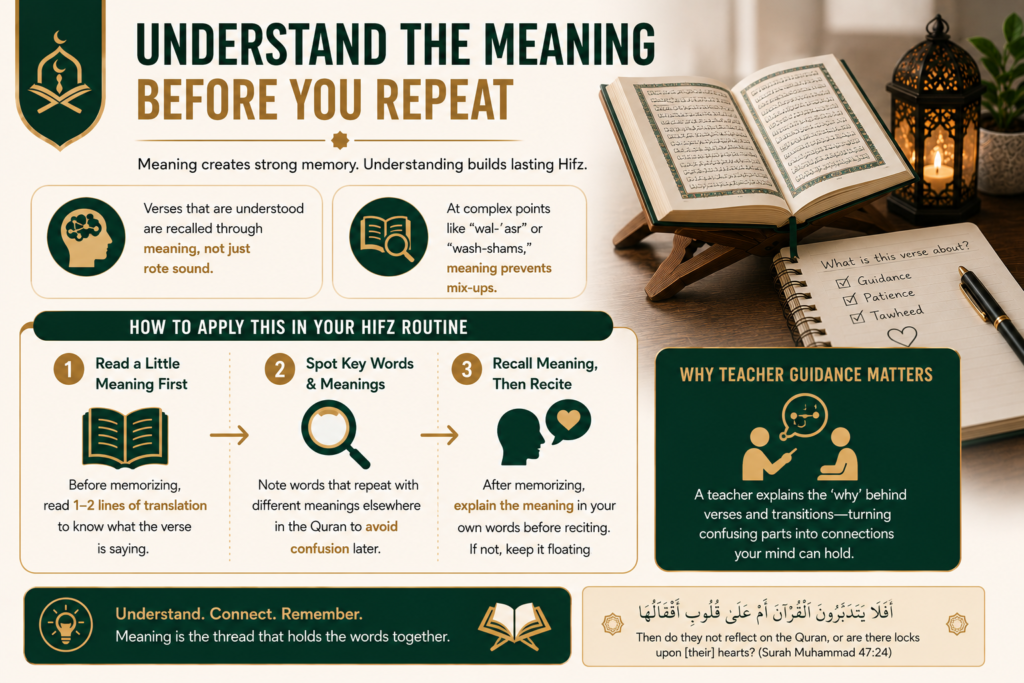
This matters most at points where Arabic sentence structure differs sharply from the reader’s native language — conditional clauses, oath structures (“wal-‘asr,” “wash-shams”), or verses with an implied subject that only becomes clear from context. Memorizing these purely by sound, without knowing what’s being said, is where confusion between similar-sounding ayahs usually starts.
A simple way to build this in without turning every session into a tafsir study:
- Before memorizing a new portion, read one or two lines of translation for it — not a full commentary, just enough to know what the verse is saying.
- Note any word that repeats with a different meaning elsewhere in the Quran (a frequent source of mix-ups), and mark it mentally as you memorize.
- After the portion is memorized, briefly recall the meaning in your own words before reciting it. If you can’t explain what you just memorized, the words are still floating on sound alone.
This step is also where a teacher adds real value beyond correction: pointing out the meaning behind a difficult transition, or why one ayah logically follows another, turns two verses that felt arbitrary into a sequence the mind can actually hold onto.
See How Our Online Classes Work
Get a glimpse of a real online session and explore how students learn Quran with experienced teachers in a supportive and interactive environment.
Start Your Hifz Journey With UAE Quran Academy Today
You don’t need to guess your way through Hifz or rebuild a routine from scratch. UAE Quran Academy pairs every student with a certified teacher, a schedule built around your actual availability, and 1-on-1 correction that catches mistakes before they become habits — for kids, adults, and busy professionals alike.
Every plan starts with a placement conversation, not a fixed curriculum handed to everyone the same way. Your teacher builds your sabaq-and-muraja’ah balance around how much time you actually have in a day, not an idealized schedule you’ll abandon in week two — which is the single biggest reason self-guided Hifz attempts stall out.
Book your free trial Hifz class now →
Our Quran Memorization Courses
- Quran Memorization (Hifz) Course
- Hifz for Kids Course
- Hifz for Adults Course
- Hifz for Ladies / Sisters Course
- Hifz for Men Course
- Quran Memorization Center (UAE)
- Juz Amma Memorization Program
- Hifz Completion & Hafiz Certification
Enroll today and begin your journey toward becoming a Hafiz with expert guidance, personalized learning plans, and flexible online classes.
Start Learning Quran with Expert Tutors in the UAE
Accredited online Quran and Arabic classes tailored for adults and children. Schedule your session today.
Book Your Free Trial
Conclusion
Faster Quran memorization isn’t about longer hours — it’s about a routine that balances new memorization with revision, active recall instead of passive reading, and understanding meaning instead of memorizing sound alone. Whether you’re working through your first short surah or pushing toward completing the whole Quran, the same principles apply: consistency, structured repetition, honest self-testing, and revision that never stops once material is “learned.”
Sincerity and patience carry you through the slow weeks; method is what determines how fast the fast weeks actually are. Put both together, with the right guidance alongside you, and the goal of becoming a Hafiz of the Quran moves from distant to realistic.
FAQs
How long does it take to memorize the Quran?
Timelines vary widely based on daily consistency, age, and prior Arabic reading ability, but most structured programs plan for one to three years of daily study. Students who revise consistently alongside new memorization tend to finish faster than those who memorize quickly but skip revision.
What is the best age to start memorizing the Quran?
There’s no fixed minimum age — children as young as five or six can begin with short surahs, while adults can start Hifz at any stage of life. What matters more than age is a consistent daily routine and correct pronunciation from the start.
How many times should I repeat a verse to memorize it?
Repeating each new verse 10–15 times with focused attention is a common benchmark, though the number varies by verse length and individual memory. What matters more than a fixed count is testing recall without looking after each repetition round.
Why do I keep forgetting Quran I’ve already memorized?
Forgetting happens when memorized material isn’t revisited regularly — it’s the natural result of skipping muraja’ah, not a sign of weak memory. Building revision into every session, not just new memorization, is the direct fix.
Should I understand the meaning of verses while memorizing?
Yes — understanding the meaning gives the words a logical structure to follow, which makes them easier to recall than memorizing sound alone. Reading a short tafsir or translation before memorizing a surah is a practical way to build that understanding.
Is it better to memorize alone or with a teacher?
A teacher speeds up the process by correcting mistakes in real time and keeping you accountable to a schedule, which self-study struggles to replicate. Reciting to another person also activates recall differently than silent self-testing, which strengthens retention.


Leave a Reply