 Quran
Quran

Open the Quran looking for a quick answer, and you’ll find something bigger: a complete way of living. What we learn from the Quran isn’t a list of rules to memorize and forget — it’s a practical guide for how to treat your parents, handle your temper, speak to strangers, and find peace when life falls apart. These lessons shape how a believer prays, works, forgives, and hopes.
This article walks through the core lessons the Quran teaches, grounded in the verses themselves, with the Arabic text, transliteration, English translation, and exact surah and ayah reference for every citation.
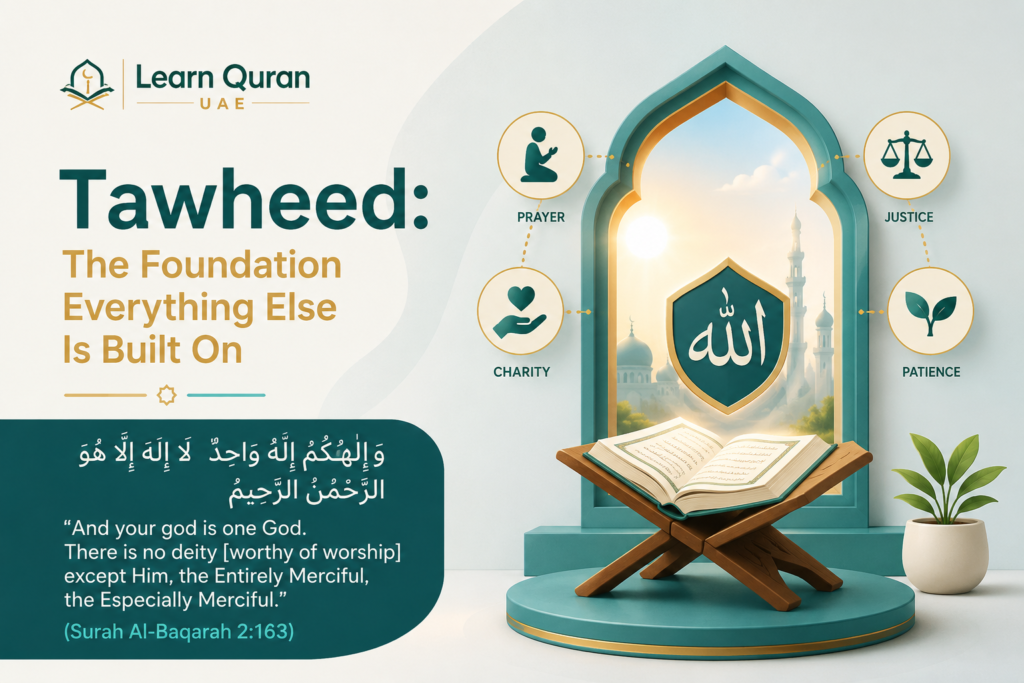
1. Tawheed: The Foundation Everything Else Is Built On
Tawheed is the belief in the absolute oneness of Allah — that He has no partners, no equals, and no need for intermediaries between Himself and His creation. Every other lesson in the Quran rests on this one. Prayer, charity, patience, justice — none of it makes sense without first establishing who you’re doing it for.
وَإِلَٰهُكُمْ إِلَٰهٌ وَاحِدٌ ۖ لَّا إِلَٰهَ إِلَّا هُوَ الرَّحْمَٰنُ الرَّحِيمُ
Wa ilāhukum ilāhun wāḥid, lā ilāha illā huwa ar-Raḥmānu ar-Raḥīm. “
And your god is one God. There is no deity [worthy of worship] except Him, the Entirely Merciful, the Especially Merciful.” (Surah Al-Baqarah 2:163)
The practical effect of Tawheed is that it removes a particular kind of fear — the fear of what people think, what they can take from you, or how they judge you. If Allah alone controls outcomes, seeking the approval of people loses its grip on you. This is why Tawheed isn’t an abstract doctrine; it’s the psychological foundation for everything else the Quran teaches about confidence, humility, and trust.
How Tawheed Changes Daily Decisions?
A believer who has internalized Tawheed makes decisions differently — not based on “what will people say” but “what does Allah want here.” That single shift removes a layer of anxiety most people carry without naming it. It also explains why children raised with a clear understanding of Tawheed, often through structured Quran classes for kids, tend to develop a steadier sense of identity than those who absorb faith only as a set of disconnected rituals.
2. Justice: A Standard the Quran Applies Even Against Yourself
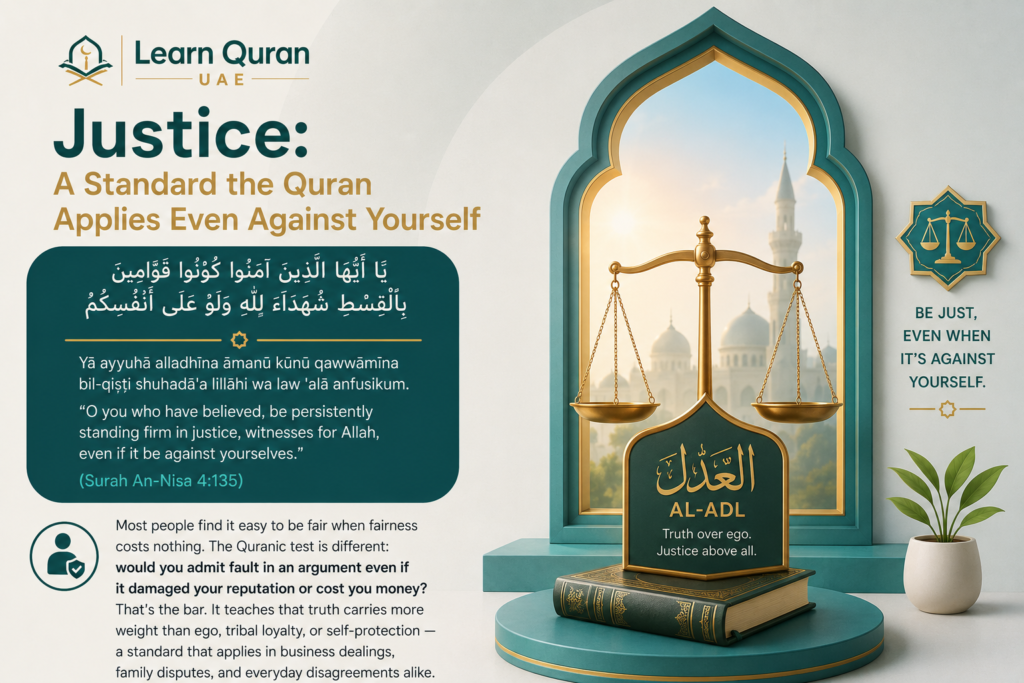
Justice in the Quran isn’t situational — it doesn’t bend for friends, family, or self-interest. The standard set is uncomfortable by design: be just even when it costs you.
يَا أَيُّهَا الَّذِينَ آمَنُوا كُونُوا قَوَّامِينَ بِالْقِسْطِ شُهَدَاءَ لِلَّهِ وَلَوْ عَلَىٰ أَنفُسِكُمْ
Yā ayyuhā alladhīna āmanū kūnū qawwāmīna bil-qisṭi shuhadā’a lillāhi wa law ‘alā anfusikum. “
O you who have believed, be persistently standing firm in justice, witnesses for Allah, even if it be against yourselves.” (Surah An-Nisa 4:135)
Most people find it easy to be fair when fairness costs nothing. The Quranic test is different: would you admit fault in an argument even if it damaged your reputation or cost you money? That’s the bar. It teaches that truth carries more weight than ego, tribal loyalty, or self-protection — a standard that applies in business dealings, family disputes, and everyday disagreements alike.
3. Patience (Sabr): An Active Tool, Not Passive Suffering
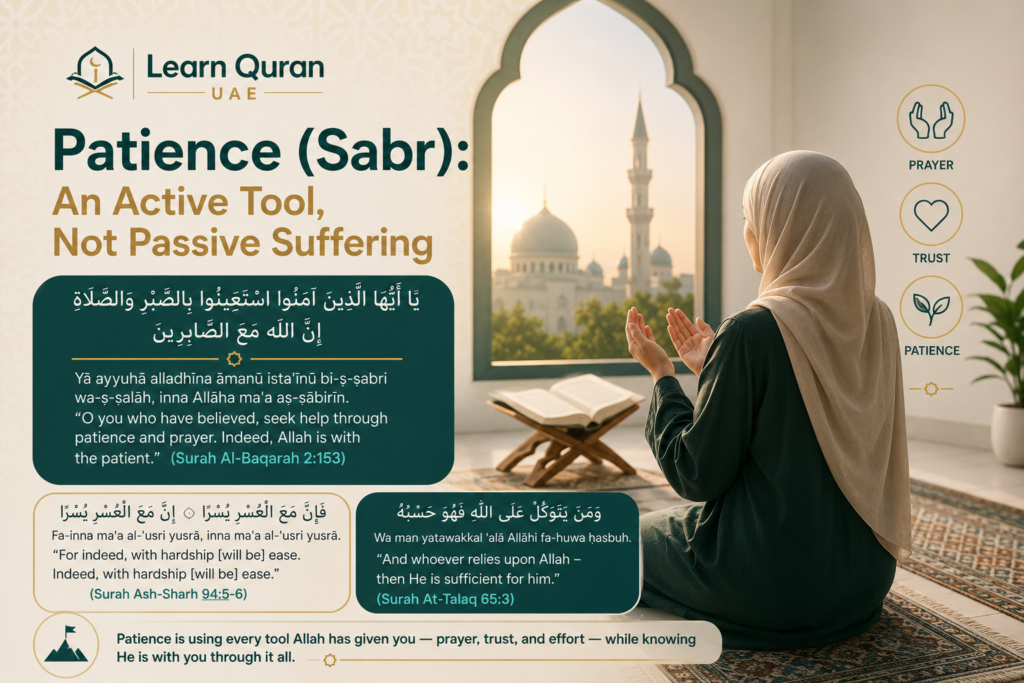
Sabr is commonly misunderstood as quiet endurance — sitting still and absorbing pain. The Quran frames it differently: patience is something you actively use, a tool for getting through hardship rather than a state of resignation.
يَا أَيُّهَا الَّذِينَ آمَنُوا اسْتَعِينُوا بِالصَّبْرِ وَالصَّلَاةِ ۚ إِنَّ اللَّهَ مَعَ الصَّابِرِينَ
Yā ayyuhā alladhīna āmanū ista’īnū bi-ṣ-ṣabri wa-ṣ-ṣalāh, inna Allāha ma’a aṣ-ṣābirīn. “
O you who have believed, seek help through patience and prayer. Indeed, Allah is with the patient.” (Surah Al-Baqarah 2:153)
Notice the phrasing: “seek help through patience.” It’s positioned as a method, paired directly with prayer, not as a separate virtue you either have or don’t. The Quran reinforces this with one of its most quoted promises:
فَإِنَّ مَعَ الْعُسْرِ يُسْرًا إِنَّ مَعَ الْعُسْرِ يُسْرًا
Fa-inna ma’a al-‘usri yusrā, inna ma’a al-‘usri yusrā. “
For indeed, with hardship [will be] ease. Indeed, with hardship [will be] ease.” (Surah Ash-Sharh 94:5-6)
A common mistake people make with this verse is reading it as a guarantee that hardship will simply disappear. The more accurate reading, consistent with classical tafsir, is that ease arrives alongside hardship — not necessarily after it. That distinction matters practically: it means you’re meant to function and find moments of relief even while the difficulty is still present, not wait passively for it to end before living normally again.
Why Patience and Trust in Allah Are Taught Together?
The Quran rarely discusses patience in isolation — it’s almost always paired with trust (Tawakkul), because patience without trust collapses into bitterness. Tawakkul means doing your best with full effort and then releasing the outcome.
وَمَن يَتَوَكَّلْ عَلَى اللَّهِ فَهُوَ حَسْبُهُ
Wa man yatawakkal ‘alā Allāhi fa-huwa ḥasbuh.
And whoever relies upon Allah – then He is sufficient for him.” (Surah At-Talaq 65:3)
This isn’t passivity. Tawakkul doesn’t mean skipping the work — it means putting in the effort and then letting go of the anxiety over what you can’t control. Women navigating major life transitions — career changes, raising children, caring for aging parents — often find this lesson especially grounding, which is part of why structured study through Quran classes for ladies tends to focus heavily on Sabr and Tawakkul together rather than teaching them as separate topics.
4. Gratitude: A Mindset the Quran Ties Directly to Increase
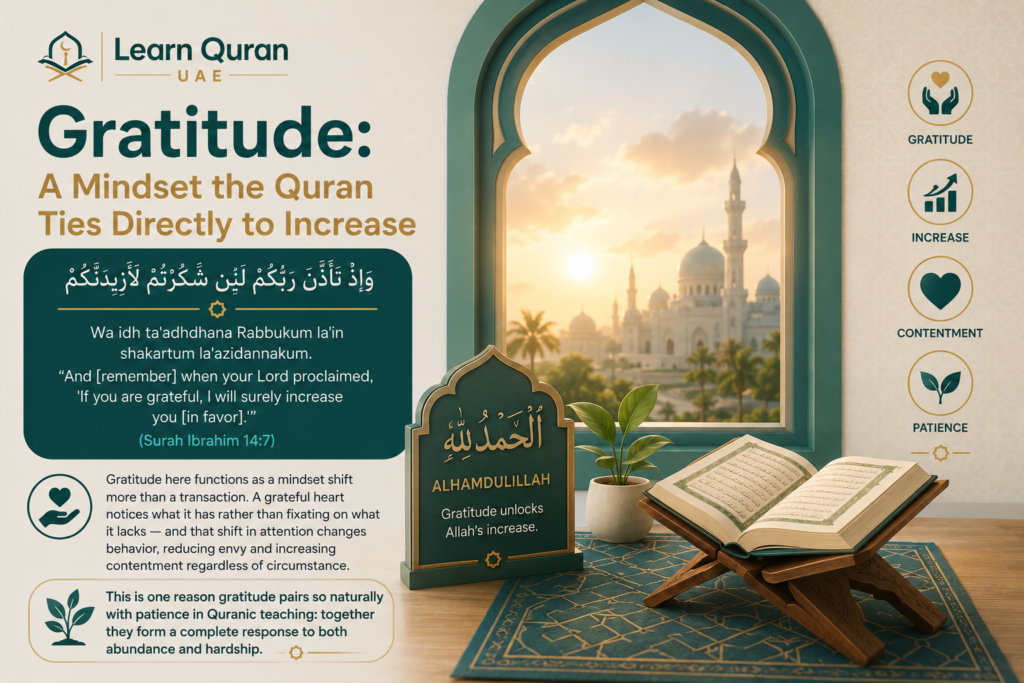
Gratitude in the Quran isn’t framed as a polite afterthought — it’s tied directly to a promise of increase.
وَإِذْ تَأَذَّنَ رَبُّكُمْ لَئِن شَكَرْتُمْ لَأَزِيدَنَّكُمْ
Wa idh ta’adhdhana Rabbukum la’in shakartum la’azīdannakum.
“And [remember] when your Lord proclaimed, ‘If you are grateful, I will surely increase you [in favor].'” (Surah Ibrahim 14:7)
Gratitude here functions as a mindset shift more than a transaction. A grateful heart notices what it has rather than fixating on what it lacks — and that shift in attention changes behavior, reducing envy and increasing contentment regardless of circumstance. This is one reason gratitude pairs so naturally with patience in Quranic teaching: together they form a complete response to both abundance and hardship.
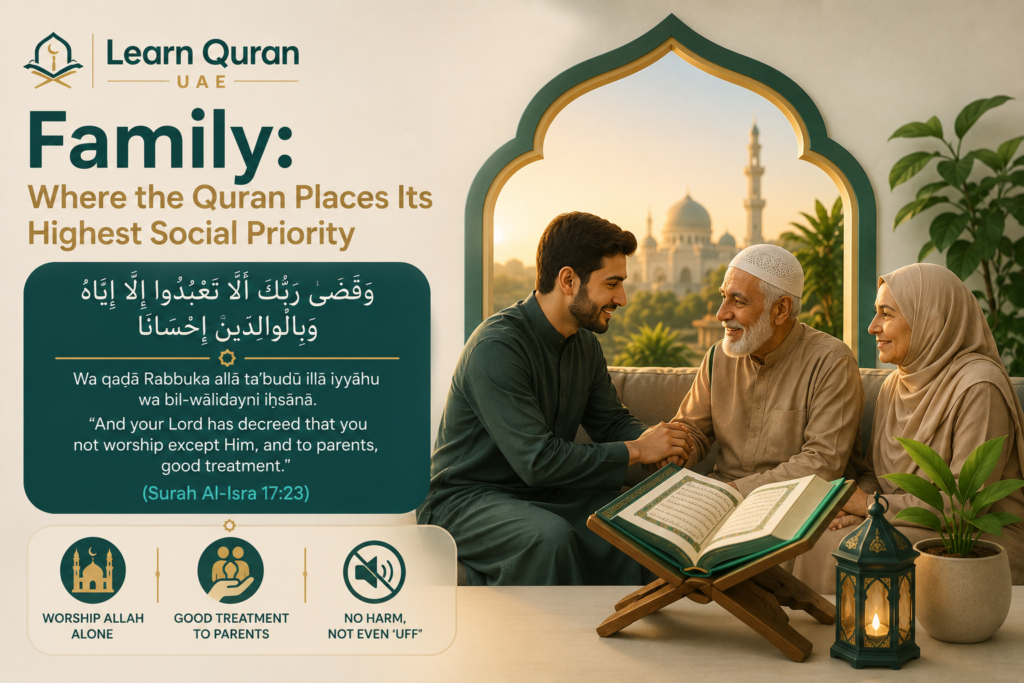
5. Family: Where the Quran Places Its Highest Social Priority
The Quran places kindness to parents directly beside the command to worship Allah alone — a sequencing choice that signals priority.
وَقَضَىٰ رَبُّكَ أَلَّا تَعْبُدُوا إِلَّا إِيَّاهُ وَبِالْوَالِدَيْنِ إِحْسَانًا
Wa qaḍā Rabbuka allā ta’budū illā iyyāhu wa bil-wālidayni iḥsānā.
“And your Lord has decreed that you not worship except Him, and to parents, good treatment.” (Surah Al-Isra 17:23)
A frequent misreading of this verse stops at “be kind to parents.” The actual command, continued in the following ayah, goes further — prohibiting even a sound of irritation (“uff”) toward them. That’s a specific behavioral standard, not a vague suggestion. It teaches emotional regulation in exactly the relationship where people often let their guard down the most.
Read also: What Is Ijazah & Its Types, Importance And How to Get?
Experience a Live Quran Class
Watch a short sample from one of our online Quran classes and discover our engaging teaching style, interactive lessons, and personalized learning approach.
Start Learning Quran with Expert Tutors in the UAE
Accredited online Quran and Arabic classes tailored for adults and children. Schedule your session today.
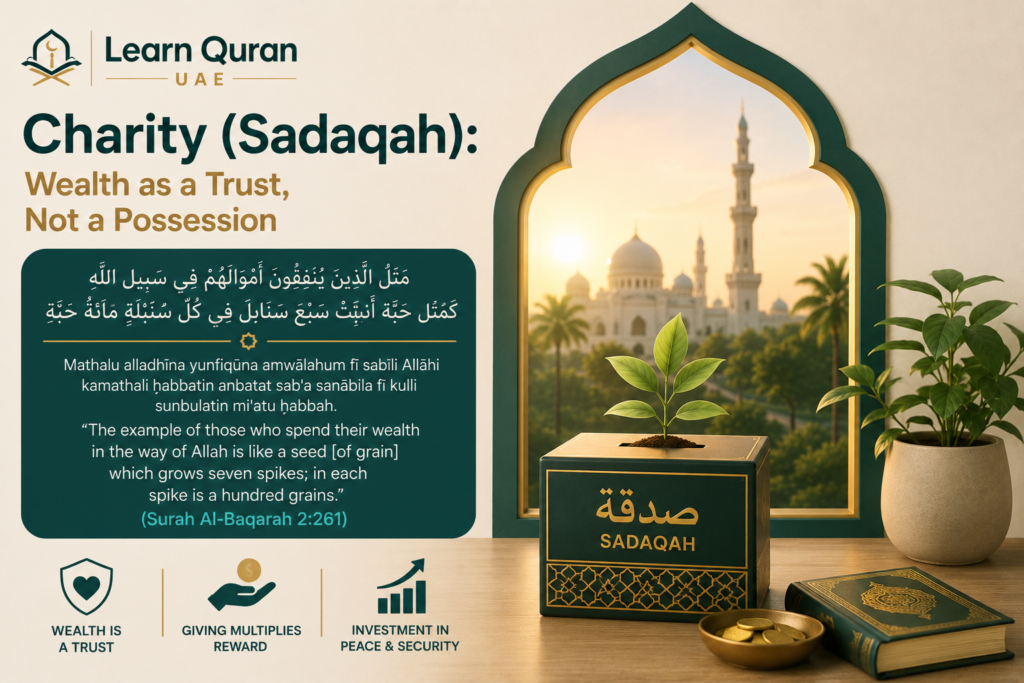
Book Your Free Trial6. Charity (Sadaqah): Wealth as a Trust, Not a Possession
The Quran reframes wealth as something held in trust rather than something fully owned — and it describes giving in terms of multiplication, not subtraction.
مَّثَلُ الَّذِينَ يُنفِقُونَ أَمْوَالَهُمْ فِي سَبِيلِ اللَّهِ كَمَثَلِ حَبَّةٍ أَنبَتَتْ سَبْعَ سَنَابِلَ فِي كُلِّ سُنبُلَةٍ مِّائَةُ حَبَّةٍ
Mathalu alladhīna yunfiqūna amwālahum fī sabīli Allāhi kamathali ḥabbatin anbatat sab’a sanābila fī kulli sunbulatin mi’atu ḥabbah.
“The example of those who spend their wealth in the way of Allah is like a seed [of grain] which grows seven spikes; in each spike is a hundred grains.” (Surah Al-Baqarah 2:261)
The math described here doesn’t follow ordinary accounting logic, and that’s the point — the verse is describing a spiritual return, not a literal multiplication of currency. Practically, this lesson shifts giving from an obligation into a form of investment in long-term peace of mind, since holding tightly to material things tends to produce anxiety rather than security.
7. Forgiveness: Letting Go as a Form of Self-Liberation
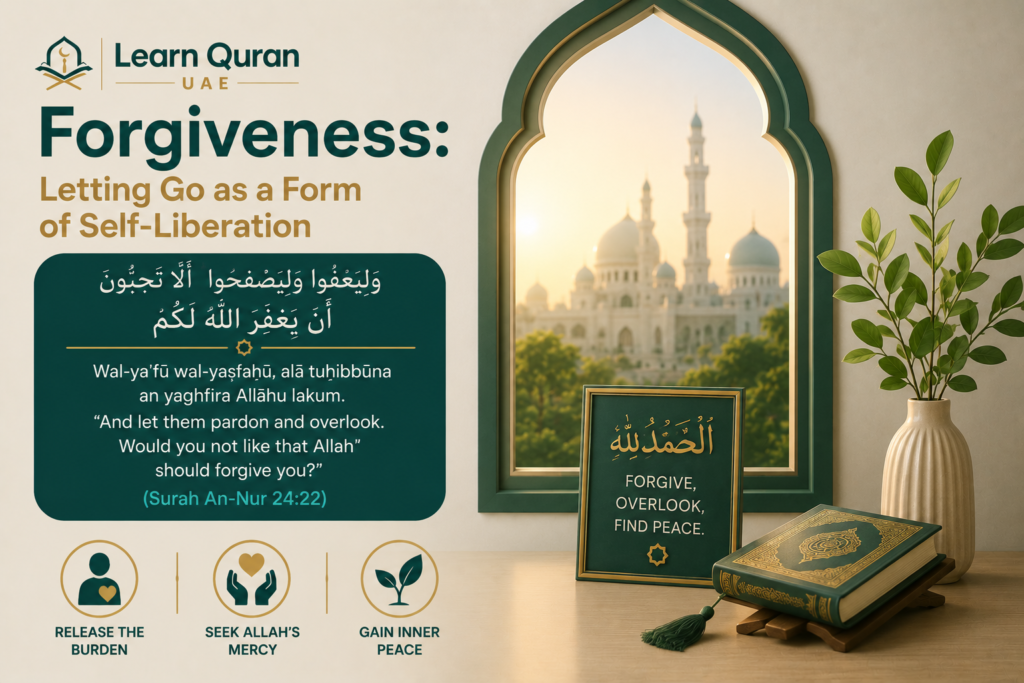
The Quran’s case for forgiveness isn’t built on the offender deserving it — it’s built on the forgiver’s own need for peace and for Allah’s mercy.
وَلْيَعْفُوا وَلْيَصْفَحُوا ۗ أَلَا تُحِبُّونَ أَن يَغْفِرَ اللَّهُ لَكُمْ
Wal-ya’fū wal-yaṣfaḥū, alā tuḥibbūna an yaghfira Allāhu lakum.
“And let them pardon and overlook. Would you not like that Allah should forgive you?” (Surah An-Nur 24:22)
This question functions almost like a mirror: it reframes forgiveness not as weakness but as self-interest aligned with a higher principle. Holding a grudge is described elsewhere in Islamic teaching as carrying a weight — and the Quran’s logic here is that releasing that weight benefits the person holding it as much as the person being forgiven.
8. Protecting Others: What the Quran Says About Gossip and Privacy
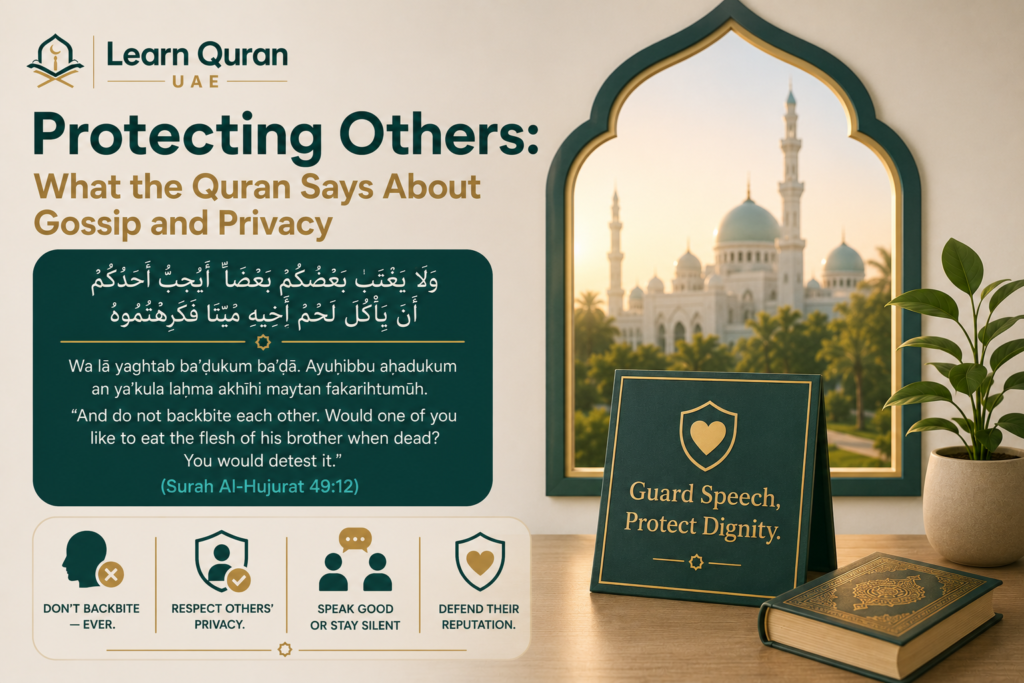
The Quran uses one of its most graphic metaphors in the entire text to describe backbiting (gheebah) — comparing it to eating the flesh of a dead relative.
وَلَا يَغْتَب بَّعْضُكُم بَعْضًا ۚ أَيُحِبُّ أَحَدُكُمْ أَن يَأْكُلَ لَحْمَ أَخِيهِ مَيْتًا فَكَرِهْتُمُوهُ
Wa lā yaghtab ba’ḍukum ba’ḍā. Ayuḥibbu aḥadukum an ya’kula laḥma akhīhi maytan fakarihtumūh.
“And do not backbite each other. Would one of you like to eat the flesh of his brother when dead? You would detest it.” (Surah Al-Hujurat 49:12)
The severity of the imagery here is deliberate — gossip is treated not as casual conversation but as a genuine violation of another person’s dignity, even when what’s said is factually true. The lesson extends into a positive duty as well: defending someone’s reputation when they’re not present to defend it themselves.
9. Honoring Promises
The Quran treats promises and contracts as binding obligations, not flexible social niceties.
يَا أَيُّهَا الَّذِينَ آمَنُوا أَوْفُوا بِالْعُقُودِ
Yā ayyuhā alladhīna āmanū awfū bil-‘uqūd.
“O you who have believed, fulfill [all] contracts.” (Surah Al-Ma’idah 5:1)
This principle applies at every scale — from formal business contracts down to a small promise made to a child. The implementation detail worth noting: scholars generally read this command as covering both explicit agreements and implied social commitments, meaning reliability itself becomes a marker of faith, not just a personality trait.
This same emphasis on consistency and follow-through is part of why structured learning works better than sporadic self-study. Adults returning to faith-based study after years away often benefit from the accountability built into Quran classes for adults, where a fixed schedule mirrors the discipline the Quran asks of its readers in other areas of life.

Read also: Best Country to Learn Quran
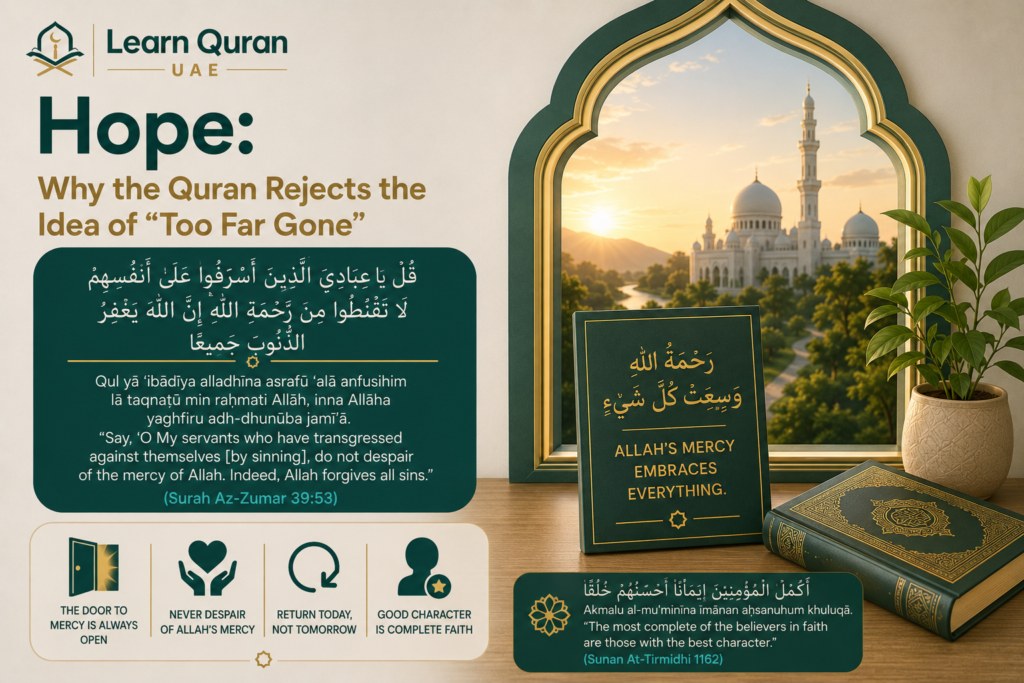
10. Hope: Why the Quran Rejects the Idea of “Too Far Gone”
The Quran directly addresses the fear of being permanently disqualified from mercy — and rejects it without qualification.
قُلْ يَا عِبَادِيَ الَّذِينَ أَسْرَفُوا عَلَىٰ أَنفُسِهِمْ لَا تَقْنَطُوا مِن رَّحْمَةِ اللَّهِ ۚ إِنَّ اللَّهَ يَغْفِرُ الذُّنُوبَ جَمِيعًا
Qul yā ‘ibādiya alladhīna asrafū ‘alā anfusihim lā taqnaṭū min raḥmati Allāh, inna Allāha yaghfiru adh-dhunūba jamī’ā.
“Say, ‘O My servants who have transgressed against themselves [by sinning], do not despair of the mercy of Allah. Indeed, Allah forgives all sins.'” (Surah Az-Zumar 39:53)
This is reinforced in hadith literature, where good character itself is held up as a marker of complete faith:
أَكْمَلُ الْمُؤْمِنِينَ إِيمَانًا أَحْسَنُهُمْ خُلُقًا
Akmalu al-mu’minīna īmānan aḥsanuhum khuluqā.
“The most complete of the believers in faith are those with the best character.” (Sunan At-Tirmidhi 1162)
The practical takeaway here is straightforward: despair itself is treated as a spiritual error, not a realistic response to having sinned. As long as someone is alive, the door to returning is described as open — no waiting period, no minimum requirement met first.
See How Our Online Classes Work
Get a glimpse of a real online session and explore how students learn Quran with experienced teachers in a supportive and interactive environment.
Build a Real Connection With These Lessons — Not Just a Reading List
Reading about these lessons is a starting point. Living them requires actually understanding the Arabic, the context behind each verse, and how scholars across centuries have applied them — which is difficult to do alone with a translation and good intentions.
UAE Quran Academy connects students with qualified, native Arabic-speaking tutors who teach Tajweed, Tafsir, and Quranic Arabic in a structured, one-on-one format. Whether you’re starting from the basics or want to go deeper into the meanings behind these verses, your first class is built around where you actually are — not a fixed curriculum that assumes prior knowledge you may not have.
[Book Your Free Trial Class Today]
Our Online Quran Courses Include:
- Online Quran Classes in UAE
- Quran Classes for Kids
- Quran Classes for Adults
- Quran Classes for Ladies / Sisters
- Quran Classes for Men
- Quran Course for Beginners
- Quran Classes for Toddlers
- Weekend Quran Classes
- Intensive Quran Course
- Al-Azhar Quran Course
- Arabic & Quran Classes
- Zoom Quran Classes
- Skype Quran Classes
Start Learning Quran with Expert Tutors in the UAE
Accredited online Quran and Arabic classes tailored for adults and children. Schedule your session today.
Book Your Free Trial
Conclusion
What we learn from the Quran isn’t a static list — it’s a connected framework. Tawheed anchors everything; justice and honesty govern how you treat others, even at personal cost; patience and trust in Allah carry you through hardship without bitterness; gratitude shapes how you see what you already have. Family, charity, and honoring your word build the social fabric the Quran insists faith must produce, not just private belief.
Forgiveness and the refusal to despair tie the whole framework together — they exist because no one applies any of this perfectly, and the Quran accounts for that. Each lesson here comes from the text itself, verified against its exact surah and ayah, because what we learn from the Quran should be grounded in what it actually says, not in a vague impression of what it might mean. Studying these verses with proper guidance turns them from interesting ideas into a working part of daily life.
FAQs
What is the single most important lesson the Quran teaches?
Tawheed — the oneness of Allah — is the foundational lesson, because every other teaching in the Quran, from justice to patience to charity, is built on the premise of complete reliance on and accountability to one God. Without this foundation, the other lessons function as ethics without a spiritual anchor.
What does the Quran say about dealing with hardship?
The Quran teaches that ease accompanies hardship rather than simply following it, as stated in Surah Ash-Sharh (94:5-6): “For indeed, with hardship [will be] ease.” Patience (Sabr) is presented as an active tool for getting through difficulty, not passive endurance.
Does the Quran say forgiveness is required even if someone doesn’t deserve it?
Yes. Surah An-Nur (24:22) frames forgiveness as something the forgiver needs for their own peace and as a path to receiving Allah’s forgiveness, independent of whether the offending party has earned it.
How does the Quran address people who feel they’ve sinned too much to return to faith?
Surah Az-Zumar (39:53) directly rejects this fear, stating that Allah forgives all sins and instructing believers never to despair of His mercy. Despair itself is treated as a spiritual error rather than a realistic conclusion.
Where can I verify these Quran and hadith citations myself?
Every verse cited in this article includes its exact surah and ayah number and a direct link to quran.com, and the hadith citation links to sunnah.com, both of which are widely used platforms for verifying authentic Quranic text and hadith chains.

Leave a Reply