 Tajweed
Many Muslims ask whether Tajweed is obligatory the first time they sit with the Quran and realize how many rules exist for pronouncing a single letter. The honest answer is not a flat yes or no — it depends on which mistake you’re talking about and which layer of Tajweed you mean.
Some errors change the actual meaning of Allah’s words, and correcting them is a duty on every Muslim without exception. Other rules refine and beautify recitation, and scholars are divided on how binding they are. Getting this distinction right is what actually answers the question “is Tajweed obligatory” — not picking a side in an oversimplified debate.
Tajweed is obligatory to the extent that it prevents mistakes that change the meaning of the Quran’s words — this part is agreed upon by scholarly consensus. The detailed, technical rules that refine and beautify recitation are considered recommended (Mustahab) by many jurists, while specialists in Qira’at and Tajweed hold a stricter view that the full application of the rules is a personal duty.
This article breaks down what Tajweed is, what the scholarly disagreement is actually about, and how to know which mistakes in your own recitation matter most.
Is Tajweed Obligatory?
Is Tajweed obligatory? The answer depends on the type of mistake being discussed. Islamic scholars unanimously agree that every Muslim must learn enough Tajweed to avoid errors that change the pronunciation or meaning of the Quran (Lahn Jali). However, there is scholarly disagreement over whether mastering every detailed Tajweed rule is individually obligatory or a recommended act that perfects and beautifies Quran recitation.
For most Muslims, the priority is to recite the Quran correctly without altering its meaning while gradually improving their recitation over time. Learning Tajweed with a qualified teacher helps identify meaning-changing mistakes and build proper pronunciation step by step. This balanced approach allows every believer to recite the Quran accurately while striving for excellence in accordance with the teachings of the Quran and the Sunnah.
Importance of Learning Tajweed:
Tajweed is the set of rules governing how each letter of the Quran is pronounced, including its point of articulation (makharij), its inherent qualities (sifaat), and rules like elongation (madd) and nasalization (ghunnah).
The word itself comes from an Arabic root meaning “to make better” or “to perfect.” Applied to recitation, Tajweed is not a separate skill layered on top of reading the Quran — it is the correct way of reading it, aimed at preserving the exact pronunciation used when the Quran was revealed to the Prophet Muhammad ﷺ.

The Quranic Command Behind Learning and Reading the Quran With Tajweed
Nearly every scholarly discussion of whether Tajweed is obligatory returns to one verse, from Surah Al-Muzzammil.
وَرَتِّلِ الْقُرْآنَ تَرْتِيلًا
“Wa rattilil-Qur’aana tarteelaa”
“And recite the Qur’an with measured recitation.” — Surah Al-Muzzammil, 73:4
Scholars translate tarteel as reciting slowly, clearly, and with attentive care for each letter. The disagreement isn’t over whether this verse commands care in recitation — everyone agrees it does. The disagreement is over exactly how much technical precision tarteel requires, which is where the two positions below diverge.
Working through this with a teacher who can hear your recitation live tends to resolve the question faster than reading about it — UAE Quran Academy’s Tajweed course is built around exactly that kind of one-on-one correction.
Scholars’ Opinion About Whether You Can Recite The Quran Without Tajweed Or Not
It is easy to describe the debate as “some scholars say Tajweed is fully obligatory, others say it’s fully optional” — but that framing overstates the gap and misrepresents both sides. The more accurate picture is that scholars agree on a wide core and disagree only at the edges.
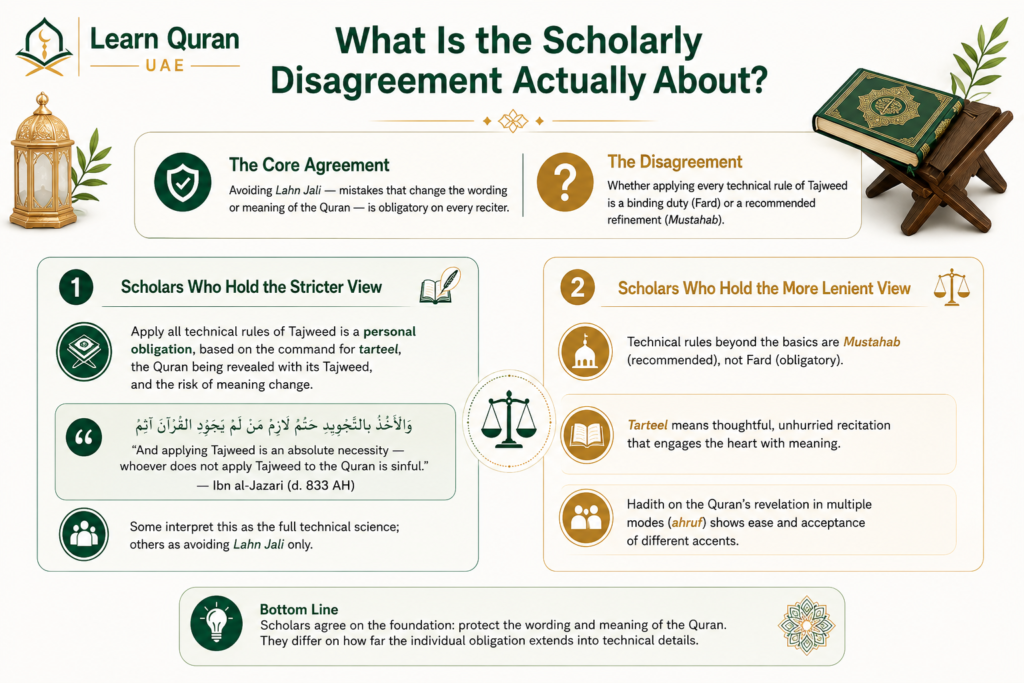
There is broad agreement that avoiding Lahn Jali — mistakes that change the actual wording or meaning of the Quran — is obligatory on every reciter. The disagreement is over the technical, terminology-based rules of Tajweed: whether applying every named rule (specific durations of elongation, precise categorization of letter qualities, and so on) is itself a binding duty on the individual, or a recommended refinement built on top of an already-valid recitation. Even within that disagreement, scholars sometimes classify borderline mistakes differently, which is why blanket statements about “obligatory” or “optional” tend to oversimplify a genuinely nuanced position.
1. Scholars Who Hold the Stricter View
Specialists in Qira’at and Tajweed argue that applying the technical rules in full is a personal obligation, built on the command for tarteel, the fact that the Quran was revealed to the Prophet ﷺ already carrying its Tajweed, and the risk that even a small mispronunciation can shift a word’s meaning.
The most cited statement behind this position comes from Ibn al-Jazari, the ninth-century (Hijri) scholar whose didactic poem remains the foundation of the Tajweed sciences:
وَالْأَخْذُ بِالتَّجْوِيدِ حَتْمٌ لَازِمٌ مَنْ لَمْ يُجَوِّدِ الْقُرْآنَ آثِمٌ
“And applying Tajweed is an absolute necessity — whoever does not apply Tajweed to the Quran is sinful.”
Even among scholars who take this statement seriously, its interpretation is disputed. Some read “applying Tajweed” here as the full technical science, meaning Ibn al-Jazari is describing a strict personal obligation on every reciter. Others read it as referring specifically to the level of care needed to avoid corrupting the wording of the Quran — that is, avoiding Lahn Jali — rather than mastery of every named rule and its exact terminology. This is the crux of why “is Tajweed obligatory” doesn’t have a single one-line answer even among specialists.
2. Scholars Who Hold the More Lenient View
Many jurists, particularly within the Hanafi school, hold that the technical rules of Tajweed beyond the basics are Mustahab (recommended) rather than Fard (obligatory). Their reading of tarteel centers on thoughtful, unhurried recitation that lets the heart engage with meaning — not the flawless technical execution of every named rule.
This view draws on reports of the Prophet ﷺ accepting recitation from companions with different backgrounds and accents, recorded in the hadith literature on the Quran’s revelation in multiple modes (ahruf), found in Sahih al-Bukhari and Sahih Muslim. If every technical rule were a strict individual obligation, these scholars argue, most non-Arabic speakers would be sinning every time they recited — a conclusion that conflicts with Islam’s built-in ease.
Experience a Live Quran Class
Watch a short sample from one of our online Quran classes and discover our engaging teaching style, interactive lessons, and personalized learning approach.
Start Learning Quran with Expert Tutors in the UAE
Accredited online Quran and Arabic classes tailored for adults and children. Schedule your session today.
Book Your Free TrialThe Difference Between Major And Minor Tajweed Mistakes When Reciting The Quran
Regardless of where a scholar lands on the broader debate, the classification of recitation errors into two categories is where practical consensus actually lives.
Understanding this distinction resolves most of the anxiety around whether a given mistake is sinful.
| Feature | Lahn Jali (اللحن الجلي) | Lahn Khafi (اللحن الخفي) |
| Definition | Clear error that changes pronunciation or meaning | Hidden error that affects recitation quality, not meaning |
| Example | Pronouncing ع as أ in نَعْبُدُ | Shortening a required madd or ghunnah |
| Detected By | Any Arabic speaker | Trained students of Tajweed |
| Intentional Error | Sinful by scholarly consensus | Not sinful, but should be avoided |
| Unintentional Error | Must be corrected when known | Recommended to improve |
| Who Should Avoid It | Every Muslim | Those seeking excellence in recitation, especially imams |
A practical test you can apply to your own recitation: ask first whether the mistake would change the word’s meaning to any Arabic speaker. If yes, it is Lahn Jali and needs correcting immediately. If it would only be noticed by someone specifically trained in Tajweed, it is Lahn Khafi — worth refining over time, not a source of guilt in the meantime.
Read also: How to Learn the Quran? Step-by-Step Guide
Can You Recite Quran Without Tajweed?
You can’t fully separate recitation from Tajweed, since every reader already applies some level of pronunciation whether or not they’ve studied it formally. The real question is which category your mistakes fall into.
If your errors change meaning, correcting them isn’t optional under any scholarly position. If your errors are limited to the finer technical points — the exact area scholars disagree on — your recitation is still valid, even if a specialist would consider it unrefined.
Do You Have to Learn Tajweed Yourself?
Learning Tajweed is not optional in the same way for every Muslim. Islamic scholars distinguish between the minimum level of Tajweed that every reciter must learn and the advanced technical knowledge required only of those who teach or specialize in the science.
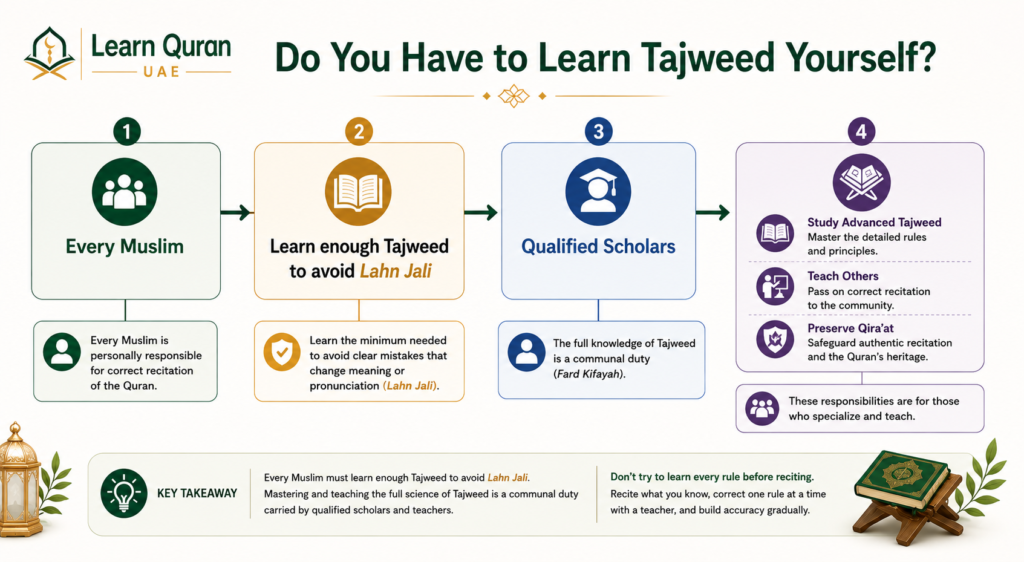
Understanding this distinction helps learners focus on what is personally required while recognizing the importance of preserving Tajweed through qualified scholars and teachers.
The Individual Duty (Fard Ayn)
Every Muslim is personally responsible for learning enough Tajweed to avoid Lahn Jali—clear mistakes that alter the pronunciation or meaning of the Quran. This obligation applies regardless of a person’s native language or how long they have been reciting, and it is the one point on which both scholarly opinions fully agree.
The Communal Duty (Fard Kifayah)
Beyond the individual obligation, mastering the full science of Tajweed—including its detailed terminology, articulation rules, and theoretical principles—is considered a communal responsibility rather than an individual one.
This distinction is summarized below:
| Obligation Type | Scope | Applies To |
| Fard Ayn | Correct recitation that avoids Lahn Jali | Every Muslim |
| Fard Kifayah | Advanced study, preservation, and teaching of Tajweed | Qualified members of the Muslim community |
A common mistake beginners make is trying to learn every rule before reciting at all. It works better the other way: recite what you know, correct one rule at a time with a teacher, and build accuracy gradually. Structured programs like Quran with Tajweed at UAE Quran Academy are built around that same gradual correction rather than front-loading theory before you’ve recited a single line.
Benefits of Reciting the Quran with Tajweed
Learning Tajweed changes more than pronunciation accuracy — it shapes the reader’s relationship with the recitation itself.
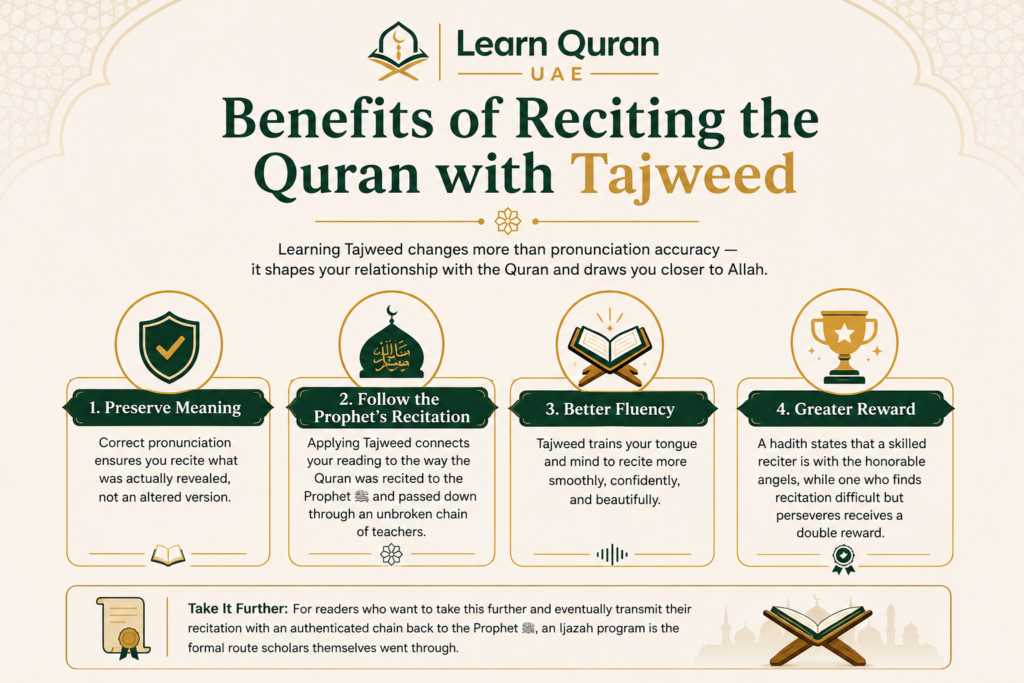
- It protects the meaning. Correct pronunciation ensures you recite what was actually revealed, not an altered version.
- It follows the Prophet’s own recitation. Applying Tajweed connects your reading to the way the Quran was recited to the Prophet ﷺ and passed down through an unbroken chain of teachers.
- It rewards effort, not perfection. A hadith narrated by Aisha (may Allah be pleased with her) states that a skilled reciter is with the honorable angels, while someone who finds recitation difficult but perseveres receives a double reward — recorded in Sahih al-Bukhari and Sahih Muslim.
For readers who want to take this further and eventually transmit their recitation with an authenticated chain back to the Prophet ﷺ, an Ijazah program is the formal route scholars themselves went through.
Read also: How to Learn the Quran in the UAE?
See How Our Online Classes Work
Get a glimpse of a real online session and explore how students learn Quran with experienced teachers in a supportive and interactive environment.
Start Learning Tajweed the Right Way
You don’t need to resolve a centuries-old scholarly debate before you start reciting correctly. A certified tutor can hear your recitation, tell you within minutes which mistakes are Lahn Jali and need fixing now, and which are refinements to build over time.
UAE Quran Academy’s instructors assess your current level, correct meaning-changing mistakes first, and layer in the technical rules at a pace that fits your schedule — whether you’re starting from the Arabic alphabet or refining recitation you’ve had for years.
Our Tajweed Courses
- Tajweed Course
- Learn Quran Online with Tajweed
- Tajweed for Kids Course
- Tajweed for Adults Course
- Tajweed for Ladies / Sisters Course
- Tajweed for Beginners Course
- Advanced Tajweed Course
Enroll today and take the first step toward beautiful, accurate Quran recitation with expert guidance.
Start Learning Quran with Expert Tutors in the UAE
Accredited online Quran and Arabic classes tailored for adults and children. Schedule your session today.
Book Your Free TrialStart Your Quran Classes Today →

Conclusion
So, is Tajweed obligatory? The accurate answer isn’t “yes for everyone” or “no, it’s optional” — it’s that avoiding mistakes which change the Quran’s wording is a personal duty scholars agree on, while the technical, terminology-based rules of Tajweed are where genuine disagreement exists.
Specialists in Qira’at, following statements like Ibn al-Jazari’s, hold that full technical application is a personal obligation. Many jurists hold that only meaning-altering mistakes are strictly required, with the finer rules recommended rather than compulsory. Both positions agree on far more than they disagree on.
The practical takeaway is this: you don’t need to master every technical rule before your recitation counts, but you do need to correct anything that changes meaning — and a teacher who can hear you recite is the fastest way to know which category your own mistakes fall into.
Frequently Asked Questions
Is Tajweed compulsory for every Muslim?
Avoiding mistakes that change the meaning of the Quran’s words (Lahn Jali) is compulsory for every Muslim by scholarly agreement. Full technical mastery of Tajweed’s named rules is where scholars differ, with some holding it as a personal duty and others as a communal one.
Can you recite Quran without Tajweed?
You can’t fully separate recitation from Tajweed, since some level of pronunciation is always present. What matters is whether a mistake changes the meaning of the words (Lahn Jali) or is a minor technical refinement (Lahn Khafi) that scholars debate rather than agree on.
What did Ibn al-Jazari say about Tajweed?
Ibn al-Jazari stated that applying Tajweed is an absolute necessity and that whoever fails to do so is sinful. Scholars disagree on whether he meant the full technical science of Tajweed or specifically the level needed to avoid corrupting the Quran’s wording.
What is the difference between Lahn Jali and Lahn Khafi?
Lahn Jali is a clear mistake that changes a word’s meaning, such as confusing similar-sounding letters. Lahn Khafi is a hidden, technical mistake that doesn’t change meaning, and scholars differ on how strictly some borderline cases should be classified.
Do I need a teacher to learn Tajweed correctly?
Yes — Tajweed is a listening-based skill, and self-study rarely catches pronunciation errors in your own voice. A certified teacher identifies which of your mistakes are meaning-changing and which are refinements, far faster than independent practice.

Leave a Reply