 Hifz
Have you ever heard a young child recite a long surah with no mistakes? Maybe you wondered how they did it. The answer is hifz.
So what is hifz? The word has two meanings. In Arabic, hifz means to protect or preserve something. In Quran learning, it means to memorize the Quran so you can recite it without looking at the book.
Muslims have kept the Quran this way for more than 1,400 years. Teachers pass it to students, one generation after the next. In this guide, you will learn what hifz means, who is called a hafiz, how a hifz student works each day, and why real hifz is more than remembering words.
What you’ll learn in this article
- The two meanings of hifz in plain words.
- A simple table that compares them.
- Why hifz and hifdh are the same word.
- What sabaq, sabqi, and manzil mean.
- The five parts of complete hifz.
What Is Hifz? The Two Meanings Of Hifdh In Islam
The word hifz has a language meaning and a learning meaning. They are not two separate ideas. The second one grows out of the first, as you will see below.
Hifz Meaning In Arabic: To Protect And Preserve
In Arabic, hifz means to protect, guard, or preserve. It comes from three root letters: ḥ, f, and ẓ. Every word built from this root is about keeping something safe so it is not lost or harmed.
The scholar al-Raghib al-Isfahani explained that hifz is the opposite of forgetting. It also means to watch over something and take care of it, the way a guard watches a gate.
The Quran uses words from this root 44 times. Most of them are about protection. For example, in Surah Yusuf (12:12), Yusuf’s brothers promise their father they will guard him.
The most famous use is about the Quran itself. In Surah Al-Hijr (15:9), Allah says He sent down the Quran and He will guard it. Scholars explain that nothing can be added to the Quran, and nothing in it can be lost or changed.
So in its first meaning, hifz is not about memory at all. It is about care and protection.
Hifz Meaning In Quran Learning: To Memorize
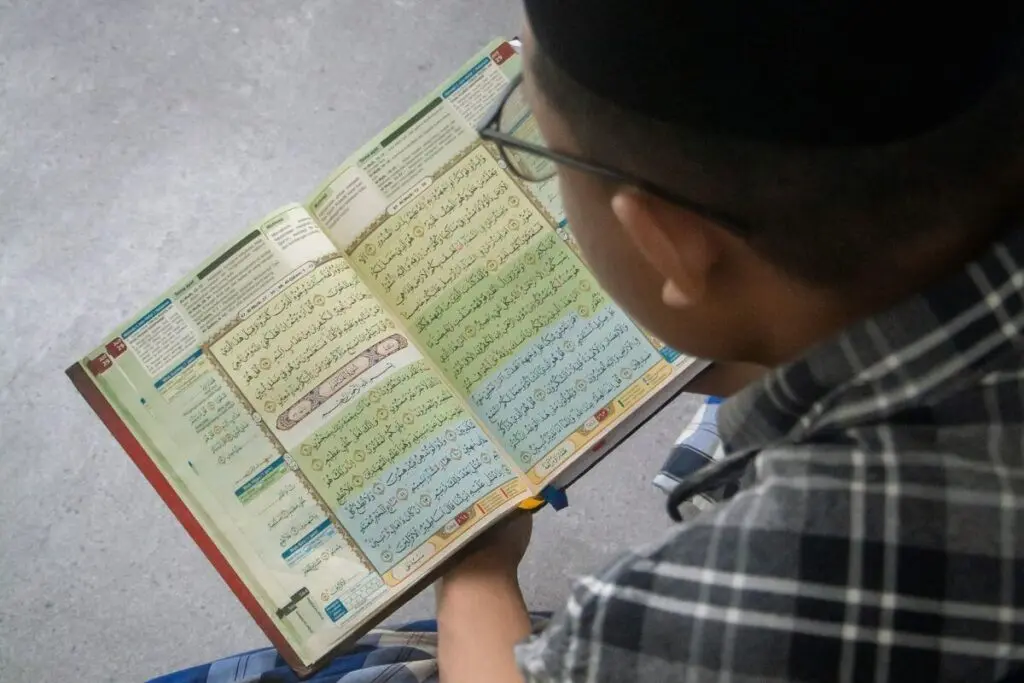
In Quran classes, hifz has a narrower meaning: memorizing the Quran. You learn the words by heart, in the right order. Then you can recite them without opening the mushaf, the printed copy of the Quran.
Scholars describe this hifz as keeping the verses from being forgotten by going over them often. It also means you can recall them in the order they came down.
A man who memorizes the whole Quran is called a hafiz. A woman is called a hafiza. This kind of hifz is done out loud. You hear the verses, say them many times, and then recite them to a teacher who checks each word.
Hifz does not have to start big. Every Muslim learns Surah Al-Fatiha and a few short surahs to pray. Some people keep going, a little each day, until they know all 114 surahs.
The Two Meanings Side By Side, And Why A Hafiz Needs Both
The table below compares the two meanings point by point.
| Point | Hifz in Arabic (to protect) | Hifz in Quran learning (to memorize) |
| Main idea | Keeping something safe from loss | Holding the Quran’s words in memory |
| What you do | Guard, watch over, take care | Learn verses by heart and recite them |
| The opposite | Neglect and loss | Forgetting |
| Everyday example | A guard watching over a treasure | A student reciting a surah without the book |
| How long it lasts | It never ends | It starts with learning and goes on with review |
| The result | The thing stays safe and unchanged | You can recite correctly from memory |
A true hafiz needs both meanings. Memorizing puts the Quran in your mind, and protecting it keeps it there. The name itself points to this: hafiz means “guardian” or “keeper.”
That is why scholars give the title hafiz to someone who has learned the whole Quran and keeps it well. They should be able to recite it to others with correct tajweed.
If someone memorized the Quran and later forgot much of it because they stopped reviewing, scholars do not usually call them a hafiz. A real excuse, like old age or illness, is the exception.
An easy rule to remember: memorizing makes you a memorizer, and protecting what you memorized keeps you a hafiz. The Prophet ﷺ compared the Quran to camels tied with a rope. If the owner keeps watch, they stay. If he lets go, they wander off.
Hifz vs. Hifdh: What’s the Difference?
There is no difference. Hifz and hifdh are the same word. Both are English spellings of the Arabic word حفظ.
The last Arabic letter, ظ, has no exact sound in English. So some people write it with a “z” (hifz), some with “dh” (hifdh), and some with “th” (hifth). The same thing happens with hafiz and hafidh. If you search for “hifz meaning” or “what is hifdh,” you are asking about the same thing.
Experience a Live Quran Class
Watch a short sample from one of our online Quran classes and discover our engaging teaching style, interactive lessons, and personalized learning approach.
Start Learning Quran with Expert Tutors in the UAE
Accredited online Quran and Arabic classes tailored for adults and children. Schedule your session today.
Book Your Free TrialWhat The Quran Says About Hifz
The Quran speaks about its own memorization in several verses. In Surah Al-Qamar (54:17), Allah says He made the Quran easy to remember, then asks if anyone will take the lesson. The same verse comes four times in that surah, in verses 17, 22, 32, and 40.
Allah also made memorizing easy for the Prophet ﷺ. In Surah Al-Qiyamah (75:16-17), He tells the Prophet not to rush his tongue, because gathering the Quran in his heart is Allah’s job. In Surah Al-A’la (87:6), He promises the Prophet will recite and not forget.
The Quran lives in the hearts of believers too. Surah Al-Ankabut (29:49) describes it as clear signs kept in the chests of people given knowledge.
If the Quran is easy to remember, what most learners need is a plan and someone to check them. The Quran memorization (hifz) course at Learn Quran UAE has separate classes for kids, adults, ladies, and men, so you can learn at a pace that fits your life.
How A Hifz Day Works: Sabaq, Sabqi, And Manzil
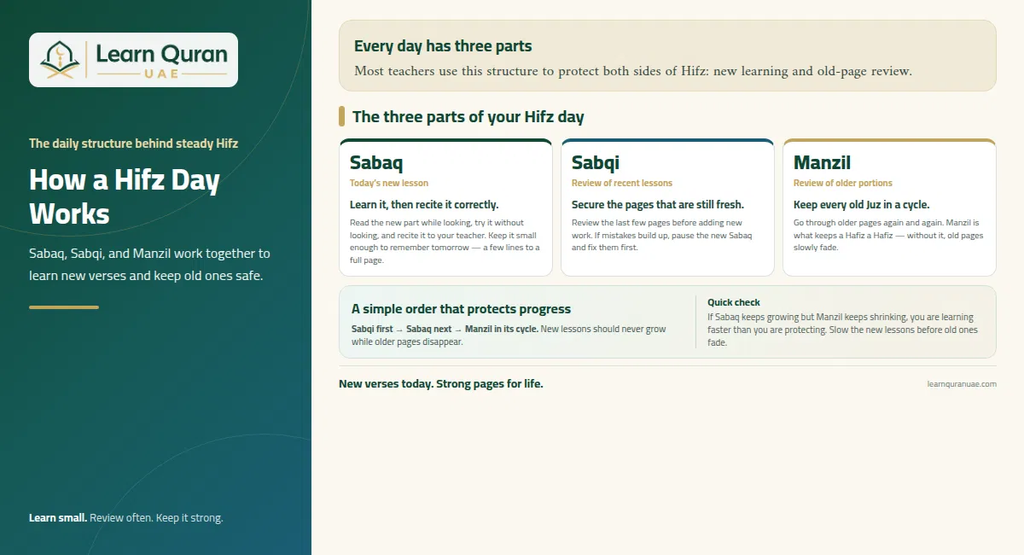
Most hifz teachers split each day into three parts. These names come from Quran schools, especially in South Asia. Together, they cover both sides of hifz: learning new verses and keeping old ones safe.
Sabaq: Today’s New Lesson
Sabaq means “lesson.” It is the new part of the Quran you memorize today. A beginner might learn a few lines. A student with more practice might learn a full page.
The steps are simple. First, you read the new part many times while looking at the page. Next, you try to say it without looking. When you can do that, you recite it to your teacher.
Your teacher listens to every word and every tajweed rule. The lesson only counts as done when it is correct. If there are mistakes, you go back and practice before moving on.
The size of your sabaq matters. It should be small enough that you can still remember it tomorrow. A big lesson you cannot hold is not progress. Small, steady lessons at a quiet time each day, like after Fajr, usually work better than long, rushed ones.
Sabqi: Review Of Recent Lessons
Sabqi is the review of your recent lessons. It usually covers the last few pages you learned, or the juz you are working on right now.
Why do you need it? New memory is weak. It fades fastest in the first days after you learn something. Sabqi gives those fresh verses time to settle until they feel solid.
Most students recite their sabqi to the teacher every day, before the new sabaq. This order is on purpose. It makes sure old work is safe before new work is added on top.
If your sabqi has a lot of mistakes, many teachers will pause the new lesson. They want you to fix the recent pages first. This can feel slow, but it saves time later, because you will not have to relearn pages you lost.
Manzil: Review Of Older Portions
Manzil means “station” or “stopping place.” In Quran reading, the Quran is split into seven manzils so people can finish it in a week. In hifz, manzil means the review of everything you memorized a while ago.
Students go through their old portions in a cycle. That way, every part of what they know gets reviewed again and again. A juz you learned two years ago gets the same care as one you learned two months ago.
Manzil is what keeps a hafiz a hafiz. Without it, older pages slowly fade, even if the student is still learning new ones.
Try this quick check. If your sabaq keeps growing but your manzil keeps shrinking, you are learning faster than you are protecting. Most teachers will slow down the new lessons before they let old ones fade. A Quran memorization planner and tracker can help you see all three parts on one page.
Is Hifz Of The Quran Required For Every Muslim?
It depends on how much you memorize. Scholars from the four Sunni schools describe three levels.
Every Muslim must memorize enough to pray, like Surah Al-Fatiha and a few short surahs. This is a personal duty (fard ‘ayn). Memorizing the whole Quran is a group duty (fard kifayah). As long as enough Muslims in a community memorize it, the duty is met for everyone.
Beyond that, memorizing the whole Quran is a highly rewarded choice for each person. The scholar Ibn Abd al-Barr wrote that the first step of knowledge is to memorize and understand the Book of Allah. He also made clear that memorizing all of it is not required of everyone.
Hifz Is More Than Memorizing: The 5 Parts Of A Complete Practice
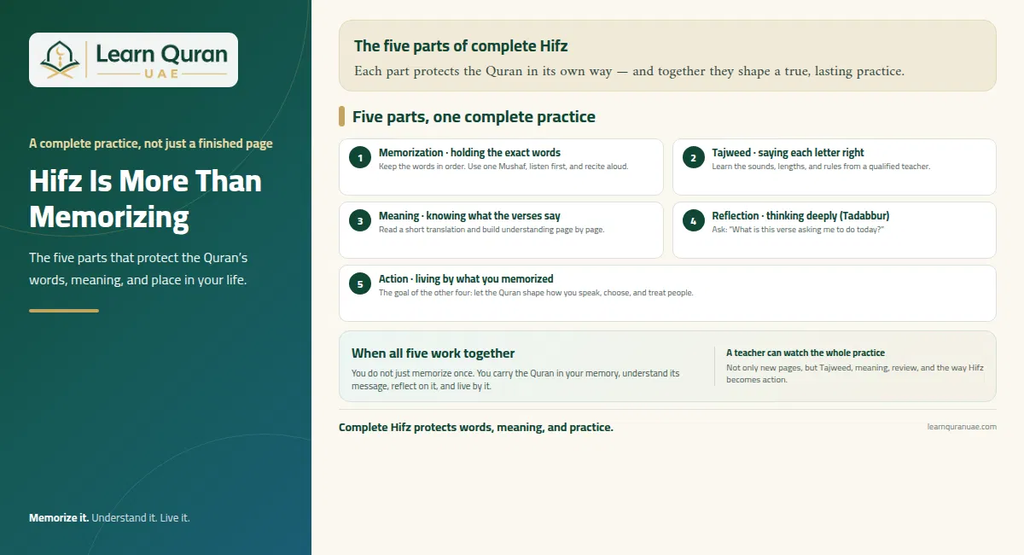
Scholars say that protecting the Quran covers its words, its meanings, and acting on it. If you turn that into a personal plan, complete hifz has five parts. Each part protects the Quran in its own way.
1. Memorization: Learning The Quran’s Words By Heart In The Right Order
Memorization means keeping the exact words of the Quran in your mind, in the right order. It is the base that the other four parts stand on.
One tip helps a lot here. Imam al-Nawawi advised using the same copy of the Quran every time. Your eyes start to remember where each verse sits on the page. Many students use the standard Madinah print, where each page ends at the end of a verse.
It also helps to listen to a skilled reciter before you memorize a page. Hearing the verses first gives your memory two paths: what you see and what you hear.
Finally, say the verses out loud, not only in your head. Your tongue learns the words too. When your eyes, ears, and voice all work together, the words stick better.
2. Tajweed: Reciting Each Letter With The Correct Sound
Tajweed is the set of rules for saying each letter of the Quran correctly. It covers where each sound comes from, how long to hold it, and when letters blend.
This matters for hifz because memory keeps whatever you give it. If you memorize a wrong sound, you will keep the wrong sound. And a mistake you repeat for years is much harder to fix than one you catch on the first day.
For example, some Arabic letters sound alike to new learners, such as the two “h” sounds, ه and ح. A teacher hears the difference right away. A recording cannot tell you that you got it wrong.
That is why hifz is learned from a qualified teacher, not from recordings alone. If you are new to it, this step-by-step guide to reciting the Quran with tajweed is a good place to start.
3. Meaning: Understanding What The Verses You Memorize Say
Meaning is knowing what the verses you memorized are talking about. You do not need to be a scholar. You just need a basic idea of each passage.
Some scholars, like Shaykh Ibn Uthaymin, encouraged people to memorize and understand together. He also said that memorizing without full understanding still has reward. You can learn the meanings little by little.
Meaning also helps your memory. Ideas that connect are easier to recall than sounds you do not understand. When you know a passage tells a story, you can follow the story to the next verse.
A simple habit works well. Before you memorize a new page, read a short English translation of it. It only takes a few minutes, and the page will make more sense when you start.
You can also ask your teacher to explain one key word from the page you are memorizing. Those small words add up over time. Soon you will start to notice them in other surahs too.
4. Reflection: Thinking About What Each Verse Asks Of You
Reflection is called tadabbur in Arabic. It means stopping to think about a verse and what it asks of you. In Surah Sad (38:29), Allah says the Quran was sent down so people would think about its verses.
Reflection is different from meaning. Meaning tells you what a verse says. Reflection asks what that verse has to do with your own life today.
Try asking one question each time you finish a sabaq: “What is this verse asking me to do?” If you memorize a verse about patience, think of a moment this week when you will need patience.
A hafiz who reflects carries the Quran in the heart, not only on the tongue. Over time, the verses start to shape how they think and what they choose.
Some students keep a small notebook for this. They write one line about each verse that touched them. Later, those notes help them remember both the verse and its lesson.
5. Action: Living By The Verses You Have Memorized
Action is the last part, and it is the goal of the other four. It means living by the verses you carry.
When Aisha was asked about the Prophet’s character, she said his character was the Quran (Sahih Muslim 746). He did not just recite it. He lived it in how he spoke, worked, and treated people.
The Prophet ﷺ also gave a serious warning. Among the first people judged will be a man who learned the Quran only so others would call him a reciter (Sahih Muslim 1905). Hifz is worship, and the reward depends on why you do it.
A fair test of your hifz: if any of the five parts is missing, it is not complete in the full sense scholars meant. A teacher who keeps an eye on all five helps you become a true hafiz, not just someone who memorized once.
Families across the UAE use this kind of guided hifz with their children and for themselves. You can read what students and parents say about their classes on the Learn Quran UAE student reviews page.
Rewards of hifz in the hadith
The Prophet ﷺ spoke about the people of the Quran many times. Here are a few of his words:
- “The best of you are those who learn the Quran and teach it” (Sahih al-Bukhari 5027).
- The companion of the Quran will be told to recite and rise, and his rank will be at the last verse he recites (Sunan al-Tirmidhi 2914).
- The skilled reciter is with the noble angels, and the one who struggles gets two rewards (Sahih Muslim 798).
- The Quran will come on the Day of Judgment to speak up for its companions (Sahih Muslim 804).
The hadith about two rewards is good news for beginners. Slow, hard work on the Quran is never wasted.
Common Mistakes That Stop Hifz
Most people who give up on hifz do not fail at learning new pages. They fail at keeping them. These four mistakes cause most of the trouble:
- Going too fast. A big daily lesson feels good at first. But if you cannot review it all, you end up relearning the same pages.
- Skipping review. Some students add new pages but leave out sabqi and manzil. After a few months, the early pages are gone.
- Learning without a teacher. When no one checks your recitation, small tajweed errors turn into habits that are hard to break.
- Thinking you are done at the last page. Finishing the Quran is not the end of hifz. It is the start of a lifetime of manzil.
The good news is that each mistake has a simple fix. Keep your sabaq small, review every day, recite to a teacher, and treat manzil as part of your life.
See How Our Online Classes Work
Get a glimpse of a real online session and explore how students learn Quran with experienced teachers in a supportive and interactive environment.
Start Learning Quran with Expert Tutors in the UAE
Accredited online Quran and Arabic classes tailored for adults and children. Schedule your session today.
Book Your Free TrialStart Your Hifz With Learn Quran UAE Today
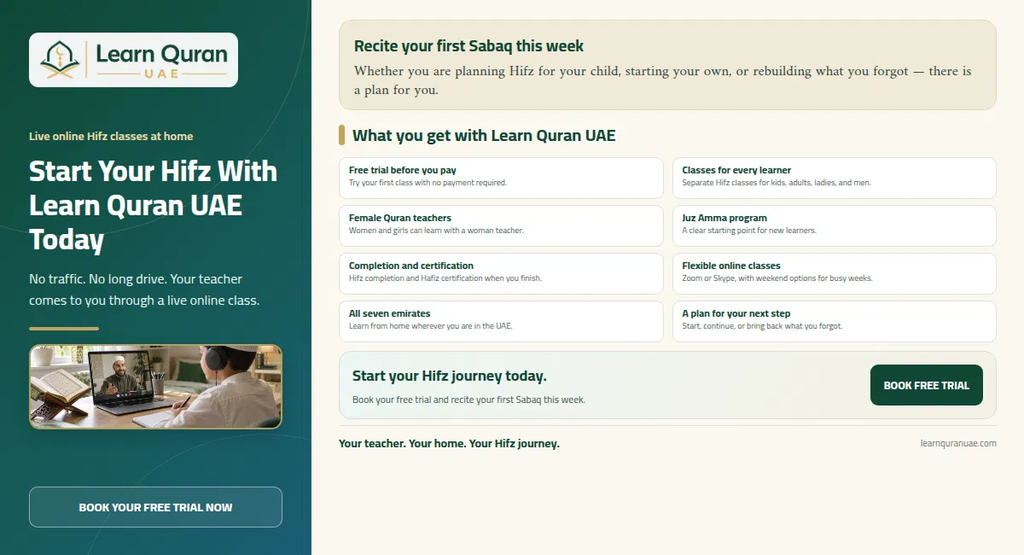
You do not need to drive to a Quran center or plan your week around traffic. Learn Quran UAE, also known as UAE Quran Academy, brings your hifz teacher to your home through live online classes. With your classes, you get:
- A free trial class before you pay anything
- Separate hifz classes for kids, adults, ladies, and men
- Female Quran teachers for sisters and girls
- A Juz Amma memorization program if you are just starting
- Hifz completion and hafiz certification when you finish
- Classes on Zoom or Skype, plus weekend options for busy weeks
- Teaching for students in all seven emirates
If you are planning hifz for your child, starting your own, or trying to bring back what you forgot, there is a plan for you. Book your free trial now and recite your first sabaq this week.
Our Quran Memorization Courses
Browse our courses, choose the one that suits you and start your Quran memorization journey.
- Quran Memorization (Hifz) Course
- Hifz for Kids Course
- Hifz for Adults Course
- Hifz for Ladies / Sisters Course
- Hifz for Men Course
- Quran Memorization Center (UAE)
- Juz Amma Memorization Program
- Hifz Completion & Hafiz Certification
Conclusion
So, what is hifz? In Arabic, hifz means to protect and preserve. In Quran learning, it means to memorize the Quran so you can recite it from memory. These two meanings fit together. Memorizing is how you protect the Quran inside yourself.
That is why the title hafiz is about more than finishing. A true hafiz learns the whole Quran and then keeps it safe for life. The daily routine of sabaq, sabqi, and manzil makes that possible. New verses are learned, recent verses are made strong, and old verses are never left behind.
Complete hifz also reaches past the words. It joins memorization, tajweed, meaning, reflection, and action. When all five are in place, the Quran is kept safe in your memory, correct on your tongue, clear in your mind, alive in your heart, and visible in how you live.
You do not have to begin with the whole Quran. Every Muslim already carries some of it for prayer. You can build from there, one short lesson at a time. Even a few lines a day, reviewed with care, add up over months and years.
Hifz or hifdh, the spelling changes nothing about the goal. It is a promise to look after the Book of Allah, just as Allah promised to guard it. Start with one page, keep it safe, and let it lead you to the next.
FAQs
Many people have the same questions when they first hear about hifz. Here are short, clear answers to the ones we hear most often.
What Does Hifz Mean In Simple Words?
Hifz means memorizing the Quran by heart. The Arabic word also means to protect, so doing hifz means learning the Quran and keeping it safe in your memory through regular review.
What Is Hifz Ul Quran?
Hifz ul Quran means “memorization of the Quran.” It is the full process of learning all 114 surahs by heart. The person who completes it and keeps it is called a hafiz or hafiza.
Can I Do Hifz Using A Quran Pdf?
You can use a hifz Quran PDF for review, but it should not replace a printed mushaf and a teacher. One printed copy helps your visual memory, and a teacher catches tajweed mistakes a PDF cannot.
How Long Does Hifz Of The Quran Take?
It is different for everyone. Your time depends on your daily lesson size, how well you review, your age, and your reading level. You can read more in this guide on how long it takes to memorize the Quran.
Can Adults And Women Do Hifz?
Yes, anyone can do hifz at any age. Women have memorized the Quran in every generation since the time of the Prophet ﷺ, and adults often do well with a steady daily plan and a teacher.
Can I Do Hifz If I Do Not Speak Arabic?
Yes, you can do hifz without speaking Arabic. Millions of Muslims who are not Arabs have memorized the Quran. You first need to read the Arabic letters correctly, and then you can memorize with a teacher and learn the meanings over time.
At What Age Can A Child Start Hifz?
A child can start hifz as soon as they can listen and repeat short surahs. Many children begin with Al-Fatiha and the short surahs of Juz Amma. Imam al-Shafi’i memorized the whole Quran by the age of seven.



Leave a Reply