 Tajweed
Most students who can read the Quran fluently still make consistent errors in one area: the madd. They hold sounds too long, cut them too short, or confuse similar types in the middle of a recitation. The result is a technically readable but rhythmically broken tilawah that misrepresents the way the Quran was revealed and transmitted.
The madd rules in tajweed are not optional stylistic choices. They are precise, obligatory rulings that govern how long a sound is held, when it must be extended, when extension is permitted, and when a reader has no choice but to hold it at the full six counts. Mastering these rules is what separates a reader from a reciter — and this guide covers every type, its definition, its ruling, and how to apply it correctly.
Introduction to Madd: Definition and Linguistic Meaning
Before examining individual types, every student needs a clear foundation in what madd actually means and why it exists in the recitation of the Quran.
In Arabic, the word madd (مد) means increase or extension. Allah uses this root in the Quran itself:
“وَيُمْدِدْكُمْ بِأَمْوَالٍ وَبَنِينَ”
Wa yumdidkum bi-amwaalin wa baneen
“And give you increase of wealth and children”
In the science of tajweed, madd is defined as the prolongation of the voice through one of the three madd letters — the alif (ا), the waw (و), or the ya (ي) — when a cause is present in the form of a hamzah or sukoon, or naturally as part of the letter itself.
The Three Madd Letters
The three madd letters each have a specific condition for functioning as a madd letter:
| Letter | Condition |
| Alif (ا) | Sukoon, preceded by a fathah |
| Waw (و) | Sukoon, preceded by a dhammah |
| Ya (ي) | Sukoon, preceded by a kasrah |
The Two Letters of Leen
Separate from the madd letters are the two letters of leen (حرفا اللين): a sukoon waw preceded by a fathah (as in خَوْف) and a sukoon ya preceded by a fathah (as in صَيْف). These are relevant to Madd Leen, one of the types covered below.
Madd vs. Qasr
Madd (extension) is contrasted with qasr (shortening). Qasr carries two meanings in tajweed terminology. First, when discussing the measure of a madd, qasr means holding the sound to only two counts. Second, when discussing whether a madd exists at all, qasr means the complete absence of extension.
The Two Primary Divisions: Madd Asli and Madd Far’i
All madd rules in tajweed flow from a single foundational division. Understanding this split makes every subsequent rule easier to learn and retain.
Madd Asli (The Natural Madd)
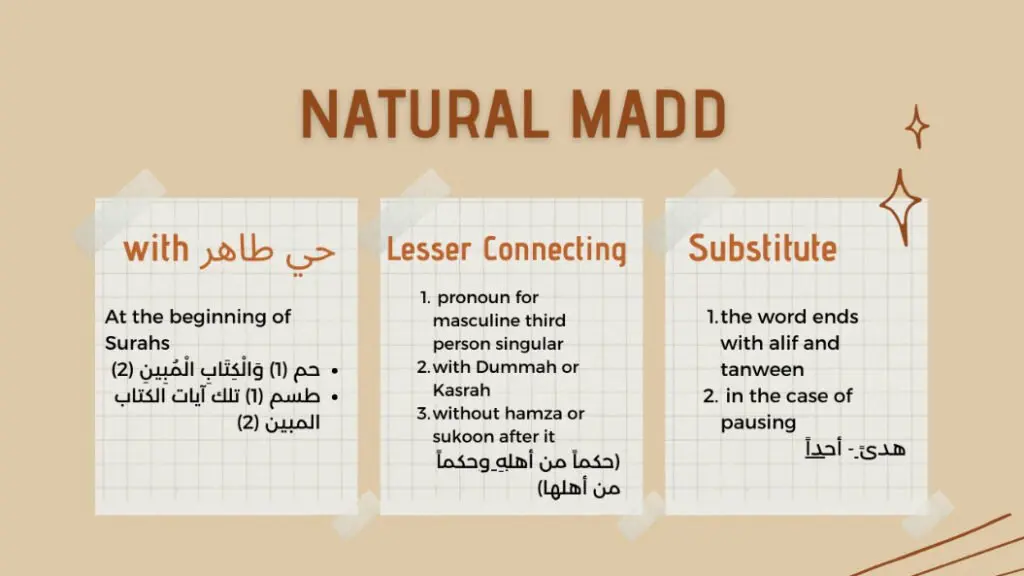
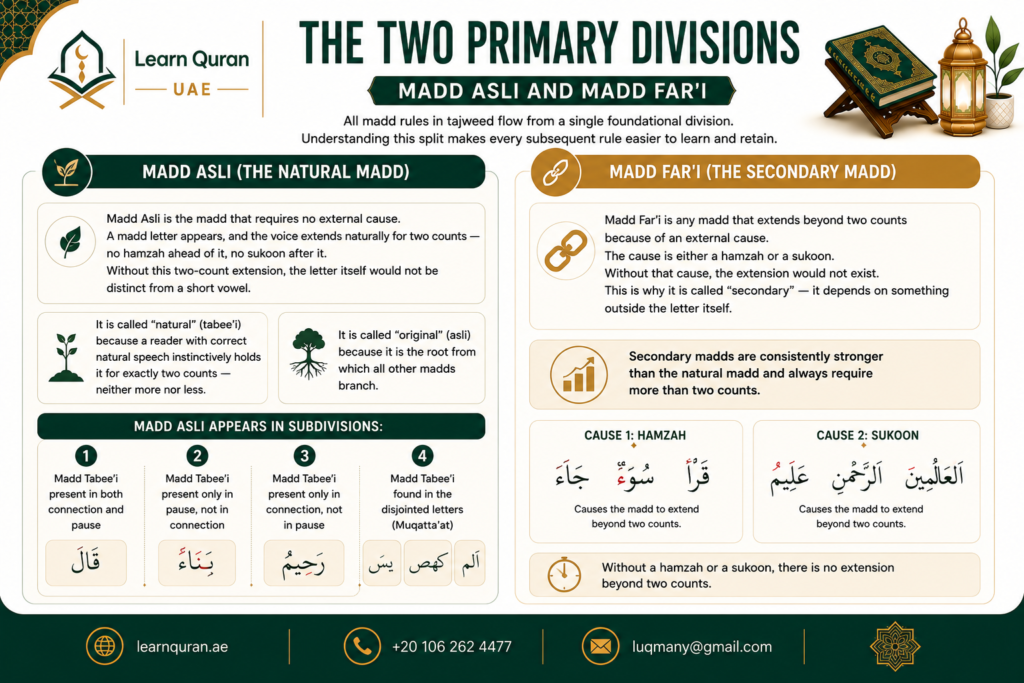
Madd Asli is the madd that requires no external cause. A madd letter appears, and the voice extends naturally for two counts — no hamzah ahead of it, no sukoon after it. Without this two-count extension, the letter itself would not be distinct from a short vowel.
It is called “natural” (tabee’i) because a reader with correct natural speech instinctively holds it for exactly two counts — neither more nor less. It is called “original” (asli) because it is the root from which all other madds branch.
Madd Asli appears in subdivisions:
- Madd Tabee’i that is present in both connection and pause.
- Madd Tabee’i present only in pause, not in connection.
- Madd Tabee’i present only in connection, not in pause.
- Madd Tabee’i found in the disjointed letters at the opening of certain surahs
Madd Far’i (The Secondary Madd)
Madd Far’i is any madd that extends beyond two counts because of an external cause. The cause is either a hamzah or a sukoon. Without that cause, the extension would not exist. This is why it is called “secondary” — it depends on something outside the letter itself.
Secondary madds are consistently stronger than the natural madd and always require more than two counts.
The Three Rulings of Madd Tajweed Rules
The madd tajweed rules assign one of three legal rulings to every type of madd. These rulings determine how much flexibility a reciter has.
Wajib (Obligatory)
The obligatory madd must be held at a fixed measure. Reducing it below that measure is an error. The Madd Wajib Muttasil falls into this category — it must be held at four or five counts and cannot be shortened.
Ja’iz (Permissible)
The permissible madd allows the reciter to choose between two or more valid measures. For example, the Madd Ja’iz Munfasil may be recited at two, four, or five counts, all of which are correct for the Hafs ‘an ‘Asim recitation.
Lazim (Necessary)
The lazim madd carries the strongest ruling. It must be held at exactly six counts in all cases — during connection and during pause — and no reduction is permitted. This is the highest category in the madd tajweed rules chart.
Types of Madd in Tajweed Caused by a Hamzah
The hamzah is the first of the two external causes that produce a secondary madd. When a hamzah appears in relation to a madd letter, one of three specific types arises.
Madd Muttasil (Connected Madd)
This madd occurs when a hamzah follows a madd letter within the same word. The connection between the madd letter and the hamzah is unbroken because they share a single word.
Ruling: Obligatory (Wajib). Must be held four or five counts.
Examples from the Quran:
- جَاءَ (jaa’a) — the alif is followed immediately by a hamzah in the same word.
- سُوءُ (soo’u) — the waw madd letter is followed by a hamzah in the same word.
- جِيءَ (jee’a) — the ya madd letter followed by a hamzah in the same word.
| Madd Type | Cause | Ruling | Count |
| Madd Muttasil | Hamzah after madd in same word | Wajib | 4-5 counts |
| Madd Munfasil | Hamzah after madd in next word | Ja’iz | 4-5 counts |
| Madd Badal | Hamzah before madd letter | Ja’iz | 2 counts (Hafs) |
Madd Munfasil (Separated Madd)
This madd occurs when the madd letter ends one word and a hamzah begins the next word. The cause is the same as Madd Muttasil — a hamzah adjacent to a madd letter — but the separation across a word boundary changes the ruling from obligatory to permissible.
Ruling: Permissible (Ja’iz). May be held two, four, or five counts (the most common practice for Hafs is four or five).
Examples:
- يَا أَيُّهَا (yaa ayyuhaa) — the alif in يَا is followed by a hamzah beginning the next word.
- إِنَّا أَنْزَلْنَاهُ (innaa anzalnaahu) — the alif in إِنَّا is followed by a hamzah in the next word.
Madd Badal (Substitute Madd)
Madd Badal is unique in that the hamzah comes before the madd letter, not after it. Historically, the original word contained two hamzahs together; the second was converted into a madd letter to ease pronunciation — hence the name “substitute.”
Ruling: Permissible (Ja’iz). For Hafs ‘an ‘Asim, it is held at two counts only.
Example: آمَنُوا (aamanoo) — originally أَأمَنُوا, the second hamzah became an alif madd
The Tajweed Course at UAE Quran Academy gives you one-on-one sessions with a qualified instructor who will assess your current madd application, identify which types you are misapplying, and correct them systematically. Enroll in the Tajweed Course and begin reciting with precision.

Refine your Tajweed and recite with confidence today.
Types of Madd in Tajweed Caused by a Sukoon
The sukoon is the second external cause. When a sukoon follows a madd letter, it creates one of two types, and the distinction between them is one of the most commonly tested points in Tajweed study.
Madd Lazim (Necessary Madd)
The Madd Lazim arises when the sukoon following the madd letter is permanent — meaning it does not disappear during normal connection and does not appear only at pause. The sukoon is fixed in both states.
Ruling: Necessary (Lazim). Must be held at exactly six counts. No reduction is permitted.
This is the strongest madd in the entire madd tajweed rules chart. Scholars described it as follows:
أَقْوَى الْمُدُودِ لَازِمٌ فَمَا اتَّصَلْ — فَعَارِضٌ فَذُو انْفِصَالٍ فَبَدَلْ
“The strongest madd is Lazim, then Muttasil, then ‘Arid, then Munfasil, then Badal”
Madd Lazim divides into four subtypes:

1. Kalimi Muthaqqal (Weighted Word Madd)
A madd letter followed by a doubled (shaddah) letter in the same word. The shaddah contains a sukoon within it, making the following letter carry both sukoon and shaddah.
Example: الضَّالِّينَ — the ya madd letter is followed by a doubled lam, creating Madd Lazim at six counts
2. Kalimi Mukhaffaf (Light Word Madd)
A madd letter followed by a single sukoon (not doubled) in the same word. This occurs in very limited positions in the Quran.
Example: آلْآنَ (Surah Yunus: 91) — the alif is followed by a fixed sukoon
Read also: Tajweed Rules – The 11 Major Rules With Examples In Details
3. Harfi Muthaqqal (Weighted Letter Madd)
Found in the disjointed letters (fawatih al-suwar) at the opening of certain surahs, where the letter contains a madd followed by a doubled sound.
Example: الم — the meem (م) is spelled out as م-ي-م, and the ya in the middle functions as a madd followed by a doubled meem
4. Harfi Mukhaffaf (Light Letter Madd)
Also found in the disjointed letters, where a madd sound is followed by an unblended sukoon.
Example: ص (Saad) — spelled out as ص-ا-د, contains a madd at six counts
The Prophet ﷺ’s companions transmitted the Quran with precise attention to these measures. Reciting الضَّالِّينَ in Salah with only two counts instead of six is a tajweed error, though scholars have noted it does not invalidate the prayer since it does not corrupt the meaning — but it remains an error that every reciter should correct.
Madd ‘Arid lil-Sukoon (Madd Arising at Pause)
This madd occurs when a reader pauses on a word that ends with a consonant, causing a temporary sukoon to appear on the final letter. That temporary sukoon is what creates the madd — it exists only because of the pause and disappears during connection.
Ruling: Permissible (Ja’iz). May be held two, four, or six counts.
Examples:
- Pausing on الرَّحِيمْ — the sukoon appears on the meem only at pause.
- Pausing on الْعَالَمِينْ — the sukoon on the nun exists only in the paused state.
This is commonly mistaken for Madd Lazim by students because the sukoon feels the same in practice. The critical distinction: in Madd Lazim the sukoon is present in both connection and pause; in Madd ‘Arid it exists only when you stop.
Experience a Live Quran Class
Watch a short sample from one of our online Quran classes and discover our engaging teaching style, interactive lessons, and personalized learning approach.
Start Learning Quran with Expert Tutors in the UAE
Accredited online Quran and Arabic classes tailored for adults and children. Schedule your session today.
Book Your Free TrialThe Madd Tajweed Rules Chart: Ranking by Strength
When two causes of madd meet in a single letter, only the stronger cause governs. This principle is essential for applying the madd tajweed rules chart correctly.
| Rank | Madd Type | Cause | Ruling | Count |
| 1 | Madd Lazim | Permanent sukoon | Lazim | 6 |
| 2 | Madd Muttasil | Hamzah in same word | Wajib | 4-5 |
| 3 | Madd ‘Arid lil-Sukoon | Temporary sukoon at pause | Ja’iz | 2, 4, or 6 |
| 4 | Madd Munfasil | Hamzah in next word | Ja’iz | 4-5 |
| 5 | Madd Badal | Hamzah before madd | Ja’iz | 2 |
A clear example of two causes meeting: the word آمِّينَ in Surah Al-Ma’idah contains both a Madd Badal (alif following a hamzah) and a Madd Lazim (the following meem is doubled). Since Madd Lazim outranks Madd Badal, the reader holds the alif for six counts — the lazim ruling takes full effect.
Common Errors in Applying Madd Rules in Tajweed
Students who learn the definitions correctly still make predictable errors when they move from theory to recitation. These are the most damaging and most common:
Extending the Natural Madd Beyond Two Counts
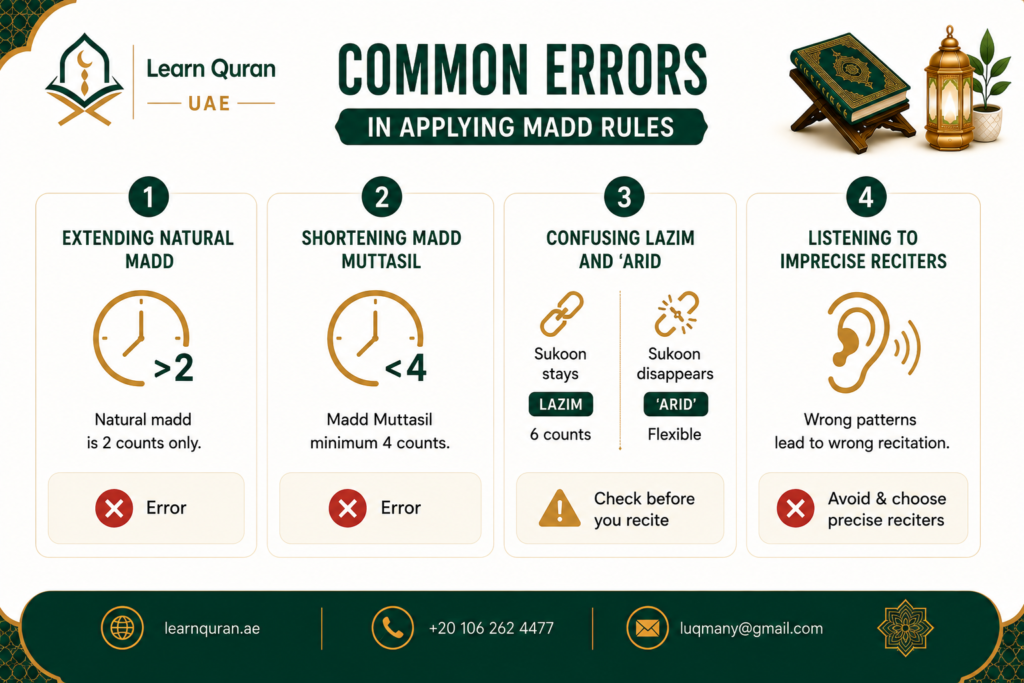
The Madd Tabee’i has exactly two counts — no more. Many students, especially those who have heard certain popular reciters, unconsciously hold the natural madd for three or four counts. This is an error regardless of how natural it sounds after repeated exposure.
Shortening the Madd Muttasil
Some readers rush through the Madd Muttasil at two counts. Since the ruling is obligatory (wajib), shortening it is a tajweed error with no valid basis in the recitation of Hafs. The minimum for Madd Muttasil is four counts.
Confusing Madd Lazim and Madd ‘Arid
Both types involve a sukoon after a madd letter. The confusion is understandable. The practical check: if the sukoon disappears when you connect to the next word, it is ‘Arid and you have flexibility in count. If the sukoon remains regardless of connection, it is Lazim and you must hold six counts.
Listening to Imprecise Reciters and Absorbing Their Patterns
Auditory memory embeds itself deeply. Students who listen extensively to a reciter with madd errors will reproduce those errors automatically. Scholars specifically recommend reciters such as al-Husary and al-Minshawi for deliberate Tajweed study precisely because their precision in madd application is consistent and reliable.
Why Madd Errors Persist Without a Teacher
The madd rules in tajweed are not difficult to understand in theory. The difficulty is that the human ear adapts to what it hears repeatedly, and most students cannot reliably hear their own errors.
A student who has been holding الضَّالِّينَ at four counts for three years has a deeply reinforced muscle memory. They cannot hear the difference between four counts and six counts in their own voice. A teacher listening from outside hears it immediately.
This is not a weakness specific to certain learners. The Quran’s oral transmission chain exists precisely because self-correction has never been sufficient. Every generation received the Quran mouth to ear, with teachers correcting students in real time. The Prophet ﷺ himself received it from Jibreel ﷺ in this way, and Jibreel reviewed it with him every Ramadan.
“مَثَلُ الَّذِي يَقْرَأُ الْقُرْآنَ وَهُوَ حَافِظٌ لَهُ مَعَ السَّفَرَةِ الْكِرَامِ الْبَرَرَةِ، وَمَثَلُ الَّذِي يَقْرَأُ الْقُرْآنَ وَهُوَ يَتَعَاهَدُهُ وَهُوَ عَلَيْهِ شَدِيدٌ، فَلَهُ أَجْرَانِ”
“Such a person as recites the Qur’an and masters it by heart will be with the noble righteous scribes. And such a person as exerts himself to learn the Qur’an by heart and recites it with great difficulty will have a double reward.”
Even the one who struggles — who gets the counts wrong and keeps correcting — receives double reward. But that correction only happens reliably through a qualified teacher.
If you are currently reciting and unsure whether your madd counts are accurate, that uncertainty itself is the answer. A teacher will resolve it in the first session.
How to Practice Madd Rules in Tajweed Effectively
Understanding the rules is the first stage. Building them into reliable recitation habits requires a structured practice approach that reinforces the correct measures until they become automatic.
Listen Before You Recite
Before any practice session, listen to the passage you plan to recite using a reciter known for Tajweed precision. Al-Husary’s murattal recordings are widely used for this purpose. Listening primes your auditory memory with the correct counts before your voice has to produce them.
Practice Madd Types in Isolation First
Rather than reading a full page and trying to apply all madd rules simultaneously, isolate each type. Spend one session finding and reciting every Madd Muttasil in a Surah. Spend another session on every Madd Lazim. Isolation builds accuracy faster than simultaneous application.
Count Physically
In early stages, counting the madd beats on your fingers during recitation sounds mechanical but is extremely effective. Once your ear and tongue have internalized the correct count, the physical counting becomes unnecessary. Start with it and phase it out over weeks, not days.
Record and Review
Record your recitation on your phone, then listen back with specific attention to the madd lengths. The difference between how you think you sound and how you actually sound is often significant. This gap closes quickly with regular recording and review.
Recite to a Teacher Weekly at Minimum
No amount of self-practice eliminates the need for teacher review. A weekly recitation session with a qualified teacher, where you recite and they correct in real time, is what prevents errors from embedding and becoming permanent.
If your Tajweed foundation needs strengthening alongside madd practice, the Learn Quran Online with Tajweed program at UAE Quran Academy combines madd training with comprehensive Tajweed instruction in a flexible online format. Join the Learn Quran Online with Tajweed course and build the recitation accuracy that makes every prayer feel grounded and correct.

Build lasting Tajweed skills through flexible online learning.
Madd in Daily Prayer: Why It Matters Beyond Study
The madd rules in tajweed are not only for formal Quran recitation. They apply every time a Muslim recites in Salah — which means five times daily, every day.
الضَّالِّينَ appears in every unit of every prayer. It contains Madd Lazim Kalimi Muthaqqal at six counts. Every Muslim who prays recites it multiple times daily, yet many recite it at two or four counts without realizing the error.
Scholars have confirmed that shortening Madd Lazim in الضَّالِّينَ is a tajweed error but does not invalidate the prayer because it does not alter the meaning of the word. However, an error that occurs multiple times in every prayer, every day, across years of worship is worth correcting precisely because it is so frequent and so easily fixed.
The same principle applies to every surah recited in prayer. Students who master the madd rules find that their prayer recitation changes noticeably — it becomes more measured, more rhythmically correct, and more closely aligned with how the Quran was transmitted.
Read also: Noon Sakinah and Tanween Rules – The Complete Guide
See How Our Online Classes Work
Get a glimpse of a real online session and explore how students learn Quran with experienced teachers in a supportive and interactive environment.
Start Mastering Madd Tajweed Rules at UAE Quran Academy
Most students who read the Quran have never had their madd counts formally assessed. They recite, they make errors, and because no one corrects them, the errors become habit. Habit becomes what feels natural. What feels natural becomes what they teach their children.
UAE Quran Academy breaks this cycle through one-on-one online instruction with certified Tajweed teachers who specialize in precisely this kind of assessment and correction.
Here is what you get when you enroll:
- A qualified teacher who assesses your current madd application in your first session.
- Targeted correction of specific madd types where your counts are off.
- Structured progression through all madd rules in tajweed from Tabee’i to Lazim.
- Flexible scheduling that fits work, school, and family schedules
- Real-time audio correction that self-study cannot replicate.
Available programs include the Tajweed Course for a comprehensive approach to all Tajweed rules including madd, the Advanced Tajweed Course for students who already have foundational knowledge and want to reach Ijazah-level precision, and the Quran Reading with Tajweed Course for students who want to improve their reading alongside their Tajweed application simultaneously.
Every session is live, one-to-one, and delivered by a teacher who has been trained to hear and correct the exact errors described in this guide.
Enroll in UAE Quran Academy’s Tajweed programs and have your madd counts assessed by a qualified teacher in your very first session.
Our Tajweed Courses
- Tajweed Course
- Learn Quran Online with Tajweed
- Tajweed for Kids Course
- Tajweed for Adults Course
- Tajweed for Ladies / Sisters Course
- Tajweed for Beginners Course
- Advanced Tajweed Course
Enroll today and take the first step toward beautiful, accurate Quran recitation with expert guidance.
Start Learning Quran with Expert Tutors in the UAE
Accredited online Quran and Arabic classes tailored for adults and children. Schedule your session today.
Book Your Free TrialConclusion
The madd rules in tajweed are a precise and teachable system. Madd Asli holds for two counts with no cause required. Madd Far’i extends beyond two counts whenever a hamzah or sukoon appears, producing five main types — Muttasil, Munfasil, Badal, Lazim, and ‘Arid — each with its own ruling, its own count range, and its own position in the strength hierarchy.
The madd tajweed rules chart ranks Madd Lazim at the top because its cause is permanent and its ruling allows no flexibility. Every other type sits below it in strength, and when two causes meet in one letter, the stronger one always governs.
Knowing these rules intellectually is the first step. The second step is reciting them correctly under the ear of a qualified teacher who can hear what you cannot hear in your own voice. At UAE Quran Academy, that correction is available from your first session, delivered by certified instructors through live one-on-one online instruction.
Frequently Asked Questions
What is the difference between Madd Lazim and Madd ‘Arid lil-Sukoon?
Madd Lazim has a permanent sukoon (during continuation and pause) and requires six counts. Madd ‘Arid has a temporary sukoon caused only by pausing, offering flexibility of two, four, or six counts.
How many counts is Madd Muttasil in Hafs ‘an ‘Asim?
For the Hafs ‘an ‘Asim recitation — the most widely practiced in the world — Madd Muttasil is held at four or five counts. It is classified as wajib (obligatory), meaning the count cannot be reduced below four.
What is Madd Badal and why is it only two counts?
Madd Badal occurs when a hamzah precedes a madd letter, with the madd letter originally being a second hamzah that was converted to ease pronunciation. In the Hafs recitation, Madd Badal is held at only two counts because its cause (the preceding hamzah) is considered weaker than causes that follow the madd letter.
Does getting the madd count wrong in Salah invalidate the prayer?
Scholars have confirmed that madd errors, including shortening Madd Lazim in words like الضَّالِّينَ, are tajweed errors but do not invalidate the prayer because they do not corrupt the meaning of the words. However, they remain errors that every reciter should work to correct.
Can I learn madd rules in tajweed through self-study alone?
You can learn the definitions and theory through self-study. Applying them correctly in live recitation requires a teacher. The madd counts feel different from the inside than they sound from the outside, and errors that are invisible to the reciter are immediately audible to a qualified listener.


Leave a Reply