 Hifz
No, not the whole Quran. You only have to memorise what your prayer needs, which is mainly Surah Al-Fatihah. Memorising the full Quran is a shared duty on the Muslim community, not on every single person.
If you’ve ever felt guilty for not being a hafiz, that answer may come as a relief. Maybe a friend told you it’s a duty on every Muslim, and you’ve worried about it ever since. You’re not alone, and the full picture is gentler than you might think.
Below, you’ll find what scholars actually said, with links to every source. We’ll cover what you must memorise, what counts as a sin and what doesn’t, and what to do if you forget what you once learned.
What You’ll Learn in This Article
- The one part of the Quran every Muslim must memorise.
- The difference between the prayer requirement and full Hifz.
- Help for new Muslims with Al-Fatihah and reading from the mushaf.
- What is a sin and what is not.
- What to do if you memorise the Quran and forget it.
- A simple step-by-step plan to memorise more.
What Is the Islamic Ruling on Quran Memorization?
Scholars don’t give one ruling for the whole Quran. They split it into three levels, depending on how much of the Quran we’re talking about and who carries the responsibility.
Level 1: Obligatory on Every Muslim (Fard Ayn): Memorizing Al-Fatihah
The first level applies to you personally. You must memorise what your prayer needs, which is mainly Surah Al-Fatihah. The Prophet ﷺ said: “There is no prayer for the one who does not recite the Opening of the Book” (Bukhari), as cited by Islamweb.
Imam Ahmad gave an easy way to measure it. A person must learn whatever they can’t do without in their prayer. Imam Ibn Hazm said that if you memorise Al-Fatihah with “Bismillah” plus one more surah, your duty is done, as quoted by Dar al-Ifta of Egypt.
Ibn Hazm also noted something worth knowing. Scholars agreed that memorising some of the Quran is a must, but they never settled on one exact amount for everyone. The one point nobody disputed was that Al-Fatihah and one more surah is enough. So if you know Al-Fatihah well, you’ve met this level. Everything beyond it falls under the next two.
Level 2: Obligatory on the Community (Fard Kifayah): Memorizing the Whole Quran
The second level is about the community, not you alone. Ibn Hazm recorded that scholars agreed on two points here, as quoted by Dar al-Ifta.
First, memorising the whole Quran is a good and praised act. Second, keeping all of it safe is a duty on the Ummah as a group, not on each person.
This is where a lot of the confusion comes from. When someone tells you “memorising the Quran is a duty,” they’re usually thinking of this level, and applying it to you personally by mistake.
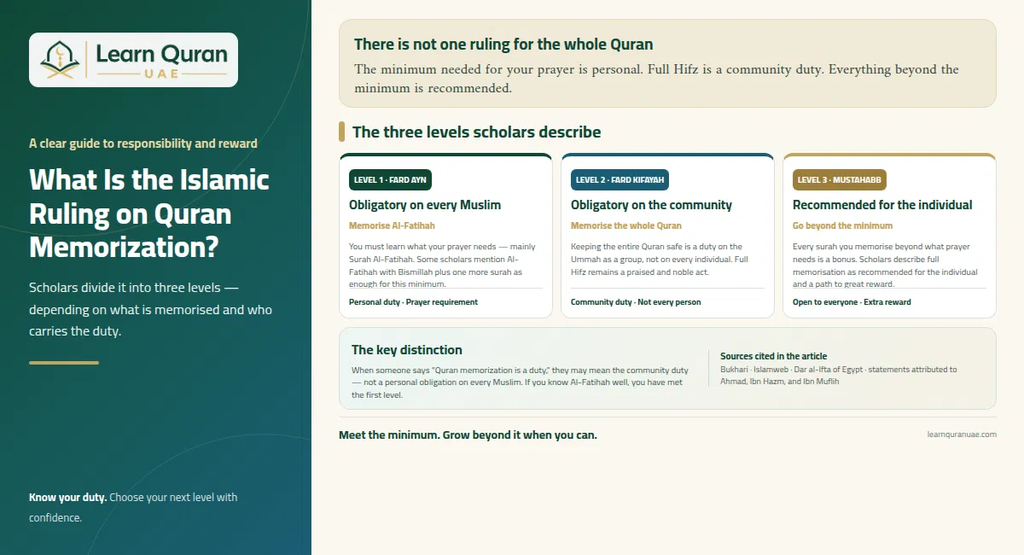
Level 3: Recommended (Mustahabb): Memorizing Beyond the Minimum
The third level is open to everyone. Anything you memorise beyond what prayer needs is a bonus that brings reward. Ibn Muflih, quoted by Islamweb, put it plainly: scholars agree that memorising the whole Quran is recommended for the individual.
Sheikh Mahmoud Shalabi of Dar al-Ifta added that whoever memorises the Quran earns a high rank in Paradise. That’s the prize waiting for anyone who goes beyond the minimum.
Personal Duty vs. Community Duty: How the Two Rulings Differ
The first two levels raise two practical questions. Why is Al-Fatihah the only surah you must know? And how does a community actually carry its share of the duty?
Why Is Al-Fatihah Obligatory But Not Other Surahs?
Al-Fatihah is obligatory because prayer isn’t valid without it, and no other surah has that status. The hadith quoted above names Al-Fatihah by name. Sheikh Ibn Baz explained that it’s a pillar (rukn) of every prayer, while reciting another surah after it is a sunnah.
Scholars then use a simple rule. If a duty can’t be done without something, that something becomes a duty too. Prayer depends on Al-Fatihah, so learning it becomes a must. Other surahs don’t carry that weight.
That’s also why Al-Fatihah comes first in line. Scholars said that learning what your prayer needs comes before any extra memorisation.
And it explains why Ibn Hazm’s safe minimum includes one more surah. Some scholars hold that you must recite a little after Al-Fatihah, while most, including Ibn Baz, say Al-Fatihah alone is enough. Learning one short surah keeps you safe on both views.
[image: a student reciting Surah Al-Fatihah from a mushaf]
If you’d like to go past Al-Fatihah, the Quran Memorization (Hifz) Course at Learn Quran UAE starts wherever you are. You can begin with short surahs and build up slowly, with a teacher listening to every verse.
How Does a Community Fulfil the Duty of Hifz?
Memorising alone doesn’t meet this duty. Dar al-Ifta of Egypt explains that Muslims must also pass the Quran on, learn it, and teach it. A hafiz who teaches keeps the Quran alive for the people around him, and his students carry it to the next generation.
It’s also tied to place. According to Dar al-Ifta, it applies to the people of every town. Someone, somewhere in the world, knowing the Quran by heart isn’t enough.
The same fatwa adds a point that’s easy to miss. In Islamic law, the means to a goal take the ruling of the goal. If teachers are needed to keep the Quran safe, then providing classes and teachers becomes part of the duty too.
Dr. Ali Gomaa links this to the verse “And We have certainly made the Quran easy for remembrance” (Al-Qamar: 17). Since Allah made the Quran easy to memorise, he says, the ways of reaching that goal should be made easy as well.
So you can take part even if you never become a hafiz. Enrolling your children in Hifz classes, supporting a local teacher, or learning a portion and teaching it to someone else all help your community meet this duty.
What Happens If No One in a Community Memorises the Quran?
If no one in a community memorises the Quran, everyone in that community shares the sin, as Dar al-Ifta of Egypt makes clear. Why such a strict rule? Imam al-Juwayni, quoted by Imam al-Suyuti, explained it. There must always be a large number of people who know the Quran by heart.
Scholars call this large number “tawatur.” When many people carry the same text in their memory, nobody can change a single word without others noticing. It’s one of the ways the Quran has stayed unchanged for over 1,400 years.
If that number falls too low, the protection weakens. So the community can’t leave this duty to chance. Every child or adult who memorises the Quran helps the whole Ummah meet it.
Start Learning Quran with Expert Tutors in the UAE
Accredited online Quran and Arabic classes tailored for adults and children. Schedule your session today.
Book Your Free TrialHelp for New Muslims: Mistakes in Al-Fatihah and Reading From the Mushaf
If you’ve just accepted Islam, learning Al-Fatihah in Arabic can feel like a lot at once. Scholars made clear allowances for this, so there’s no need to panic over every letter.
Does a Mistake in Al-Fatihah Make My Prayer Invalid?
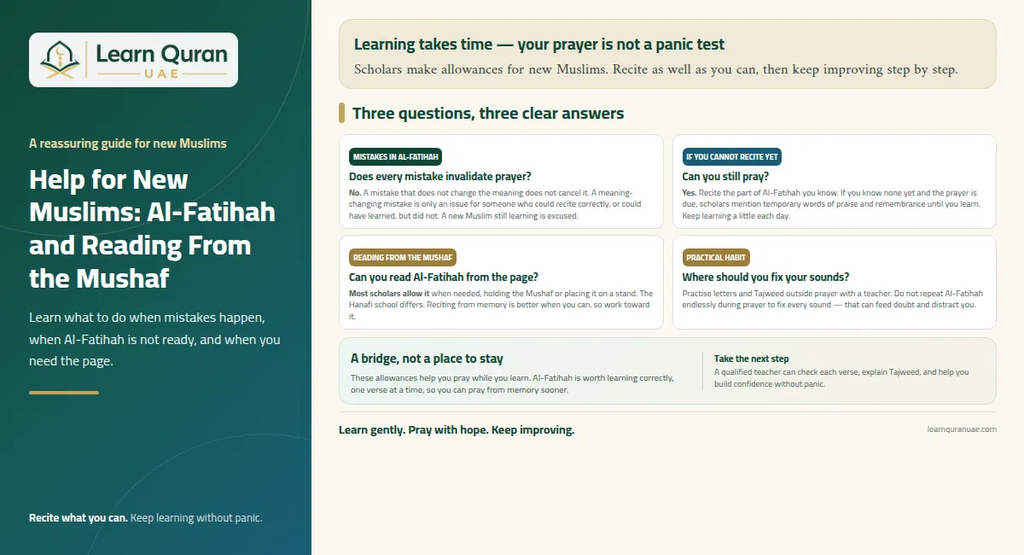
Not always. The answer depends on two things: the kind of mistake you make, and whether you were able to learn the correct way. Scholars divide recitation mistakes into two types.
- The first type changes the meaning of a word. Sheikh Ahmed Mamdouh of Dar al-Ifta gave two examples: saying “an’amtu” (I blessed) instead of “an’amta” (You blessed), or “iyyaki” instead of “iyyaka,” which turns words meant for Allah into words spoken to a woman. This is the only type that can cancel a prayer.
- The second type doesn’t change the meaning, like small vowel slips or a missed tajweed rule. These never cancel your prayer. Sheikh Ibn Baz said many ordinary Muslims make them, and the person should simply be shown the right way after the prayer.
If you want to know how much tajweed you’re actually required to learn, read our guide: Is Tajweed Obligatory?
Even the first type only cancels the prayer under one condition. IslamQA explains that it applies to someone who could recite correctly, or could have learned, and didn’t.
So if you’re a new Muslim and still learning, your prayer counts even when you make a meaning-changing mistake. Recite as well as you can and keep improving.
The same fatwa adds a practical tip. Don’t keep repeating Al-Fatihah over and over in your prayer to fix every sound. That habit feeds doubt and pulls your focus away. Practise the correct sounds of each letter outside prayer instead.
What If I Can’t Recite Al-Fatihah Yet?
You can still pray. A man once came to the Prophet ﷺ and said he couldn’t learn any of the Quran. He asked what would be enough for him. The Prophet ﷺ taught him to say: “Subhan Allah, walhamdu lillah, wa la ilaha illa Allah, wallahu akbar, wa la hawla wa la quwwata illa billah” (Abu Dawud and al-Nasa’i), as reported by IslamQA.
Scholars, as IslamQA notes, apply this to someone who has just become Muslim and hasn’t had time to learn before the prayer is due. You say these words in place of the recitation. If you know part of Al-Fatihah, recite the part you know. Then keep learning a little each day until you have all of it.
Think of this allowance as a bridge, not a place to stay. You’ll recite Al-Fatihah for the rest of your life, so it’s worth learning it as soon as you reasonably can.
Can I Read Al-Fatihah From the Mushaf During Prayer?
Yes, according to most scholars. Dar al-Ifta of Egypt says reading from the mushaf in prayer is valid, whether you hold it or rest it on a stand.
Its evidence is that Dhakwan, a servant of Aisha (may Allah be pleased with her), led her in Ramadan prayers reading from a mushaf.
The Shafi’i and Hanbali schools allow it in both required and extra prayers. The Hanafi school disagrees. It says reading from the mushaf cancels the prayer, because holding it and turning pages counts as too much movement.
Even scholars who allow it say reciting from memory is better. Sheikh Owaida Othman of Dar al-Ifta explained that some scholars disliked it in required prayers, since looking at the page can weaken your focus.
For a new Muslim, Sheikh Ibn Baz gives a balanced answer. It’s allowed when there’s a need, but you should work on memorising so you won’t need it anymore.
If you’re a new Muslim, the Quran Reading Course at Learn Quran UAE can help you learn Al-Fatihah correctly, one verse at a time, so you can pray from memory sooner.
Read also: Why Do Muslims Memorise the Quran?
Is It a Sin Not to Memorise the Whole Quran?
No, not in itself. Some related actions can carry blame, though, so it helps to pull them apart.
What Is Not a Sin
Allah says: “So recite what is easy of the Quran” (Al-Muzzammil: 20), a verse Dar al-Ifta’s scholars cite on this question. The verse asks us to recite. It doesn’t ask every Muslim to memorise the whole book.
What surprises many people is that this holds even if you’re able to memorise more. Dr. Ali Gomaa, the former Grand Mufti of Egypt, was asked this exact question. His answer: a person who could memorise more but doesn’t has no sin on them.
So if you have a busy job, young children, or a memory that doesn’t hold verses easily, you can let go of the guilt. The things that can be a sin are a short list, and they’re below.
What Can Be a Sin
Apart from neglecting Al-Fatihah, which we covered above, two things can carry blame. The first is leaving the Quran behind altogether. Dar al-Ifta says a person is held to account for not reading the Quran and not acting on it.
Listening on its own doesn’t fill that gap. A fatwa from Islamweb says listening doesn’t replace reading. Both are rewarded, but someone who never reads can slowly drift away from the Quran.
The second is letting the parts you memorised slip away through laziness. That one needs a closer look, so it has its own section next.
A quick look at learning with us
See how a live class works, from the teacher’s explanation to the student’s recitation. It’s a simple way to know what to expect before your first lesson.
What If I Memorize the Quran and Forget It?
It depends on why you forgot. Scholars treat forgetting through neglect very differently from forgetting despite honest effort.
What Scholars Say About Forgetting the Quran
Imam Ibn Taymiyyah called forgetting the Quran a sin. Some early scholars even counted it among the major sins. Islamweb describes it as failing to take care of a great gift from Allah.
The Prophet ﷺ warned about this directly. He said: “Keep refreshing your knowledge of the Quran, for it escapes faster than camels from their ropes” (Bukhari and Muslim).
If you’ve ever memorised a surah and then left it for a few months, you know how true that is. A camel that isn’t tied well wanders off. Verses you stop reviewing do the same, slowly and quietly.
There’s a loss in the next life too. The Prophet ﷺ said the reciter will be told: “Recite and rise.” Scholars explained that this reward belongs to the one who memorised the Quran and kept it well.
Neglect vs. Honest Effort: When Forgetting Counts Against You
The blame scholars talk about is for forgetting that comes from neglect. The Arabic word is “tafrit.” Islamweb uses it to mean you stopped caring and stopped reviewing.
Honest effort is a different story. Some people review faithfully and still find a few verses fading. For them, Allah says: “Allah does not burden a soul beyond its capacity” (Al-Baqarah: 286).
So forgetting a verse now and then isn’t what counts against you. Giving up on review is. If you keep a steady review habit, you’re doing what’s asked of you.
How to Keep What You Have Memorised
You can protect your Hifz with four simple steps.
- Set a full review cycle. Scholars never fixed one time limit for finishing the Quran, but Imam Ishaq ibn Rahawayh disliked letting forty days go by without reciting the whole thing. Use forty days as your outer limit for reviewing everything you’ve memorised once.
- Never add new verses faster than you can review old ones. Rushing ahead while earlier surahs fade is probably the most common mistake in Hifz. Our Quran Memorization Planner and Tracker shows you how to balance the two.
- Let your prayers do the work. Recite the surahs you know in your sunnah and night prayers, and each prayer becomes a short review.
- Review with someone. Recite to a teacher or a friend from time to time. They’ll catch mistakes you’d miss on your own.
Plenty of students worry about forgetting before they even start. If that’s you, read what students and parents say about their Hifz classes on the Learn Quran UAE reviews page.

Is Memorising the Quran Only About Prayer?
No. Prayer sets the minimum you must know, but memorising the Quran does much more. Beyond protecting the Quran in your community, it keeps the words close to you, so you can think about them, act on them, and teach them.
Dar al-Ifta stresses that the aim of the Quran isn’t memorising alone. The aim is to understand it, reflect on it, and live by it every day. A verse you carry in your heart is one you can think about at work, in the car, or before you sleep.
The reward is also far bigger than any duty. The Prophet ﷺ said the person who recites the Quran and knows it by heart will be with the noble angels. The one who struggles to recite it gets two rewards (Bukhari), as cited by Dar al-Ifta. So even the struggle is rewarded.
He also said: “The best of you are those who learn the Quran and teach it” (Bukhari), as cited by Dar al-Ifta. And Dr. Ali Gomaa reminds us that every letter you recite brings ten good deeds.
Imam Ahmad, explaining a hadith about the Quran and the fire, said it’s hoped the fire won’t touch someone who carries the Quran in their heart.
For more on this, see our full guide to the benefits and rewards of memorizing the Quran.
Who Should Give Quran Memorisation Extra Attention?
The ruling is the same for everyone. Still, scholars singled out two groups who should give memorisation extra attention: students of Islamic knowledge and children.
a. Students of Islamic Knowledge
Imam Ibn Abd al-Barr said that memorising the whole Quran is a must for anyone who wants to become a scholar.
He pictured learning as a ladder, and the first rung is memorising the Quran and understanding it. He warned that these steps shouldn’t be skipped. Whoever skips them on purpose leaves the path of the early scholars and goes astray, and whoever skips them through an honest misjudgment slips.
He also said that anything that helps you understand the Quran should be studied alongside memorising it. In practice, that means subjects like Arabic and tafseer grow together with your Hifz instead of waiting until after it.
Imam al-Nawawi made a similar point. The early scholars would only teach hadith and fiqh to students who already had the Quran memorised.
Alukah passes on the same advice to students today: give your attention to the Book of Allah first, then move on to other sciences if you want to succeed.
And for a student who later becomes a teacher, the reward doesn’t stop. Imam Ibn Battal, quoted by Dar al-Ifta, explained that the reward of teaching keeps flowing as long as the people you taught keep reciting.
b. Children
Teaching children to memorise the Quran is recommended, and it’s how the early Muslims raised their children. Ibn Abbas said he had memorised the Mufassal surahs by the age of ten, when the Prophet ﷺ passed away (Bukhari).
Imam Ibn Kathir explained why starting young works so well. Children memorise more easily, and what they learn stays with them longer and more firmly.
There’s a practical benefit too. A child who learns early grows up already knowing what to recite in prayer. They’re ready when prayer becomes a duty.
Scholars added some sensible advice for parents. Give children small amounts they can manage, and leave them time to play so they don’t grow tired of the Quran. Our Hifz for Kids classes follow the same idea, with short lessons paced for young learners.
A Step-by-Step Plan for Memorising Beyond Al-Fatihah
Sheikh Ibn Baz described an easy order for going past Al-Fatihah, and every step pays off in your prayers straight away.
Before moving on, ask yourself three questions. Can I recite this without looking? Is my tajweed right? Am I still reviewing what came before?
For daily memorising techniques, see how to learn the Quran by heart.
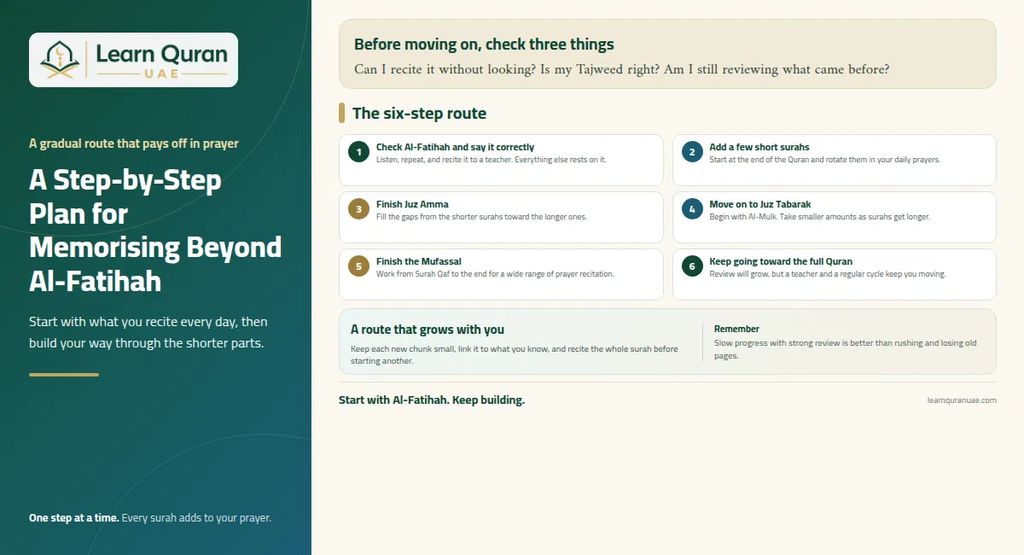
Step 1: Check Your Al-Fatihah and Say It Correctly
Start with Al-Fatihah, even if you think you already know it. You recite it in every unit (rak’ah) of every prayer, which adds up to many times a day.
That repetition cuts both ways. Say it correctly and you earn reward every time. Carry a small mistake and you repeat it every time.
Go slowly, one verse at a time. Listen to a trusted reciter, repeat after him, and then recite it to a teacher. Our guide on how to recite the Quran with tajweed walks you through the basics.
Many adults learned Al-Fatihah as children and haven’t had it checked since. If that sounds familiar, a short session with a teacher is a smart place to begin. Everything else you memorise will rest on it.
Step 2: Add a Few Short Surahs to Recite After Al-Fatihah
The sunnah of reciting after Al-Fatihah, mentioned earlier, applies in the first two units of Dhuhr, Asr, Maghrib, and Isha, and in Fajr, as Sheikh Ibn Baz explained. A few short surahs let you follow it every day.
Begin with the shortest surahs at the end of the Quran. They’re quick to learn and easy to keep. Learn one, use it in your prayers for a while, then add the next.
Try rotating the surahs you recite. A lot of people use the same one or two for years, and the rest slowly fade. Using all of them keeps each one fresh.
Step 3: Finish Juz Amma (the 30th Part)
Juz Amma is the last of the Quran’s 30 parts. Sheikh Ibn Baz named it as a good goal for any Muslim. Most of the short surahs you hear in daily prayers come from here.
If you finished Step 2, part of Juz Amma is already done. Now you’re filling the gaps, working from the shorter surahs towards the longer ones near the start of the part.
Keep each new chunk small. Learn a few verses, link them to what you already know, and recite the whole surah before starting another.
Finishing Juz Amma gives you plenty to recite in prayer, and it does a lot for your confidence. For many learners, this is when Hifz stops feeling out of reach.
Step 4: Move On to Juz Tabarak (the 29th Part)
Juz Tabarak, the 29th part, opens with Surah Al-Mulk. Sheikh Ibn Baz listed it as the next goal after Juz Amma. The surahs are longer here, so you may need to take a smaller amount each day at first. That’s normal, and much better than rushing.
You’re now holding two full parts, so give them a fixed slot in your week. Many learners pick one day to recite both parts from memory from start to finish.
That weekly run-through also shows you exactly which surahs are weak. Mark them, and give them extra time in the days that follow.
Step 5: Finish the Mufassal, From Surah Qaf to the End
The Mufassal is the final section of the Quran. Sheikh Ibn Baz explained that it runs from Surah Qaf to the end, and he encouraged Muslims to memorise it if they can.
With Juz Amma and Juz Tabarak behind you, you’re already part of the way there. What’s left are the surahs from Qaf up to Al-Mulk, and you can take them one at a time.
Reach this point and you’ll have a wide range of surahs for every prayer, including longer passages for night prayer. Even if you stop here, you’ll have achieved a great deal.
Step 6: Keep Going Towards the Full Quran
If Allah makes it easy for you, aim for the whole Quran. It’s the highest level of Hifz, and it brings the rewards described above for those who carry the Quran in their hearts.
By now, review will take up more of your time than new verses. Don’t let that discourage you. It just means you have a lot worth protecting.
Plan your review so you get through the whole Quran on a regular cycle, staying within the forty-day limit mentioned earlier. If you’re wondering about the full timeline, read how long it takes to memorize the Quran.
Most people who complete the Quran had a teacher to keep them on schedule and push them through the slow weeks. It’s a long road, and it’s much easier when you don’t walk it alone.
Watch a real lesson before you book
Not sure what online Quran classes look like? This short clip gives you a feel for our teaching style and how each class is built around the student.
Start Learning Quran with Expert Tutors in the UAE
Accredited online Quran and Arabic classes tailored for adults and children. Schedule your session today.
Book Your Free TrialStart Memorising the Quran With Learn Quran UAE Today
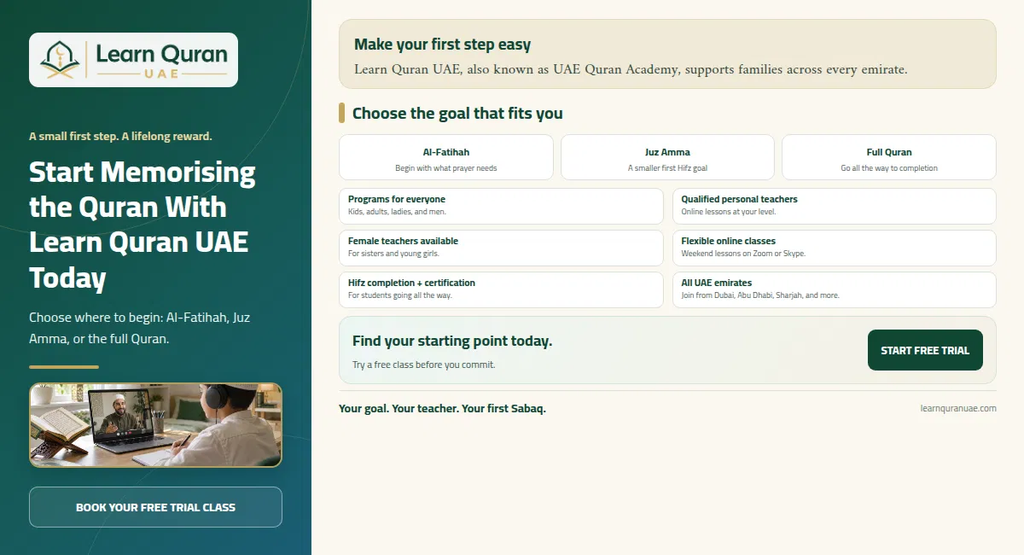
Your duty is small, and the reward on offer is huge. All that’s left is choosing where to begin: Al-Fatihah, Juz Amma, or the full Quran.
Learn Quran UAE (UAE Quran Academy) makes that start easy for families across the Emirates. With us, you get:
- Hifz programs for kids, adults, ladies, and men
- The Juz Amma Memorization Program, if you’d like a smaller first goal
- Hifz Completion and Hafiz Certification for those going all the way
- Personal online classes with qualified teachers who work at your level
- Female teachers for sisters and young girls
- Weekend classes and lessons on Zoom or Skype
- Classes you can join from Dubai, Abu Dhabi, Sharjah, or any other emirate
- A free trial class, so you can try it before you commit
Our Quran Memorization Courses
If you are waiting for the perfect time to start memorization the Quran, you may never start. Stop waiting, browse our courses and click Free Trial.
- Quran Memorization (Hifz) Course
- Hifz for Kids Course
- Hifz for Adults Course
- Hifz for Ladies / Sisters Course
- Hifz for Men Course
- Quran Memorization Center (UAE)
- Juz Amma Memorization Program
- Hifz Completion & Hafiz Certification
Conclusion
So, is memorising the Quran obligatory in Islam? For you as an individual, the only must is what your prayer needs: Surah Al-Fatihah, plus a short surah after it according to some scholars.
The full Quran is a different matter. It’s a duty on the whole community, and every town needs people who know it by heart and teach it. When enough people do, everyone else is free of sin. When nobody does, the whole community shares the blame.
If you’re a new Muslim, you have room to learn. Mistakes you make while you’re still learning don’t cancel your prayer, and you can lean on a mushaf for a while.
Not memorising the whole Quran isn’t a sin on its own. What can be a sin is failing to learn Al-Fatihah when you’re able, leaving the Quran without reading or acting on it, or letting what you memorised slip away through laziness.
And “not required” never means “not important.” Memorising the Quran protects it, keeps its words close to your heart, and brings a reward that places the hafiz alongside the noble angels.
If you’re wondering where to go from here, keep it simple. Make sure your Al-Fatihah is correct. Then add one small goal at a time: a few short surahs, then Juz Amma. Keep reviewing what you know, and the Quran will stay with you for life.
FAQs
Still have a question in mind? Here are quick answers to the questions people ask most often about memorising the Quran, with the full details in the sections above.
Do Muslims Have to Memorize the Quran?
Muslims have to memorize only part of the Quran. Each person needs what prayer requires, while memorizing the full Quran is a shared duty that some Muslims carry out for the community.
Is It Compulsory to Memorize the Quran?
Only Surah Al-Fatihah is compulsory, because prayer isn’t valid without it. Memorizing the rest of the Quran isn’t compulsory for each person, though it’s highly recommended.
Is Memorizing the Quran Mandatory for the Muslim Community?
Yes, memorizing the full Quran is mandatory for the community as a shared duty (fard kifayah). If enough people memorize it, others are free of sin. If no one does, the whole community is sinful.
Do You Have to Memorize the Quran to Be a Good Muslim?
No, being a good Muslim doesn’t depend on memorizing the whole Quran. What matters is knowing what your prayer requires and reading, understanding, and living by the Quran.
Does a Mistake in Al-Fatihah Cancel My Prayer?
Only a mistake that changes the meaning can cancel your prayer, and only if you were able to learn the correct way. Small slips and tajweed errors don’t cancel it, and new Muslims who are still learning aren’t blamed.
Can I Read Al-Fatihah From the Mushaf in Prayer?
Yes, most scholars allow reading from the mushaf in prayer, and Dar al-Ifta of Egypt says the prayer is valid. Reciting from memory is still better, so use the mushaf only while you learn.
Is It a Sin to Forget the Quran After Memorizing It?
Many scholars say forgetting the Quran through neglect is a sin, and some called it a major sin. The blame is for giving up on review, so regular revision protects you.
Can Listening to the Quran Replace Memorizing or Reading It?
No, listening doesn’t replace reading the Quran. Both are rewarded, but someone who only listens and never reads can slowly drift away from the Quran.



Leave a Reply